Paper I — Q6
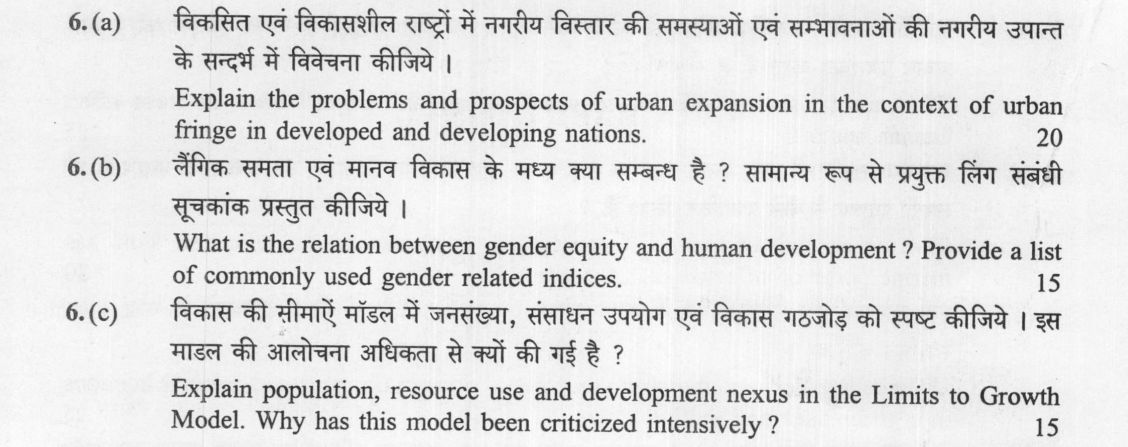
(a) Explain the problems and prospects of urban expansion in the context of urban fringe in developed and developing nations. (20…
Explain the problems and prospects of urban expansion in the context of urban fringe in developed and developing nations. 20 marks
What is the relation between gender equity and human development? Provide a list of commonly used gender related indices. 15 marks
Explain population, resource use and development nexus in the Limits to Growth Model. Why has this model been criticized intensively? 15 marks
हिंदी में प्रश्न पढ़ें
विकसित एवं विकासशील राष्ट्रों में नगरीय विस्तार की समस्याओं एवं सम्भावनाओं की नगरीय उपान्त के सन्दर्भ में विवेचना कीजिये । (20 अंक)
लैंगिक समता एवं मानव विकास के मध्य क्या सम्बन्ध है ? सामान्य रूप से प्रयुक्त लिंग सम्बन्धी सूचकांक प्रस्तुत कीजिये । (15 अंक)
विकास की सीमाएँ मॉडल में जनसंख्या, संसाधन उपयोग एवं विकास गठजोड़ को स्पष्ट कीजिये । इस मॉडल की आलोचना अधिकता से क्यों की गई है ? (15 अंक)
Model answer
Written by UPSC Answer Check against this question's marking rubric, to the expected length. UPSC does not publish answers for Mains — this is one way to score well, not an official key.
The urban fringe—the dynamic transition zone along the rural-urban continuum—embodies distinct spatial, socioeconomic, and environmental transformations across developed and developing nations.
Urban Expansion in the Urban Fringe
In developed nations, automobile-led suburbanization expands commuter sheds, creating low-density leapfrog developments, extensive urban sprawl, and edge cities. This process generates high municipal service costs, automobile dependency, and gentrification pressures that price out original rural inhabitants. Conversely, in developing nations, rapid demographic pressure and rural-to-urban distress migration drive chaotic peri-urban expansion. Weak local governance creates institutional voids, resulting in acute infrastructure deficits, loss of prime agricultural land, groundwater depletion, and the rapid proliferation of unserviced informal settlements, as seen in the peri-urban belts of Delhi-NCR and Bengaluru.
Prospects in the fringe depend on proactive spatial planning. Developed nations utilize smart growth strategies, green belts, and Transit-Oriented Development (TOD) to contain sprawl and preserve open space. In developing nations, the fringe offers opportunities for planned peri-urbanization, including decentralized industrial corridors, affordable housing, and formalizing urban agriculture to bolster urban food security and green infrastructure before informal lock-in occurs.
Gender Equity and Human Development
Gender equity acts as both a constitutive end and a vital instrumental driver of human development. Grounded in Amartya Sen’s Capability Approach, expanding female agency and entitlements directly removes substantive un-freedoms. Causally, female education leads to lower total fertility rates, delayed marriage, reduced child mortality, and improved intergenerational health and schooling outcomes. Furthermore, equitable female economic participation expands national productive capacity, converting demographic transition into broad-based human development gains.
Key gender-related indices include:
- Gender Development Index (GDI): Measures female-to-male ratios across the three basic dimensions of the Human Development Index (health, education, income).
- Gender Inequality Index (GII): Captures loss in achievement due to gender disparities across reproductive health (maternal mortality, adolescent birth rates), empowerment (parliamentary seats, secondary education), and labour force participation.
- Gender Empowerment Measure (GEM): A legacy UNDP metric (now largely superseded by GII) that assessed female political and economic decision-making power.
- Global Gender Gap Index (GGGI): Formulated by the World Economic Forum (WEF) to benchmark national progress in closing gender parity gaps across economic, educational, health, and political sub-indexes.
- Social Institutions and Gender Index (SIGI): Published by the OECD to measure the root drivers of inequality by evaluating discriminatory social institutions, legal codes, and customary norms.
Limits to Growth: Nexus and Critique
Commissioned by the Club of Rome, Meadows et al. (1972) employed a System Dynamics methodology (the World3 model) to simulate the non-linear nexus among five interdependent variables: population, industrial output, agricultural production, non-renewable resource reserves, and pollution. The model showed that positive feedback loops of exponential industrial and population growth eventually collide with finite biophysical limits. As non-renewable resources deplete, increasing capital must be diverted to resource extraction, starving industry and agriculture of investment. Consequently, pollution escalates and food production drops, driving a systemic "overshoot and collapse" of population and industrial capacity within the 21st century.
The model faced intense criticism on multiple fronts:
- Technological Optimism and Price Mechanisms: Economists such as Robert Solow and Julian Simon argued that the model ignored market signals. In reality, resource scarcity drives price increases, incentivizing exploration, recycling, technological innovation, and factor substitution.
- Marxist Critique: Scholars criticized the model's neo-Malthusian determinism, pointing out that environmental degradation stems from the inequitable global distribution and capitalist overconsumption of resources rather than absolute population numbers.
- Methodological Flaws: Critics highlighted its highly aggregated global assumptions, empirical inaccuracies regarding resource exhaustion timelines, and reliance on deterministic loops that underestimated human policy adaptability and structural changes toward service- and knowledge-based economies.
Resolving these spatial, demographic, and resource contradictions requires integrating peri-urban spatial planning, embedding gender equity at the core of human capabilities, and shifting economic paradigms from resource-intensive throughput to circular, regenerative development models.
What "Explain" is asking you to do
Make the working of something clear — what sets it off, what follows from what, and what it produces. Explain is the Commission's mechanism word: it dominates the technical papers and the “explain why” stems, where the marks sit in the causal chain and not in the label.
Structure that answers it
State what it is → the initiating condition → the chain of cause, step by step → an instance where it plays out → what the chain produces
Where marks are lost
Describing what something looks like instead of why it works that way. Naming the stages without linking them reads as description too.
How this answer will be evaluated
Approach
Framework: Concept or mechanism > Diagram > Regional example > Application. (a) explain: definition/context > points in order > small example > short close | (b) explain: definition/context > points in order > small example > short close | (c) explain: definition/context > points in order > small example > short close Full marks: Comprehensive, well-structured, with diagrams and specific examples.
Key points expected
- Define urban fringe and its expansion mechanism
- Problems: land conversion, infrastructure deficit, informal settlements
- Prospects: affordable housing, industrial growth, service access
- Compare developed vs developing nation contexts
- Define gender equity and human development
- Explain the causal link between the two
- List commonly used gender related indices
- Provide a clear, structured list of indices
Evaluation rubric
Each sub-part is marked on its own, against the marks and word limit printed on the paper.
- (a) Problems and prospects of urban expansion in the urban fringe for developed and developing nations. 20 marks
explain— definition/context → points in order → small example → short close
Must cover
- Define urban fringe and its expansion mechanism
- Problems: land conversion, infrastructure deficit, informal settlements
- Prospects: affordable housing, industrial growth, service access
- Compare developed vs developing nation contexts
Loses marks
- Description without mechanism of expansion
- No distinction between developed and developing contexts
- Answer with no diagram or sketch
Earns more
- Labelled diagram of urban fringe expansion
- Specific regional examples (e.g., Delhi NCR, London)
- Link physical land use to human consequence
- Mention of specific policies or planning acts
Extra mark
- Recent census data on urban growth
- Specific named committee or report on urban planning
- (b) Relation between gender equity and human development, plus a list of gender indices. 15 marks
explain— definition/context → points in order → small example → short close
Must cover
- Define gender equity and human development
- Explain the causal link between the two
- List commonly used gender related indices
- Provide a clear, structured list of indices
Loses marks
- Vague or undefined relationship between concepts
- Incomplete or incorrect list of indices
- Lack of structure in presenting the list
Earns more
- Mention of specific indices like GDI, GII, GEM
- Brief explanation of what each index measures
- Link to broader human development goals
- Use of a simple diagram or flowchart
Extra mark
- Citation of a specific UNDP report
- Reference to a specific national policy
- (c) Population, resource use, and development nexus in the Limits to Growth Model, and its criticisms. 15 marks
explain— definition/context → points in order → small example → short close
Must cover
- Explain the Limits to Growth Model's core premise
- Detail the population-resource-development nexus
- List intensive criticisms of the model
- Provide a balanced view of the model's validity
Loses marks
- Failure to explain the nexus clearly
- Ignoring the criticisms of the model
- No diagram or visual representation of the model
Earns more
- Diagram of the model's feedback loops
- Mention of specific critics (e.g., Meadows, Forrester)
- Reference to specific data or projections from the model
- Link to contemporary environmental issues
Extra mark
- Mention of the 'Club of Rome' report
- Reference to a specific alternative model
Practice this exact question
Write your answer and it is marked point by point against the model answer above — what you covered, what you missed, what you got wrong.
Evaluate my answer →More from Geography 2023 Paper I
- Q3 (a) What are the causes of origin of local winds? Discuss their significance on prevailin…
- Q4 (a) Give an account of marine resources and their economic significance. How has marine p…
- Q5 Answer the following in about 150 words each: (a) Explain the sequential development of a…
- Q6 (a) Explain the problems and prospects of urban expansion in the context of urban fringe…
- Q7 (a) Explain with suitable diagrams A. Losch's model of the Theory of Location related to…
- Q8 (a) "Rural settlements are expressions of the basic relationships between human beings an…