Paper I — Q8
(a) "Rural settlements are expressions of the basic relationships between human beings and their physical and social…
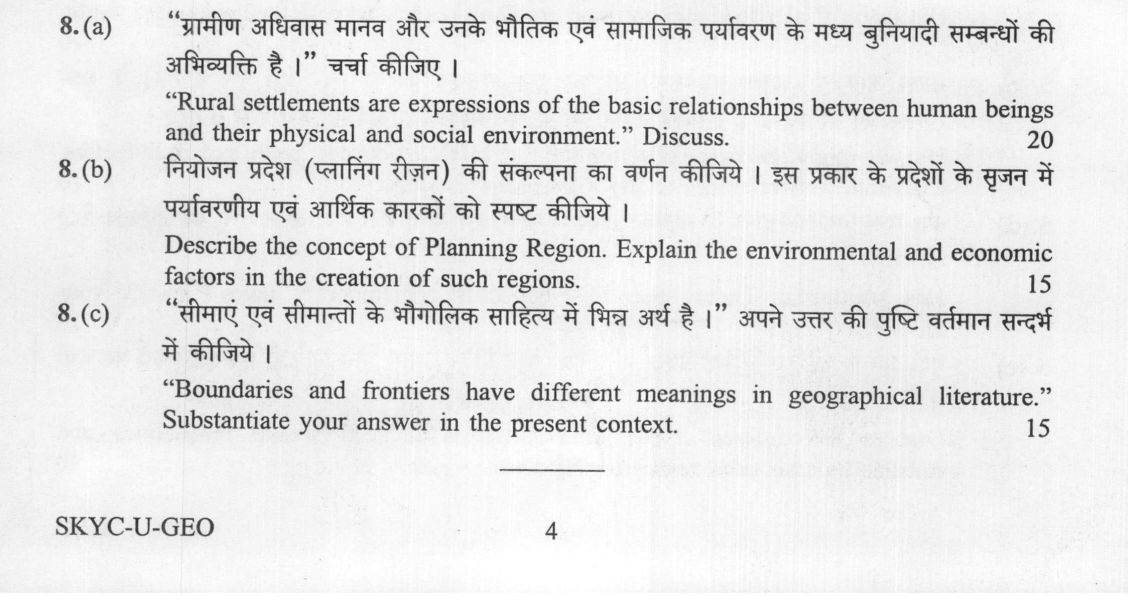
"Rural settlements are expressions of the basic relationships between human beings and their physical and social environment." Discuss. 20 marks
Describe the concept of Planning Region. Explain the environmental and economic factors in the creation of such regions. 15 marks
"Boundaries and frontiers have different meanings in geographical literature." Substantiate your answer in the present context. 15 marks
हिंदी में प्रश्न पढ़ें
"ग्रामीण अधिवास मानव और उनके भौतिक एवं सामाजिक पर्यावरण के मध्य बुनियादी सम्बन्धों की अभिव्यक्ति है ।" चर्चा कीजिये । (20 अंक)
नियोजन प्रदेश (प्लानिंग रीजन) की संकल्पना का वर्णन कीजिये । इस प्रकार के प्रदेशों के सृजन में पर्यावरणीय एवं आर्थिक कारकों को स्पष्ट कीजिये । (15 अंक)
"सीमाएँ एवं सीमान्तों के भौगोलिक साहित्य में भिन्न अर्थ है ।" अपने उत्तर की पुष्टि वर्तमान सन्दर्भ में कीजिये । (15 अंक)
Model answer
Written by UPSC Answer Check against this question's marking rubric, to the expected length. UPSC does not publish answers for Mains — this is one way to score well, not an official key.
Rural settlements manifest the spatial crystallization of human adaptations to their physical and social milieu. Derwent Whittlesey conceptualized this human-environment interface through his ecological trilogy of site (physical niche), situation (regional connectivity), and society (cultural-institutional frameworks). Settlement morphology directly mirrors the localized resource base: in fertile alluvial tracts like the Middle Ganga Plain, intensive agriculture and groundwater availability foster compact, nucleated villages. In contrast, the undulating topography, semi-arid conditions of the Deccan Plateau, or dissected Himalayan terrain induce dispersed or hamleted patterns due to fragmented arable patches and pastoral economies.
Social dimensions further govern the internal spatial arrangement. In Indian villages, ritual hierarchy and the caste system historically structured settlement geography, where dominant landowning castes occupied central, elevated sites with access to water bodies, while marginalized groups were segregated into peripheral hamlets (such as tolas or cheris). However, modern forces of globalization, rural road connectivity under PMGSY, canal networks (such as the Indira Gandhi Canal), and peri-urban real estate markets are transforming these traditional structures. Dispersed desert settlements have transformed into nucleated canal colonies, while linear roadside settlements increasingly override caste-based spatial divides.
Planning Region: Concept and Delineation Factors
A planning region is an administratively viable, functionally cohesive geographic unit possessing internal structural unity and nodal integration to address common developmental problems. Following Robert Dickinson’s regional criteria, planning regions are hierarchical, categorized into macro regions (resource-rich river basins or physiographic units), meso regions (sub-divisions based on economic specialization like the Chota Nagpur industrial belt), and micro regions (districts or watersheds for grassroots execution).
Environmental factors provide the natural canvas for region delineation. Drainage basins, physiographic homogeneity, and resource endowments define ecological boundaries where natural interdependencies require unified resource management. The Damodar Valley Corporation (DVC) and the integrated Narmada Basin development illustrate how river basins serve as unified planning regions to balance flood control, hydel power, and irrigation.
Economic factors shape functional planning spaces through market linkages, transport corridors, growth poles, and agglomeration economies. As spatial interactions intensify around core nodes, functional regions supersede static physical boundaries. The National Capital Region (NCR) exemplifies an economic planning region delineated by commuter sheds, industrial inter-linkages, and urban spillover, coordinated to decentralize economic pressure across state jurisdictions.
Boundaries and Frontiers in the Contemporary Context
In political geography, boundaries and frontiers represent contrasting stages and forms of spatial delimitation. Richard Hartshorne defined a boundary as an inner-oriented, legally demarcated, two-dimensional line separating sovereign jurisdictions. Conversely, J.R.V. Prescott and Stephen Jones characterized a frontier as an outer-oriented, centrifugal, zonal transition area characterized by porous socio-cultural interaction and incomplete political integration, reflecting the historic "frontier thesis" of expanding settlement.
In the contemporary world, the transition from frontiers to rigid boundaries is evident along India's borders. The Radcliffe Line and the McMahon Line represent demarcated boundaries, whereas the Line of Actual Control (LAC) in Ladakh functions as a disputed, militarized frontier zone lacking definitive linear agreement. Similarly, the open border regime under the 1950 Indo-Nepal Treaty retains frontier-like characteristics of cultural and economic permeability, contrasting sharply with the securitized, fenced Indo-Pakistan boundary. In Northeast India, historically autonomous tribal frontier zones have progressively integrated into sovereign administrative space, while serving as economic transition zones under the Act East policy. Globally, climate change and melting polar ice are opening the Arctic, transforming it from a physical barrier into an active resource and geopolitical frontier where international maritime boundaries remain intensely contested.
Spatial organization—spanning micro-level village layouts, nodal planning regions, and interstate borders—reflects the dynamic dialectic between natural terrain and human institutions. Advancing sustainable development requires spatial planning frameworks that harmonize regional ecological thresholds with changing socio-economic flows.
What "Discuss" is asking you to do
Lay the issue out from more than one side — how it arose, what is claimed for it, what is held against it, and where it now stands. UPSC attaches discuss to broad topics with several live dimensions, so coverage of the dimensions earns more than the strength of your opinion.
Structure that answers it
Set the issue up → the case as it is made → the case against → the dimension both sides leave out → where the balance now lies
Where marks are lost
Listing facts with no thread between them, or arguing one side throughout and calling it a discussion.
How this answer will be evaluated
Approach
Framework: Concept > Diagram > Regional Example > Application. (a) discuss: intro > 3-4 dimensions > example > balanced close | (b) describe: define > structure or process in order > labelled diagram > significance | (c) justify: claim > 3-4 reasons > evidence > conclusion Full marks: Clear causal chains, precise definitions, labelled diagrams, and specific Indian examples.
Key points expected
- Define rural settlement as a spatial expression
- Physical factors: relief, climate, water, soil
- Social factors: culture, economy, land tenure
- Balanced conclusion on human-environment interaction
- Define Planning Region (functional/homogeneous)
- Environmental factors: topography, resources, climate
- Economic factors: infrastructure, market access, industry
- Significance of such regions in development
Evaluation rubric
Each sub-part is marked on its own, against the marks and word limit printed on the paper.
- (a) Analyze the interplay between rural settlements and physical/social environments. 20 marks
discuss— intro → 3-4 dimensions → example → balanced close
Must cover
- Define rural settlement as a spatial expression
- Physical factors: relief, climate, water, soil
- Social factors: culture, economy, land tenure
- Balanced conclusion on human-environment interaction
Loses marks
- Description without causal mechanism
- Answer with no diagram or sketch
- Ignoring the social environment aspect
Earns more
- Labelled sketch of settlement pattern
- Specific Indian regional example (e.g., Punjab)
- Link between physical cause and human consequence
- Reference to specific settlement types (nucleated/linear)
Extra mark
- Recent census data on rural population
- Specific named geographical theory
- (b) Define Planning Region and detail environmental/economic factors in its creation. 15 marks
describe— define → structure or process in order → labelled diagram → significance
Must cover
- Define Planning Region (functional/homogeneous)
- Environmental factors: topography, resources, climate
- Economic factors: infrastructure, market access, industry
- Significance of such regions in development
Loses marks
- Confusing planning region with administrative unit
- Omitting either environmental or economic factors
- No clear definition provided
Earns more
- Labelled diagram of a planning region
- Specific Indian example (e.g., NITI Aayog regions)
- Distinction between formal and functional regions
- Link between environmental constraint and economic choice
Extra mark
- Reference to specific planning commission report
- Map showing specific regional boundaries
- (c) Differentiate between boundaries and frontiers in geographical literature. 15 marks
justify— claim → 3-4 reasons → evidence → conclusion
Must cover
- Define boundary (line, legal, fixed)
- Define frontier (zone, fluid, cultural)
- Key differences in nature and function
- Present context: modern geopolitical examples
Loses marks
- Treating boundary and frontier as synonyms
- No reference to 'present context'
- Lack of geographical precision in definitions
Earns more
- Diagram contrasting line vs zone
- Specific example (e.g., India-Pakistan border)
- Reference to specific geographical thinker (e.g., Ratzel)
- Discussion of 'soft' vs 'hard' borders
Extra mark
- Reference to specific international treaty
- Recent geopolitical event illustrating the difference
Practice this exact question
Write your answer and it is marked point by point against the model answer above — what you covered, what you missed, what you got wrong.
Evaluate my answer →More from Geography 2023 Paper I
- Q5 Answer the following in about 150 words each: (a) Explain the sequential development of a…
- Q6 (a) Explain the problems and prospects of urban expansion in the context of urban fringe…
- Q7 (a) Explain with suitable diagrams A. Losch's model of the Theory of Location related to…
- Q8 (a) "Rural settlements are expressions of the basic relationships between human beings an…