Paper I — Q2
(a) "Evidences from palaeomagnetism and sea floor spreading have validated that continents and ocean basins have never been…
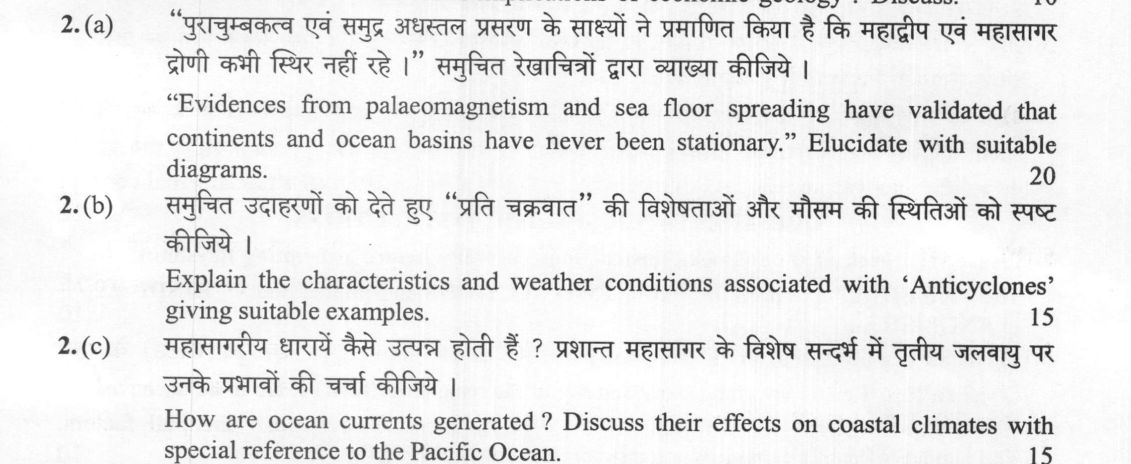
"Evidences from palaeomagnetism and sea floor spreading have validated that continents and ocean basins have never been stationary." Elucidate with suitable diagrams. 20 marks
Explain the characteristics and weather conditions associated with 'Anticyclones' giving suitable examples. 15 marks
How are ocean currents generated? Discuss their effects on coastal climates with special reference to the Pacific Ocean. 15 marks
हिंदी में प्रश्न पढ़ें
"पुराचुम्बकत्व एवं समुद्र अधस्तल प्रसरण के साक्ष्यों ने प्रमाणित किया है कि महाद्वीप एवं महासागर द्रोणी कभी स्थिर नहीं रहे ।" समुचित रेखाचित्रों द्वारा व्याख्या कीजिये । (20 अंक)
समुचित उदाहरणों को देते हुए "प्रति चक्रवात" की विशेषताओं और मौसम की स्थितियों को स्पष्ट कीजिये । (15 अंक)
महासागरीय धारायें कैसे उत्पन्न होती हैं ? प्रशान्त महासागर के विशेष संदर्भ में तृतीय जलवायु पर उनके प्रभावों की चर्चा कीजिये । (15 अंक)
Model answer
Written by UPSC Answer Check against this question's marking rubric, to the expected length. UPSC does not publish answers for Mains — this is one way to score well, not an official key.
The dynamic nature of Earth's lithosphere, originally postulated in continental drift, achieved empirical validation through palaeomagnetic discoveries and the sea floor spreading hypothesis.
Palaeomagnetism and Sea Floor Spreading
Palaeomagnetic evidence emerged from the study of remanent magnetism preserved in iron-rich minerals, such as magnetite, when volcanic rocks cool below the Curie point. Reconstructed Apparent Polar Wandering (APW) paths from different continents revealed divergent polar trajectories across geological epochs. Because the geomagnetic poles could not have diverged simultaneously in multiple directions, these differing APW curves can only be reconciled by the independent physical movement of the continents over time.
Seafloor spreading, proposed by Harry Hess and corroborated by the Vine-Matthews-Morley hypothesis, demonstrated that new oceanic crust continuously forms at Mid-Ocean Ridges (MORs) via upwelling basaltic magma. As this magma solidifies, it records the prevailing polarity of Earth's magnetic field, which undergoes periodic geomagnetic reversals. This mechanism produces alternating, symmetrical bands of normal and reversed magnetic anomalies parallel to the ridge axis.
`` [ MOR Axis / Upwelling Magma ] | Normal Polarity | <- Reversed| Normal Polarity |Reversed -> <- Old Crust | Newest Crust | Old Crust -> ==================== Moho ==================== ``
Radiometric dating from ocean-drilling projects confirmed a progressive age increase in oceanic basalts with distance from the ridge crest toward oceanic trenches. By correlating the spatial widths of these symmetrical magnetic stripes with known geomagnetic polarity timescales, geophysicists precisely calculate seafloor spreading rates, ranging from 2 to 5 cm/year at the Mid-Atlantic Ridge to over 15 cm/year along the East Pacific Rise, proving the continuous mobility of ocean basins and continents.
Characteristics and Weather Conditions of Anticyclones
Anticyclones are high-pressure atmospheric systems characterized by a central high barometric core, gentle pressure gradients, and outward-diverging surface winds that circulate clockwise in the Northern Hemisphere and counter-clockwise in the Southern Hemisphere due to the Coriolis force. They predominantly form in the subtropical high-pressure belts, driven by dynamic air subsidence along the descending limb of the Hadley cell, and in polar continental source regions driven by intense thermal cooling, such as the Siberian High.
The dominant characteristic of an anticyclone is large-scale vertical subsidence, which causes compressional adiabatic warming. This process lowers relative humidity, suppresses vertical convection, and dissipates clouds, generating stable, dry, and clear skies.
Seasonal weather manifestations vary distinctly. In summer, persistent anticyclonic ridging promotes intense diurnal insolation, leading to severe heatwaves and drought conditions. In winter, clear skies cause rapid nocturnal terrestrial radiational cooling, producing strong near-surface temperature inversions. These inversions trap particulate matter and moisture, yielding dense radiation fog, frost, and smog, as observed during winter over northern India and continental Europe.
Generation of Ocean Currents and Coastal Climates in the Pacific
Ocean currents are driven by primary physical mechanisms: planetary wind stress transferring momentum through Ekman transport, the Coriolis effect deflecting moving water masses, horizontal density gradients generated by thermohaline circulation (temperature and salinity variations), and bathymetric steering combined with continental boundary deflection.
In the Pacific Ocean, ocean currents exert profound climatic controls:
The warm Kuroshio Current, forming the western boundary of the North Pacific Gyre, transports tropical heat poleward along the coast of Japan. It elevates coastal temperatures, raises atmospheric humidity, and amplifies precipitation and typhoon intensity.
The cold California Current flows equatorward along North America's west coast. Its cool waters stabilize the overlying marine layer, suppressing precipitation and creating coastal Mediterranean aridity alongside persistent advection fog belts.
The cold Peru (Humboldt) Current induces strong coastal upwelling of cold, nutrient-rich bottom waters. This keeps the coastal air dry and cool, driving the hyper-aridity of the Atacama Desert. During periodic El Niño Southern Oscillation (ENSO) events, the breakdown of easterly trade winds allows warm equatorial waters to replace the cold coastal upwelling, disrupting marine ecosystems and triggering anomalous, torrential rainfall across the normally arid Peruvian littoral.
Understanding the coupled mechanics of lithospheric drift, atmospheric subsidence, and oceanic gyres is therefore essential for deciphering the evolution of global landforms and regional climatic regimes.
What "Elucidate" is asking you to do
Make a stated proposition plain and then prove it with instances. Elucidate stems almost always carry a claim or a named concept, and very often the words “with examples” or “with suitable diagrams” — the illustration is part of the directive, not decoration.
Structure that answers it
Plain-language statement of what the proposition means → the part that is obscure, resolved → first illustration → second illustration → why the proposition holds
Where marks are lost
Adding terminology; elucidate rewards removing it. The commoner loss is a clean explanation with no example, when the stem asked for examples.
How this answer will be evaluated
Approach
Framework: Concept or mechanism > Diagram > Regional example > Application. (a) examine: intro > how/why with reasoning > evidence > conclusion | (b) explain: definition/context > points in order > small example > short close | (c) discuss: intro > 3-4 dimensions > example > balanced close Full marks: Clear mechanism, labelled diagrams, specific regional examples, strong causal links.
Key points expected
- Mechanism of magnetic reversal recording in basalt
- Diagram of sea floor spreading at mid-ocean ridge
- Link between magnetic stripes and plate movement
- Explanation of why basins are not stationary
- Definition of Anticyclone (high pressure system)
- Characteristics: sinking air, clear skies, stable weather
- Weather conditions: dry, calm, temperature inversion
- Suitable examples (e.g., Subtropical highs, Siberian high)
Evaluation rubric
Each sub-part is marked on its own, against the marks and word limit printed on the paper.
- (a) Elucidate how palaeomagnetism and sea floor spreading prove continental drift. 20 marks
examine— intro → how/why with reasoning → evidence → conclusion
Must cover
- Mechanism of magnetic reversal recording in basalt
- Diagram of sea floor spreading at mid-ocean ridge
- Link between magnetic stripes and plate movement
- Explanation of why basins are not stationary
Loses marks
- Description without mechanism
- Answers with no diagram
Earns more
- Mention of specific magnetic anomaly patterns
- Reference to specific ocean basins (e.g., Atlantic)
Extra mark
- Labelled sketch map of magnetic stripes
- Mention of specific magnetic reversal chron
- (b) Explain characteristics and weather conditions of Anticyclones with examples. 15 marks
explain— definition/context → points in order → small example → short close
Must cover
- Definition of Anticyclone (high pressure system)
- Characteristics: sinking air, clear skies, stable weather
- Weather conditions: dry, calm, temperature inversion
- Suitable examples (e.g., Subtropical highs, Siberian high)
Loses marks
- Description without mechanism
- Answers with no diagram
Earns more
- Mention of specific regional anticyclones
- Link to specific weather phenomena (e.g., fog, drought)
Extra mark
- Labelled sketch map of pressure system
- Mention of specific climatic impact
- (c) Discuss generation of ocean currents and their effects on coastal climates (Pacific focus). 15 marks
discuss— intro → 3-4 dimensions → example → balanced close
Must cover
- Mechanism of current generation (wind, density, Coriolis)
- Effects on coastal climates (temperature, precipitation)
- Specific reference to Pacific Ocean currents
- Link physical cause to human consequence
Loses marks
- Description without mechanism
- Answers with no diagram
Earns more
- Mention of specific Pacific currents (e.g., Kuroshio, California)
- Link to specific climatic events (e.g., El Niño)
Extra mark
- Labelled sketch map of Pacific currents
- Mention of specific climatic impact
Practice this exact question
Write your answer and it is marked point by point against the model answer above — what you covered, what you missed, what you got wrong.
Evaluate my answer →More from Geography 2023 Paper I
- Q1 Answer the following in about 150 words each: (a) What is "Geostrophic Wind"? Explain the…
- Q2 (a) "Evidences from palaeomagnetism and sea floor spreading have validated that continent…
- Q3 (a) What are the causes of origin of local winds? Discuss their significance on prevailin…
- Q4 (a) Give an account of marine resources and their economic significance. How has marine p…
- Q5 Answer the following in about 150 words each: (a) Explain the sequential development of a…