Paper I — Q5
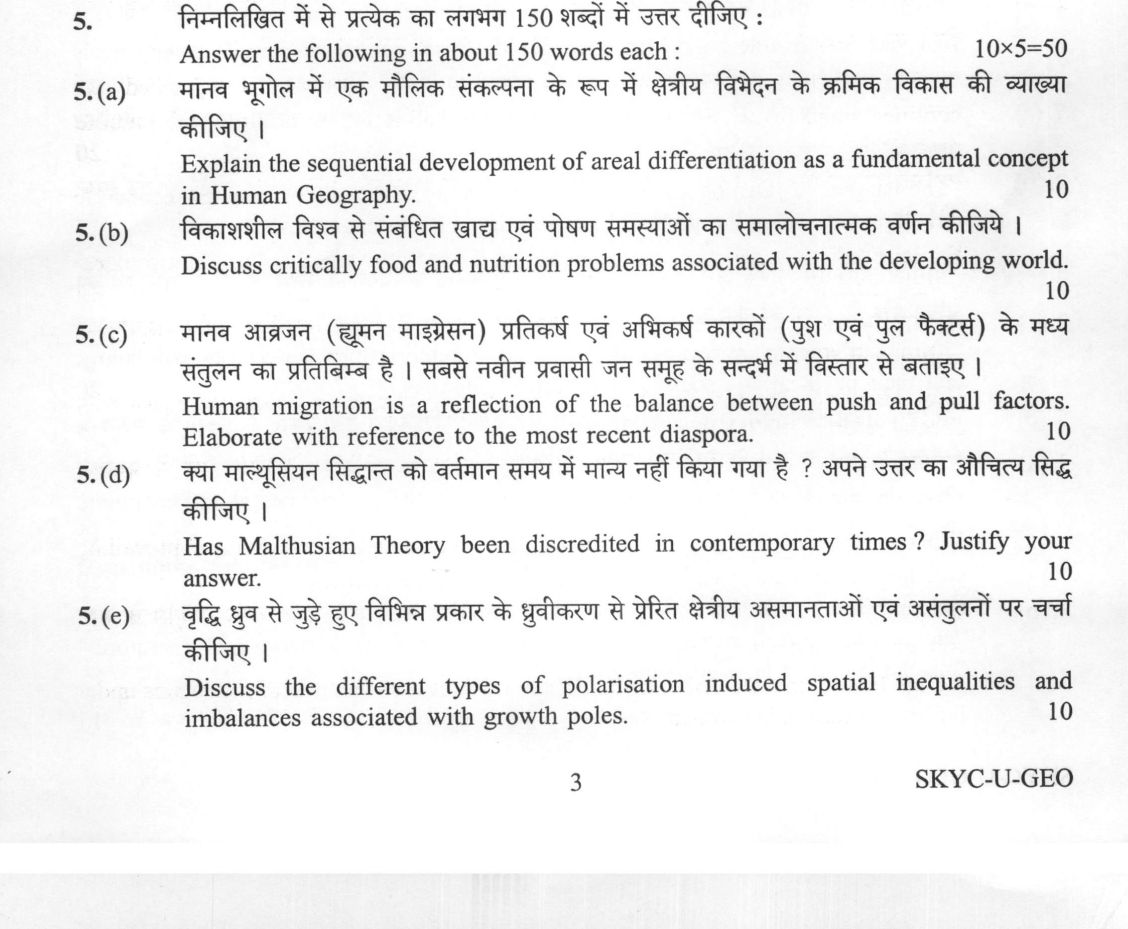
Answer the following in about 150 words each: (a) Explain the sequential development of areal differentiation as a fundamental…
Answer the following in about 150 words each: Explain the sequential development of areal differentiation as a fundamental concept in Human Geography. 10 marks
Discuss critically food and nutrition problems associated with the developing world. 10 marks
Human migration is a reflection of the balance between push and pull factors. Elaborate with reference to the most recent diaspora. 10 marks
Has Malthusian Theory been discredited in contemporary times? Justify your answer. 10 marks
Discuss the different types of polarisation induced spatial inequalities and imbalances associated with growth poles. 10 marks
हिंदी में प्रश्न पढ़ें
निम्नलिखित में से प्रत्येक का लगभग 150 शब्दों में उत्तर दीजिए : मानव भूगोल में एक मौलिक संकल्पना के रूप में क्षेत्रीय विभेदन के क्रमिक विकास की व्याख्या कीजिए । (10 अंक)
विकासशील विश्व से संबंधित खाद्य एवं पोषण समस्याओं का समालोचनात्मक वर्णन कीजिए । (10 अंक)
मानव आप्रवास (ह्यूमन माइग्रेशन) प्रतिकर्ष एवं अभिकर्ष कारकों (पुश एवं पुल फैक्टर्स) के मध्य संतुलन का प्रतिबिंब है । सबसे नवीन प्रवासी जन समूह के संदर्भ में विस्तार से बताइए । (10 अंक)
क्या माल्थूसियन सिद्धांत को वर्तमान समय में मान्य नहीं किया गया है ? अपने उत्तर का औचित्य सिद्ध कीजिए । (10 अंक)
वृद्धि ध्रुव से जुड़े हुए विभिन्न प्रकार के ध्रुवीकरण से प्रेरित क्षेत्रीय असमानताओं एवं असंतुलनों पर चर्चा कीजिए । (10 अंक)
Model answer
Written by UPSC Answer Check against this question's marking rubric, to the 150-word length. UPSC does not publish answers for Mains — this is one way to score well, not an official key.
(a) Sequential Development of Areal Differentiation
Areal differentiation, conceptualised as the study of spatial variation across the Earth's surface, evolved through distinct epistemological phases. Rooted in Alfred Hettner’s chorological approach, the concept was formalised by Richard Hartshorne in The Nature of Geography (1939), which established areal differentiation as geography's central purpose—the descriptive, idiographic integration of phenomena within unique regions. Carl Sauer modified this perspective through the Berkeley School, arguing that areal differentiation results from cultural landscapes fashioned by human agency acting upon the natural medium over time. In 1953, Fred K. Schaefer critiqued Hartshorne’s regional exceptionalism as unscientific, initiating the Quantitative Revolution which sought nomothetic, universal laws rather than unique descriptions. Contemporary post-positivist geography and modern GIS-based computational regional analysis have reconciled these traditions, synthesising spatial science with context-specific local variations to model human-environment interactions.
(b) Food and Nutrition Problems in the Developing World
Food and nutrition crises in developing regions have transitioned from simple calorie deficits to structural and qualitative deprivations. While the calorie-protein gap persists in marginalized pockets, micronutrient deficiencies—specifically iron (anaemia), Vitamin A, and iodine—constitute widespread hidden hunger. As Amartya Sen established through his Entitlement Approach, hunger in the modern developing world rarely stems from Food Availability Decline (FAD), but from failures of exchange entitlements, market dysfunction, and purchasing power collapse. Furthermore, historical Structural Adjustment Programmes (SAPs) exacerbated vulnerability by curtailing agrarian subsidies, dismantling public procurement, and reorienting smallholder agriculture toward export-oriented cash crops at the expense of staple food security. Consequently, developing nations face the double burden of malnutrition—where persistent child stunting and wasting coexist with rising urban obesity and non-communicable diseases, a vulnerability clearly visible in India’s NFHS-5 data.
(c) Push-Pull Balance in Post-2010 Diasporas
Human migration operates through Everett Lee’s model as an interplay between origin push factors and destination pull factors, yet recent global diaspora formations demonstrate that acute push pressures frequently override rational pull calculations. The Syrian conflict post-2011 and the Ukrainian displacement post-2022 generated massive refugee corridors into Europe, where existential threats, state collapse, and infrastructure destruction served as non-negotiable push forces. Similarly, the stateless Rohingya exodus from Myanmar to Bangladesh and Southeast Asia reflects persecution-driven forced migration where pull factors were virtually non-existent. Conversely, voluntary economic diasporas demonstrate structured push-pull equilibriums: Indian migration reflects domestic underemployment and wage disparities (push) balanced against high-tech employment opportunities in the United States or infrastructure labour demand and remittances in the Gulf Cooperation Council (pull), producing distinct, stratified migration streams.
(d) Evaluation of Malthusian Theory in Contemporary Times
Thomas Malthus’s thesis—that population grows geometrically while food production expands arithmetically—was historically discredited by technological innovation and demographic modernization. Ester Boserup demonstrated that population pressure acts as an autonomous stimulus for agricultural intensification. Simultaneously, the Green Revolution, through high-yielding varieties and synthetic inputs, expanded food production far beyond Malthusian ceilings. Furthermore, the global Demographic Transition proved that socioeconomic development and female literacy induce endogenous fertility decline, averting unchecked population explosions. Nevertheless, the theory’s core premise of biophysical limits has experienced a neo-Malthusian revival. Planetary boundary frameworks, widespread soil degradation, groundwater depletion, and climate change-induced yield shocks demonstrate that absolute ecological carrying capacities exist. Thus, while Malthus’s arithmetic mechanics were simplistic, his fundamental warning regarding ecological overshoot remains salient for global resource governance.
(e) Polarisation-Induced Inequalities in Growth Poles
François Perroux’s growth pole concept and Gunnar Myrdal’s cumulative causation model demonstrate that propulsive industries trigger spatial inequalities when agglomeration dynamics outpace regional dispersion. Spatial polarisation occurs because initial centrifugal spread effects are overwhelmed by centripetal backwash effects, continuously draining capital, skilled human resources, and raw materials from the hinterland into the core. Sectoral polarisation manifests as high-value secondary and tertiary activities concentrate exclusively at the pole, leaving surrounding agrarian economies structurally stagnant. Functional and social polarisation subsequently emerge through agglomeration diseconomies at the core—manifested in inflated land values, infrastructural congestion, and socio-spatial segregation between elite enclaves and informal settlements. In India, corridors such as Mumbai-Pune and Delhi-NCR exemplify this pattern, generating hyper-concentrated wealth nodes while sustaining severe regional imbalances across their surrounding rural peripheries.
What "Explain" is asking you to do
Make the working of something clear — what sets it off, what follows from what, and what it produces. Explain is the Commission's mechanism word: it dominates the technical papers and the “explain why” stems, where the marks sit in the causal chain and not in the label.
Structure that answers it
State what it is → the initiating condition → the chain of cause, step by step → an instance where it plays out → what the chain produces
Where marks are lost
Describing what something looks like instead of why it works that way. Naming the stages without linking them reads as description too.
How this answer will be evaluated
Approach
Framework: Concept > Diagram > Regional Example > Application. (a) explain: definition/context > points in order > small example > short close | (b) discuss: intro > 3-4 dimensions > example > balanced close | (c) explain: definition/context > points in order > small example > short close | (d) justify: claim > 3-4 reasons > evidence > conclusion | (e) discuss: intro > 3-4 dimensions > example > balanced close Full marks: Clear causal chain, specific examples, and balanced judgment.
Key points expected
- Define areal differentiation (Ratzel/Friedmann)
- Trace evolution from environmental determinism to regional science
- Link to spatial analysis and regional planning
- Short closing on its current relevance
- Distinguish between food insecurity and malnutrition
- Identify 3-4 key dimensions (e.g., poverty, climate, distribution)
- Provide a specific regional example (e.g., Sub-Saharan Africa)
- Balanced conclusion on the complexity of the issue
Evaluation rubric
Each sub-part is marked on its own, against the marks and word limit printed on the paper.
- (a) Sequential development of areal differentiation as a fundamental concept. 10 marks · 150 words
explain— definition/context → points in order → small example → short close
Must cover
- Define areal differentiation (Ratzel/Friedmann)
- Trace evolution from environmental determinism to regional science
- Link to spatial analysis and regional planning
- Short closing on its current relevance
Loses marks
- Listing regions without explaining the concept
- Ignoring the 'sequential' or developmental aspect
Earns more
- Mention of specific geographers (e.g., Ratzel, Hartshorne)
- Reference to the 'regional approach' vs 'spatial approach'
Extra mark
- Sketch of a conceptual model of regional differentiation
- (b) Critical discussion of food and nutrition problems in the developing world. 10 marks · 150 words
discuss— intro → 3-4 dimensions → example → balanced close
Must cover
- Distinguish between food insecurity and malnutrition
- Identify 3-4 key dimensions (e.g., poverty, climate, distribution)
- Provide a specific regional example (e.g., Sub-Saharan Africa)
- Balanced conclusion on the complexity of the issue
Loses marks
- Generalizing without specific examples
- Focusing only on production, ignoring distribution/access
Earns more
- Mention of 'hidden hunger' (micronutrient deficiency)
- Reference to food systems or supply chain issues
Extra mark
- Citing a specific statistic (e.g., FAO data on undernourishment)
- (c) Elaborate on push/pull factors of migration with reference to recent diaspora. 10 marks · 150 words
explain— definition/context → points in order → small example → short close
Must cover
- Define push and pull factors clearly
- Explain the 'balance' or interaction between them
- Reference a specific recent diaspora (e.g., Syrian, Venezuelan, or Indian IT)
- Link factors to the specific case study
Loses marks
- Listing factors without applying them to a specific diaspora
- Ignoring the 'balance' aspect of the prompt
Earns more
- Mention of 'push' factors like conflict or climate change
- Mention of 'pull' factors like economic opportunity or safety
Extra mark
- Reference to a specific migration theory (e.g., Lee's model)
- (d) Justify whether Malthusian Theory has been discredited in contemporary times. 10 marks · 150 words
justify— claim → 3-4 reasons → evidence → conclusion
Must cover
- State the core claim of Malthusian Theory
- Provide 3-4 reasons for its discrediting (e.g., Green Revolution, tech)
- Provide evidence (e.g., population vs. food production trends)
- Conclude with a balanced judgment (e.g., 'discredited but relevant')
Loses marks
- Simply saying 'yes' or 'no' without justification
- Ignoring the 'contemporary times' aspect
Earns more
- Mention of 'Neo-Malthusian' perspectives
- Reference to technological advancements in agriculture
Extra mark
- Citing a specific graph or data point on food production
- (e) Discuss types of polarisation induced spatial inequalities from growth poles. 10 marks · 150 words
discuss— intro → 3-4 dimensions → example → balanced close
Must cover
- Define 'growth poles' and 'polarisation'
- Identify 3-4 types of spatial inequalities (e.g., urban-rural, regional)
- Explain the mechanism of 'backwash' vs 'spread' effects
- Provide a specific example (e.g., Mumbai vs. rural Maharashtra)
Loses marks
- Describing inequality without linking it to growth poles
- Ignoring the 'types' of polarisation
Earns more
- Mention of Perroux or Boudeville (growth pole theorists)
- Reference to 'trickle-down' vs 'polarisation' effects
Extra mark
- Sketch of a growth pole with backwash/spread arrows
Practice this exact question
Write your answer and it is marked point by point against the model answer above — what you covered, what you missed, what you got wrong.
Evaluate my answer →More from Geography 2023 Paper I
- Q2 (a) "Evidences from palaeomagnetism and sea floor spreading have validated that continent…
- Q3 (a) What are the causes of origin of local winds? Discuss their significance on prevailin…
- Q4 (a) Give an account of marine resources and their economic significance. How has marine p…
- Q5 Answer the following in about 150 words each: (a) Explain the sequential development of a…
- Q6 (a) Explain the problems and prospects of urban expansion in the context of urban fringe…
- Q7 (a) Explain with suitable diagrams A. Losch's model of the Theory of Location related to…
- Q8 (a) "Rural settlements are expressions of the basic relationships between human beings an…