Paper I — Q7
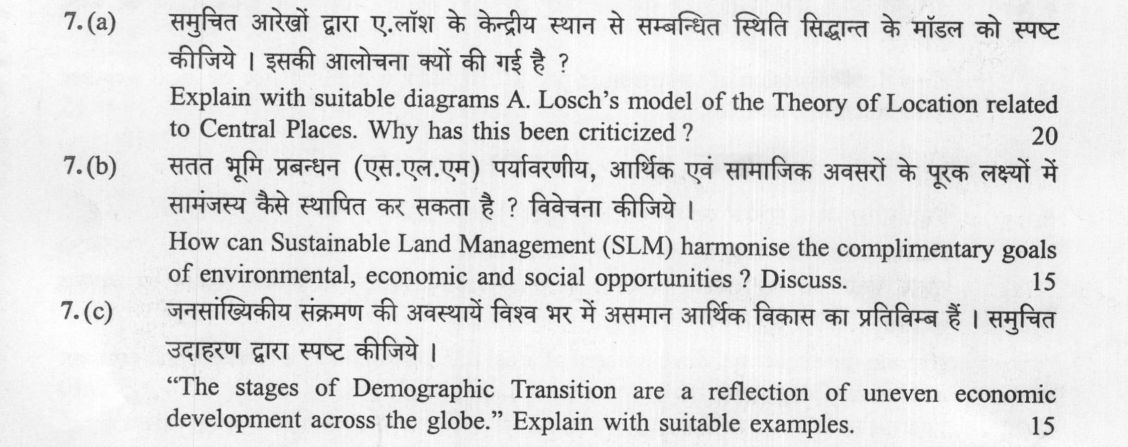
(a) Explain with suitable diagrams A. Losch's model of the Theory of Location related to Central Places. Why has this been…
Explain with suitable diagrams A. Losch's model of the Theory of Location related to Central Places. Why has this been criticized? 20 marks
How can Sustainable Land Management (SLM) harmonise the complimentary goals of environmental, economic and social opportunities? Discuss. 15 marks
"The stages of Demographic Transition are a reflection of uneven economic development across the globe." Explain with suitable examples. 15 marks
हिंदी में प्रश्न पढ़ें
समुचित आरेखों द्वारा ए.लोश के केन्द्रीय स्थान से सम्बन्धित स्थिति सिद्धान्त के मॉडल को स्पष्ट कीजिये । इसकी आलोचना क्यों की गई है ? (20 अंक)
सतत भूमि प्रबन्धन (एस.एल.एम) पर्यावरणीय, आर्थिक एवं सामाजिक अवसरों के पूरक लक्ष्यों में सामंजस्य कैसे स्थापित कर सकता है ? विवेचना कीजिये । (15 अंक)
"जनसांख्यिकीय संक्रमण की अवस्थाएँ विश्व भर में असमान आर्थिक विकास का प्रतिबिम्ब हैं ।" समुचित उदाहरण द्वारा स्पष्ट कीजिये । (15 अंक)
Model answer
Written by UPSC Answer Check against this question's marking rubric, to the expected length. UPSC does not publish answers for Mains — this is one way to score well, not an official key.
Location, land management and population change all reflect uneven economic development.
Losch’s central-place model. A. Lösch rejected Christaller’s single-commodity, perfectly regular hexagons. He assumed a homogeneous plain but allowed several goods and several K-values—K=3 (market principle), K=4 (transport principle) and K=7 (administrative principle)—to operate simultaneously. Because different goods have different thresholds and ranges, the market area of a central place is not one neat hexagon but a composite of overlapping hexagons. Around a central place A, six sectors are relatively favourable to A (rich sectors) and six are favourable to neighbouring centres (poor sectors). The boundary between rich and poor sectors is found by comparing transport costs to the nearest competitors. Losch showed that the least-cost position is obtained by rotating the market boundary until the angle between the lines from the new centre to the two nearest existing centres is 150°. This 150° rotation gives the least transport-cost position and yields the 150° principle: a new industrial centre should be sited where that angle is 150°, minimising weighted transport cost and avoiding excessive competition. Diagram: draw A at the centre, six neighbours at 60° intervals, nested/overlapping hexagons labelled K=3, K=4, K=7; arrange industrial/service sectors around A by K-value; shade six alternating 60° sectors as A-rich and six as A-poor; mark the 150° rays. Criticism: the model remains geometrically rigid, assumes a featureless plain, and neglects actual transport-cost variations.
Sustainable Land Management. Sustainable Land Management (SLM) harmonises environmental, economic and social goals by treating land as a common-pool resource whose productivity depends on soil, water, vegetation and institutions. Environmentally, it conserves soil and water through contour bunding, check dams, afforestation, agroforestry and integrated watershed management, reducing erosion and restoring groundwater. Economically, it raises productivity and diversifies income through improved cropping, fodder, horticulture and market linkages, so that conservation pays. Socially, it secures livelihoods and equity through participatory planning and tenure security. In Sukhomajri, Mahendragarh (Haryana), community-managed check dams, afforestation and crop diversification increased groundwater, yields and household income while reducing soil loss. Watershed development in Alwar district, Rajasthan, combined rainwater harvesting, soil conservation and livelihood support to improve cropping and reduce distress migration. The Forest Rights Act, 2006, strengthens social and environmental outcomes by securing tribal land tenure, giving communities a stake in forest conservation and reducing illegal encroachment. Thus SLM aligns the triple bottom line: ecological stability, economic returns and social inclusion.
Demographic Transition and uneven development. Demographic Transition Theory (DTT) links population change to economic development, but its stages appear unevenly across and within countries. Stage 1, with high birth and death rates, is now largely historical; it resembles pre-industrial conditions and no country is fully in Stage 1 today, though parts of Sub-Saharan Africa still show high fertility and mortality. Stage 2 begins when death rates fall first because of food security, sanitation and medicine, while birth rates remain high; this creates a demographic dividend. India, now in Stage 3 with TFR around 2.0 and declining birth rates, passed through Stage 2 after independence, and its large working-age population is a legacy of that mortality decline. Stage 3, where birth rates fall to low levels, is visible in Japan’s ageing structure even though Japan is now in Stage 4/5. Stage 4/5, with low birth and death rates and negative or zero growth, is seen in Germany. The model is Eurocentric because it assumes a single sequence driven by industrialisation. Within India, Kerala’s low fertility and high human development contrast with Uttar Pradesh’s higher fertility and lower development, showing uneven regional development. In the Islamic world, fertility decline in Iran, Indonesia and Bangladesh has occurred under distinct religious, policy and economic conditions, challenging the classic Western sequence. Hence DTT stages reflect uneven economic development, but not a uniform path.
What "Explain" is asking you to do
Make the working of something clear — what sets it off, what follows from what, and what it produces. Explain is the Commission's mechanism word: it dominates the technical papers and the “explain why” stems, where the marks sit in the causal chain and not in the label.
Structure that answers it
State what it is → the initiating condition → the chain of cause, step by step → an instance where it plays out → what the chain produces
Where marks are lost
Describing what something looks like instead of why it works that way. Naming the stages without linking them reads as description too.
How this answer will be evaluated
Approach
Framework: UPSC Geography Paper 1. (a) explain: definition/context > points in order > small example > short close | (b) discuss: intro > 3-4 dimensions > example > balanced close | (c) explain: definition/context > points in order > small example > short close Full marks: Comprehensive, well-structured, with clear diagrams and examples.
Key points expected
- Define Losch's model of Central Place Theory
- Draw a suitable diagram of the model
- Explain the key concepts of the model
- Discuss the criticisms of the model
- Define Sustainable Land Management (SLM)
- Explain the environmental goals of SLM
- Explain the economic goals of SLM
- Explain the social goals of SLM
Evaluation rubric
Each sub-part is marked on its own, against the marks and word limit printed on the paper.
- (a) Explain Losch's model of Central Place Theory and its criticisms. 20 marks
explain— definition/context → points in order → small example → short close
Must cover
- Define Losch's model of Central Place Theory
- Draw a suitable diagram of the model
- Explain the key concepts of the model
- Discuss the criticisms of the model
Loses marks
- No diagram provided
- Vague or incomplete explanation
- Failure to address criticisms
Earns more
- Mention the assumptions of the model
- Compare with Christaller's model
- Provide a real-world example
- Discuss the limitations of the model
Extra mark
- Reference to specific scholars or works
- Detailed analysis of the diagram
- (b) Discuss how SLM harmonizes environmental, economic, and social goals. 15 marks
discuss— intro → 3-4 dimensions → example → balanced close
Must cover
- Define Sustainable Land Management (SLM)
- Explain the environmental goals of SLM
- Explain the economic goals of SLM
- Explain the social goals of SLM
Loses marks
- Lack of clarity in defining SLM
- Failure to address all three goals
- No examples or case studies
Earns more
- Provide examples of SLM practices
- Discuss the interlinkages between goals
- Mention challenges in implementation
- Highlight successful SLM case studies
Extra mark
- Reference to specific policies or programs
- Data or statistics supporting the discussion
- (c) Explain how demographic transition stages reflect uneven economic development. 15 marks
explain— definition/context → points in order → small example → short close
Must cover
- Define the stages of Demographic Transition
- Link each stage to economic development
- Provide suitable examples of countries
- Explain the relationship between stages and development
Loses marks
- No clear link to economic development
- Lack of suitable examples
- Incomplete explanation of stages
Earns more
- Mention specific demographic indicators
- Discuss the impact of economic policies
- Compare different regions or countries
- Highlight current trends in demographic transition
Extra mark
- Reference to specific demographic data
- Analysis of future demographic trends
Practice this exact question
Write your answer and it is marked point by point against the model answer above — what you covered, what you missed, what you got wrong.
Evaluate my answer →More from Geography 2023 Paper I
- Q4 (a) Give an account of marine resources and their economic significance. How has marine p…
- Q5 Answer the following in about 150 words each: (a) Explain the sequential development of a…
- Q6 (a) Explain the problems and prospects of urban expansion in the context of urban fringe…
- Q7 (a) Explain with suitable diagrams A. Losch's model of the Theory of Location related to…
- Q8 (a) "Rural settlements are expressions of the basic relationships between human beings an…