Paper I — Q3
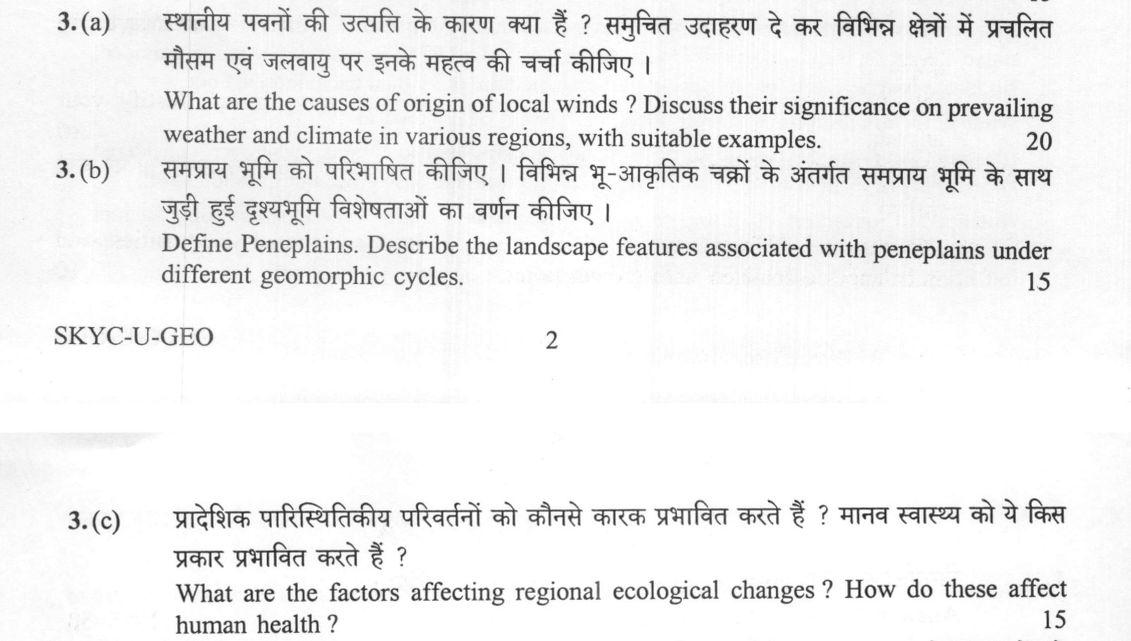
(a) What are the causes of origin of local winds? Discuss their significance on prevailing weather and climate in various…
What are the causes of origin of local winds? Discuss their significance on prevailing weather and climate in various regions, with suitable examples. 20 marks
Define Peneplains. Describe the landscape features associated with peneplains under different geomorphic cycles. 15 marks
What are the factors affecting regional ecological changes? How do these affect human health? 15 marks
हिंदी में प्रश्न पढ़ें
स्थानीय पवनों की उत्पत्ति के कारण क्या हैं ? समुचित उदाहरण दे कर विभिन्न क्षेत्रों में प्रचलित मौसम एवं जलवायु पर इनके महत्व की चर्चा कीजिये । (20 अंक)
समप्राय भूमि को परिभाषित कीजिए । विभिन्न भू-आकृतिक चक्रों के अन्तर्गत समप्राय भूमि के साथ जुड़ी हुई दृश्यभूमि विशेषताओं का वर्णन कीजिए । (15 अंक)
प्रादेशिक पारिस्थितिकीय परिवर्तनों को कौनसे कारक प्रभावित करते हैं ? मानव स्वास्थ्य को ये किस प्रकार प्रभावित करते हैं ? (15 अंक)
Model answer
Written by UPSC Answer Check against this question's marking rubric, to the expected length. UPSC does not publish answers for Mains — this is one way to score well, not an official key.
Local winds Local winds arise from small-scale pressure differences produced by thermal, dynamic and topographic causes. Thermal causes include differential heating and cooling of land, water and slopes, generating sea and land breezes, mountain and valley breezes, and summer winds such as the Loo. Dynamic causes involve local pressure gradients, frictional deflection and the interaction of regional pressure systems with local surfaces, producing mesoscale circulation and foehn-type flows. Topographic causes occur when air is forced over ridges or through valleys, causing compression, expansion and orographic effects, as in the Santa Ana, Chinook, Foehn, Mistral and Bora. Their significance lies in modifying temperature, humidity and precipitation. Hot dry winds like the Loo and Santa Ana lower humidity, raise daytime temperatures, increase evapotranspiration and drought risk, while Kal Baisakhi in Punjab brings hot, dusty pre-monsoon conditions that affect sowing and heat stress. Cold moist winds such as the Mistral and Bora can cool regions, increase relative humidity and influence winter weather. Foehn and Chinook winds cause sudden warming, snowmelt and occasional flooding or avalanches. Local winds also interact with prevailing winds: sea breezes can enhance coastal convection and pre-monsoon showers, while the Loo reinforces summer dryness and dust transport over northern India. In California, Santa Ana winds increase wildfire risk; in the Alps and Rockies, Foehn/Chinook winds alter snowpack and valley weather. Seasonal and diurnal variation is important: sea and land breezes recur daily, the Loo is strongest in summer, Santa Ana in autumn, and Mistral/Bora in winter, thereby shaping local climate, agriculture, fire risk and human comfort.
Peneplains A peneplain is a near-base-level erosion surface formed when a landmass has been reduced to low relief by prolonged denudation. In the Davisian cycle it is the ultimate, old-age stage, not a penultimate stage. The landscape is characterised by low relief, gently rolling surfaces, meandering streams, swampy or poorly drained areas, and residual hills called monadnocks. Evolution proceeds from youth, with steep valleys and rapid erosion, through maturity, with graded rivers and broader valleys, to old age, when relief is subdued and base level is approached. In the Penckian cycle, emphasis is placed on parallel retreat of slopes and the formation of piedmont treppen, stepped slopes, as the landscape evolves toward a peneplain. This contrasts with pediplains, which develop in arid regions through pedimentation and bajada formation, and etchplains, which are shaped mainly by chemical solution and karst processes. Uplift can rejuvenate a peneplain, creating dissected surfaces with river terraces, while subsidence can preserve it. Thus peneplains represent different geomorphic cycles but share the common feature of a subdued, near-base-level surface.
Ecological change and health Regional ecological changes are driven by biotic, abiotic and anthropogenic factors. Biotic factors include invasive species, pathogen outbreaks, species interactions and vegetation succession. Abiotic factors include climate change, altered rainfall, temperature extremes and natural disasters such as floods, droughts and cyclones. Anthropogenic factors include urbanization, pollution, land-use change and deforestation, which alter habitats, water regimes and nutrient cycles. These changes affect human health directly and indirectly. Direct impacts include respiratory diseases from air pollution, water-borne diseases from degraded water quality, and heat stress from urban heat islands and climate warming. Indirect impacts include the expansion of vector-borne diseases such as malaria, dengue and chikungunya into new regions, food insecurity from crop failure and loss of ecosystem services, and mental health stress from displacement, disasters and environmental degradation. In India, urban heat islands, water pollution and vector-borne disease expansion illustrate these links. Therefore, managing regional ecological change requires integrated environmental governance, pollution control, sustainable land use, disaster preparedness, public health surveillance and climate adaptation, linking ecosystem protection with human well-being and livelihoods.
What "Discuss" is asking you to do
Lay the issue out from more than one side — how it arose, what is claimed for it, what is held against it, and where it now stands. UPSC attaches discuss to broad topics with several live dimensions, so coverage of the dimensions earns more than the strength of your opinion.
Structure that answers it
Set the issue up → the case as it is made → the case against → the dimension both sides leave out → where the balance now lies
Where marks are lost
Listing facts with no thread between them, or arguing one side throughout and calling it a discussion.
How this answer will be evaluated
Approach
Framework: Concept > Diagram > Regional Example > Application. (a) discuss: intro > 3-4 dimensions > example > balanced close | (b) describe: define > structure or process in order > labelled diagram > significance | (c) analyse: intro > causes > effects > stakeholders/linkages > way forward Full marks: Mechanism + Diagram + Regional Example + Application
Key points expected
- Mechanism of origin (thermal/pressure/orographic)
- Significance on prevailing weather
- Significance on regional climate
- Suitable examples (e.g., Loo, Mistral)
- Precise definition of Peneplain
- Landscape features (monadnocks, residual hills)
- Link to geomorphic cycles (Davisian)
- Labelled diagram of peneplain profile
Evaluation rubric
Each sub-part is marked on its own, against the marks and word limit printed on the paper.
- (a) Explain causes of local winds and their impact on weather/climate with examples. 20 marks
discuss— intro → 3-4 dimensions → example → balanced close
Must cover
- Mechanism of origin (thermal/pressure/orographic)
- Significance on prevailing weather
- Significance on regional climate
- Suitable examples (e.g., Loo, Mistral)
Loses marks
- Description without causal mechanism
- No diagram or sketch map
- Generic examples without regional context
Earns more
- Labelled sketch map of wind direction
- Distinction between weather and climate impact
- Specific regional examples (e.g., Sirocco, Chinook)
Extra mark
- Recent disaster data linked to local winds
- Precise meteorological terminology
- (b) Define Peneplains and describe landscape features under different geomorphic cycles. 15 marks
describe— define → structure or process in order → labelled diagram → significance
Must cover
- Precise definition of Peneplain
- Landscape features (monadnocks, residual hills)
- Link to geomorphic cycles (Davisian)
- Labelled diagram of peneplain profile
Loses marks
- No definition provided
- Missing diagram of landscape features
- Confusing peneplain with other landforms
Earns more
- Distinction between peneplain and pediplain
- Mention of specific cycles (youth, maturity, old age)
- Reference to specific regions (e.g., Deccan)
Extra mark
- Reference to specific geologist (Davis)
- Comparison with other landforms
- (c) Identify factors affecting regional ecological changes and their impact on human health. 15 marks
analyse— intro → causes → effects → stakeholders/linkages → way forward
Must cover
- Factors affecting ecological changes (biotic/abiotic)
- Link to human health consequences
- Causal chain from environment to health
- Specific examples of health impacts
Loses marks
- Listing factors without health link
- No causal mechanism explained
- Generic health impacts without specific examples
Earns more
- Distinction between direct and indirect health impacts
- Reference to specific diseases (e.g., vector-borne)
- Mention of policy or mitigation measures
Extra mark
- Recent census or health data
- Reference to specific ecological zones
Practice this exact question
Write your answer and it is marked point by point against the model answer above — what you covered, what you missed, what you got wrong.
Evaluate my answer →More from Geography 2023 Paper I
- Q1 Answer the following in about 150 words each: (a) What is "Geostrophic Wind"? Explain the…
- Q2 (a) "Evidences from palaeomagnetism and sea floor spreading have validated that continent…
- Q3 (a) What are the causes of origin of local winds? Discuss their significance on prevailin…
- Q4 (a) Give an account of marine resources and their economic significance. How has marine p…
- Q5 Answer the following in about 150 words each: (a) Explain the sequential development of a…
- Q6 (a) Explain the problems and prospects of urban expansion in the context of urban fringe…