Paper I — Q4
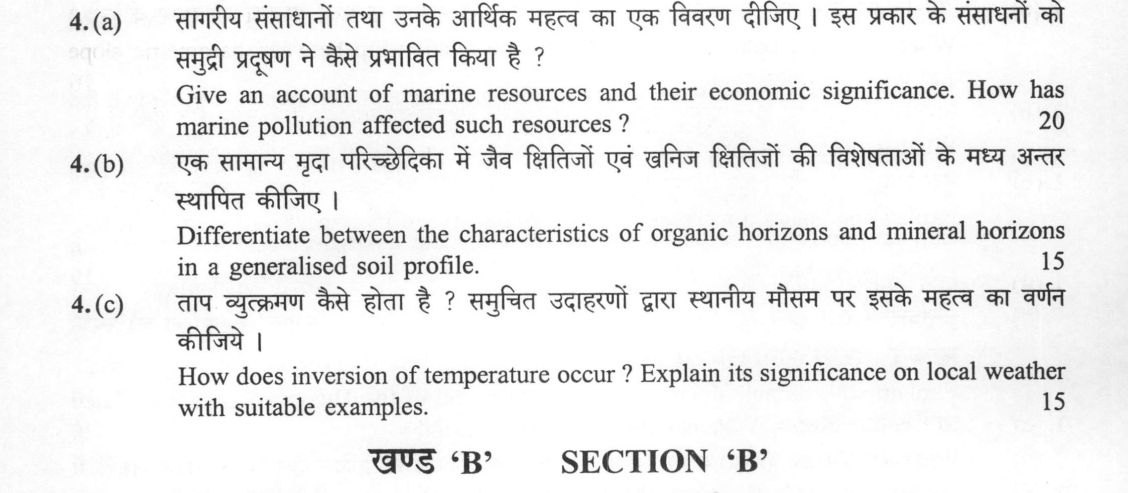
(a) Give an account of marine resources and their economic significance. How has marine pollution affected such resources? (20…
Give an account of marine resources and their economic significance. How has marine pollution affected such resources? 20 marks
Differentiate between the characteristics of organic horizons and mineral horizons in a generalised soil profile. 15 marks
How does inversion of temperature occur? Explain its significance on local weather with suitable examples. 15 marks
हिंदी में प्रश्न पढ़ें
सागरीय संसाधनों तथा उनके आर्थिक महत्व का एक विवरण दीजिए । इस प्रकार के संसाधनों को समुद्री प्रदूषण ने कैसे प्रभावित किया है ? (20 अंक)
एक सामान्य मृदा परिछेदिका में जैव क्षितिजों एवं खनिज क्षितिजों की विशेषताओं के मध्य अंतर स्थापित कीजिए । (15 अंक)
ताप व्युत्क्रमण कैसे होता है ? समुचित उदाहरणों द्वारा स्थानीय मौसम पर इसके महत्व का वर्णन कीजिये । (15 अंक)
Model answer
Written by UPSC Answer Check against this question's marking rubric, to the expected length. UPSC does not publish answers for Mains — this is one way to score well, not an official key.
Marine resources and pollution Marine resources are the ocean’s biotic and abiotic endowments that support livelihoods, trade and national income. Biotic resources include fisheries, plankton, seaweeds and other marine organisms; they provide protein, employment for fisherfolk and raw material for food, feed and pharma. Abiotic resources include petroleum, natural gas, polymetallic nodules, marine sand and salt; they add to energy security, mineral supply and export earnings. Together they strengthen food security, improve trade balance, sustain coastal communities and form the basis of the blue economy. In India, fisheries and marine products contribute to GDP, millions of livelihoods and foreign exchange, while offshore hydrocarbons and mineral sands support industry. Their sustainable use can expand the blue economy through aquaculture, seaweed farming and value addition. Pollution damages these assets: oil spills smother seabeds, reduce fish and shellfish quality and destroy tourism; plastic pollution entangles fauna, clogs gills and enters food chains; eutrophication from nutrient runoff causes algal blooms, hypoxia and fish kills; heavy metals from industrial discharge bioaccumulate in fish and make marine food unsafe. Pollution also raises cleanup costs and weakens export competitiveness. Thus pollution converts a productive marine commons into a degraded, costly resource.
Organic and mineral horizons In a generalised soil profile, horizons differ in material, colour, structure and process. The organic horizon in a generalised profile is O; in organic soils H/L/F layers may also occur. O is formed from litter and humus; it is dark, loose, rich in biological activity and low in mineral particles. The mineral horizons are A, E, B, C and R. A is topsoil: mineral particles mixed with humus, dark but not an organic horizon; it is the main rooting horizon. E is the eluvial zone where fine clay, organic matter and bases are leached out, giving a lighter, bleached appearance. B is the illuvial zone where leached materials accumulate; it is often lighter or reddish/yellowish, more compact, blocky or prismatic, and shows clay, iron or humus enrichment. C is the weathered parent material, and R is bedrock. A labelled profile can be read as O (0–5 cm), A (5–25 cm), E (25–40 cm), B (40–80 cm), C (80–120 cm) and R below. Eluviation, strongest in E, and illuviation in B link horizon development: material removed from upper layers is deposited below, creating the characteristic sequence. The O horizon may be thin or absent in cultivated mineral soils, while mineral dominance increases with depth.
Temperature inversion and local weather Temperature inversion occurs when temperature increases with height instead of decreasing, trapping cold air near the surface. Radiation inversion forms on clear winter nights when the ground loses heat by long-wave radiation, cooling the air in contact with it; low sun angle and long nights strengthen it, causing frost and dense fog in Punjab and the Indo-Gangetic plain. Subsidence inversion occurs under anticyclonic high pressure, where descending air warms adiabatically aloft and suppresses vertical mixing, producing persistent haze and poor air quality. Advection inversion forms when warm air moves over a cold land or sea surface; coastal advection inversions can bring fog and low clouds. Frontal inversion occurs when warm air rides over cold air at a front, producing prolonged cloud and rain. The weather significance is that inversion acts as a lid: it encourages fog, frost damage to crops, accumulation of pollutants and smog episodes. Delhi’s November smog is a classic example, where winter inversion, low wind and crop burning trap particulates near the ground. Coastal cities may experience fog and reduced visibility due to advection inversion.
Conclusion Marine resource degradation, soil horizon alteration and inversion-related pollution are linked environmental problems. Sustainable blue-economy management, soil conservation and air-quality planning must be integrated spatially to protect livelihoods, food systems and public health.
What "Explain" is asking you to do
Make the working of something clear — what sets it off, what follows from what, and what it produces. Explain is the Commission's mechanism word: it dominates the technical papers and the “explain why” stems, where the marks sit in the causal chain and not in the label.
Structure that answers it
State what it is → the initiating condition → the chain of cause, step by step → an instance where it plays out → what the chain produces
Where marks are lost
Describing what something looks like instead of why it works that way. Naming the stages without linking them reads as description too.
How this answer will be evaluated
Approach
Framework: Concept or mechanism > Diagram > Regional example > Application. (a) account for: state the phenomenon > the causes in order of weight > conclusion | (b) compare: paired headings or table > key differences > significance > conclusion | (c) explain: definition/context > points in order > small example > short close Full marks: Clear mechanism, labelled diagrams, specific examples, and strong causal links.
Key points expected
- Categorize resources (biotic, abiotic, energy)
- Explain economic significance (fisheries, minerals, energy)
- Mechanism of pollution impact (eutrophication, bioaccumulation)
- Link physical cause to human consequence
- Paired headings or table for comparison
- Key differences in composition (humus vs minerals)
- Significance of each horizon type
- Labelled diagram of soil profile
Evaluation rubric
Each sub-part is marked on its own, against the marks and word limit printed on the paper.
- (a) State marine resources, their economic value, and the causal impact of pollution. 20 marks
account for— state the phenomenon → the causes in order of weight → conclusion
Must cover
- Categorize resources (biotic, abiotic, energy)
- Explain economic significance (fisheries, minerals, energy)
- Mechanism of pollution impact (eutrophication, bioaccumulation)
- Link physical cause to human consequence
Loses marks
- Description without mechanism
- Answers with no diagram
- Generic pollution talk without specific marine context
Earns more
- Labelled sketch map of marine resources
- Specific examples of pollution (oil spills, plastics)
- Mention of specific economic sectors (shipping, tourism)
Extra mark
- Recent disaster or census data
- Specific committee or report on marine pollution
- (b) Differentiate organic and mineral horizons in a soil profile. 15 marks
compare— paired headings or table → key differences → significance → conclusion
Must cover
- Paired headings or table for comparison
- Key differences in composition (humus vs minerals)
- Significance of each horizon type
- Labelled diagram of soil profile
Loses marks
- Description without mechanism
- Answers with no diagram
- Confusing organic and mineral characteristics
Earns more
- Specific horizon names (O, A, B, C)
- Explanation of humification vs mineralization
- Regional example of soil profile
Extra mark
- Specific soil type example (e.g., Podzol, Chernozem)
- Detailed diagram with depth markers
- (c) Explain temperature inversion mechanism and its local weather significance. 15 marks
explain— definition/context → points in order → small example → short close
Must cover
- Definition/context of temperature inversion
- Mechanism of occurrence (radiation, subsidence, frontal)
- Significance on local weather (smog, fog, stability)
- Suitable examples (e.g., Los Angeles, Delhi)
Loses marks
- Description without mechanism
- Answers with no diagram
- Confusing inversion with normal lapse rate
Earns more
- Labelled diagram of inversion layer
- Explanation of stability and air quality
- Specific local weather phenomena (fog, smog)
Extra mark
- Recent disaster or census data
- Specific city example with data
Practice this exact question
Write your answer and it is marked point by point against the model answer above — what you covered, what you missed, what you got wrong.
Evaluate my answer →More from Geography 2023 Paper I
- Q1 Answer the following in about 150 words each: (a) What is "Geostrophic Wind"? Explain the…
- Q2 (a) "Evidences from palaeomagnetism and sea floor spreading have validated that continent…
- Q3 (a) What are the causes of origin of local winds? Discuss their significance on prevailin…
- Q4 (a) Give an account of marine resources and their economic significance. How has marine p…
- Q5 Answer the following in about 150 words each: (a) Explain the sequential development of a…
- Q6 (a) Explain the problems and prospects of urban expansion in the context of urban fringe…
- Q7 (a) Explain with suitable diagrams A. Losch's model of the Theory of Location related to…