Paper II — Q1
(a) On the outline map of India provided to you, mark the location of all of the following. Write in your QCA Booklet the…
On the outline map of India provided to you, mark the location of all of the following. Write in your QCA Booklet the significance of these locations, whether physical/commercial/economic/ecological/environmental/cultural, in not more than 30 words for each entry: 2×10=20 Nathula
Hutti
Ross Island
Moreh
Ramappa
Namdapha National Park
Sela Tunnel
Ennore Port
Ramagundam
Betwa River
Describe the origin, distribution and economic significance of Gondwana system of rocks in India. 10 marks
Examine the role of Indian Earth Observation Satellite Technology in enhancing weather forecasting and disaster management. 10 marks
Discuss the impact of the National Green Tribunal Act, 2010 on forest conservation in India. 10 marks
हिंदी में प्रश्न पढ़ें
आपको दिए गए भारत के रेखा मानचित्र पर, निम्नलिखित सभी की स्थिति को अंकित कीजिए। अपनी क्यू० सी० ए० पुस्तिका में इन स्थानों में से प्रत्येक का भौतिक/वाणिज्यिक/आर्थिक/पारिस्थितिक/पर्यावरणीय/सांस्कृतिक महत्व अधिकतम 30 शब्दों में लिखिए : 2×10=20 नाथुला
हट्टी
रॉस द्वीप
मोरेह
रामप्पा
नामदफा राष्ट्रीय उद्यान
सेला सुरंग
एन्नोर बंदरगाह
रामगुंडम
बेतवा नदी
भारत में गोंडवाना प्रणाली की चट्टानों की उत्पत्ति, वितरण और आर्थिक महत्व का वर्णन कीजिए। 10
मौसम पूर्वानुमान और आपदा प्रबंधन को बढ़ाने में भारतीय पृथ्वी अवलोकन उपग्रह प्रौद्योगिकी की भूमिका का परीक्षण कीजिए। 10
भारत में वन संरक्षण पर राष्ट्रीय हरित अधिकरण अधिनियम, 2010 के प्रभाव की विवेचना कीजिए। 10
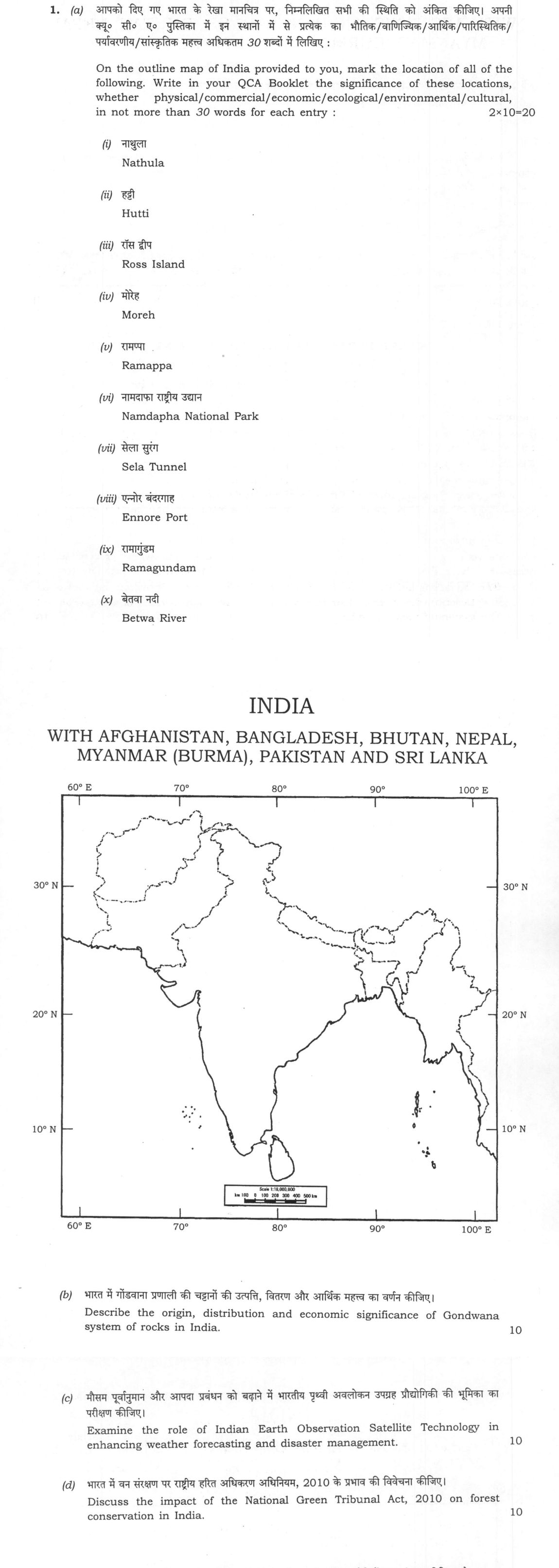
The figure this question refers to, in words
The question paper is a scan and the diagram did not survive as text. This is the figure as read from the original page — every component, value and label — so the question can be worked from the text below.
(a) An outline map of India and its neighboring countries (Afghanistan, Bangladesh, Bhutan, Nepal, Myanmar, Pakistan, Sri Lanka). The map is enclosed in a rectangular frame with latitude and longitude grid lines. Longitude lines are marked at the top and bottom at 60° E, 70°, 80°, 90°, and 100° E. Latitude lines are marked on the left and right sides at 10° N, 20° N, and 30° N. The map shows the outlines of the landmasses, including the Indian peninsula, Sri Lanka, and the island chains in the Indian Ocean (Lakshadweep and Andaman & Nicobar Islands). A scale bar is located at the bottom center, labeled 'Scale 1:18,000,000' with a distance scale in kilometers ranging from 0 to 500 km.
Model answer
Written by UPSC Answer Check against this question's marking rubric, to the expected length. UPSC does not publish answers for Mains — this is one way to score well, not an official key.
Nathula is a high mountain pass in Sikkim, near Nathang Valley on the India–Tibet border, approximately 27.4° N, 88.8° E. It is a strategic border point and main trade route between India and China, noted for border trade, security and connectivity.
Hutti is in Bagalkot district, Karnataka, near the Hutti River, approximately 16.5° N, 75.8° E. It is known for the Hutti Gold Mine, a gold-producing area significant for mining, employment and environmental regulation.
Ross Island is in Port Blair, Andaman and Nicobar Islands, in the Bay of Bengal, approximately 11.7° N, 92.7° E. It was the British colonial capital of the Andamans and is now a heritage and coral-reef site, important for tourism and conservation.
Moreh is a border town in Moreh district, Manipur, on the India–Myanmar border near the Moreh–Myitkyina road, approximately 24.7° N, 93.9° E. It is significant for cross-border trade, connectivity and security with Myanmar.
Ramappa refers to the Ramappa Temple at Palampet in Mulugu district, Telangana, in the Godavari basin, approximately 18.9° N, 78.9° E. It is a 13th-century Kakatiya temple, significant as a cultural heritage site and UNESCO tentative-list monument.
Namdapha National Park is in West Kameng district, Arunachal Pradesh, near Daporijo, approximately 27.7° N, 96.5° E. It is a major biodiversity hotspot in the Eastern Himalaya, significant for snow leopards, red pandas, tigers and eco-tourism.
Sela Tunnel is in West Kameng district, Arunachal Pradesh, near Sela Pass on NH 37, approximately 27.7° N, 96.5° E. It is a road tunnel improving all-season connectivity, trade and strategic movement in the northeast.
Ennore Port is in Chennai district, Tamil Nadu, on the Bay of Bengal coast, approximately 13.2° N, 80.3° E. It is a major container and cargo port, significant for logistics, trade and port-led industrial development.
Ramagundam is in Khammam district, Telangana, in the Godavari basin, approximately 18.3° N, 79.9° E. It is an industrial and power town, significant for thermal power plants, coal-based energy and industrial growth.
Betwa River rises in Chhatarpur district, Madhya Pradesh, approximately 25.5° N, 78.5° E, and joins the Yamuna near Prayagraj. It is a major Yamuna tributary, significant for irrigation, water supply and river-linking proposals.
Gondwana system of India consists mainly of sedimentary rocks—sandstones, shales, siltstones, conglomerates and coal-bearing formations—deposited in a large inland Gondwana basin from the late Carboniferous/Permian to the Jurassic, roughly 300 to 145 million years ago. It formed in fluvial, lacustrine, deltaic and coastal environments as the Indian landmass lay within the Gondwana supercontinent. The basin's stratigraphy records changing climate and sea-level conditions. The rocks are distributed across central and eastern India, especially the Deccan, Godavari, Mahanadi, Narmada, Son, Damodar and Jharia basins, with major outcrops in Chhattisgarh, Jharkhand, Odisha, Madhya Pradesh, West Bengal and Andhra Pradesh. Its red beds and laterites also support soil formation and construction materials. Economically, the system is vital because it hosts India’s major coal seams, along with iron ore, manganese, copper, uranium, bauxite, laterite, clay and building stones, making it central to energy, mining and industrial development.
Indian Earth Observation Satellite Technology supports weather forecasting and disaster management through continuous remote sensing. Geostationary INSAT-3D, 3DR and 3DS satellites carry a 19-channel sounder with 18 infrared and one visible channel, along with high-resolution imagers, providing data on clouds, temperature, moisture, wind and severe weather. Oceansat satellites monitor sea-surface temperature and ocean winds, while Resourcesat, Cartosat and RISAT provide land, water, topographic and all-weather radar data. RISAT is especially useful during cloudy monsoon conditions. These systems help forecast monsoon, cyclones, rainfall and drought, and support disaster management by mapping flood extents, landslide-prone areas, urban heat islands, forest fires and post-event damage, enabling early warning, response and recovery planning. They improve lead time for cyclone tracks and rainfall nowcasting. The data are used by IMD, NDMA and state disaster authorities, and also support climate studies, water-resource assessment and agricultural monitoring.
National Green Tribunal Act, 2010 established the NGT as a specialized statutory tribunal for environmental disputes, giving effect to the right to a clean environment under Article 21. It has original jurisdiction over cases involving the Forest Conservation Act, Wildlife Protection Act, Environment Protection Act and related environmental laws, and can grant injunctions, compensation, restoration orders and directions to public authorities. For forest conservation, the NGT has strengthened enforcement by hearing challenges to deforestation, mining, road projects and industrial clearances in forest areas, directing compensatory afforestation, restoration of degraded forest land, monitoring of forest-clearance conditions and protection of critical habitats. It can also direct forest departments to prepare action plans and report compliance. This has made forest clearance more accountable and has brought ecological concerns into development decisions. It has also encouraged litigation and public interest cases, though its impact depends on timely implementation, field monitoring and coordination with forest and revenue departments.
What "Describe" is asking you to do
Give a full, ordered account of the thing named — its parts, stages or mechanism — in the sequence in which it actually exists or occurs. Most describe questions come from the science optionals, where the marks sit in correct technical detail and, where the stem says so, a labelled diagram.
Structure that answers it
One-line identification of the subject → the parts or stages in their real order, each with its defining detail → labelled diagram where the subject is structural → closing line on function or significance
Where marks are lost
Loose general prose where the examiner is ticking named parts, correct terminology and their sequence; and in the General Studies papers, turning to evaluation before the description is finished.
How this answer will be evaluated
Approach
Framework: Map Work & Regional Geography. (a) describe: Map marking > Significance (physical/commercial/ecological) | (b) describe: Origin (Precambrian) > Distribution (Deccan Trap) > Economic significance | (c) discuss: Intro (ISRO role) > Weather forecasting (METSAT) > Disaster management (CARTOSAT) | (d) discuss: Intro (NGT Act 2010) > Impact on forest conservation > Balanced close (challenges) Full marks: Precise map work; specific satellite names; balanced NGT analysis with examples.
Key points expected
- Nathula: Sikkim/China trade
- Hutti: Gold mining
- Gondwana: Precambrian, Deccan Trap, Coal/Iron
- METSAT/CARTOSAT: Weather/Disaster
- NGT 2010: Forest conservation impact
Evaluation rubric
Each sub-part is marked on its own, against the marks and word limit printed on the paper.
- (a) Mark 10 locations on map; write 30-word significance for each. 20 marks · 30 words
describe— Map marking → Significance (physical/commercial/ecological)
Must cover
- Accurate map marking of all 10 points
- Nathula: Sikkim/China border trade
- Hutti: Karnataka gold mining
- Ross Island: Andaman heritage/ecology
Loses marks
- Wrong state for location
- Generic description without specific significance
Earns more
- Moreh: Mizoram border trade
- Ramappa: Telangana UNESCO temple
- Namdapha: Arunachal biodiversity
- Sela Tunnel: Arunachal connectivity
Extra mark
- Ennore: Chennai port logistics
- Ramagundam: Telangana thermal power
- (b) Explain Gondwana origin, distribution, and economic value. 10 marks · 30 words
describe— Origin (Precambrian) → Distribution (Deccan Trap) → Economic significance
Must cover
- Precambrian origin (Gondwanaland)
- Distribution: Deccan Trap, Eastern Ghats
- Economic: Coal, Iron, Manganese, Bauxite
- Labelled map of distribution
Loses marks
- No map/diagram
- Confusing with Cretaceous rocks
Earns more
- Mention of sedimentary/metamorphic nature
- Specific mines (Jharia, Singhbhum)
Extra mark
- Reference to specific geological age (Permian-Carboniferous)
- (c) Examine satellite role in weather and disaster management. 10 marks · 30 words
discuss— Intro (ISRO role) → Weather forecasting (METSAT) → Disaster management (CARTOSAT)
Must cover
- Mention specific satellites (METSAT, Oceansat, CARTOSAT)
- Weather: Cyclone tracking, monsoon forecasting
- Disaster: Flood mapping, drought assessment
- Link to disaster management cycle (pre/during/post)
Loses marks
- No specific satellite names
- Vague 'technology helps' without mechanism
Earns more
- Example of specific disaster (e.g., 2019 Cyclone Fani)
- Mention of remote sensing techniques
Extra mark
- Reference to specific ISRO mission (e.g., INSAT-3D)
- (d) Discuss NGT Act 2010 impact on forest conservation. 10 marks · 30 words
discuss— Intro (NGT Act 2010) → Impact on forest conservation → Balanced close (challenges)
Must cover
- Mention NGT Act 2010
- Impact: Environmental clearance enforcement
- Impact: Afforestation orders
- Balanced view: Challenges (delays, implementation)
Loses marks
- No mention of specific forest impact
- One-sided (only positive or only negative)
Earns more
- Specific case (e.g., Western Ghats mining ban)
- Mention of Forest (Conservation) Act link
Extra mark
- Reference to specific NGT judgment
Practice this exact question
Write your answer and it is marked point by point against the model answer above — what you covered, what you missed, what you got wrong.
Evaluate my answer →More from Geography 2023 Paper II
- Q1 (a) On the outline map of India provided to you, mark the location of all of the followin…
- Q2 (a) Examine the environmental challenges caused by the solid waste in metropolitan region…
- Q3 (a) Indian Pharma Industry has to move from 'volume' to 'value' leadership to capture glo…
- Q4 (a) With falling fertility rate and rising median age, how can India translate demographi…