Paper II — Q6
(a) A large number of Indian cities have a complex morphological characteristics due to their historical evolution. Elucidate…
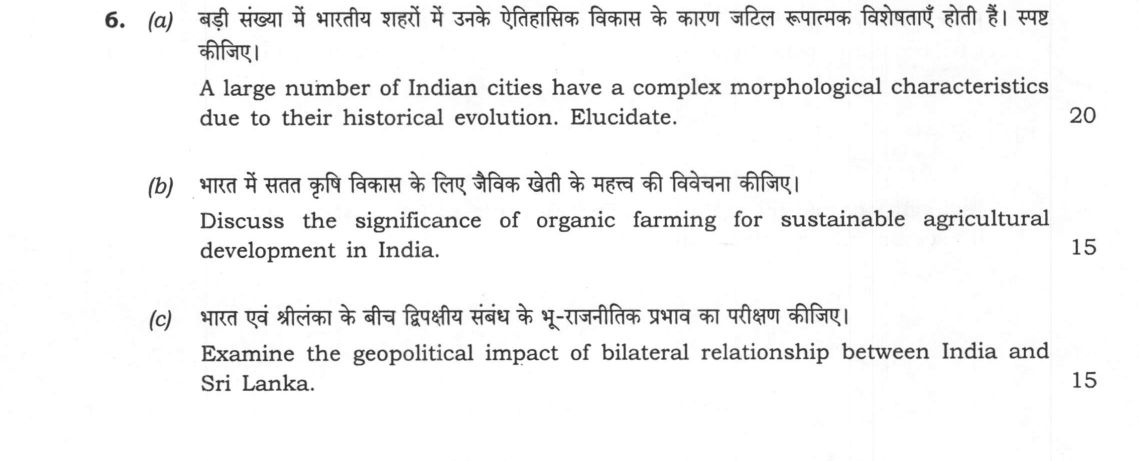
A large number of Indian cities have a complex morphological characteristics due to their historical evolution. Elucidate. 20 marks
Discuss the significance of organic farming for sustainable agricultural development in India. 15 marks
Examine the geopolitical impact of bilateral relationship between India and Sri Lanka. 15 marks
हिंदी में प्रश्न पढ़ें
बड़ी संख्या में भारतीय शहरों में उनके ऐतिहासिक विकास के कारण जटिल रूपात्मक विशेषताएँ होती हैं। स्पष्ट कीजिए। 20
भारत में सतत कृषि विकास के लिए जैविक खेती के महत्व की विवेचना कीजिए। 15
भारत एवं श्रीलंका के बीच द्विपक्षीय संबंध के भू-राजनीतिक प्रभाव का परीक्षण कीजिए। 15
Model answer
Written by UPSC Answer Check against this question's marking rubric, to the expected length. UPSC does not publish answers for Mains — this is one way to score well, not an official key.
Spatial organization in South Asia reflects deep historical overlays, ecological imperatives, and geostrategic realignments. From layered urban forms to sustainable rural landscapes and maritime frontiers, geographical processes shape India's internal development and regional positioning.
Urban Morphology and Historical Evolution in Indian Cities
Indian urban morphology rarely conforms strictly to Western constructs like Burgess’s Concentric Zone or Hoyt’s Sector Theory, exhibiting instead a polycentric, composite structure derived from successive cultural epochs. Ancient Indo-Gangetic cities such as Varanasi and Pataliputra evolved organically along riverine axes, displaying religious cores, ghats, and high-density pedestrian lanes.
Medieval Islamic urbanism introduced walled fort-cities exemplified by Shahjahanabad (Delhi). These were structured around a central citadel, congregational mosques, and specialized commercial spines, further subdivided into inward-looking havelis and segregated neighborhood quarters known as katras.
Colonial intervention superimposed a stark spatial dichotomy, creating distinct "dual cities." The British established geometrically gridded quarters—comprising cantonments, low-density administrative civil lines, and fortified commercial districts like the Bombay Fort area and Madras—spatially segregated from the dense "native" towns. Post-independence urbanization added layers of planned modernism (e.g., Chandigarh), followed by peripheral sub-cities, peri-urban informal sprawl, and highway corridors. Consequently, contemporary Indian urban morphology represents a juxtaposition of historic traditional cores, colonial enclaves, and unregulated post-colonial suburban fringes.
Organic Farming and Sustainable Agricultural Development
Organic farming is vital for reversing the land degradation, groundwater depletion, and chemical contamination caused by intensive Green Revolution practices. It restores soil health by enhancing microbial biomass and soil organic carbon, aiding the ecological stabilization of fragile zones, such as transitioning traditional jhum (shifting cultivation) to settled regenerative farming in the North-East. Sikkim’s achievement as India’s first fully organic state demonstrates this potential. Additionally, organic practices improve water-use efficiency, conserve agro-biodiversity, aid carbon sequestration, and enable farmers to tap into high-value domestic and export markets.
However, transition barriers persist, notably the initial yield drop during the gestation period, high certification costs, and fragmented supply chains. Policy interventions such as the Paramparagat Krishi Vikas Yojana (PKVY) and the Mission Organic Value Chain Development for North Eastern Region (MOVCDNER) provide financial support, cluster-based capacity building, and simplified certification through the Participatory Guarantee System (PGS-India), embedding organic farming firmly into India's climate-resilient agricultural trajectory.
Geopolitical Impact of India–Sri Lanka Bilateral Relations
Sri Lanka’s location along critical Sea Lines of Communication (SLOCs) in the Indian Ocean makes it indispensable to South Asian geopolitics. Maritime proximity across the Palk Strait creates friction over mechanized bottom-trawling by Indian fishermen, while the ethnic Tamil question continues to influence India's domestic political discourse and bilateral diplomacy.
Geostrategically, Chinese investments—notably the 99-year lease of Hambantota Port and the Colombo Port City project—pose challenges to India’s maritime domain awareness and traditional sphere of influence in the Indian Ocean Region. India has countered this through economic stabilization packages, energy grid interconnectivity, renewable power investments in the Jaffna peninsula, and strategic alignments under the SAGAR (Security and Growth for All in the Region) doctrine and the Sagarmala port-led development framework. Sri Lanka thereby remains a crucial node for India’s Indo-Pacific strategy, energy security, and maritime surveillance.
Conclusion
From the morphological complexity of heritage cities to the agro-ecological stabilization of rural heartlands and maritime diplomacy across the Palk Strait, India’s geography requires a multi-scale development strategy that harmonizes urban renewal, sustainable agriculture, and resilient regional security architectures.
What "Elucidate" is asking you to do
Make a stated proposition plain and then prove it with instances. Elucidate stems almost always carry a claim or a named concept, and very often the words “with examples” or “with suitable diagrams” — the illustration is part of the directive, not decoration.
Structure that answers it
Plain-language statement of what the proposition means → the part that is obscure, resolved → first illustration → second illustration → why the proposition holds
Where marks are lost
Adding terminology; elucidate rewards removing it. The commoner loss is a clean explanation with no example, when the stem asked for examples.
How this answer will be evaluated
Approach
Framework: Concept > Diagram > Regional Example > Application. (a) explain: definition/context > points in order > small example > short close | (b) discuss: intro > 3-4 dimensions > example > balanced close | (c) examine: intro > how/why with reasoning > evidence > conclusion Full marks: Comprehensive, well-structured, with specific examples and diagrams.
Key points expected
- Define morphological characteristics (form, structure, layout)
- Identify specific historical phases (e.g., Mughal, Colonial, Post-Independence)
- Explain the mechanism of 'layered' or 'juxtaposed' urban forms
- Provide a specific Indian city example (e.g., Delhi, Kolkata, Hyderabad)
- Define organic farming and sustainable development
- Explain the mechanism of soil health improvement
- Discuss economic viability for small/marginal farmers
- Provide a specific Indian state or region example
Evaluation rubric
Each sub-part is marked on its own, against the marks and word limit printed on the paper.
- (a) Explain the causal link between historical evolution and complex urban morphology. 20 marks
explain— definition/context → points in order → small example → short close
Must cover
- Define morphological characteristics (form, structure, layout)
- Identify specific historical phases (e.g., Mughal, Colonial, Post-Independence)
- Explain the mechanism of 'layered' or 'juxtaposed' urban forms
- Provide a specific Indian city example (e.g., Delhi, Kolkata, Hyderabad)
Loses marks
- General description of city growth without morphological focus
- No specific Indian city examples provided
- Confusing morphology with general urbanization statistics
Earns more
- Mention specific historical features (e.g., Mughal Charbagh, British grid)
- Reference specific urban planning acts or policies
- Discuss the impact of modernization on historical cores
Extra mark
- Labelled sketch map of a specific city's morphology
- Reference to specific census data on urban sprawl
- (b) Discuss the role of organic farming in achieving sustainable agricultural development. 15 marks
discuss— intro → 3-4 dimensions → example → balanced close
Must cover
- Define organic farming and sustainable development
- Explain the mechanism of soil health improvement
- Discuss economic viability for small/marginal farmers
- Provide a specific Indian state or region example
Loses marks
- General discussion of agriculture without organic focus
- No link to sustainability (environmental/economic/social)
- Ignoring the Indian context
Earns more
- Mention specific government schemes (e.g., Paramparagat Krishi Vikas Yojana)
- Reference specific organic zones or clusters
- Discuss market linkages and certification processes
Extra mark
- Data on organic produce price premiums
- Reference to specific organic farming success stories
- (c) Examine the geopolitical impact of India-Sri Lanka bilateral relations. 15 marks
examine— intro → how/why with reasoning → evidence → conclusion
Must cover
- Define the geopolitical context (Indian Ocean, strategic location)
- Explain the 'how' and 'why' of the relationship's impact
- Provide evidence of specific geopolitical events or agreements
- Conclude with the current state of the relationship
Loses marks
- General discussion of India-Sri Lanka relations without geopolitical focus
- No specific evidence or examples provided
- Ignoring the strategic dimension of the Indian Ocean
Earns more
- Mention specific agreements (e.g., 1974 Indo-Sri Lanka Agreement)
- Reference specific geopolitical events (e.g., 1987 IPKF intervention)
- Discuss the role of China in the region
Extra mark
- Map showing strategic locations (e.g., Hambantota, Trincomalee)
- Reference to specific recent diplomatic summits
Practice this exact question
Write your answer and it is marked point by point against the model answer above — what you covered, what you missed, what you got wrong.
Evaluate my answer →More from Geography 2023 Paper II
- Q3 (a) Indian Pharma Industry has to move from 'volume' to 'value' leadership to capture glo…
- Q4 (a) With falling fertility rate and rising median age, how can India translate demographi…
- Q5 Answer the following questions in about 150 words each: 10×5=50 (a) Identify the jute-pro…
- Q6 (a) A large number of Indian cities have a complex morphological characteristics due to t…
- Q7 (a) Discuss the green energy initiatives of India as a signatory nation to the Paris Agre…
- Q8 (a) Why India lags behind many other countries in agricultural productivity? Suggest suit…