Paper II — Q5
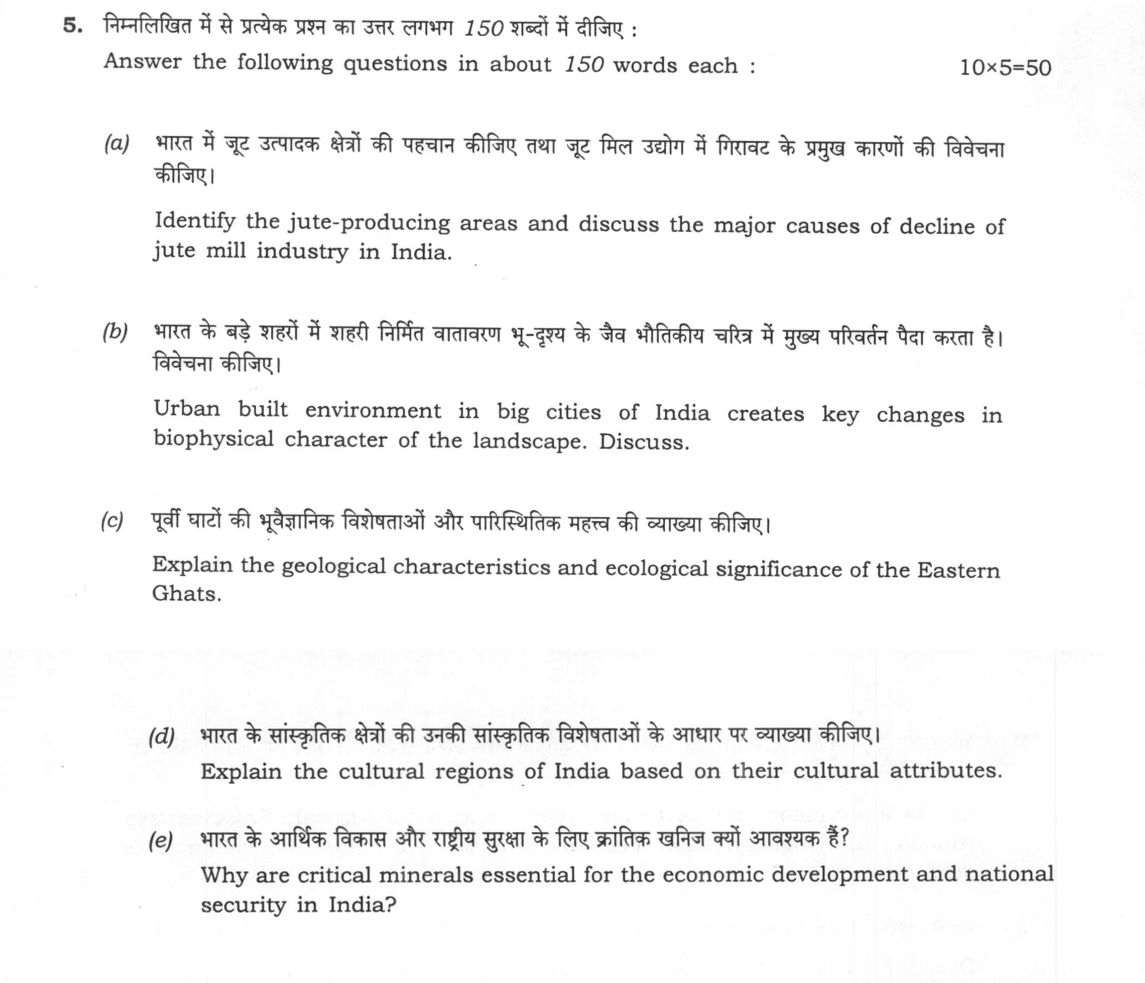
Answer the following questions in about 150 words each: 10×5=50 (a) Identify the jute-producing areas and discuss the major…
Answer the following questions in about 150 words each: 10×5=50
Identify the jute-producing areas and discuss the major causes of decline of jute mill industry in India.
Urban built environment in big cities of India creates key changes in biophysical character of the landscape. Discuss.
Explain the geological characteristics and ecological significance of the Eastern Ghats.
Explain the cultural regions of India based on their cultural attributes.
Why are critical minerals essential for the economic development and national security in India?
हिंदी में प्रश्न पढ़ें
निम्नलिखित में से प्रत्येक प्रश्न का उत्तर लगभग 150 शब्दों में दीजिए : 10×5=50
भारत में जूट उत्पादक क्षेत्रों की पहचान कीजिए तथा जूट मिल उद्योग में गिरावट के प्रमुख कारणों की विवेचना कीजिए।
भारत के बड़े शहरों में शहरी निर्मित वातावरण भू-दृश्य के जैव भौतिकीय चरित्र में मुख्य परिवर्तन पैदा करता है। विवेचना कीजिए।
पूर्वी घाटों की भूवैज्ञानिक विशेषताओं और पारिस्थितिक महत्व की व्याख्या कीजिए।
भारत के सांस्कृतिक क्षेत्रों की उनकी सांस्कृतिक विशेषताओं के आधार पर व्याख्या कीजिए।
भारत के आर्थिक विकास और राष्ट्रीय सुरक्षा के लिए क्रांतिक खनिज क्यों आवश्यक हैं?
Model answer
Written by UPSC Answer Check against this question's marking rubric, to the 150-word length. UPSC does not publish answers for Mains — this is one way to score well, not an official key.
Jute. Jute is produced mainly in the humid, low-lying Bengal delta and the Ganga-Brahmaputra basin, especially West Bengal’s Nadia and Murshidabad, Bihar’s Purnia and Assam’s Goalpara. As a monsoon-dependent, rain-fed crop, jute is sensitive to floods, drought, soil salinity and fibre quality, which makes raw supply unstable. The decline of India’s jute mill industry is structural. Bangladesh has gained a cost advantage through cheaper labour, better raw jute quality and export incentives, while synthetic fibres such as polypropylene and polyester have substituted for many jute products. Indian mills face obsolescent machinery, high power and processing costs, irregular raw-material supply, labour disputes and weak marketing. Water pollution in the Hooghly basin further raises treatment costs and affects quality. Without modernisation, credit and product diversification, the industry remains vulnerable. The industry also needs stronger branding, eco-friendly packaging demand, stable export markets, institutional credit support, and integration with renewable energy to reduce costs.
Urban built environment. The built environment of big Indian cities changes the biophysical landscape by replacing soil and vegetation with impervious surfaces such as concrete, asphalt, glass and metal. These materials absorb and re-radiate heat, intensifying urban heat islands, especially in Delhi, Mumbai and Bengaluru. Reduced infiltration and permeability lower groundwater recharge, increase surface runoff and alter drainage patterns, making cities more prone to waterlogging and flash flooding. Loss of green cover reduces evapotranspiration, shade and carbon sequestration, while dense building canyons trap particulate matter and modify wind flow. The result is a modified microclimate: higher night temperatures, poorer air quality, altered humidity and stress on water resources. Vehicle and industrial waste heat, low albedo roofs and compact urban form further amplify warming, health and water stress, while stormwater systems designed for lower flows struggle with peak runoff and flooding. Sustainable planning must restore permeability, green cover and heat-sensitive design.
Eastern Ghats. The Eastern Ghats are a discontinuous mountain system running along India’s eastern coast, composed largely of Archaean gneisses and schists. Unlike the Western Ghats, which form a more continuous faulted escarpment with varied geology and higher relief, the Eastern Ghats are lower and more broken, with general elevations of 600–1,200 m but peaks such as Arma Konda/Jindhagada exceeding 1,600 m. The range is rich in bauxite and iron ore, reflecting its ancient crystalline basement. Ecologically, it supports dry deciduous forests, wildlife and the Eastern Ghats elephant corridor, linking fragmented habitats. It also locally marks watershed divides among the Cauvery, Krishna and Godavari basins, though it is cut through by eastward-flowing rivers and is not the principal water divide of peninsular India. Its hills regulate local rainfall, recharge springs and sustain riverine ecosystems, making conservation important for biodiversity, rural livelihoods, water security, climate resilience and long-term ecosystem service flows.
Cultural regions. India’s cultural regions can be understood through language, religion, kinship, settlement and material culture. The Indo-Gangetic Aryan-Hindu core is marked by Indo-Aryan languages, Sanskrit and Hindi traditions, temple and pilgrimage culture, agrarian settlement and caste-based social organisation. The Dravidian south, including Tamil Nadu and Kerala, is defined by Dravidian languages, temple architecture, classical arts, paddy cultivation and, in Kerala, matrilineal kinship. The tribal belt of central India is characterised by Adivasi communities, forest-based livelihoods, clan identity, oral traditions and shifting cultivation. The Himalayan-Tibetan Buddhist region has Tibetan languages, monasteries, highland pastoralism and Buddhist ritual life. The Northeastern mosaic combines Tibeto-Burman languages, clan-based societies, rice cultivation and distinctive settlement patterns, with matrilineal practices among some Khasi and Jaintia communities. These regions are not rigid; they overlap through trade, migration, film, media, shared national symbols, constitutional citizenship, regional languages, local festivals, arts and crafts now, while retaining local identities.
Critical minerals. Critical minerals are essential because they underpin technologies that drive economic growth and national security. Lithium is needed for battery storage, rare earth elements for electronics and magnets, cobalt for EV batteries, and graphite for anodes. India’s renewable energy transition, electric mobility, solar and wind power, data centres, 5G networks, defence electronics, missiles, satellites and communication systems all depend on these inputs. Shortages or supply disruptions can raise costs, delay projects and weaken strategic autonomy. India imports a large share of these minerals, especially from China, creating vulnerability in global markets and geopolitical tensions. The National Critical Mineral Mission, domestic exploration, recycling, strategic reserves and diversified sourcing are therefore needed to secure supply, support manufacturing, reduce import dependence, ensure resilience and protect national security. Their concentration in a few countries makes supply chains strategic, requiring long-term planning, investment and international partnerships for strategic sectors, growth and stability now.
What "Discuss" is asking you to do
Lay the issue out from more than one side — how it arose, what is claimed for it, what is held against it, and where it now stands. UPSC attaches discuss to broad topics with several live dimensions, so coverage of the dimensions earns more than the strength of your opinion.
Structure that answers it
Set the issue up → the case as it is made → the case against → the dimension both sides leave out → where the balance now lies
Where marks are lost
Listing facts with no thread between them, or arguing one side throughout and calling it a discussion.
How this answer will be evaluated
Approach
Framework: Concept or mechanism > Diagram > Regional example > Application. (a) discuss: intro > 3-4 dimensions > example > balanced close | (b) discuss: intro > 3-4 dimensions > example > balanced close | (c) explain: definition/context > points in order > small example > short close | (d) explain: definition/context > points in order > small example > short close | (e) justify: claim > 3-4 reasons > evidence > conclusion Full marks: Precise mechanism, labelled diagram, specific Indian examples, balanced conclusion.
Key points expected
- Identify West Bengal, Bihar, Assam as key areas
- Explain the 'Jute Cycle' (retting to baling)
- Link physical cause (water) to human consequence (mill location)
- Discuss competition from synthetic fibers (polypropylene)
- Define 'Urban Heat Island' (UHI) effect
- Explain the 'Sponge City' concept or lack thereof
- Link impervious surfaces to hydrological changes
- Mention specific Indian cities (e.g., Delhi, Mumbai)
Evaluation rubric
Each sub-part is marked on its own, against the marks and word limit printed on the paper.
- (a) Locate jute areas and analyze the causal chain of industry decline. · 150 words
discuss— intro → 3-4 dimensions → example → balanced close
Must cover
- Identify West Bengal, Bihar, Assam as key areas
- Explain the 'Jute Cycle' (retting to baling)
- Link physical cause (water) to human consequence (mill location)
- Discuss competition from synthetic fibers (polypropylene)
Loses marks
- Listing areas without explaining the 'why'
- Ignoring the role of water in the process
- Attributing decline solely to labor issues
Earns more
- Mention specific rivers (Hooghly, Ganga) for retting
- Reference the Jute (Control) Order, 1965
- Note the shift of mills to Bangladesh
- Mention the 'Golden Fiber' status
Extra mark
- Labelled map of jute belt
- Recent production statistics (e.g., 2022-23)
- (b) Explain how urban built environment alters biophysical landscape character. · 150 words
discuss— intro → 3-4 dimensions → example → balanced close
Must cover
- Define 'Urban Heat Island' (UHI) effect
- Explain the 'Sponge City' concept or lack thereof
- Link impervious surfaces to hydrological changes
- Mention specific Indian cities (e.g., Delhi, Mumbai)
Loses marks
- Describing city growth without biophysical link
- Ignoring the 'built' aspect (infrastructure)
- Vague statements about 'pollution' without mechanism
Earns more
- Reference 'Albedo' effect of dark roofs
- Mention 'Green Cover' reduction
- Link to 'Census 2011' urbanization data
- Discuss 'Air Quality Index' (AQI) impact
Extra mark
- Diagram of UHI mechanism
- Specific data on temperature rise in a city
- (c) Detail geological structure and ecological role of Eastern Ghats. · 150 words
explain— definition/context → points in order → small example → short close
Must cover
- Identify as 'folded mountains' (unlike Western Ghats)
- Mention 'Precambrian' or 'Archean' rock age
- Explain 'discontinuous' nature of the range
- Link to 'Eastern Coastal Plain' formation
Loses marks
- Confusing with Western Ghats (fault block)
- Ignoring the 'geological' aspect (rock type)
- Failing to link geology to ecology
Earns more
- Name specific peaks (e.g., Arma Konda)
- Mention 'Biodiversity Hotspot' status
- Reference 'Tribal' populations in the region
- Discuss 'Water shed' importance
Extra mark
- Sketch map of Eastern Ghats
- Mention specific 'National Park' (e.g., Similipal)
- (d) Classify Indian cultural regions based on specific attributes. · 150 words
explain— definition/context → points in order → small example → short close
Must cover
- Identify 'North Indian' (Hindi belt) region
- Identify 'South Indian' (Dravidian) region
- Mention 'Linguistic' as a primary attribute
- Reference 'Caste' or 'Religion' as secondary attributes
Loses marks
- Listing regions without 'attributes'
- Ignoring the 'South' or 'North' divide
- Vague cultural generalizations
Earns more
- Mention 'Cuisine' differences (e.g., Rice vs Wheat)
- Reference 'Architecture' styles (e.g., Temple vs Mosque)
- Name specific 'Cultural Zones' (e.g., Bengali, Marathi)
- Discuss 'Language Commission' recommendations
Extra mark
- Map of linguistic zones
- Reference to 'Census' language data
- (e) Argue why critical minerals are vital for economy and security. · 150 words
justify— claim → 3-4 reasons → evidence → conclusion
Must cover
- Define 'Critical Minerals' (e.g., Lithium, Cobalt)
- Link to 'Renewable Energy' transition (EVs, Solar)
- Mention 'National Security' (defense tech)
- Reference 'Import Dependence' (e.g., China)
Loses marks
- Confusing 'critical' with 'common' minerals
- Ignoring the 'security' aspect
- Failing to link to 'economic development'
Earns more
- Name specific minerals (e.g., Rare Earths)
- Mention 'National Critical Mineral Mission'
- Reference 'Make in India' initiative
- Discuss 'Supply Chain' vulnerabilities
Extra mark
- List of 'Critical Minerals' (2023 list)
- Mention specific 'Mine' (e.g., Singrauli)
Practice this exact question
Write your answer and it is marked point by point against the model answer above — what you covered, what you missed, what you got wrong.
Evaluate my answer →More from Geography 2023 Paper II
- Q2 (a) Examine the environmental challenges caused by the solid waste in metropolitan region…
- Q3 (a) Indian Pharma Industry has to move from 'volume' to 'value' leadership to capture glo…
- Q4 (a) With falling fertility rate and rising median age, how can India translate demographi…
- Q5 Answer the following questions in about 150 words each: 10×5=50 (a) Identify the jute-pro…
- Q6 (a) A large number of Indian cities have a complex morphological characteristics due to t…
- Q7 (a) Discuss the green energy initiatives of India as a signatory nation to the Paris Agre…
- Q8 (a) Why India lags behind many other countries in agricultural productivity? Suggest suit…