Paper II — Q7
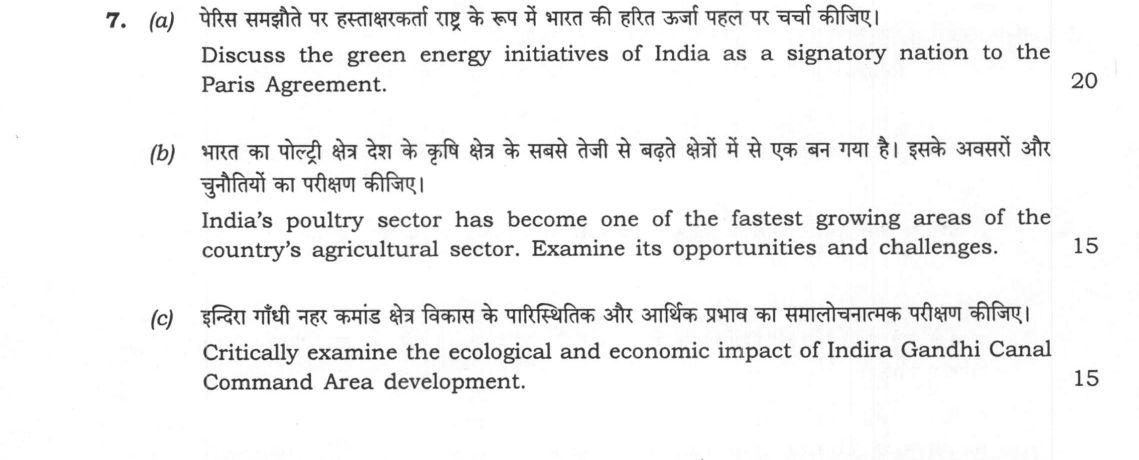
(a) Discuss the green energy initiatives of India as a signatory nation to the Paris Agreement. 20 (b) India's poultry sector…
Discuss the green energy initiatives of India as a signatory nation to the Paris Agreement. 20 marks
India's poultry sector has become one of the fastest growing areas of the country's agricultural sector. Examine its opportunities and challenges. 15 marks
Critically examine the ecological and economic impact of Indira Gandhi Canal Command Area development. 15 marks
हिंदी में प्रश्न पढ़ें
पेरिस समझौते पर हस्ताक्षरकर्ता राष्ट्र के रूप में भारत की हरित ऊर्जा पहल पर चर्चा कीजिए। 20
भारत का पोल्ट्री क्षेत्र देश के कृषि क्षेत्र के सबसे तेजी से बढ़ते क्षेत्रों में से एक बन गया है। इसके अवसरों और चुनौतियों का परीक्षण कीजिए। 15
इंदिरा गांधी नहर कमांड क्षेत्र विकास के पारिस्थितिक और आर्थिक प्रभाव का समालोचनात्मक परीक्षण कीजिए। 15
Model answer
Written by UPSC Answer Check against this question's marking rubric, to the expected length. UPSC does not publish answers for Mains — this is one way to score well, not an official key.
India’s developmental pathway necessitates balancing rapid economic growth with environmental sustainability across its energy, livestock, and water resource systems.
Green Energy Initiatives under the Paris Agreement
In alignment with Article 4 (mitigation commitments through Nationally Determined Contributions) and Article 7 (adaptation) of the Paris Agreement, India updated its NDCs to target a 45% reduction in emissions intensity of GDP by 2030 and achieve 50% cumulative electric power installed capacity from non-fossil sources, aiming for 500 GW of non-fossil capacity.
Supply-side initiatives center on the National Solar Mission, fostering ultra-mega solar parks, and dedicated Green Energy Corridors facilitating the transmission of onshore and offshore wind energy. The National Green Hydrogen Mission targets 5 MMT annual production by 2030 to decarbonize industrial sectors. Demand-side efficiency is driven by the Perform, Achieve, and Trade (PAT) scheme of the Bureau of Energy Efficiency, mass adoption of energy-efficient LED lighting under the UJALA program, and the Faster Adoption and Manufacturing of Hybrid and Electric Vehicles (FAME) scheme. Climate finance mechanisms, including Sovereign Green Bonds and the National Adaptation Fund for Climate Change (NAFCC), provide domestic capital mobilization to bridge transition risks.
Poultry Sector: Opportunities and Challenges
The poultry sector has emerged as a dynamic agro-industry, recording high annual growth rates.
On the opportunity side, the sector has transitioned from backyard farming to vertically integrated contract farming models, insulating smallholders from market shocks while generating non-farm rural employment. It offers vital backward linkages by creating demand for coarse grains and oilseeds, particularly maize and soybean, and forward linkages with refrigerated cold chains and processing industries. Specialized clusters in Andhra Pradesh and Tamil Nadu (notably Namakkal) exhibit strong export potential for table eggs and poultry meat.
However, significant challenges constrain the sector. Volatility in feed prices, primarily driven by domestic supply shocks in maize and soymeal, compresses operational margins. Biosecurity risks from recurring Avian Influenza outbreaks pose recurring health and economic threats. Environmental issues, including improper poultry manure disposal causing soil and groundwater contamination, alongside high antimicrobial resistance (AMR) risks from prophylactic antibiotic use, remain critical concerns. Additionally, seasonal demand variations cause sharp market price fluctuations.
Indira Gandhi Canal Command Area: Economic and Ecological Impacts
The Indira Gandhi Canal (IGNP) transformed the hyper-arid northwestern Thar Desert.
Economically, the project enabled a structural transition from subsistence pastoralism to settled, commercial agriculture. It diversified the cropping pattern, replacing drought-hardy bajra and moth bean with high-yielding, water-intensive crops such as wheat, cotton, mustard, and groundnut. This shift bolstered Rajasthan’s agricultural output, generated farm employment, fostered agro-processing hubs, and stabilized rural incomes against recurrent droughts.
Ecologically, however, the project induced severe land degradation. Excessive flood irrigation combined with shallow, impermeable subsurface gypsum layers caused rapid groundwater rise, resulting in severe waterlogging and secondary soil salinization, particularly in Sri Ganganagar, Hanumangarh, and Bikaner districts. While extensive canal-side afforestation aided sand dune stabilization, it altered the fragile desert ecology, submerging endemic flora and displacing traditional community grazing lands (orans and gochars). Furthermore, severe spatial inequity in water allocation persists, leading to acute water stress at the tail reaches of the distributary network compared to head reaches.
Way Forward
Sustaining these regional transformations requires harmonizing production targets with ecological thresholds. This demands grid modernization for renewable integration, stringent biosecurity and feed stabilization in the poultry supply chain, and volumetric water pricing alongside micro-irrigation to remediate salinity in canal commands.
What "Discuss" is asking you to do
Lay the issue out from more than one side — how it arose, what is claimed for it, what is held against it, and where it now stands. UPSC attaches discuss to broad topics with several live dimensions, so coverage of the dimensions earns more than the strength of your opinion.
Structure that answers it
Set the issue up → the case as it is made → the case against → the dimension both sides leave out → where the balance now lies
Where marks are lost
Listing facts with no thread between them, or arguing one side throughout and calling it a discussion.
How this answer will be evaluated
Approach
Framework: Concept or mechanism > Diagram > Regional example > Application. (a) discuss: intro > 3-4 dimensions > example > balanced close | (b) examine: intro > how/why with reasoning > evidence > conclusion | (c) critically evaluate: positives > negatives/limits > conditions/safeguards > conclusion Full marks: Comprehensive mechanism explanation with precise Indian examples, diagrams, and balanced critical analysis
Key points expected
- Link India's initiatives to Paris Agreement NDCs
- Explain mechanism of specific green energy source
- Name specific Indian locations or projects
- Provide balanced conclusion on progress vs targets
- Identify 3-4 specific opportunities
- Identify 3-4 specific challenges
- Provide reasoning for each point
- Include specific evidence or examples
Evaluation rubric
Each sub-part is marked on its own, against the marks and word limit printed on the paper.
- (a) Intro > 3-4 dimensions of green energy > example > balanced close 20 marks
discuss— intro → 3-4 dimensions → example → balanced close
Must cover
- Link India's initiatives to Paris Agreement NDCs
- Explain mechanism of specific green energy source
- Name specific Indian locations or projects
- Provide balanced conclusion on progress vs targets
Loses marks
- Generic description without mechanism
- No specific Indian examples
- Missing link to Paris Agreement
Earns more
- Mention specific renewable energy targets
- Reference specific government schemes
- Discuss international cooperation aspects
- Include recent policy developments
Extra mark
- Labelled sketch map of energy projects
- Specific recent data or statistics
- (b) Intro > how/why with reasoning > evidence > conclusion 15 marks
examine— intro → how/why with reasoning → evidence → conclusion
Must cover
- Identify 3-4 specific opportunities
- Identify 3-4 specific challenges
- Provide reasoning for each point
- Include specific evidence or examples
Loses marks
- Listing without reasoning
- No specific examples
- Missing either opportunities or challenges
Earns more
- Mention specific poultry regions
- Reference market trends
- Discuss technological aspects
- Include policy framework
Extra mark
- Recent market data or statistics
- Specific case study of poultry sector
- (c) Positives > negatives/limits > conditions/safeguards > conclusion 15 marks
critically evaluate— positives → negatives/limits → conditions/safeguards → conclusion
Must cover
- Identify ecological impacts (positive and negative)
- Identify economic impacts (positive and negative)
- Provide critical analysis with evidence
- Include conditions or safeguards
Loses marks
- Only positive or only negative impacts
- No critical analysis
- Missing either ecological or economic dimension
Earns more
- Mention specific ecological changes
- Reference economic benefits to farmers
- Discuss long-term sustainability
- Include specific regional examples
Extra mark
- Labelled map of canal command area
- Specific ecological or economic data
Practice this exact question
Write your answer and it is marked point by point against the model answer above — what you covered, what you missed, what you got wrong.
Evaluate my answer →More from Geography 2023 Paper II
- Q4 (a) With falling fertility rate and rising median age, how can India translate demographi…
- Q5 Answer the following questions in about 150 words each: 10×5=50 (a) Identify the jute-pro…
- Q6 (a) A large number of Indian cities have a complex morphological characteristics due to t…
- Q7 (a) Discuss the green energy initiatives of India as a signatory nation to the Paris Agre…
- Q8 (a) Why India lags behind many other countries in agricultural productivity? Suggest suit…