Paper II — Q3
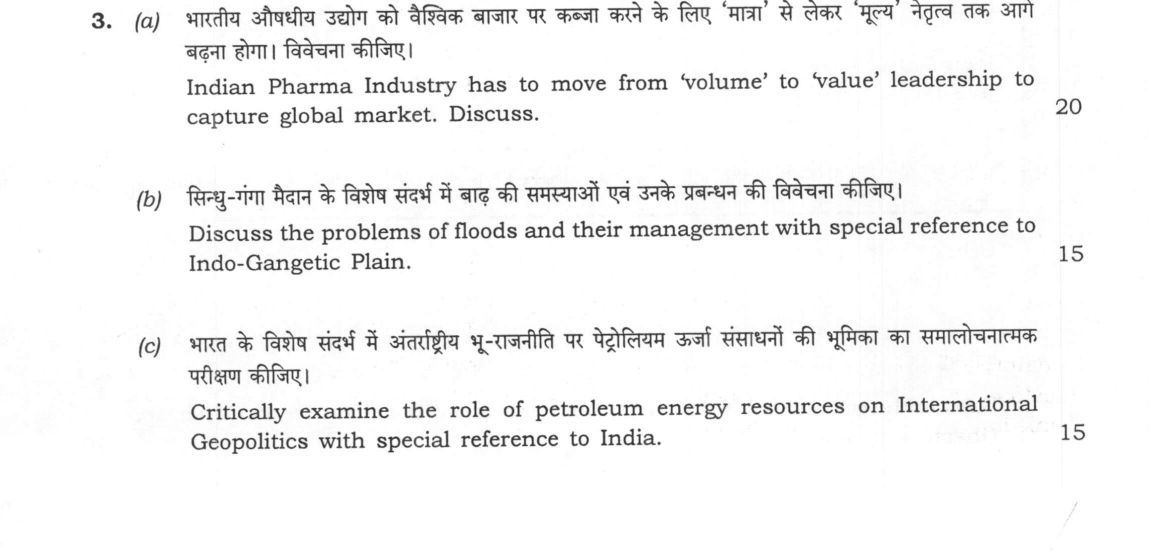
(a) Indian Pharma Industry has to move from 'volume' to 'value' leadership to capture global market. Discuss. 20 (b) Discuss the…
Indian Pharma Industry has to move from 'volume' to 'value' leadership to capture global market. Discuss. 20 marks
Discuss the problems of floods and their management with special reference to Indo-Gangetic Plain. 15 marks
Critically examine the role of petroleum energy resources on International Geopolitics with special reference to India. 15 marks
हिंदी में प्रश्न पढ़ें
भारतीय औषधीय उद्योग को वैश्विक बाजार पर कब्जा करने के लिए 'मात्रा' से लेकर 'मूल्य' नेतृत्व तक आगे बढ़ना होगा। विवेचना कीजिए। 20
सिंधु-गंगा मैदान के विशेष संदर्भ में बाढ़ की समस्याओं एवं उनके प्रबंधन की विवेचना कीजिए। 15
भारत के विशेष संदर्भ में अंतर्राष्ट्रीय भू-राजनीति पर पेट्रोलियम ऊर्जा संसाधनों की भूमिका का समालोचनात्मक परीक्षण कीजिए। 15
Model answer
Written by UPSC Answer Check against this question's marking rubric, to the expected length. UPSC does not publish answers for Mains — this is one way to score well, not an official key.
Part (a): From volume to value India’s pharmaceutical strength is visible in volume: it supplies about 40% of the US generic-drug supply and around 60% of global vaccines, yet much of this is low-margin, me-too generics. The shift to value leadership means moving up the chain into patented drugs, biosimilars, complex APIs, and globally regulated high-value products. The deficit is structural. India remains dependent on China for about 68% of API imports, exposing supply chains to price shocks, geopolitical risk, and quality variability. R&D gaps and regulatory hurdles—reflected in repeated FDA/EMA warnings and import alerts—show that quality systems must match global standards. The PLI Scheme 2.0, innovation clusters in Hyderabad and Ahmedabad, and Atmanirbhar Bharat policy are attempts to build domestic API, formulation, and R&D ecosystems. Spatially, value creation is uneven: southern and western hubs have stronger R&D and biotech linkages, while northern and eastern regions often remain formulation- or API-intensive. This is not merely a commercial upgrade; it is a question of whether India can capture global market share in high-value therapeutics. Without deeper innovation, India will remain a large supplier of cheap molecules rather than a leader in value.
Part (b): Floods in the Indo-Gangetic Plain Floods in the IGP are not one hazard. Riverine flooding in the Ganga-Yamuna belt, flash floods from foothill catchments, and urban waterlogging in cities such as Kanpur and Patna interact. Natural causes—monsoon variability, snowmelt, and flat alluvial topography—are aggravated by anthropogenic factors: embankment breaches, floodplain encroachment, siltation, and altered river regimes. The Farakka barrage affects flow and sedimentation downstream, while Bihar’s Kosi embankments have repeatedly failed, showing that hard structures alone are insufficient. UP’s Rapti basin illustrates the need for flood forecasting and early warning. Management must combine structural measures—levees, flood-retention basins, drainage—with non-structural measures: NDMA guidelines, flood-risk zoning, wetland restoration, and the National Flood Risk Mitigation Framework. Because the IGP is India’s food bowl, recurrent floods undermine agro-economic stability and food security, making flood management a development issue, not merely a disaster issue. The plain’s dense population and intensive agriculture make every flood a livelihood and food-security shock.
Part (c): Petroleum and international geopolitics Petroleum remains a core variable in international geopolitics because it links energy security, trade routes, and state power. OPEC+ production cuts can move global prices, while the Strait of Hormuz, through which about 20% of global oil passes, is a chokepoint whose disruption would affect India’s imports. India’s vulnerability is high: about 85% of its crude oil is imported. The Russia-Ukraine war showed both risk and opportunity: India gained discounted Russian crude, but also faced sanctions, shipping, and payment complexities. Strategic petroleum reserves at Visakhapatnam, Mangalore, and Padur provide limited buffer capacity, but India still needs diversified sources. Its energy diplomacy—Chabahar with Iran, engagement with US shale producers, and a West Asian pivot—aims to reduce dependence on any single supplier or route. Yet transition tensions persist: net-zero commitments, the National Biofuel Policy, and renewable expansion compete with continued oil demand. A critical reading shows that petroleum is not only an economic input but a maritime and diplomatic lever, and India’s security depends on balancing imports, reserves, diplomacy, and transition. Maritime geography therefore shapes India’s energy security as much as domestic demand.
Way forward The three issues are linked by resource security and spatial vulnerability. Pharma value leadership requires R&D, API self-reliance, and regulatory trust. Flood management requires integrated river-basin planning and climate-resilient IGP development. Energy security requires diversification, strategic reserves, and a credible transition. Together they point to a broader need: India must convert scale into quality, hazard exposure into resilience, and import dependence into strategic autonomy.
What "Discuss" is asking you to do
Lay the issue out from more than one side — how it arose, what is claimed for it, what is held against it, and where it now stands. UPSC attaches discuss to broad topics with several live dimensions, so coverage of the dimensions earns more than the strength of your opinion.
Structure that answers it
Set the issue up → the case as it is made → the case against → the dimension both sides leave out → where the balance now lies
Where marks are lost
Listing facts with no thread between them, or arguing one side throughout and calling it a discussion.
How this answer will be evaluated
Approach
Framework: Concept or mechanism > Diagram > Regional example > Application. (a) discuss: intro > 3-4 dimensions > example > balanced close | (b) discuss: intro > 3-4 dimensions > example > balanced close | (c) examine: intro > how/why with reasoning > evidence > conclusion Full marks: Clear causal chains, precise regional examples, and effective use of diagrams/data.
Key points expected
- Define 'volume' vs 'value' leadership in pharma context
- Identify current reliance on generics and API imports
- Explain the mechanism of value addition (R&D, IP, biologics)
- Link value leadership to global market capture
- Identify physical causes of floods in Indo-Gangetic Plain
- Explain the mechanism of flood generation (monsoon, snowmelt)
- Discuss specific management strategies (dams, embankments, urban planning)
- Link physical causes to human consequences (displacement, economic loss)
Evaluation rubric
Each sub-part is marked on its own, against the marks and word limit printed on the paper.
- (a) Explain the shift from volume to value leadership in Indian pharma for global capture. 20 marks
discuss— intro → 3-4 dimensions → example → balanced close
Must cover
- Define 'volume' vs 'value' leadership in pharma context
- Identify current reliance on generics and API imports
- Explain the mechanism of value addition (R&D, IP, biologics)
- Link value leadership to global market capture
Loses marks
- Generic description of pharma industry without 'value' focus
- Ignoring the 'global market' aspect of the question
Earns more
- Mention specific global market segments (biologics, vaccines)
- Reference PLI scheme or specific policy interventions
- Compare with global leaders (US, EU, Japan)
Extra mark
- Cite specific recent data on pharma exports
- Name a specific Indian company's value shift strategy
- (b) Analyze flood problems and management strategies in the Indo-Gangetic Plain. 15 marks
discuss— intro → 3-4 dimensions → example → balanced close
Must cover
- Identify physical causes of floods in Indo-Gangetic Plain
- Explain the mechanism of flood generation (monsoon, snowmelt)
- Discuss specific management strategies (dams, embankments, urban planning)
- Link physical causes to human consequences (displacement, economic loss)
Loses marks
- Description of floods without explaining the mechanism
- Ignoring the 'management' aspect of the question
Earns more
- Mention specific dams (Tehri, Bhakra) or embankments
- Reference recent flood events (e.g., 2021 Bihar floods)
- Discuss the role of river interlinking or flood forecasting
Extra mark
- Include a labelled sketch map of the Indo-Gangetic Plain
- Cite specific census data on flood-affected population
- (c) Critically analyze the role of petroleum resources in international geopolitics, focusing on India. 15 marks
examine— intro → how/why with reasoning → evidence → conclusion
Must cover
- Explain the geopolitical significance of petroleum resources
- Analyze India's dependence on imported petroleum
- Discuss India's strategies to secure energy (diversification, diplomacy)
- Link petroleum resources to international power dynamics
Loses marks
- Generic discussion of energy without 'geopolitical' focus
- Ignoring the 'special reference to India' requirement
Earns more
- Mention specific energy partnerships (e.g., India-Russia, India-Oman)
- Reference the role of OPEC or specific geopolitical events
- Discuss India's renewable energy transition as a geopolitical tool
Extra mark
- Cite specific data on India's petroleum import dependence
- Name a specific geopolitical conflict related to petroleum
Practice this exact question
Write your answer and it is marked point by point against the model answer above — what you covered, what you missed, what you got wrong.
Evaluate my answer →More from Geography 2023 Paper II
- Q1 (a) On the outline map of India provided to you, mark the location of all of the followin…
- Q2 (a) Examine the environmental challenges caused by the solid waste in metropolitan region…
- Q3 (a) Indian Pharma Industry has to move from 'volume' to 'value' leadership to capture glo…
- Q4 (a) With falling fertility rate and rising median age, how can India translate demographi…
- Q5 Answer the following questions in about 150 words each: 10×5=50 (a) Identify the jute-pro…
- Q6 (a) A large number of Indian cities have a complex morphological characteristics due to t…