Paper II — Q2
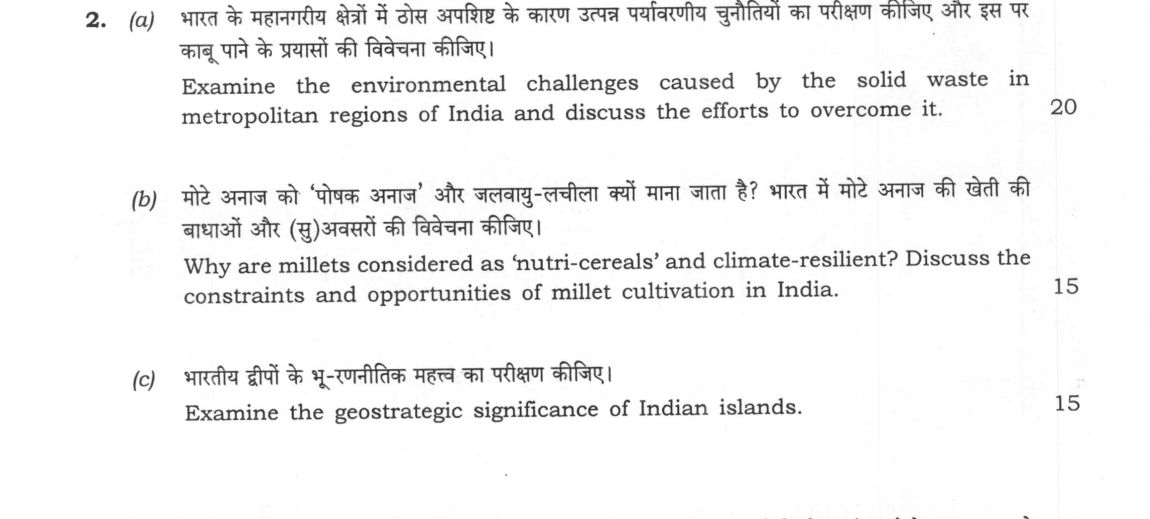
(a) Examine the environmental challenges caused by the solid waste in metropolitan regions of India and discuss the efforts to…
Examine the environmental challenges caused by the solid waste in metropolitan regions of India and discuss the efforts to overcome it. 20 marks
Why are millets considered as 'nutri-cereals' and climate-resilient? Discuss the constraints and opportunities of millet cultivation in India. 15 marks
Examine the geostrategic significance of Indian islands. 15 marks
हिंदी में प्रश्न पढ़ें
भारत के महानगरीय क्षेत्रों में ठोस अपशिष्ट के कारण उत्पन्न पर्यावरणीय चुनौतियों का परीक्षण कीजिए और इस पर काबू पाने के प्रयासों की विवेचना कीजिए। 20
मोटे अनाज को 'पोषक अनाज' और जलवायु-लचीला क्यों माना जाता है? भारत में मोटे अनाज की खेती की बाधाओं और (सु)अवसरों की विवेचना कीजिए। 15
भारतीय द्वीपों के भू-रणनीतिक महत्व का परीक्षण कीजिए। 15
Model answer
Written by UPSC Answer Check against this question's marking rubric, to the expected length. UPSC does not publish answers for Mains — this is one way to score well, not an official key.
India’s environmental geography is shaped by the interaction of urban metabolism, agricultural ecology, and maritime space. Metropolitan waste, millet systems, and island territories each reveal how resource use and territorial reach determine sustainability and security.
Metropolitan solid waste. Indian metropolitan regions produce heterogeneous waste, typically 50–60% biodegradable and 8–10% plastic, with the balance including paper, glass, metal and construction debris. Because metropolitan areas concentrate population, consumption and industry, even modest mismanagement has large environmental effects. The challenge is not merely volume but poor handling: open dumping generates leachate that contaminates groundwater, while anaerobic decomposition releases methane and causes landfill fires. Delhi’s Okhla and Ghazipur landfills have repeatedly caught fire, showing how unsegregated waste and poor closure create public-health and climate risks. The Solid Waste Management Rules, 2016 require source segregation, processing, biomining of old landfills and C&D waste processing, but implementation remains uneven. Many cities lack material-recovery facilities, biomining is patchy, and C&D waste is often dumped rather than recycled. Biomining can convert old organic waste into compost and biogas, reducing methane, while C&D processing can supply construction material and reduce landfill pressure. Yet positive models exist. Indore’s community-led segregation and processing have made it a seven-time cleanest city, while Surat’s landfill mining shows that old dumps can be treated as resources. Swachh Bharat Mission-Urban 2.0 strengthens this by shifting focus from cleanliness to waste processing, circularity and citizen participation. Source segregation also reduces the quantity entering landfills and improves recycling of plastics, paper and metals, making waste management more circular.
Millets as nutri-cereals. Millets are called nutri-cereals because they combine staple value with micronutrients: high protein (about 11%), calcium, iron, fiber, low glycemic index and gluten-free status, making them useful for diabetes, celiac and nutritionally vulnerable populations. They are climate-resilient because many are C4 crops with high water-use efficiency, drought tolerance, low input needs and short growing periods of 60–90 days, allowing cultivation in rainfed and marginal lands. This makes them suitable for heat-stressed, low-fertility regions where rice and wheat may be less reliable. Constraints include low yields, limited MSP procurement, weak processing and branding infrastructure, and changing dietary preferences toward wheat and rice. Opportunities are substantial: the UN International Year of Millets 2023 raised global visibility; state millet missions in Karnataka, Odisha and Madhya Pradesh are expanding area and value chains; and exports to Africa and the Middle East can diversify India’s food trade. Better milling, packaging, market access and farmer support can convert nutritional advantage into income and dietary change. Millet missions can also strengthen rural livelihoods and reduce dependence on water-intensive cereals.
Geostrategic significance of Indian islands. The Andaman and Nicobar Islands control the Six Degree Channel, a potential alternative to the Malacca Strait, and host INS Baaz and a tri-service command, enabling surveillance, rapid response and deterrence against the Chinese “String of Pearls”. Lakshadweep secures the Nine Degree Channel, with Minicoy’s proximity to the Maldives giving India a forward maritime presence in the Indian Ocean. Its waters also hold potential seabed resources. As India-China maritime competition intensifies, these islands help India project power, protect sea lanes and monitor activity beyond the first island chain. They also provide early warning, logistics and communication support for the Navy and Coast Guard, extending India’s ability to secure its maritime approaches. Their location near major shipping routes makes them important for monitoring commercial and military traffic.
In sum, metropolitan waste management, millet cultivation and island geostrategy are linked tests of Indian statecraft: sustainable cities require circular waste systems, food security requires climate-smart crops, and maritime power requires forward island bases. A coherent policy combining urban sustainability, agricultural resilience and maritime security is essential for India’s long-term development.
What "Examine" is asking you to do
Test the proposition the question puts to you and return a finding on how far it holds. Examine stems carry a claim, or ask whether something has happened, and expect evidence weighed both ways before the extent is stated — often with remedial measures attached.
Structure that answers it
Restate the claim as the question frames it → evidence that supports it → evidence that undercuts it → the conditions under which it holds → verdict on how far it stands
Where marks are lost
Stopping at description. An examination has to reach a finding, and “examine with justification” means the extent must be stated, not implied.
How this answer will be evaluated
Approach
Framework: Concept or mechanism > Diagram > Regional example > Application. (a) examine: intro > how/why with reasoning > evidence > conclusion | (b) discuss: intro > 3-4 dimensions > example > balanced close | (c) examine: intro > how/why with reasoning > evidence > conclusion Full marks: Clear mechanism, precise Indian examples, labelled diagram, balanced discussion.
Key points expected
- Mechanism of environmental degradation (leachate, GHG, air)
- Specific challenges in metropolitan regions (space, volume)
- Efforts to overcome (policy, tech, segregation)
- Link physical cause to human consequence
- Reasons for 'nutri-cereal' status (nutrients)
- Reasons for 'climate-resilient' status (drought/heat)
- Constraints of cultivation in India
- Opportunities of cultivation in India
Evaluation rubric
Each sub-part is marked on its own, against the marks and word limit printed on the paper.
- (a) Examine environmental challenges of solid waste in Indian metros and discuss efforts to overcome them. 20 marks
examine— intro → how/why with reasoning → evidence → conclusion
Must cover
- Mechanism of environmental degradation (leachate, GHG, air)
- Specific challenges in metropolitan regions (space, volume)
- Efforts to overcome (policy, tech, segregation)
- Link physical cause to human consequence
Loses marks
- Description without mechanism
- Generic points not specific to metros
- No diagram or map
Earns more
- Mention of SWM Rules 2016
- Specific metro examples (Delhi, Mumbai, Bengaluru)
- Diagram of waste management cycle
- Mention of specific technologies (plasma, composting)
Extra mark
- Labelled sketch map of a metro waste site
- Recent data on waste generation in metros
- (b) Explain why millets are nutri-cereals/climate-resilient and discuss constraints/opportunities. 15 marks
discuss— intro → 3-4 dimensions → example → balanced close
Must cover
- Reasons for 'nutri-cereal' status (nutrients)
- Reasons for 'climate-resilient' status (drought/heat)
- Constraints of cultivation in India
- Opportunities of cultivation in India
Loses marks
- Only listing millets without explaining 'why'
- Ignoring the 'constraints' or 'opportunities' part
- No link to climate resilience
Earns more
- Mention of specific millets (Jowar, Bajra, Ragi)
- Link to IY2023 (International Year of Millets)
- Regional examples of cultivation
- Diagram of millet lifecycle or nutrient profile
Extra mark
- Specific data on millet yield or nutrition
- Mention of specific government schemes for millets
- (c) Examine the geostrategic significance of Indian islands. 15 marks
examine— intro → how/why with reasoning → evidence → conclusion
Must cover
- Geostrategic significance (maritime security, trade)
- Specific islands (Andaman, Lakshadweep, Nicobar)
- Link to Indian Ocean Region (IOR) strategy
- Reasoning for their importance
Loses marks
- General talk about islands without geostrategic focus
- Ignoring specific Indian islands
- No map or diagram
Earns more
- Mention of specific bases or facilities
- Link to China's 'String of Pearls'
- Diagram/map of Indian islands in IOR
- Mention of EEZ (Exclusive Economic Zone)
Extra mark
- Labelled sketch map of Indian islands
- Recent geopolitical event involving Indian islands
Practice this exact question
Write your answer and it is marked point by point against the model answer above — what you covered, what you missed, what you got wrong.
Evaluate my answer →More from Geography 2023 Paper II
- Q1 (a) On the outline map of India provided to you, mark the location of all of the followin…
- Q2 (a) Examine the environmental challenges caused by the solid waste in metropolitan region…
- Q3 (a) Indian Pharma Industry has to move from 'volume' to 'value' leadership to capture glo…
- Q4 (a) With falling fertility rate and rising median age, how can India translate demographi…
- Q5 Answer the following questions in about 150 words each: 10×5=50 (a) Identify the jute-pro…