Paper I — Q1
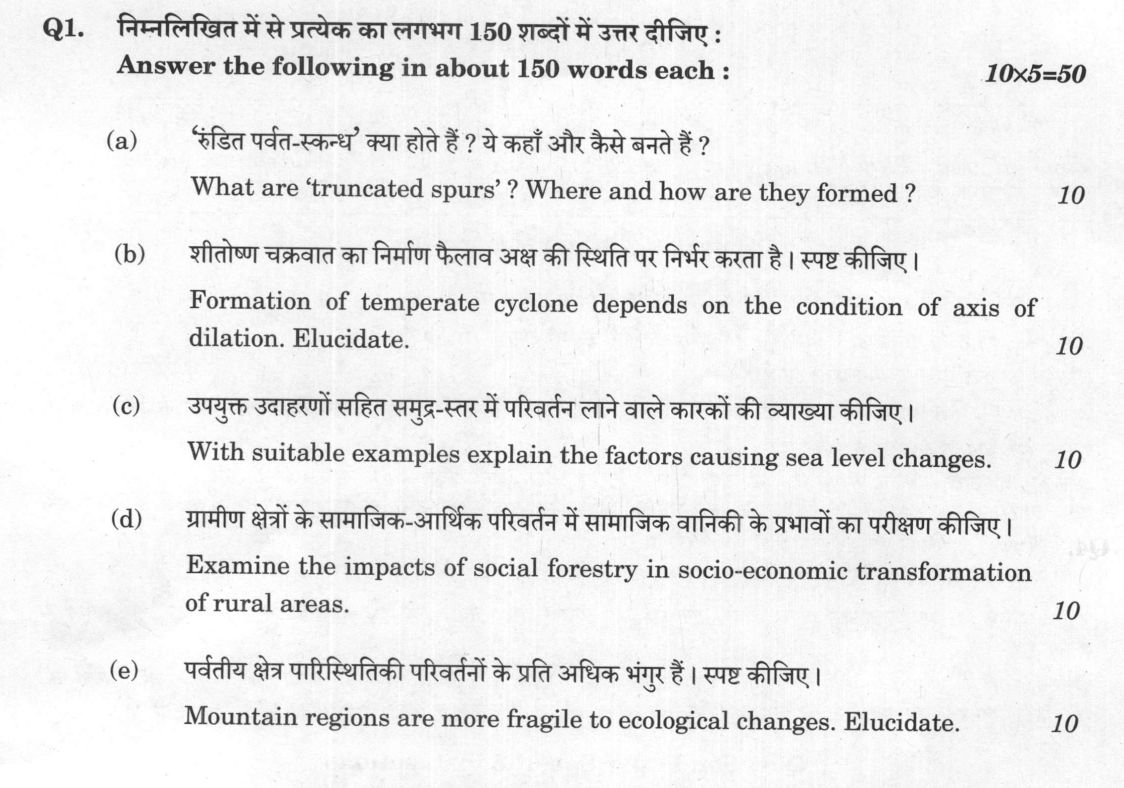
Answer the following in about 150 words each : 10×5=50 (a) What are 'truncated spurs' ? Where and how are they formed ? 10 (b)…
Answer the following in about 150 words each : 10×5=50
What are 'truncated spurs' ? Where and how are they formed ? 10 marks
Formation of temperate cyclone depends on the condition of axis of dilation. Elucidate. 10 marks
With suitable examples explain the factors causing sea level changes. 10 marks
Examine the impacts of social forestry in socio-economic transformation of rural areas. 10 marks
Mountain regions are more fragile to ecological changes. Elucidate. 10 marks
हिंदी में प्रश्न पढ़ें
निम्नलिखित में से प्रत्येक का लगभग 150 शब्दों में उत्तर दीजिए :
'छिन्नित पर्वत-स्कन्ध' क्या होते हैं ? ये कहाँ और कैसे बनते हैं ? 10 marks
शीतोष्ण चक्रवात का निर्माण फैलाव अक्ष की स्थिति पर निर्भर करता है । स्पष्ट कीजिए । 10
उपयुक्त उदाहरणों सहित समुद्र-स्तर में परिवर्तन लाने वाले कारकों की व्याख्या कीजिए । 10
ग्रामीण क्षेत्रों के सामाजिक-आर्थिक परिवर्तन में सामाजिक वानिकी के प्रभावों का परीक्षण कीजिए । 10
पर्वतीय क्षेत्र पारिस्थितिकी परिवर्तनों के प्रति अधिक भंगुर हैं । स्पष्ट कीजिए । 10
Model answer
Written by UPSC Answer Check against this question's marking rubric, to the 150-word length. UPSC does not publish answers for Mains — this is one way to score well, not an official key.
(a) Truncated Spurs
Truncated spurs are steep-sided, triangular bedrock facets along glacial valley walls, formed where the lower ends of pre-existing interlocking river spurs have been sheared off. In pre-glacial landscapes, fluvial erosion creates V-shaped valleys characterized by overlapping interlocking spurs. When climatic cooling initiates valley glaciation, glaciers fill these channels. Because ice is a rigid, high-viscosity body, valley glaciers cannot easily meander around sinuous bends. Instead, through intense basal and lateral glacial erosion—predominantly plucking and striating abrasion—the glacier bulldozes and planes down the projecting rock spurs. This process widens and straightens the valley floor into a characteristic flat-bottomed, steep-walled U-shaped glacial trough. Outstanding examples occur in glaciated Alpine valleys such as the Lauterbrunnen Valley in Switzerland and the upper glaciated reaches of the Bhagirathi-Gangotri valley in the Uttarakhand Himalayas. Geomorphologically, truncated spurs serve as diagnostic evidence of past glacial valley modification and Pleistocene ice advancement.
(b) Axis of Dilation and Temperate Cyclogenesis
Temperate cyclogenesis relies fundamentally on frontogenesis—the spatial intensification of horizontal thermal gradients between contrasting air masses—which is governed by the atmospheric deformation wind field. In kinematic frontogenesis theory, deformation contains an axis of contraction (along which air compresses) and an axis of dilation (the axis of maximum horizontal stretching). When cold polar air and warm subtropical air collide, frontogenesis occurs efficiently only if the isotherms lie at an angle of less than 45 degrees to the axis of dilation. The deformation wind field stretches and aligns the isotherms parallel to this dilation axis, concentrating the thermal gradient into a sharp, narrow discontinuity. As elucidated in the Bjerknes Polar Front Theory, this intensified thermal contrast destabilizes the boundary, creating an embryonic low-pressure wave. As warm air converges and ascends along the tilted frontal surface while cold air undercuts it, cyclonic vorticity develops. If the axis of dilation is misaligned, frontolysis occurs, preventing temperate cyclone formation.
(c) Factors Causing Sea Level Changes
Sea level changes result from the interplay of global eustatic processes and localized isostatic or tectonic adjustments. Eustatic changes represent absolute variations in ocean volume and basin capacity driven by climate dynamics. Glacio-eustasy involves the freezing or melting of terrestrial ice sheets; during glacial periods, ocean levels drop, whereas interglacial deglaciation causes global transgressions. Thermal expansion (steric effect) further expands ocean water volume as sea surface temperatures rise. According to the IPCC Sixth Assessment Report (AR6), global mean sea levels are currently rising at approximately 3.7 mm per year, driven primarily by thermal expansion and cryospheric melt in Greenland and Antarctica. Conversely, isostatic factors represent local vertical crustal movements. Post-glacial isostatic rebound in Scandinavia and the Hudson Bay causes relative sea levels to fall, while deltaic sediment loading and tectonic subsidence in the Bengal Delta cause relative local sea level rise. Tectonic seafloor spreading rates over geological timescales also alter basin capacity.
(d) Social Forestry and Rural Transformation
Formalized through the National Commission on Agriculture (1976), social forestry drives rural socio-economic transformation by promoting afforestation on non-forest lands, including village commons, panchayat lands, and farm boundaries. It directly resolves rural energy and biomass deficits by securing local fuelwood, fodder, and small timber availability, thereby preventing deforestation of natural forests. Economically, social forestry creates rural livelihood diversification. The landmark Arabari experiment in West Bengal laid the groundwork for Joint Forest Management (JFM), demonstrating that granting local communities usufructuary rights over non-timber forest products (NTFPs) generates steady income and reduces poverty. Socially, institutional arrangements like Van Panchayats and Women Self-Help Groups (SHGs) have fostered gender empowerment by reducing women's daily drudgery in fuelwood collection and involving them in nursery enterprise management. In Gujarat, strip plantations and farm forestry converted degraded wastelands into income-generating agroforestry assets, enhancing rural ecological and economic resilience.
(e) Fragility of Mountain Regions to Ecological Changes
Mountain ecosystems possess exceptional ecological fragility arising from high relief energy, steep gravitational slopes, structural-tectonic instability, and thin, weakly developed topsoils vulnerable to accelerated mass wasting. A defining characteristic of mountain ecology is vertical zonation, where distinct climatic, floral, and faunal belts are compressed into narrow altitudinal bands. Because these ecological niches are tightly bound to specific micro-climates, even minor temperature or precipitation shifts disrupt habitat continuity, forcing endemic species into higher elevations—the "escalator to extinction" effect. Furthermore, Elevation-Dependent Warming (EDW) amplifies global warming at high altitudes, accelerating cryospheric degradation. In the Indian Himalayan Region, rapid glacial retreat and permafrost thawing increase the frequency of catastrophic Glacial Lake Outburst Floods (GLOFs) and debris flows, as witnessed in the Chamoli and South Lhonak Lake disasters. Anthropogenic interventions like slope-destabilizing infrastructure exacerbate these baseline vulnerabilities, illustrating that mountain regions require low-impact, ecologically aligned development strategies.
What "Elucidate" is asking you to do
Make a stated proposition plain and then prove it with instances. Elucidate stems almost always carry a claim or a named concept, and very often the words “with examples” or “with suitable diagrams” — the illustration is part of the directive, not decoration.
Structure that answers it
Plain-language statement of what the proposition means → the part that is obscure, resolved → first illustration → second illustration → why the proposition holds
Where marks are lost
Adding terminology; elucidate rewards removing it. The commoner loss is a clean explanation with no example, when the stem asked for examples.
How this answer will be evaluated
Approach
Framework: Concept or mechanism > Diagram > Regional example > Application. (a) explain: definition/context > points in order > small example > short close | (b) explain: definition/context > points in order > small example > short close | (c) explain: definition/context > points in order > small example > short close | (d) examine: intro > how/why with reasoning > evidence > conclusion | (e) explain: definition/context > points in order > small example > short close Full marks: Clear mechanism, precise examples, labelled diagram, strong application
Key points expected
- Definition of truncated spur
- Mechanism of formation (river capture/erosion)
- Location (meandering rivers)
- Diagram of formation process
- Definition of axis of dilation
- Mechanism of cyclone formation
- Role of polar front
- Diagram of cyclone structure
Evaluation rubric
Each sub-part is marked on its own, against the marks and word limit printed on the paper.
- (a) Define truncated spurs and explain their formation process and location. 10 marks · 150 words
explain— definition/context → points in order → small example → short close
Must cover
- Definition of truncated spur
- Mechanism of formation (river capture/erosion)
- Location (meandering rivers)
- Diagram of formation process
Loses marks
- Description without mechanism
- Confusing with other landforms
Earns more
- Mention of oxbow lake formation
- Specific river example (e.g., Ganga, Mississippi)
Extra mark
- Labelled sketch map of a specific river bend
- (b) Explain how the axis of dilation condition affects temperate cyclone formation. 10 marks · 150 words
explain— definition/context → points in order → small example → short close
Must cover
- Definition of axis of dilation
- Mechanism of cyclone formation
- Role of polar front
- Diagram of cyclone structure
Loses marks
- Description without mechanism
- Confusing with tropical cyclones
Earns more
- Mention of baroclinic zone
- Specific region example (e.g., North Atlantic)
Extra mark
- Labelled sketch map of polar front cyclone
- (c) Explain factors causing sea level changes with suitable examples. 10 marks · 150 words
explain— definition/context → points in order → small example → short close
Must cover
- Definition of sea level change
- Mechanism of thermal expansion
- Mechanism of ice melt
- Examples of specific sea level changes
Loses marks
- Description without mechanism
- Confusing with tides
Earns more
- Mention of glacial isostatic adjustment
- Specific location example (e.g., Maldives, Netherlands)
Extra mark
- Labelled sketch map of sea level rise
- (d) Examine impacts of social forestry in socio-economic transformation of rural areas. 10 marks · 150 words
examine— intro → how/why with reasoning → evidence → conclusion
Must cover
- Definition of social forestry
- Socio-economic impacts (income, employment)
- Environmental benefits
- Specific rural area example
Loses marks
- Description without mechanism
- Confusing with other forestry types
Earns more
- Mention of specific social forestry program
- Specific village or district example
Extra mark
- Labelled sketch map of social forestry project
- (e) Explain why mountain regions are more fragile to ecological changes. 10 marks · 150 words
explain— definition/context → points in order → small example → short close
Must cover
- Definition of ecological fragility
- Mechanism of vulnerability (steep slopes, thin soils)
- Specific mountain region example
- Diagram of ecological fragility
Loses marks
- Description without mechanism
- Confusing with other fragile ecosystems
Earns more
- Mention of specific ecological change (e.g., deforestation, climate change)
- Specific mountain range example (e.g., Himalayas, Andes)
Extra mark
- Labelled sketch map of mountain ecological fragility
Practice this exact question
Write your answer and it is marked point by point against the model answer above — what you covered, what you missed, what you got wrong.
Evaluate my answer →More from Geography 2024 Paper I
- Q1 Answer the following in about 150 words each : 10×5=50 (a) What are 'truncated spurs' ? W…
- Q2 (a) Examine the recent views on mountain building process and divide the world mountains…
- Q3 (a) Explain air masses and associated weather dynamics. How do air masses influence the w…
- Q4 (a) How is carbon neutrality essential for future environmental conservation ? Describe v…