Paper I — Q6
(a) The urbanisation process is particularly pronounced in Asia and Africa, where too many urban residents grapple with extreme…
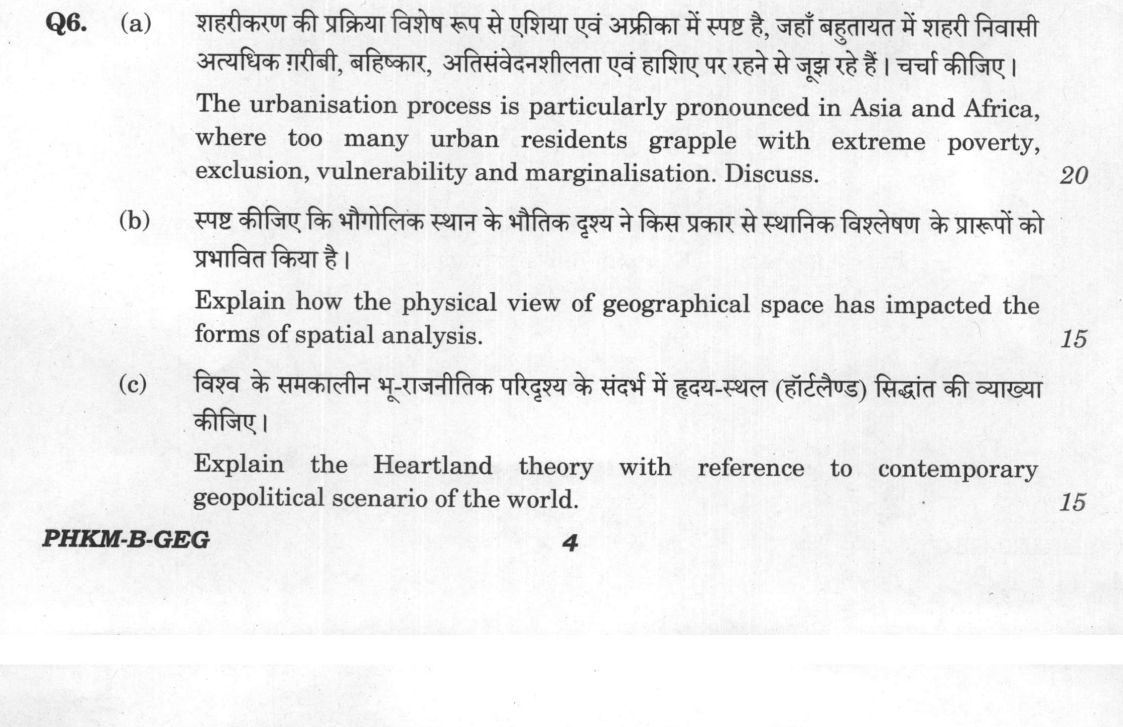
The urbanisation process is particularly pronounced in Asia and Africa, where too many urban residents grapple with extreme poverty, exclusion, vulnerability and marginalisation. Discuss. 20 marks
Explain how the physical view of geographical space has impacted the forms of spatial analysis. 15 marks
Explain the Heartland theory with reference to contemporary geopolitical scenario of the world. 15 marks
हिंदी में प्रश्न पढ़ें
शहरीकरण की प्रक्रिया विशेष रूप से एशिया एवं अफ्रीका में स्पष्ट है, जहाँ बहुतायत में शहरी निवासी अत्यधिक गरीबी, बहिष्कार, अतिसंवेदनशीलता एवं हाशिए पर रहने से जूझ रहे हैं। चर्चा कीजिए। 20
स्पष्ट कीजिए कि भौगोलिक स्थान के भौतिक दृश्य ने किस प्रकार से स्थानिक विश्लेषण के प्रारूपों को प्रभावित किया है। 15
विश्व के समकालीन भू-राजनीतिक परिदृश्य के संदर्भ में हृदय-स्थल (हार्टलैंड) सिद्धांत की व्याख्या कीजिए। 15
Model answer
Written by UPSC Answer Check against this question's marking rubric, to the expected length. UPSC does not publish answers for Mains — this is one way to score well, not an official key.
Contemporary urbanisation is disproportionately concentrated in the Global South, shifting global demographic weight toward Asia and Africa. In both continents, rapid demographic transitions and agrarian distress drive rural-to-urban migration, creating hyper-urbanisation and primate city dominance without commensurate industrialisation. According to UN-Habitat and World Bank reports, over 50% of Sub-Saharan Africa's urban population and over 30% of Asia's reside in informal settlements, characterised by high economic informality, tenure insecurity, and deficits in water, sanitation, and electricity. Urban poverty intersects with social exclusion along caste, ethnic, and gender lines, resulting in sharp spatial segregation and governance deficits. Mega-cities like Dhaka, Lagos, and Mumbai face compounding vulnerabilities to climate shocks—urban heat islands, flooding, and sea-level rise—alongside public health crises. However, the trajectory varies: Asian urbanisation features prominent state-led interventions—such as China’s hukou system regulating migration and India’s Smart Cities Mission and Pradhan Mantri Awas Yojana—whereas African urbanisation has largely unfolded amid post-structural adjustment deregulation, weak municipal planning, and uncontrolled peri-urban sprawl.
Physical View of Space and Spatial Analysis
The conceptualisation of geographical space has directly dictated the evolution of analytical paradigms. Space was traditionally viewed as absolute space—a fixed, neutral Cartesian container grounded in Newtonian physics. This physicalist perspective framed classical chorology and regional inventory. During the Quantitative Revolution, this container view enabled positivist spatial science, reducing geographical phenomena to geometric properties, isotropic planes, and distance-decay functions in gravity and spatial interaction models, which form the bedrock of modern GIScience and spatial statistics.
Critiques of this rigid physicalism prompted the adoption of relative space (Einsteinian, measured in relational time-cost metrics) and relational space (Henri Lefebvre’s produced space, Edward Soja’s thirdspace). Recognizing space as socially produced rather than a passive physical background enabled the rise of behavioural geography, which analysed cognitive mapping and perception. It also catalyzed Marxist political economy, notably David Harvey's analysis of spatial fixes in capital accumulation, as well as post-structuralist, feminist, and post-colonial geographies that scrutinize power asymmetries, spatial justice, and lived experience.
Heartland Theory in Contemporary Geopolitics
Halford Mackinder’s Heartland Theory (1904) posited that the pivot area of Eurasia, inaccessible to maritime power, formed the primary fortress of terrestrial dominance, bordered by the Inner (Rimland) and Outer Crescents. His closed heartland thesis argued that controlling Eastern Europe enabled control of the Heartland, the World-Island, and ultimately global hegemony.
In contemporary geopolitics, Mackinder's thesis remains evident in the Russia-Ukraine conflict, where Moscow attempts to preserve its strategic buffer and secure access over the Eurasian gateway against NATO’s eastward expansion, which operates as an Atlanticist containment strategy. Simultaneously, China’s Belt and Road Initiative (BRI) builds continental overland transport corridors across Central Asia to consolidate Heartland integration while extending economic reach into the Rimland.
However, Mackinder's strict geographic determinism faces substantial limitations. Nicholas Spykman’s Rimland thesis demonstrated that the littoral margins, rich in resources and population, possess superior geopolitical weight. Modern technological transformations—including intercontinental air power, nuclear deterrence, cyber warfare, and space capabilities—have diminished the physical insularity of the Heartland. Furthermore, the rise of an economically dynamic Indo-Pacific and multipolar maritime alliances (such as the Quad) shifts the fulcrum of global contestation from continental Eurasia to maritime sea lanes.
Addressing these urban vulnerabilities and geopolitical frictions requires transitioning from technocratic, exclusionary spatial planning to inclusive, climate-resilient urban governance, while replacing zero-sum territorial containment with multilateral, rules-based spatial cooperation.
What "Discuss" is asking you to do
Lay the issue out from more than one side — how it arose, what is claimed for it, what is held against it, and where it now stands. UPSC attaches discuss to broad topics with several live dimensions, so coverage of the dimensions earns more than the strength of your opinion.
Structure that answers it
Set the issue up → the case as it is made → the case against → the dimension both sides leave out → where the balance now lies
Where marks are lost
Listing facts with no thread between them, or arguing one side throughout and calling it a discussion.
How this answer will be evaluated
Approach
Framework: Concept or mechanism > Diagram > Regional example > Application. (a) discuss: intro > 3-4 dimensions > example > balanced close | (b) explain: definition/context > points in order > small example > short close | (c) explain: definition/context > points in order > small example > short close Full marks: Comprehensive, well-structured, with specific examples and clear causal links.
Key points expected
- Define rapid urbanization in developing regions
- Link rural-urban migration to slum formation
- Explain institutional exclusion and lack of services
- Provide specific regional examples (e.g., Lagos, Dhaka)
- Define 'physical view' of geographical space
- Explain the concept of 'space as a container'
- Link physical view to specific analysis forms (e.g., distance decay)
- Mention the role of physical features in analysis
Evaluation rubric
Each sub-part is marked on its own, against the marks and word limit printed on the paper.
- (a) Explain the specific drivers of urban poverty and marginalization in Asia and Africa. 20 marks
discuss— intro → 3-4 dimensions → example → balanced close
Must cover
- Define rapid urbanization in developing regions
- Link rural-urban migration to slum formation
- Explain institutional exclusion and lack of services
- Provide specific regional examples (e.g., Lagos, Dhaka)
Loses marks
- General description of urbanization without specific focus on poverty
- Ignoring the specific context of Asia and Africa
- No link between physical growth and social exclusion
Earns more
- Mention 'urbanization without industrialization'
- Reference informal sector dependence
- Discuss climate vulnerability in urban areas
- Cite specific census or UN-Habitat data
Extra mark
- Labelled sketch map of a specific Asian/African city
- Reference to specific policy frameworks (e.g., SDG 11)
- (b) Describe how the physical view of space shapes spatial analysis methods. 15 marks
explain— definition/context → points in order → small example → short close
Must cover
- Define 'physical view' of geographical space
- Explain the concept of 'space as a container'
- Link physical view to specific analysis forms (e.g., distance decay)
- Mention the role of physical features in analysis
Loses marks
- Confusing physical space with social space
- No specific examples of spatial analysis forms
- Vague description without clear causal link
Earns more
- Contrast with 'social construction of space'
- Reference to specific models (e.g., gravity model)
- Discuss the role of GIS in physical spatial analysis
- Mention the concept of 'absolute space'
Extra mark
- Diagram illustrating physical vs. social space
- Reference to specific geographers (e.g., R.D. Soderstrom)
- (c) Explain the Heartland theory and its relevance to current geopolitics. 15 marks
explain— definition/context → points in order → small example → short close
Must cover
- Define the Heartland theory (Mackinder)
- Identify the 'Heartland' region (Eurasia)
- Explain the 'World Island' concept
- Link theory to contemporary geopolitical scenarios (e.g., US-China)
Loses marks
- No clear definition of the Heartland theory
- Failure to link theory to contemporary scenarios
- Confusing Heartland with Rimland
Earns more
- Mention the 'Rimland' theory (Spykman) as a counterpoint
- Reference to specific contemporary events (e.g., Belt and Road Initiative)
- Discuss the role of sea power vs. land power
- Mention the concept of 'pivot area'
Extra mark
- Labelled map of the Heartland region
- Reference to specific contemporary geopolitical analysis
Practice this exact question
Write your answer and it is marked point by point against the model answer above — what you covered, what you missed, what you got wrong.
Evaluate my answer →More from Geography 2024 Paper I
- Q3 (a) Explain air masses and associated weather dynamics. How do air masses influence the w…
- Q4 (a) How is carbon neutrality essential for future environmental conservation ? Describe v…
- Q5 Answer the following in about 150 words each : 10×5=50 (a) Critically examine the signifi…
- Q6 (a) The urbanisation process is particularly pronounced in Asia and Africa, where too man…
- Q7 (a) Explain the basis of D. Whittlesey's classification of agricultural regions of the wo…
- Q8 (a) What is complementary region ? With reference to hierarchy of settlements, describe t…