Paper I — Q3
(a) Explain air masses and associated weather dynamics. How do air masses influence the weather conditions of the Northern…
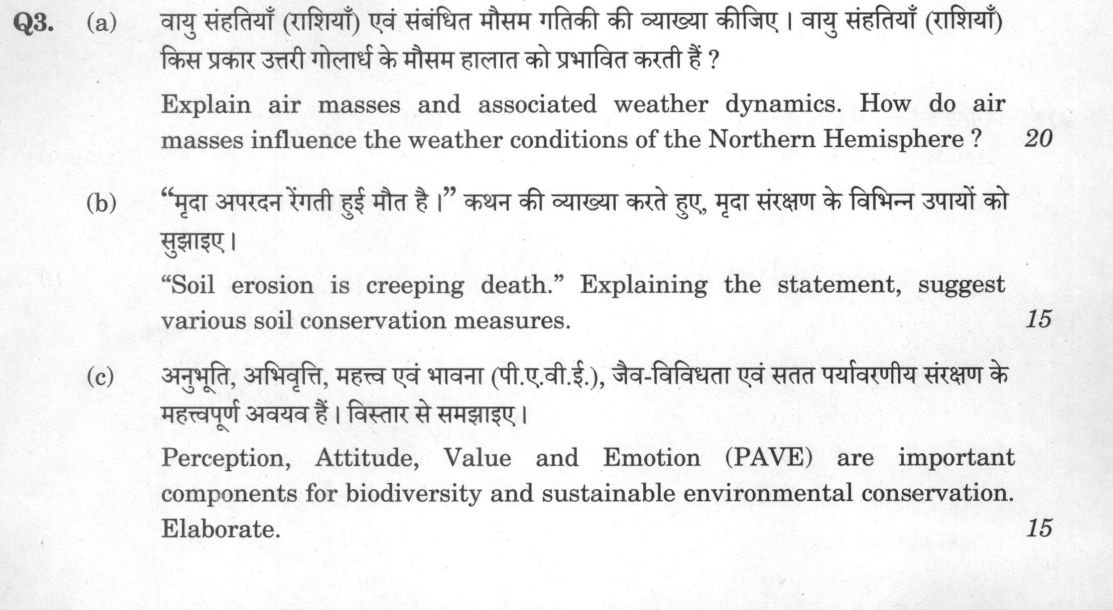
Explain air masses and associated weather dynamics. How do air masses influence the weather conditions of the Northern Hemisphere ? 20 marks
"Soil erosion is creeping death." Explaining the statement, suggest various soil conservation measures. 15 marks
Perception, Attitude, Value and Emotion (PAVE) are important components for biodiversity and sustainable environmental conservation. Elaborate. 15 marks
हिंदी में प्रश्न पढ़ें
वायु संहितियाँ (राशियाँ) एवं संबंधित मौसम गतिकी की व्याख्या कीजिए । वायु संहितियाँ (राशियाँ) किस प्रकार उत्तरी गोलार्ध के मौसम हालात को प्रभावित करती हैं ? 20 marks
"मृदा अपरदन रेंगती हुई मौत है ।" कथन की व्याख्या करते हुए, मृदा संरक्षण के विभिन्न उपायों को सुझाइए । 15
अनुभूति, अभिवृति, महत्व एवं भावना (पी.ए.वी.ई.), जैव-विविधता एवं सतत पर्यावरणीय संरक्षण के महत्वपूर्ण अवयव हैं । विस्तार से समझाइए । 15
Model answer
Written by UPSC Answer Check against this question's marking rubric, to the expected length. UPSC does not publish answers for Mains — this is one way to score well, not an official key.
(a) Air masses and Northern Hemisphere weather Air masses are large, horizontally coherent bodies of air whose temperature and moisture are imprinted by source regions over land or sea. Classification uses latitude—arctic (A), polar (P), tropical (T), equatorial (E)—and surface type—continental (c) or maritime (m). In the Northern Hemisphere the important types are cA, cP, mP, cT, mT and mE; cE is rarely invoked but, where used, denotes hot, dry, unstable air over equatorial land. cA is very cold and dry; cP cold, dry and stable in winter but unstable in summer; mP cool, moist and cloudy; cT hot, dry and unstable; mT warm, moist and unstable; mE warm, moist and unstable. Weather dynamics arise when these masses meet. Thermal contrast along the polar front produces baroclinic zones, frontogenesis, uplift, cloud bands and cyclogenesis. A cross-section would show cold dense air beneath warm moist air, a sloping frontal surface, rising warm air, and a low-pressure centre; this is why fronts are weather-making boundaries. Stable air gives clear, dry weather; unstable air gives convection, thunderstorms and heavy rain. In North America, cP over the Great Lakes causes lake-effect snow, mP Atlantic lows cause nor’easters, and cP descending the Rockies causes chinook winds. In Europe, cP/cA outbreaks from Siberia bring cold waves, while mP and mT produce Atlantic rain, Mediterranean instability and foehn winds. In Asia, cP/cA Siberian air drives winter monsoon, while seasonal ITCZ migration shifts mT and cT masses, producing the Indian monsoon and its breaks.
(b) Soil erosion as creeping death The phrase “creeping death” means erosion is slow, often invisible at first, but cumulative: it strips topsoil, lowers fertility, reduces infiltration, increases runoff, silts reservoirs and can become irreversible once gullies deepen. In India, water erosion occurs as sheet, rill and gully erosion in the Deccan, Western Ghats, Himalayan foothills and red-soil tracts; wind erosion affects arid Rajasthan, Gujarat and the Indo-Gangetic plains; coastal erosion threatens deltas and coasts. A map would show hotspots where slope, rainfall, deforestation and overgrazing combine, especially in the Western Ghats, Deccan, Himalayan foothills and red-soil regions. Conservation must match the process. Mechanical measures include contour bunding, terracing, check dams and gully plugging. Agronomic measures include strip cropping, mulching, crop rotation, cover crops, zero tillage and proper spacing. Biological measures include vegetative cover, grass strips, agroforestry, afforestation and bioengineering with roots. Policy measures include watershed development, soil-health cards, MGNREGA works, forest and land-use regulations, and incentives for sustainable farming.
(c) PAVE and biodiversity conservation Perception is the sensory and cognitive recognition of biodiversity and its decline; attitude is the predisposition to protect or exploit it; value is the instrumental or intrinsic worth assigned to nature; emotion is the affective bond—awe, grief, love—that motivates action. These are interlinked: accurate perception shapes values, values form attitudes, and emotions convert attitudes into behaviour. In India, sacred groves show a value-emotion nexus that has conserved species for generations. Project Tiger changed perception by making tigers visible and politically salient, while Joint Forest Management gave communities a stake, altering attitudes and values. Yet barriers persist: NIMBYism blocks wind farms and protected areas, and shifting baseline syndrome makes people accept degraded ecosystems as normal. Education and citizen science sharpen perception; benefit-sharing and forest rights strengthen attitude; legal recognition of ecological value institutionalises value; emotional campaigns around species loss sustain action. Conservation policy must therefore combine science with communication, education, community participation and ethical framing, so that air-mass and climate knowledge informs land, water and biodiversity planning, and PAVE processes make sustainable conservation socially durable. Thus, climatological insight and social-psychological insight are complementary: one explains the physical forcing, the other the human response needed for durable conservation.
What "Explain" is asking you to do
Make the working of something clear — what sets it off, what follows from what, and what it produces. Explain is the Commission's mechanism word: it dominates the technical papers and the “explain why” stems, where the marks sit in the causal chain and not in the label.
Structure that answers it
State what it is → the initiating condition → the chain of cause, step by step → an instance where it plays out → what the chain produces
Where marks are lost
Describing what something looks like instead of why it works that way. Naming the stages without linking them reads as description too.
How this answer will be evaluated
Approach
Framework: Concept or mechanism > Diagram > Regional example > Application. (a) explain: definition/context > points in order > small example > short close | (b) suggest: the problem in one line > implementable measures > who acts > conclusion | (c) explain: definition/context > points in order > small example > short close Full marks: Comprehensive mechanism, precise examples, clear diagrams, strong causal links.
Key points expected
- Definition of air mass (homogeneity, source region)
- Classification (e.g., cP, mT, cA, mS)
- Mechanism of frontal systems (cold/warm fronts)
- Specific impact on Northern Hemisphere weather patterns
- Explanation of 'creeping death' (slow, irreversible loss)
- Mechanism of erosion (water/wind)
- Specific conservation measures (terracing, contour ploughing)
- Link between erosion and agricultural decline
Evaluation rubric
Each sub-part is marked on its own, against the marks and word limit printed on the paper.
- (a) Define air masses, explain their dynamics, and detail their influence on Northern Hemisphere weather. 20 marks
explain— definition/context → points in order → small example → short close
Must cover
- Definition of air mass (homogeneity, source region)
- Classification (e.g., cP, mT, cA, mS)
- Mechanism of frontal systems (cold/warm fronts)
- Specific impact on Northern Hemisphere weather patterns
Loses marks
- Describing weather without linking to air mass origin
- Confusing air masses with wind belts
- No diagram or visual aid
Earns more
- Labelled diagram of air mass boundaries
- Mention of specific pressure belts (ITCZ, Subtropical)
- Link to seasonal monsoon dynamics
Extra mark
- Sketch map of Northern Hemisphere air mass distribution
- Reference to specific weather events (e.g., polar vortex)
- (b) Explain why soil erosion is 'creeping death' and list conservation measures. 15 marks
suggest— the problem in one line → implementable measures → who acts → conclusion
Must cover
- Explanation of 'creeping death' (slow, irreversible loss)
- Mechanism of erosion (water/wind)
- Specific conservation measures (terracing, contour ploughing)
- Link between erosion and agricultural decline
Loses marks
- Listing measures without explaining the 'death' aspect
- Vague generalities without specific techniques
- Ignoring the 'creeping' (gradual) nature
Earns more
- Mention of topsoil loss rates
- Reference to specific Indian erosion hotspots (e.g., Chambal)
- Distinction between sheet and gully erosion
Extra mark
- Diagram of soil profile showing erosion
- Reference to specific government schemes (e.g., NEP)
- (c) Elaborate on how PAVE components drive biodiversity and environmental conservation. 15 marks
explain— definition/context → points in order → small example → short close
Must cover
- Definition of PAVE components (Perception, Attitude, Value, Emotion)
- Link between perception and environmental awareness
- Role of values in sustainable decision-making
- Connection to biodiversity conservation outcomes
Loses marks
- Defining PAVE without linking to conservation
- Treating PAVE as separate rather than interconnected
- No specific examples of behavioral change
Earns more
- Example of a specific conservation movement
- Reference to psychological models of behavior change
- Link to policy or legislation
Extra mark
- Reference to a specific study or report on PAVE
- Mention of a specific biodiversity hotspot
Practice this exact question
Write your answer and it is marked point by point against the model answer above — what you covered, what you missed, what you got wrong.
Evaluate my answer →More from Geography 2024 Paper I
- Q1 Answer the following in about 150 words each : 10×5=50 (a) What are 'truncated spurs' ? W…
- Q2 (a) Examine the recent views on mountain building process and divide the world mountains…
- Q3 (a) Explain air masses and associated weather dynamics. How do air masses influence the w…
- Q4 (a) How is carbon neutrality essential for future environmental conservation ? Describe v…
- Q5 Answer the following in about 150 words each : 10×5=50 (a) Critically examine the signifi…
- Q6 (a) The urbanisation process is particularly pronounced in Asia and Africa, where too man…