Paper I — Q4
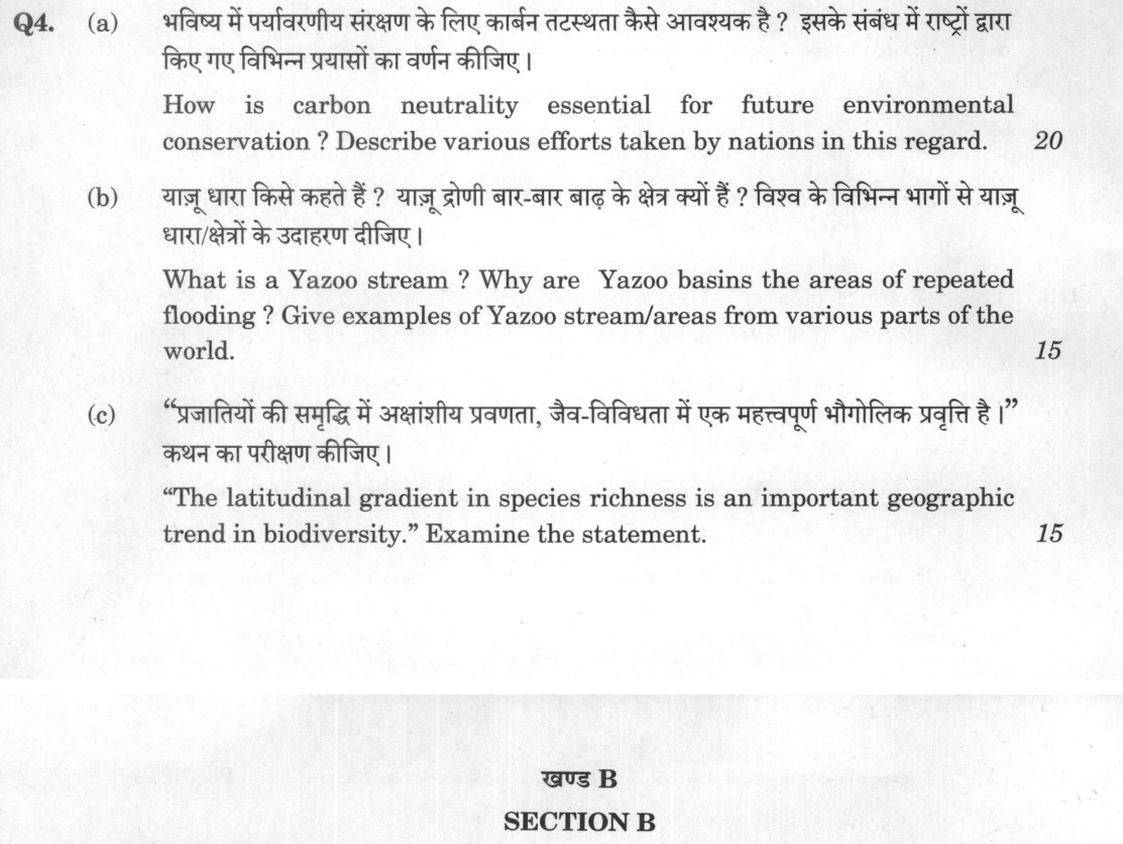
(a) How is carbon neutrality essential for future environmental conservation ? Describe various efforts taken by nations in this…
How is carbon neutrality essential for future environmental conservation ? Describe various efforts taken by nations in this regard. 20 marks
What is a Yazoo stream ? Why are Yazoo basins the areas of repeated flooding ? Give examples of Yazoo stream/areas from various parts of the world. 15 marks
"The latitudinal gradient in species richness is an important geographic trend in biodiversity." Examine the statement. 15 marks
हिंदी में प्रश्न पढ़ें
भविष्य में पर्यावरणीय संरक्षण के लिए कार्बन तटस्थता कैसे आवश्यक है ? इसके संबंध में राष्ट्रों द्वारा किए गए विभिन्न प्रयासों का वर्णन कीजिए । 20
याजू धारा किसे कहते हैं ? याजू द्रोणी बार-बार बाढ़ के क्षेत्र क्यों हैं ? विश्व के विभिन्न भागों से याजू धारा/क्षेत्रों के उदाहरण दीजिए । 15
"प्रजातियों की समृद्धि में अक्षांशीय प्रवणता, जैव-विविधता में एक महत्वपूर्ण भौगोलिक प्रवृत्ति है ।" कथन का परीक्षण कीजिए । 15
Model answer
Written by UPSC Answer Check against this question's marking rubric, to the expected length. UPSC does not publish answers for Mains — this is one way to score well, not an official key.
Earth systems operate through dynamic linkages where atmospheric regulation, fluvial geomorphology, and biogeographic patterns collectively maintain ecological equilibrium.
Carbon Neutrality and Environmental Conservation
Carbon neutrality refers to achieving net-zero carbon dioxide emissions by balancing anthropogenic emissions with equivalent carbon sequestration. It is vital for environmental conservation as it halts global warming within safe planetary boundaries (1.5°C to 2°C IPCC thresholds), preventing irreversible tipping points such as permafrost thawing and polar ice collapse. Furthermore, stabilizing atmospheric greenhouse concentrations curbs ocean acidification, reduces extreme climatic events, and protects vulnerable ecosystems from habitat degradation.
Nations have instituted multidimensional pathways to realize these targets:
India committed to net-zero emissions by 2070 at COP26 under the Panchamrit declaration. This strategy is driven by its updated Nationally Determined Contributions (NDCs), the Long-Term Low-Emission Development Strategy (LT-LEDS), the National Action Plan on Climate Change (NAPCC), and the Energy Conservation (Amendment) Act 2022.
The European Union codified the European Green Deal and Climate Law, binding member states to achieve net-zero by 2050 alongside the Carbon Border Adjustment Mechanism (CBAM). China committed to peaking carbon emissions before 2030 and reaching carbon neutrality by 2060. The United States rejoined the Paris Agreement and passed the Inflation Reduction Act to accelerate renewable infrastructure and halve emissions by 2030. Bhutan remains a pioneer carbon-negative nation, backed by a constitutional mandate to maintain 60% forest cover.
Yazoo Streams and Basin Flood Dynamics
A Yazoo stream is a tributary that runs parallel to a major river for a considerable distance along its floodplain, prevented from immediately joining the main river by the height of natural levees formed during repeated overbank deposition.
Yazoo basins suffer from chronic, repeated inundation due to distinct geomorphic mechanisms:
- Impeded Drainage and Levee Barriers: Natural levees create an elevated barrier, trapping lateral tributary discharge in backswamp lowlands.
- Backwater Aggradation: During peak main-channel discharge, high hydraulic head exerts a backwater effect into the tributary mouth, stalling outflow.
- Sediment Siltation: Continuous deposition of fine clay and silt decreases bed gradients, lowering drainage capacity and leaving water tables permanently elevated.
Global examples include the prototype Yazoo River in the Mississippi Basin (USA); the várzea drainage networks of the Amazon Basin; and the hyper-avulsive alluvial systems of the Ganga-Brahmaputra Plains, seen in the drainage-blocked backswamps of the Kosi fan and the Yamuna-Ganga interfluve tracts.
Latitudinal Gradient in Species Richness
The latitudinal diversity gradient (LDG) is the geographic pattern wherein biodiversity peaks in the tropics and declines progressively toward polar latitudes.
Key explanatory mechanisms include:
- Evolutionary Time Hypothesis: Tropics remained largely unglaciated during the Quaternary ice ages, providing evolutionary stability for prolonged speciation.
- Climatic Stability and Energy Hypothesis: Constant solar insolation, stable temperatures, and high precipitation drive elevated net primary productivity (NPP), supporting complex food webs and narrow ecological niches.
- Spatial Area Effect: The extensive, continuous tropical zone provides vast biomes that lower extinction rates through larger population sizes.
However, critical exceptions complicate this gradient:
- Marine Mid-Latitude Peaks: Pelagic biodiversity peaks in temperate open waters (~30°–40° latitude) rather than equatorial zones due to nutrient-rich upwelling and thermal tolerance limits.
- Arid Anomalies: Low-latitude hot deserts (Sahara, Thar) exhibit sharp biodiversity deficits despite high insolation, constrained by moisture deficits.
- Altitudinal Compression: Mountain systems like the Eastern Himalayan biodiversity hotspot compress high endemism and species richness across steep vertical gradients, transcending purely latitudinal trends.
Integrated Policy Synthesis
These geographic phenomena demand unified conservation frameworks. Yazoo basins and backswamp wetlands act as vital blue-carbon sinks and Ramsar sites that regulate regional hydrological regimes. Fulfilling UNFCCC carbon-neutrality pledges directly safeguards species richness along latitudinal gradients by arresting climate-induced biome shifts. Synchronizing national actions with the Convention on Biological Diversity (CBD) and India's National Biodiversity Action Plan (NBAP) ensures an integrated approach toward landscape conservation, flood mitigation, and planetary ecological stability.
What "Describe" is asking you to do
Give a full, ordered account of the thing named — its parts, stages or mechanism — in the sequence in which it actually exists or occurs. Most describe questions come from the science optionals, where the marks sit in correct technical detail and, where the stem says so, a labelled diagram.
Structure that answers it
One-line identification of the subject → the parts or stages in their real order, each with its defining detail → labelled diagram where the subject is structural → closing line on function or significance
Where marks are lost
Loose general prose where the examiner is ticking named parts, correct terminology and their sequence; and in the General Studies papers, turning to evaluation before the description is finished.
How this answer will be evaluated
Approach
Framework: Concept > Mechanism > Diagram > Regional Example > Application. (a) describe: define > structure or process in order > labelled diagram > significance | (b) explain: definition/context > points in order > small example > short close | (c) examine: intro > how/why with reasoning > evidence > conclusion Full marks: Comprehensive mechanism, precise examples, clear diagrams, and strong application.
Key points expected
- Define carbon neutrality (net-zero emissions)
- Link carbon neutrality to climate change mitigation
- Describe specific national efforts (e.g., EU Green Deal, China targets)
- Include a diagram of the carbon cycle or emission reduction
- Define Yazoo stream (retrograde/reverse flow)
- Explain the mechanism of backwater flooding
- Provide global examples (e.g., Yazoo River, Mississippi)
- Include a diagram of the river profile
Evaluation rubric
Each sub-part is marked on its own, against the marks and word limit printed on the paper.
- (a) Explain the necessity of carbon neutrality and detail national mitigation strategies. 20 marks
describe— define → structure or process in order → labelled diagram → significance
Must cover
- Define carbon neutrality (net-zero emissions)
- Link carbon neutrality to climate change mitigation
- Describe specific national efforts (e.g., EU Green Deal, China targets)
- Include a diagram of the carbon cycle or emission reduction
Loses marks
- Vague generalities without specific national examples
- Confusing carbon neutrality with carbon footprint
- No diagram or visual aid
Earns more
- Mention specific international agreements (Paris Agreement)
- Discuss renewable energy transition mechanisms
- Reference carbon trading or offsetting mechanisms
- Link to sustainable development goals
Extra mark
- Cite specific national emission reduction targets
- Mention specific carbon capture technologies
- (b) Define Yazoo streams and explain the geomorphological causes of their flooding. 15 marks
explain— definition/context → points in order → small example → short close
Must cover
- Define Yazoo stream (retrograde/reverse flow)
- Explain the mechanism of backwater flooding
- Provide global examples (e.g., Yazoo River, Mississippi)
- Include a diagram of the river profile
Loses marks
- Failing to explain the 'retrograde' mechanism
- Confusing with normal river flooding
- No diagram of the river profile
Earns more
- Explain the role of the main river's gradient
- Mention specific flood events or dates
- Discuss the impact on local agriculture
- Compare with normal river flow
Extra mark
- Mention specific engineering solutions (levees)
- Reference specific historical flood data
- (c) Analyze the latitudinal gradient in species richness and its geographic significance. 15 marks
examine— intro → how/why with reasoning → evidence → conclusion
Must cover
- Define latitudinal gradient in biodiversity
- Explain the trend (higher richness at equator)
- Provide reasoning (e.g., energy, stability, evolution)
- Include a graph or diagram of the gradient
Loses marks
- Failing to explain the 'why' behind the gradient
- Confusing with other biodiversity patterns
- No diagram or graph
Earns more
- Mention specific biomes (tropical rainforests)
- Discuss the role of climate stability
- Reference specific taxa (e.g., birds, mammals)
- Link to historical factors (glaciation)
Extra mark
- Cite specific studies or researchers (e.g., Rapoport)
- Mention specific species counts
Practice this exact question
Write your answer and it is marked point by point against the model answer above — what you covered, what you missed, what you got wrong.
Evaluate my answer →More from Geography 2024 Paper I
- Q1 Answer the following in about 150 words each : 10×5=50 (a) What are 'truncated spurs' ? W…
- Q2 (a) Examine the recent views on mountain building process and divide the world mountains…
- Q3 (a) Explain air masses and associated weather dynamics. How do air masses influence the w…
- Q4 (a) How is carbon neutrality essential for future environmental conservation ? Describe v…
- Q5 Answer the following in about 150 words each : 10×5=50 (a) Critically examine the signifi…
- Q6 (a) The urbanisation process is particularly pronounced in Asia and Africa, where too man…
- Q7 (a) Explain the basis of D. Whittlesey's classification of agricultural regions of the wo…