Paper I — Q2
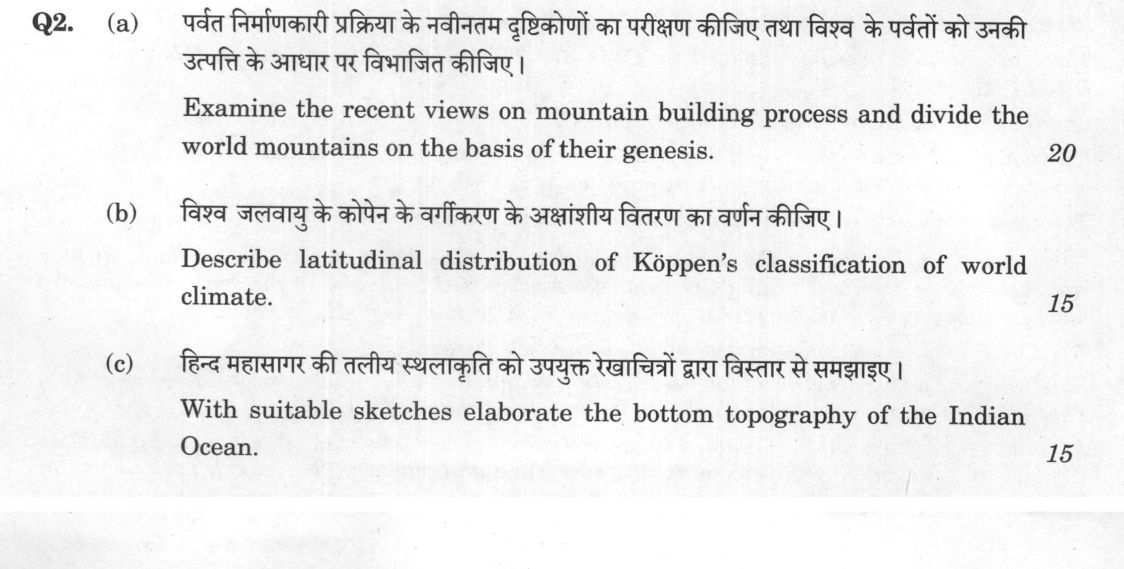
(a) Examine the recent views on mountain building process and divide the world mountains on the basis of their genesis. 20 (b)…
Examine the recent views on mountain building process and divide the world mountains on the basis of their genesis. 20 marks
Describe latitudinal distribution of Köppen's classification of world climate. 15 marks
With suitable sketches elaborate the bottom topography of the Indian Ocean. 15 marks
हिंदी में प्रश्न पढ़ें
पर्वत निर्माणकारी प्रक्रिया के नवीनतम दृष्टिकोणों का परीक्षण कीजिए तथा विश्व के पर्वतों को उनकी उत्पत्ति के आधार पर विभाजित कीजिए । 20
विश्व जलवायु के कोपेन के वर्गीकरण के अक्षांशीय वितरण का वर्णन कीजिए । 15
हिंद महासागर की तलीय स्थलाकृति को उपयुक्त रेखाचित्रों द्वारा विस्तार से समझाइए । 15
Model answer
Written by UPSC Answer Check against this question's marking rubric, to the expected length. UPSC does not publish answers for Mains — this is one way to score well, not an official key.
Mountain building, climate zonation and ocean-floor morphology are expressions of plate tectonics, mantle dynamics and surface processes.
Part (a): Mountain building Recent views treat mountain building as a lithosphere-scale process, moving beyond static fold theory to dynamic plate-tectonic and mantle-driven models. Sea-floor spreading at mid-ocean ridges, slab pull (negative buoyancy of sinking lithosphere) and slab suction (mantle-flow drag at a trench) control plate motions; convergence at trenches is mainly driven by slab pull, while suction modifies trench dynamics. The Wilson cycle explains how rifting opens basins, spreading widens them, subduction consumes crust, and collision builds orogens. Genetically, world mountains divide into fold mountains from convergence/collision (Himalayas, Alps), block/horst mountains from faulting (Vosges, Black Forest), volcanic mountains from subduction or plume activity (Cascade Range), and relict mountains from erosion of older orogens (Aravallis, Urals). Recent advances refine this: mantle plume dynamics, delamination of dense lithosphere, and critical taper wedge mechanics explain crustal thickening, exhumation, magmatism and seismicity. Delamination can produce rapid uplift without direct collision, while critical taper theory links wedge stability to basal friction, fluid pressure and sediment load. Collisional Himalayan-type orogens differ from accretionary Andean-type margins in plate convergence, slab angle, crustal addition and topographic response. The examined finding is that mountain building is not a single process but a spectrum of lithospheric responses to plate forces, mantle flow, slab dynamics and crustal strength.
Part (b): Köppen latitudinal distribution Köppen climates show latitudinal zonation modified by continentality, relief, monsoons and oceans. The pattern reflects pressure belts: ITCZ, subtropical highs, westerlies and polar easterlies. Equatorial Af, Am and Aw occur roughly 0–20°; Am has heavy year-round or monsoon rain, while Aw has a dry season caused by seasonal wind shifts and the subtropical high. Dry B climates are azonal: BWh/BSh occur in subtropical dry regions such as the Sahara and Australia, while BSk/BWk occur in mid-latitude continental interiors such as Central Asia, Patagonia and the Great Basin. C climates extend from about 25–30° to 60° in both hemispheres: Cfa/Cwa can occur near 25–30°, Cfb/Cwb and Csa/Csb dominate mid-latitudes, and Cfb can reach about 60°N. Monsoon reversal in Asia explains Cwa and Dwa. D climates are mainly northern-hemisphere, extending to about 70°N, with Dfa/Dfb/Dfc/Dfd and monsoon Dwa/Dwb; they are essentially absent in the Southern Hemisphere because of limited land area. ET and EF occupy polar regions, roughly 60–90°.
Part (c): Indian Ocean bottom topography A sketch would show a triangular basin with a central ridge system, the Makran margin in the NW, the Sunda/Java trench in the east, and sediment fans along the Indian and Southeast Asian margins. The Central Indian Ridge and Carlsberg Ridge form the mid-ocean ridge system, segmented by transform faults. The Ninety East Ridge is a north-south trending aseismic hotspot trace, not a transform-fault remnant. The Chagos-Laccadive Ridge is associated with the Réunion hotspot, while the Mascarene Plateau lies in the SW. The Wharton Basin occupies the NW. The Sunda Trench, of which the Java Trench is a segment, marks active subduction in the eastern periphery; the Makran trench/subduction zone in the NW Arabian Sea is the other major active margin, forming an accretionary prism. The western sector otherwise lacks broad marginal trenches. Asymmetrical sediment fans from the Ganga-Brahmaputra and Indus systems thicken near their mouths and thin offshore because monsoon currents and river discharge deposit sediment unevenly.
Plate tectonics unifies these themes: ridge spreading and subduction shape mountains and trenches, mantle plumes and slab dynamics modify orogens, latitude and pressure belts organise Köppen climates, and the Indian Ocean floor records spreading, subduction, plumes and sedimentation.
What "Examine" is asking you to do
Test the proposition the question puts to you and return a finding on how far it holds. Examine stems carry a claim, or ask whether something has happened, and expect evidence weighed both ways before the extent is stated — often with remedial measures attached.
Structure that answers it
Restate the claim as the question frames it → evidence that supports it → evidence that undercuts it → the conditions under which it holds → verdict on how far it stands
Where marks are lost
Stopping at description. An examination has to reach a finding, and “examine with justification” means the extent must be stated, not implied.
How this answer will be evaluated
Approach
Framework: Concept or mechanism > Diagram > Regional example > Application. (a) examine: intro > how/why with reasoning > evidence > conclusion | (b) describe: define > structure or process in order > labelled diagram > significance | (c) explain: definition/context > points in order > small example > short close Full marks: Comprehensive mechanism, clear diagrams, specific examples, and strong application.
Key points expected
- Recent views on mountain building process
- Classification of world mountains by genesis
- Reasoning for the classification
- Evidence supporting the views
- Definition of Köppen's classification
- Structure of the classification system
- Latitudinal distribution of climate zones
- Labelled diagram of distribution
Evaluation rubric
Each sub-part is marked on its own, against the marks and word limit printed on the paper.
- (a) Explain recent tectonic views on mountain building and classify world mountains by genesis. 20 marks
examine— intro → how/why with reasoning → evidence → conclusion
Must cover
- Recent views on mountain building process
- Classification of world mountains by genesis
- Reasoning for the classification
- Evidence supporting the views
Loses marks
- Description without mechanism
- No diagram or sketch
- Listing mountains without genesis
Earns more
- Mention of specific tectonic theories
- Examples of mountains for each type
- Link between process and classification
- Reference to recent geological findings
Extra mark
- Labelled sketch of mountain types
- Specific recent disaster or data
- (b) Describe the latitudinal distribution of Köppen's climate classification. 15 marks
describe— define → structure or process in order → labelled diagram → significance
Must cover
- Definition of Köppen's classification
- Structure of the classification system
- Latitudinal distribution of climate zones
- Labelled diagram of distribution
Loses marks
- No diagram or map
- Listing zones without distribution
- Ignoring the latitudinal aspect
Earns more
- Explanation of factors affecting distribution
- Examples of regions for each zone
- Link between latitude and climate
- Mention of exceptions to the pattern
Extra mark
- Specific data on temperature/precipitation
- Reference to recent climate change
- (c) Elaborate the bottom topography of the Indian Ocean with sketches. 15 marks
explain— definition/context → points in order → small example → short close
Must cover
- Description of bottom topography features
- Suitable sketches of the topography
- Explanation of the features
- Link between topography and ocean processes
Loses marks
- No sketches or diagrams
- General description without specifics
- Ignoring the 'bottom' aspect
Earns more
- Mention of specific features (e.g., ridges, trenches)
- Explanation of formation processes
- Link to tectonic activity
- Reference to specific locations
Extra mark
- Specific data on depth/width
- Reference to recent exploration
Practice this exact question
Write your answer and it is marked point by point against the model answer above — what you covered, what you missed, what you got wrong.
Evaluate my answer →More from Geography 2024 Paper I
- Q1 Answer the following in about 150 words each : 10×5=50 (a) What are 'truncated spurs' ? W…
- Q2 (a) Examine the recent views on mountain building process and divide the world mountains…
- Q3 (a) Explain air masses and associated weather dynamics. How do air masses influence the w…
- Q4 (a) How is carbon neutrality essential for future environmental conservation ? Describe v…
- Q5 Answer the following in about 150 words each : 10×5=50 (a) Critically examine the signifi…