Paper I — Q5
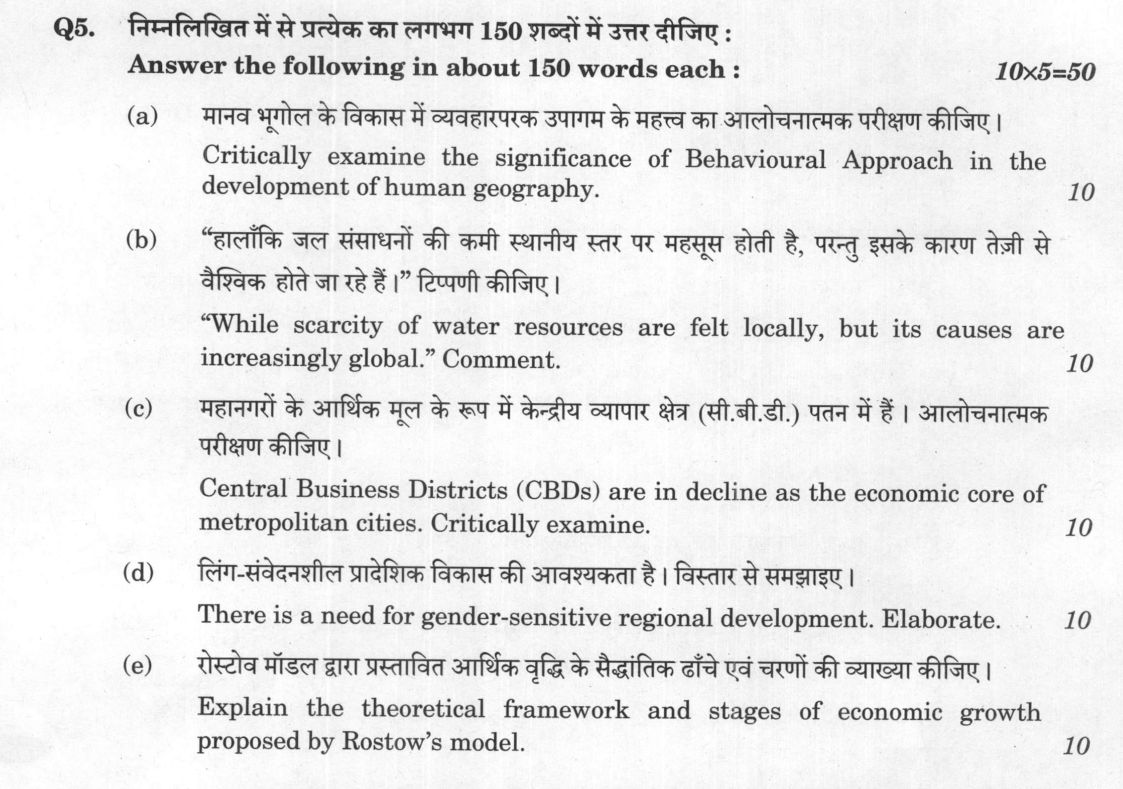
Answer the following in about 150 words each : 10×5=50 (a) Critically examine the significance of Behavioural Approach in the…
Answer the following in about 150 words each : 10×5=50
Critically examine the significance of Behavioural Approach in the development of human geography. 10 marks
"While scarcity of water resources are felt locally, but its causes are increasingly global." Comment. 10 marks
Central Business Districts (CBDs) are in decline as the economic core of metropolitan cities. Critically examine. 10 marks
There is a need for gender-sensitive regional development. Elaborate. 10 marks
Explain the theoretical framework and stages of economic growth proposed by Rostow's model. 10 marks
हिंदी में प्रश्न पढ़ें
निम्नलिखित में से प्रत्येक का लगभग 150 शब्दों में उत्तर दीजिए :
मानव भूगोल के विकास में व्यवहारपरक उपागम के महत्व का आलोचनात्मक परीक्षण कीजिए। 10
"हालांकि जल संसाधनों की कमी स्थानीय स्तर पर महसूस होती है, परंतु इसके कारण तेजी से वैश्विक होते जा रहे हैं।" टिप्पणी कीजिए। 10
महानगरों के आर्थिक मूल के रूप में केंद्रीय व्यापार क्षेत्र (सी.बी.डी.) पतन में हैं। आलोचनात्मक परीक्षण कीजिए। 10
लिंग-संवेदनशील प्रादेशिक विकास की आवश्यकता है। विस्तार से समझाइए। 10
रोस्तोव मॉडल द्वारा प्रस्तावित आर्थिक वृद्धि के सैद्धांतिक ढांचे एवं चरणों की व्याख्या कीजिए। 10
Model answer
Written by UPSC Answer Check against this question's marking rubric, to the 150-word length. UPSC does not publish answers for Mains — this is one way to score well, not an official key.
(a) The Behavioural Approach shifted human geography from objective spatial laws to the cognitive and decision-making processes that mediate between environment and action. Its significance lies in making perception, bounded rationality, and mental maps central: Pred’s behavioural matrix, Wolpert’s spatial choice theory, Lynch and Gould’s mental maps, and Hägerstrand’s time-geography showed that people act on perceived, not absolute, space. This enriched regional, urban and migration geography by explaining why similar places are chosen differently. It also made geography more interdisciplinary, linking psychology, sociology and planning. Yet it is limited: subjective data are hard to quantify, individualistic focus can ignore class, caste, gender and institutional constraints, and its policy applicability is uneven. In India, indigenous theoretical development remained limited, but behavioural ideas were applied in migration, urban settlement and consumer behaviour studies. Its legacy survives in humanistic geography, GIS-based cognitive mapping, behavioural economics and agent-based urban simulation. Thus it was a corrective, not a final paradigm.
(b) The statement is broadly valid. Water stress is experienced at the household, farm and city scale—drought in Marathwada, groundwater decline in Punjab and Haryana, salinity in coastal Andhra, and supply failures in Delhi and Chennai. Yet many drivers are global: climate change alters monsoon intensity and snowmelt; global trade creates virtual-water footprints as water-intensive crops move across borders; energy demand, industrial supply chains and urban consumption raise withdrawals beyond local catchments. Transboundary rivers add geopolitical dimensions. In India, groundwater over-exploitation, driven by pump-set subsidies and market-oriented agriculture, is a local manifestation of global price signals and export demand. However, global causes do not erase local responsibility: irrigation inefficiency, urban leakage, caste-based access and poor governance intensify scarcity. Hence the claim is correct in diagnosis but incomplete in remedy: Jal Jeevan Mission, aquifer mapping and crop-water planning must address global linkages while strengthening local water governance.
(c) The claim of CBD decline is partly true but overstated. Traditional Central Business Districts have lost some monopoly because metropolitan economies, especially in global cities, have become polycentric. Suburban office parks, edge cities and IT corridors—BKC and Andheri in Mumbai, Gurugram and Noida in Delhi, Whitefield in Bengaluru, Gachibowli in Hyderabad—draw firms seeking land, transport access and talent. Retail has shifted to malls, e-commerce has reduced footfall, and hybrid work has lowered office demand. Yet CBDs remain economic cores for high-value services, finance, headquarters, legal and institutional functions, where face-to-face coordination and agglomeration still matter. Mumbai’s Fort–Nariman Point and Delhi’s Connaught Place retain command rents and institutional density. The real change is not disappearance but redistribution: CBDs are now one node in a network of sub-centres, linked by metro rail and expressways. Thus the claim should be read as a decline of exclusive centrality, not of economic significance.
(d) Gender-sensitive regional development is necessary because growth without gender equity reproduces regional inequality. Women’s access to land, credit, transport, health, education and digital services varies sharply by state and district; NITI Aayog’s SDG Gender Index shows persistent gaps in Bihar, Uttar Pradesh and Jharkhand. A gender-blind regional plan may build roads, industrial parks or urban centres that men use more easily, while women bear unpaid care work, safety risks and limited mobility. In rural regions, MGNREGA, Ujjwala, Sukanya Samriddhi and Beti Bachao Beti Padhao can raise women’s income, health and security, but their impact depends on local implementation, land rights and participation in Panchayati Raj. In urban regions, safe public transport, childcare, skill training and flexible work matter. Thus gender-sensitive development means sex-disaggregated data, women’s representation in planning and local institutions, and region-specific interventions that convert women’s labour and agency into regional productivity, not merely welfare.
(e) Rostow’s model is a linear, stage-based theory of economic growth. Its framework assumes that societies move through successive stages as capital accumulation, technological adoption, institutional change and rising investment create self-sustaining growth. The key mechanism is a shift from subsistence to industrial production, with leading sectors generating demand, employment and further investment. The stages are: (1) traditional society, limited technology and low productivity; (2) preconditions for take-off, where education, transport, finance and entrepreneurial attitudes develop; (3) take-off, when investment rises from 5–10 per cent to over 10 per cent of national income and leading sectors expand rapidly; (4) drive to maturity, with industrialisation spreading and the economy less dependent on any single sector; and (5) age of high mass consumption, where services, consumer goods and welfare dominate. Rostow saw growth as secular and cumulative. Though influential, the model is Eurocentric and underplays inequality, dependency and structural constraints, as seen in India’s uneven regional growth.
What "Critically examine" is asking you to do
Test the proposition the question puts to you and return a finding on how far it holds. Examine stems carry a claim, or ask whether something has happened, and expect evidence weighed both ways before the extent is stated — often with remedial measures attached. “Critically” is not a section added at the end: name the yardstick you are judging by — the evidence, the stated objective, a constitutional principle, a rival explanation — and let a verdict close each part of the body. Where the question quotes a claim, that verdict must land on the claim itself, accepted, qualified or rejected, and not on the theme in general.
Structure that answers it
Restate the claim as the question frames it → evidence that supports it → evidence that undercuts it → the conditions under which it holds → verdict on how far it stands
Where marks are lost
Merits in one paragraph, demerits in the next, and a conclusion calling for a balanced and holistic approach. That is a survey with the judgement left out and it holds the answer in the middle band. The opposite error is reading “critically” as permission to attack — and with the odd pairings, critically describe or critically explain, the exposition still carries most of the marks, the judgement being a layer on it rather than a substitute for it.
How this answer will be evaluated
Approach
Framework: UPSC Geography Paper 1 Rubric. (a) examine: intro > how/why with reasoning > evidence > conclusion | (b) comment: context > arguments both sides > judgment > close | (c) examine: intro > how/why with reasoning > evidence > conclusion | (d) explain: definition/context > points in order > small example > short close | (e) explain: definition/context > points in order > small example > short close Full marks: Precise, critical, and well-structured with specific examples and diagrams.
Key points expected
- Define the shift from positivism to human perception
- Identify key figures (e.g., Haggett, Berry, Gould)
- Explain the focus on decision-making and cognition
- Critically evaluate its limitations or subsequent decline
- Define local scarcity (e.g., aquifer depletion, drought)
- Identify global causes (e.g., climate change, trade)
- Explain the mechanism of 'virtual water' trade
- Provide a specific regional example of local impact
Evaluation rubric
Each sub-part is marked on its own, against the marks and word limit printed on the paper.
- (a) Assess the contribution of the Behavioural Revolution to the discipline. 10 marks · 150 words
examine— intro → how/why with reasoning → evidence → conclusion
Must cover
- Define the shift from positivism to human perception
- Identify key figures (e.g., Haggett, Berry, Gould)
- Explain the focus on decision-making and cognition
- Critically evaluate its limitations or subsequent decline
Loses marks
- Treating it as a general 'human geography' answer
- Ignoring the 'critical' aspect of the command word
Earns more
- Mention specific concepts like 'mental maps' or 'perceptual regions'
- Reference the 'Behavioural Revolution' as a specific historical phase
Extra mark
- Cite a specific study (e.g., Gould's 'The Mental Map')
- (b) Analyze the paradox of local water scarcity with global drivers. 10 marks · 150 words
comment— context → arguments both sides → judgment → close
Must cover
- Define local scarcity (e.g., aquifer depletion, drought)
- Identify global causes (e.g., climate change, trade)
- Explain the mechanism of 'virtual water' trade
- Provide a specific regional example of local impact
Loses marks
- Focusing only on local causes without global linkage
- Ignoring the 'global' aspect of the prompt
Earns more
- Mention 'water footprint' or 'virtual water' explicitly
- Link global consumption patterns to local resource stress
Extra mark
- Cite a specific case study (e.g., California or India's groundwater)
- (c) Critically assess the claim that CBDs are losing their economic primacy. 10 marks · 150 words
examine— intro → how/why with reasoning → evidence → conclusion
Must cover
- Define the traditional role of the CBD
- Identify factors causing decline (e.g., suburbanization, e-commerce)
- Provide evidence of CBD decline (e.g., office vacancy)
- Counter-argument: CBDs as symbols of prestige or high-value services
Loses marks
- Accepting the premise without critical evaluation
- Ignoring the 'economic core' aspect of the question
Earns more
- Mention 'decentralization' or 'polycentricity'
- Reference specific cities (e.g., New York, London, Mumbai)
Extra mark
- Mention 'edge cities' or 'suburban business districts'
- (d) Explain why regional development must be gender-sensitive. 10 marks · 150 words
explain— definition/context → points in order → small example → short close
Must cover
- Define 'gender-sensitive regional development'
- Identify specific gender disparities in regional development
- Explain the impact of ignoring gender on development outcomes
- Suggest measures for gender-sensitive planning
Loses marks
- Treating it as a general 'women's development' answer
- Ignoring the 'regional' aspect of the question
Earns more
- Mention 'gender mainstreaming' or 'gender budgeting'
- Reference specific indicators (e.g., GDI, GII)
Extra mark
- Cite a specific policy or program (e.g., NITI Aayog's GDI)
- (e) Describe the theoretical framework and stages of Rostow's model. 10 marks · 150 words
explain— definition/context → points in order → small example → short close
Must cover
- Define Rostow's model (Stages of Economic Growth)
- List the five stages in order
- Explain the key features of each stage
- Mention the role of investment and technology
Loses marks
- Listing stages without explaining their features
- Ignoring the 'theoretical framework' aspect of the question
Earns more
- Mention 'take-off' as the critical stage
- Reference the 'age of high mass consumption'
Extra mark
- Critically evaluate the model's applicability to developing countries
Practice this exact question
Write your answer and it is marked point by point against the model answer above — what you covered, what you missed, what you got wrong.
Evaluate my answer →More from Geography 2024 Paper I
- Q2 (a) Examine the recent views on mountain building process and divide the world mountains…
- Q3 (a) Explain air masses and associated weather dynamics. How do air masses influence the w…
- Q4 (a) How is carbon neutrality essential for future environmental conservation ? Describe v…
- Q5 Answer the following in about 150 words each : 10×5=50 (a) Critically examine the signifi…
- Q6 (a) The urbanisation process is particularly pronounced in Asia and Africa, where too man…
- Q7 (a) Explain the basis of D. Whittlesey's classification of agricultural regions of the wo…
- Q8 (a) What is complementary region ? With reference to hierarchy of settlements, describe t…