Paper I — Q8
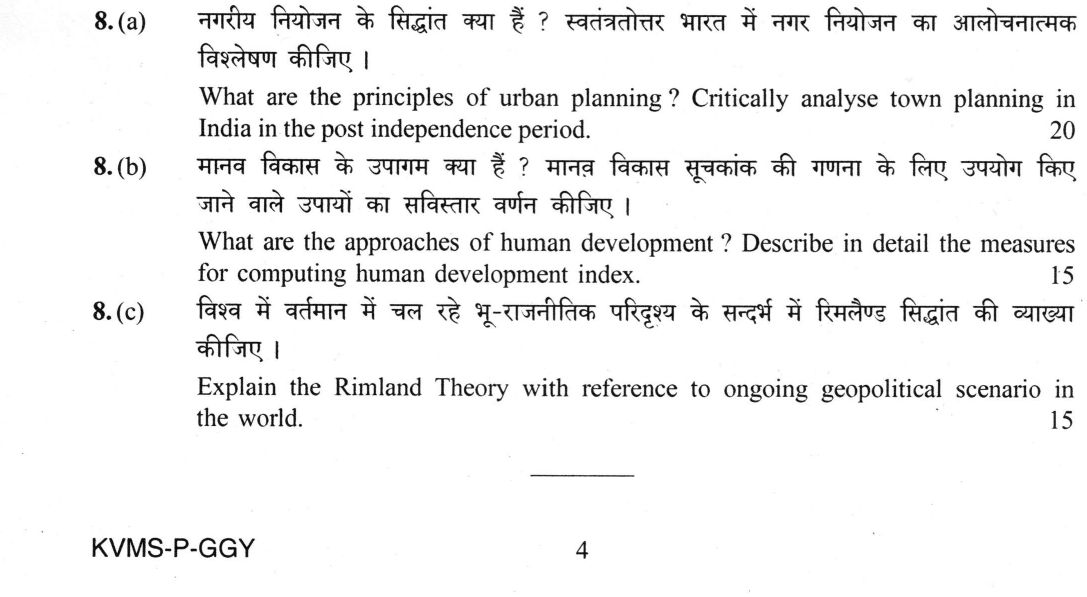
(a) What are the principles of urban planning ? Critically analyse town planning in India in the post independence period. (20…
What are the principles of urban planning ? Critically analyse town planning in India in the post independence period. 20 marks
What are the approaches of human development ? Describe in detail the measures for computing human development index. 15 marks
Explain the Rimland Theory with reference to ongoing geopolitical scenario in the world. 15 marks
हिंदी में प्रश्न पढ़ें
नगरीय नियोजन के सिद्धांत क्या हैं ? स्वतंत्रोत्तर भारत में नगर नियोजन का आलोचनात्मक विश्लेषण कीजिए । (20 अंक)
मानव विकास के उपागम क्या हैं ? मानव विकास सूचकांक की गणना के लिए उपयोग किए जाने वाले उपायों का सविस्तार वर्णन कीजिए । (15 अंक)
विश्व में वर्तमान में चल रहे भू-राजनीतिक परिदृश्य के सन्दर्भ में रिमलैण्ड सिद्धांत की व्याख्या कीजिए । (15 अंक)
Model answer
Drafted with AI by UPSC Answer Check against this question's marking rubric, to the expected length. UPSC does not publish answers for Mains — this is one way to score well, not an official key. How we build rubrics and answers.
(a) Principles of urban planning and town planning in India since 1947
Urban planning is grounded in specific historical doctrines that evolved from the industrial era to the modern city. The foundational principle is Patrick Geddes’ "survey before plan" (1915), which advocates for "conservative surgery" rather than wholesale demolition. Ebenezer Howard’s Garden City (1898) introduced the integration of urban and rural amenities, while Clarence Perry’s neighbourhood unit (1929) and Stein and Wright’s Radburn layout (1929) established the importance of pedestrian safety and local service centres. The CIAM Athens Charter (1933) and Le Corbusier’s "four functions" (dwelling, work, recreation, circulation) dominated the mid-20th century, emphasizing functional zoning and high-density towers. Jane Jacobs (The Death and Life of Great American Cities, 1961) later defended mixed use and street life, leading to New Urbanism, transit-oriented development and the compact city.
In post-independence India, these principles were applied in landmark projects. Chandigarh was initially planned by Albert Mayer and Matthew Nowicki, later redesigned by Le Corbusier, Pierre Jeanneret, Maxwell Fry, and Jane Drew using the "7Vs" (Les Sept Voies, a hierarchy of seven road types from V1 to V7) and sectoral planning. Bhubaneswar was designed by Otto Koenigsberger (1948) as a "city in a garden," followed by Gandhinagar and Navi Mumbai (CIDCO, 1971). Statutory planning began with the Delhi Development Act 1957 and the Master Plan 1962, followed by MPD-2021 and the draft MPD-2041. The Seventy-fourth Constitutional Amendment (1992) mandated planning committees for local bodies, while missions like JNNURM (2005), AMRUT, the Smart Cities Mission and PMAY-U (2015), and RERA (2016) supplemented this framework.
A critical analysis reveals significant failures. Master plans are often rigid and revised belatedly, while weak enforcement has led to the regularisation of unauthorised colonies. Exclusionary standards have produced slums housing approximately 65 million people (Census 2011). Furthermore, parastatal agencies often bypass elected municipalities, contradicting the spirit of the 74th Amendment. The neglect of hydrology in planning is evident in the devastating floods in Chennai (2015), Mumbai (2005), and Bengaluru (2022).
(b) Approaches to human development and computing the HDI
Human development is a multidimensional concept that has evolved through four primary approaches. The income approach equates development with per capita GNP. The welfare approach focuses on the consumption of goods and services. The basic needs approach, formalized by the ILO in 1976, identifies specific thresholds for food, shelter, and health. The capability approach, championed by Amartya Sen and Mahbub ul Haq, views development as the expansion of human freedom and the ability to lead a life one has reason to value.
The Human Development Index (HDI), first introduced in the UNDP's 1990 report, quantifies this progress across three dimensions:
- Health: Measured by life expectancy at birth, with goalposts of 20 and 85 years.
- Education: Measured by mean years of schooling (goalposts 0 and 15 years) and expected years of schooling (goalposts 0 and 18 years).
- Standard of Living: Measured by GNI per capita (2017 PPP dollars), with goalposts of 100 and 75,000.
The dimension index for each is calculated as: (Actual Value - Minimum) / (Maximum - Minimum). The education index is the arithmetic mean of the two schooling indices. For the income dimension, the natural logarithm of GNI is used to account for diminishing marginal utility. Since the 2010 report, the HDI is the geometric mean (the cube root of the product) of the three dimension indices. This aggregation rule penalizes low performance in any single dimension more than an arithmetic mean would. Countries are grouped as very high (0.800 and above), high (0.700–0.799), medium (0.550–0.699) and low (below 0.550) human development. Companion indices include the Gender Development Index (GDI), the Gender Inequality Index (GII), the Inequality-adjusted HDI (IHDI), the Multidimensional Poverty Index (MPI, Alkire–Foster method with OPHI, 2010) and the Planetary pressures-adjusted HDI (2020).
(c) Rimland theory and the present geopolitical scene
The Rimland Theory was developed by Nicholas John Spykman in "America's Strategy in World Politics" (1942) and "The Geography of the Peace" (1944). It was a direct response to Halford Mackinder’s Heartland Theory. While Mackinder argued that "who rules the Heartland rules the World," Spykman identified the "Rimland"—the coastal crescent of Eurasia including the European coastland, the Middle Eastern desert belt, and the Asiatic monsoon land—as the true strategic pivot. His dictum was: "Who controls the Rimland rules Eurasia; who rules Eurasia controls the destinies of the world."
In the contemporary geopolitical scenario, the Rimland remains the theatre of global power. The United States' strategy of "containment" (Kennan, 1947) and the establishment of NATO (1949) and CENTO were early applications of Rimland logic. Today, the "Indo-Pacific" strategy, the Quad, and AUKUS (2021) represent a renewed focus on securing the Rimland against the influence of the Heartland (Russia) and the rising power of the Rimland's eastern edge (China). China’s Belt and Road Initiative (2013) is an attempt to project power across the Rimland to secure energy and trade routes. Russia's war in Ukraine since February 2022, NATO's enlargement to Finland (2023) and Sweden (2024), attacks on Red Sea shipping since late 2023 and disputes in the South China Sea all lie along the Rimland's three sectors, while India, itself a Rimland power, balances through the Quad, the India–Middle East–Europe Economic Corridor (2023) and strategic autonomy.
However, the theory has limitations. It is dated by the rise of air power (de Seversky), nuclear deterrence, and cyber warfare, which have reduced the absolute dominance of coastal geography. Saul Cohen’s concept of "shatterbelts" and Brzezinski’s "The Grand Chessboard" (1997) and Robert Kaplan's The Revenge of Geography (2012) provide more nuanced frameworks for the fragmented conflicts within the Rimland, and melting Arctic sea routes are reopening its northern flank. Nevertheless, the Rimland remains the primary zone of geopolitical competition in the 21st century.
How this answer will be evaluated
Evaluation rubric
Each sub-part is marked on its own, against the marks and word limit printed on the paper.
- (a) Two tasks. First, state the principles of urban planning -- named, attributed doctrines, not generalities. Second, 'critically analyse' town planning in India since 1947, which requires both the record (new capitals, master plans, statutory apparatus, missions) and a judgement on its failures. 20 marks
Must cover
- Patrick Geddes -- 'Cities in Evolution' (1915), survey before plan, conservative surgery
- Ebenezer Howard's Garden City (1898/1902), Letchworth and Welwyn
- Clarence Perry's neighbourhood unit (1929); Stein and Wright's Radburn (1929)
- CIAM Athens Charter (1933) and Le Corbusier's four functions: dwelling, work, recreation, circulation
- Chandigarh -- Albert Mayer and Matthew Nowicki, then Le Corbusier with Pierre Jeanneret, Maxwell Fry and Jane Drew; sectors and the 7Vs
- Bhubaneswar -- Otto Koenigsberger (1948); Gandhinagar; Navi Mumbai and CIDCO (1971)
- Delhi Master Plan 1962 (DDA, under the Delhi Development Act 1957); MPD-2021 and draft MPD-2041
- Seventy-fourth Constitutional Amendment (1992); JNNURM (2005); AMRUT, Smart Cities Mission, PMAY-U (2015); RERA (2016)
Loses marks
- Offering 'principles' that are only generalities -- sustainability, equity, efficiency -- with no named doctrine or author, when Geddes, Howard, Perry and the Athens Charter are what the examiner expects
- Describing the Indian record without criticising it, although the directive is 'critically analyse'
- Attributing Chandigarh solely to Le Corbusier, omitting Albert Mayer's original plan and Nowicki's death, or crediting Bhubaneswar to Le Corbusier
- Confusing the neighbourhood unit (Perry) with the garden city (Howard) or with the Radburn layout (Stein and Wright)
- Listing central government schemes as though schemes were planning, without the statutory master-plan system that they supplement
- Ignoring the 74th Amendment and the institutional question of who plans, which is the heart of the Indian critique
Earns more
- Adds the later correctives and contemporary principles: Jane Jacobs (1961) against monofunctional zoning and for mixed use and density; New Urbanism and transit-oriented development; compact and fifteen-minute city; inclusive planning; resilience; land-value capture; and the Seventy-fourth Constitutional Amendment (1992) with its planning committees and the Twelfth Schedule
- Delivers the critical judgement: rigid and belatedly revised master plans, weak enforcement and regularisation of unauthorised colonies; exclusionary standards producing slums (about 65 million slum dwellers, Census 2011); plans without finance or land-value capture; parastatals bypassing elected municipalities against the spirit of the Seventy-fourth Amendment; shortage of planners; project-based missions displacing statutory planning; and neglect of hydrology, shown by the Chennai (2015), Mumbai (2005) and Bengaluru (2022) floods
- (b) Two tasks. First, name and explain the approaches to human development -- income, welfare, basic needs and capability. Second, describe 'in detail the measures for computing' the Human Development Index, which means the three dimensions, their indicators, the goalposts, the dimension-index formula, the treatment of income and the geometric mean. A vague description without goalposts and the aggregation rule does not meet the second demand. 15 marks
Must cover
- Mahbub ul Haq; Amartya Sen; UNDP Human Development Report, first issued 1990
- Approaches: income, welfare, basic needs (ILO, 1976), capability ('Development as Freedom', 1999)
- Life expectancy at birth; mean years of schooling (25 and over); expected years of schooling; GNI per capita (PPP)
- Goalposts: 20 and 85 years; 0 and 15 years; 0 and 18 years; 100 and 75,000 PPP dollars
- Dimension index = (actual - minimum) / (maximum - minimum); income index on natural logarithms
- HDI = geometric mean (cube root of the product) of the three dimension indices, from the 2010 report
- IHDI, GDI, GII, MPI (Alkire-Foster, OPHI), Planetary pressures-adjusted HDI
Loses marks
- Stating that the HDI is the arithmetic mean or the simple average of the three indices -- it has been the geometric mean since the 2010 report
- Using the pre-2010 indicators: adult literacy rate and gross enrolment ratio for education, and GDP per capita for income, instead of the two schooling variables and GNI per capita
- Getting the goalposts wrong or omitting them entirely, although the question asks for the measures 'in detail'
- Listing the approaches as bare names without explaining what distinguishes the capability approach from the basic needs approach
- Confusing the HDI with the Multidimensional Poverty Index or the Physical Quality of Life Index (Morris, 1979) and describing the wrong index's components
- Quoting an India rank or score without naming the report year it comes from
Earns more
- Notes the classification bands (very high 0.800 and above, high 0.700-0.799, medium 0.550-0.699, low below 0.550) and the companion indices: IHDI, GII and MPI (2010, Alkire-Foster method with OPHI), GDI (1995, redesigned 2014) and the Planetary pressures-adjusted HDI (2020)
- Criticises the index: silence on distribution, gender, environment and political freedom; equal and arbitrary weights and goalposts; the capping and log transformation of income; residual substitutability between dimensions; and problems of data quality and cross-country comparability
- (c) Explain Spykman's Rimland theory -- its author, sources, geography and dictum -- and then read the present geopolitical scene through it. Both halves are compulsory: a pure exposition of the theory without contemporary application, or a survey of current affairs without the theory, each answers only half the question. 15 marks
Must cover
- Nicholas John Spykman -- 'America's Strategy in World Politics' (1942); 'The Geography of the Peace' (1944, posthumous)
- Rimland = Mackinder's inner or marginal crescent; European coastland, Middle Eastern desert belt, Asiatic monsoon land
- Spykman's dictum: who controls the Rimland rules Eurasia; who rules Eurasia controls the destinies of the world
- Halford Mackinder -- 'The Geographical Pivot of History' (1904), 'Democratic Ideals and Reality' (1919), Heartland/pivot area and the East Europe dictum
- Alfred Thayer Mahan and sea power; offshore islands (Britain, Japan) and the Americas
- Containment (Kennan, 1947), NATO (1949), CENTO and SEATO; Quad and AUKUS (2021); Belt and Road Initiative (2013)
- Alexander de Seversky's air power critique; Saul Cohen's shatterbelts; Brzezinski, 'The Grand Chessboard' (1997)
Loses marks
- Confusing Spykman with Mackinder, or reversing the two dicta so that the Heartland thesis is attributed to Spykman
- Misplacing the Rimland -- describing it as the interior of Eurasia, or including the Heartland within it
- Explaining the theory in full and offering no contemporary application, when the question explicitly asks for the ongoing geopolitical scenario
- Offering current affairs with no theoretical anchoring, so the Rimland concept never does any analytical work
- Dating Spykman's works to the 1930s or the 1950s, or attributing 'The Geography of the Peace' to Mackinder
- Treating the theory as still literally valid without noting the critiques from air power, missiles and nuclear deterrence
Earns more
- Evaluates the theory critically: dated by air power (de Seversky), missiles, nuclear deterrence, submarines, cyber and space; too broad a zone to be analytically sharp; deterministic and written to justify American forward strategy; refined by Cohen's geostrategic regions and shatterbelts, Brzezinski's 'The Grand Chessboard' (1997) and Kaplan's 'The Revenge of Geography' (2012); and reopened on the north by Arctic routes
What "Critically analyse" is asking you to do
Break the subject into its working parts and show how they act on each other. The marks are in the interconnections — which factor drives which, and what the resulting structure explains — not in the inventory of factors. “Critically” is not a section added at the end: name the yardstick you are judging by — the evidence, the stated objective, a constitutional principle, a rival explanation — and let a verdict close each part of the body. Where the question quotes a claim, that verdict must land on the claim itself, accepted, qualified or rejected, and not on the theme in general.
Structure that answers it
Define the whole → separate it into its parts → show which part drives which → what that interaction produces → what the structure implies
Where marks are lost
Merits in one paragraph, demerits in the next, and a conclusion calling for a balanced and holistic approach. That is a survey with the judgement left out and it holds the answer in the middle band. The opposite error is reading “critically” as permission to attack — and with the odd pairings, critically describe or critically explain, the exposition still carries most of the marks, the judgement being a layer on it rather than a substitute for it.
Practice this exact question
Write your answer and it is marked point by point against the model answer above — what you covered, what you missed, what you got wrong.
Evaluate my answer →More from Geography 2026 Paper I
- Q5 Answer the following in about 150 words each : (a) “Systematic Geography is essentially a…
- Q6 (a) Discuss the Geometry of Land Values in Urban Community and delimiting the Central Bus…
- Q7 (a) What are the main concerns of radical geography ? Describe the salient features and o…
- Q8 (a) What are the principles of urban planning ? Critically analyse town planning in India…