Paper I — Q5
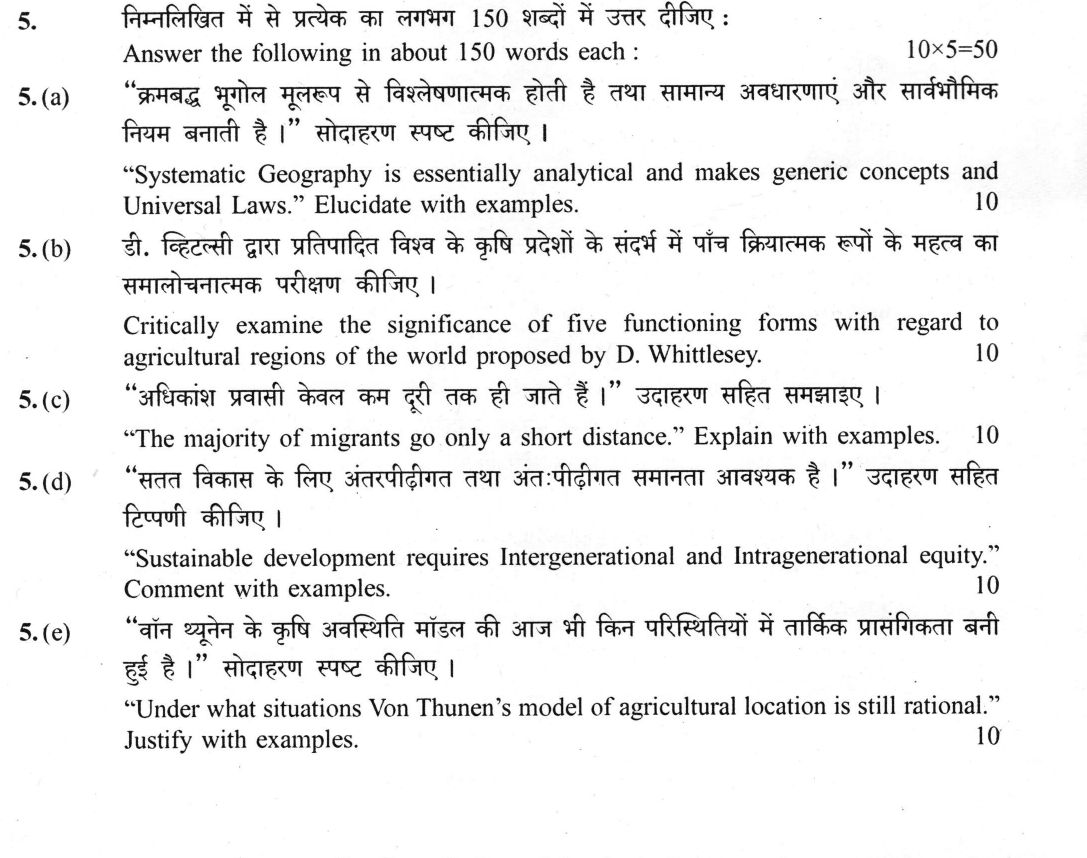
(a) “Systematic Geography is essentially analytical and makes generic concepts and Universal Laws.” Elucidate with examples. (10…
Answer the following in about 150 words each :
“Systematic Geography is essentially analytical and makes generic concepts and Universal Laws.” Elucidate with examples. 10 marks
Critically examine the significance of five functioning forms with regard to agricultural regions of the world proposed by D. Whittlesey. 10 marks
“The majority of migrants go only a short distance.” Explain with examples. 10 marks
“Sustainable development requires Intergenerational and Intragenerational equity.” Comment with examples. 10 marks
“Under what situations Von Thunen’s model of agricultural location is still rational.” Justify with examples. 10 marks
हिंदी में प्रश्न पढ़ें
निम्नलिखित में से प्रत्येक का लगभग 150 शब्दों में उत्तर दीजिए :
“क्रमबद्ध भूगोल मूलरूप से विश्लेषणात्मक होती है तथा सामान्य अवधारणाएं और सार्वभौमिक नियम बनाती है ।” सोदाहरण स्पष्ट कीजिए । (10 अंक)
डी. ह्विटलसी द्वारा प्रतिपादित विश्व के कृषि प्रदेशों के संदर्भ में पांच क्रियात्मक रूपों के महत्व का समालोचनात्मक परीक्षण कीजिए । (10 अंक)
“अधिकांश प्रवासी केवल कम दूरी तक ही जाते हैं ।” उदाहरण सहित समझाइए । (10 अंक)
“सतत विकास के लिए अंतरपीढ़ीगत तथा अंत:पीढ़ीगत समानता आवश्यक है ।” उदाहरण सहित टिप्पणी कीजिए । (10 अंक)
“वॉन थ्यूनेन के कृषि अवस्थिति मॉडल की आज भी किन परिस्थितियों में तार्किक प्रासंगिकता बनी हुई है ।” सोदाहरण स्पष्ट कीजिए । (10 अंक)
Model answer
Drafted with AI by UPSC Answer Check against this question's marking rubric, to the 150-word length. UPSC does not publish answers for Mains — this is one way to score well, not an official key. How we build rubrics and answers.
(a) Systematic geography: analytical and law-seeking
Systematic geography studies one phenomenon across the whole earth, in contrast to regional geography, which integrates many phenomena in one unique area. Bernhardus Varenius drew this line in Geographia Generalis (1650), separating geographia generalis (systematic) from geographia specialis (regional); Humboldt leaned to the systematic pole and Ritter to the regional. Hartshorne's The Nature of Geography (1939) defended the region-centred, idiographic view, while Schaefer's Exceptionalism in Geography (1953) called for a nomothetic, law-seeking discipline.
It is analytical because it isolates a single element, abstracts the recurrent from the unique, and seeks explanation and prediction. Its generic concepts and laws include:
- Davis's cycle of erosion (1899) and Horton's laws of drainage composition (1945) in physical geography.
- Ravenstein's laws of migration (1885) in population geography.
- Von Thünen's model (1826) and Weber's industrial location theory (1909) in economic geography.
- Christaller's central place theory (1933) and Zipf's rank-size rule (1949) in settlement geography.
These "laws" are probabilistic generalisations tested in real regions, so the two approaches are complementary.
(b) Whittlesey's five functioning forms
In "Major Agricultural Regions of the Earth" (1936), Derwent Whittlesey classified world agriculture by five functioning forms:
- Crop–livestock association.
- Methods of growing crops and raising stock.
- Intensity of labour, capital and organisation, and the resulting output.
- Disposal of produce — subsistence or commercial.
- Ensemble of farm buildings and structures.
Significance: The criteria are functional, not physical; they describe the whole farm system rather than a crop list. On this basis Whittlesey delimited thirteen major regions — among them nomadic herding, shifting cultivation, intensive subsistence tillage with and without paddy, commercial plantation, Mediterranean agriculture, commercial dairying and specialised horticulture — and his map remains the textbook standard.
Limitations: The criteria are qualitative and unweighted, so boundaries are subjective; the scheme is a static snapshot of the 1930s that misses mechanisation, the Green Revolution and agribusiness; and it was drawn from a western vantage point. J. C. Weaver's crop-combination method (1954) offered a quantitative successor.
(c) Ravenstein's short-distance law
The statement is the first of E. G. Ravenstein's Laws of Migration (1885, 1889). Because the friction of distance raises the cost, risk and information gap of a move, the number of migrants falls as distance rises — the principle now called distance decay.
Short moves predominate because they are cheap, keep kin networks intact and allow return. Ravenstein linked the law to step migration (village to town to city), to a counter-current for every current, and to the greater mobility of women over short distances.
It was later formalised in G. K. Zipf's inverse-distance hypothesis (1946) and the gravity model, Samuel Stouffer's intervening opportunities (1940) — migrants stop at the nearest suitable opportunity — and Everett Lee's push-pull model (1966), where distance is an intervening obstacle.
Examples: In the Census of India 2011 most migrants moved within their own district, and intra-state movement far outweighed inter-state movement; marriage migration of women, usually over short distances, is the largest single stream.
(d) Intergenerational and intragenerational equity
The Brundtland Commission's Our Common Future (1987) defined sustainable development as meeting present needs without compromising future generations' ability to meet theirs.
Intergenerational equity — fairness between present and future generations — appears in Rio Principle 3 (1992), in Edith Brown Weiss's legal theory, in the Hartwick rule (reinvest rents from exhaustible resources) and, in India, in the public trust doctrine (M. C. Mehta v. Kamal Nath, 1997) and Articles 48A and 51A(g). Example: groundwater mining for paddy in Punjab and Haryana draws down capital owed to future farmers.
Intragenerational equity — fairness within the present generation, between and within countries — underlies common but differentiated responsibilities (Rio Principle 7), the Paris Agreement (2015) and the Loss and Damage Fund (COP27, 2022). Example: the Forest Rights Act (2006) and the Niyamgiri gram sabha decisions (2013) upheld tribal claims against mining.
Comment: Present poverty relief may deplete future capital, so the two can clash. The choice turns on the discount rate (Stern Review, 2006, versus Nordhaus) and on weak (Solow, Hartwick) versus strong (Daly) sustainability — whether manufactured capital can replace natural capital.
(e) When von Thünen is still rational
In Der isolierte Staat (1826), based on his Tellow estate, von Thünen showed that with one market, a uniform plain and transport costs rising with distance, locational rent R = E(p − a) − Efk falls with distance, so land uses sort into rings by perishability and bulk. The detailed rings are obsolete, but the logic stays rational where:
- Transport is slow or costly — Horvath (1969) found Thünen-like zoning around Addis Ababa, and fuelwood and charcoal rings still surround African cities.
- Products are perishable or bulky — the milk sheds and vegetable belts of Delhi, Kolkata and Mumbai hug the market.
- One market dominates — Sinclair (1967) showed an "inverted" pattern at the urban fringe, where expected urbanisation lowers farm intensity.
- Access decides land rent — Alonso's bid-rent theory (1964), after Wingo (1961), carries the principle into urban land use; Chisholm (1962) and Peet (1969) traced it from farm to world scale.
Cold chains, subsidies and contract farming weaken distance effects, yet rent still reflects access.
How this answer will be evaluated
Evaluation rubric
Each sub-part is marked on its own, against the marks and word limit printed on the paper.
- (a) A compact note that 'elucidates with examples' a statement about systematic geography. Three things must appear: what systematic geography is (against regional geography), why it is analytical and generic rather than descriptive and unique, and actual named generic concepts and universal laws produced by its branches. 10 marks · 150 words
Must cover
- Bernhardus Varenius, 'Geographia Generalis' (1650) -- geographia generalis and geographia specialis
- Humboldt (systematic) and Ritter (regional); Hettner; Richard Hartshorne, 'The Nature of Geography' (1939)
- Nomothetic versus idiographic; Fred Schaefer, 'Exceptionalism in Geography' (1953)
- At least three named laws or models: Davis's cycle of erosion, Horton's laws of drainage composition (1945), von Thunen (1826), Weber (1909), Christaller (1933), Ravenstein (1885), Zipf (1949)
Loses marks
- Defining systematic geography and then never supplying a single named law or model, although the statement is precisely about generic concepts and universal laws
- Confusing the terms -- treating systematic geography as the idiographic one, or equating 'systematic' with 'orderly' rather than with general/topical geography
- Reversing the Humboldt-Ritter attribution, or crediting the general/special distinction to Hartshorne rather than to Varenius
- Writing an undergraduate history of geographical thought that never reaches the word 'analytical'
- Overrunning the 150-word limit with a long dualism debate at the cost of the examples
Earns more
- Explains the analytical and nomothetic character -- isolating one element over the whole earth, abstracting from the unique to the recurrent, seeking explanation and prediction -- and contrasts nomothetic with idiographic, ideally citing Schaefer's 'Exceptionalism in Geography' (1953) and the quantitative revolution
- Qualifies the claim: systematic and regional geography are complementary poles of a continuum, generalisations are tested in regions, and the search for universal laws in a human-geographical field is itself contested
- (b) 'Critically examine the significance' of the five criteria (functioning forms) on which Whittlesey built his agricultural regions. The answer must state the five criteria accurately and attribute them, show what they achieved, and then weigh their limitations. Listing the thirteen regions without the five criteria misses the question. 10 marks · 150 words
Must cover
- Derwent Whittlesey (1936), 'Major Agricultural Regions of the Earth', Annals of the Association of American Geographers
- The five criteria: crop-livestock association; methods of production; intensity of labour, capital and organisation with resulting output; disposal of produce (subsistence or commercial); ensemble of farm buildings and structures
- Thirteen major agricultural regions delimited
- Nomadic herding, shifting cultivation, intensive subsistence tillage with and without rice, commercial plantation, Mediterranean agriculture, commercial grain farming, mixed farming, commercial dairying, specialised horticulture, livestock ranching
- J. C. Weaver's crop-combination method (1954) as a quantitative successor
Loses marks
- Listing the thirteen regions instead of the five criteria, which are what the question asks about
- Getting the criteria wrong -- substituting climate, soil or relief for Whittlesey's functional criteria, which are deliberately not physical
- Omitting the fifth criterion, the ensemble of farm buildings and structures, which is the one most often forgotten
- Describing but not criticising, although the directive is 'critically examine'
- Misattributing the scheme to Baker, Weaver, Van Valkenburg or Jonasson
Earns more
- Notes what the criteria achieved: a functional rather than crop-based classification, covering the whole farm system, which yielded thirteen major agricultural regions of the world and remains the standard textbook map
- (c) The quoted statement is Ravenstein's first law of migration; the answer must identify and attribute it, explain why short-distance movement predominates, place it among his other laws and later formalisations of distance decay, and support it with real migration evidence -- 'explain with examples' makes the evidence compulsory. 10 marks · 150 words
Must cover
- E. G. Ravenstein, 'The Laws of Migration' (1885, 1889), Journal of the Royal Statistical Society
- Friction of distance / distance decay
- Step migration; counter-current; female predominance in short-distance migration
- G. K. Zipf's inverse-distance hypothesis (1946); gravity model; Samuel Stouffer's intervening opportunities (1940); Everett Lee's push-pull model (1966)
- Census of India 2011: intra-district and intra-state migration dominate; marriage migration as the largest single stream
Loses marks
- Not recognising the quotation as Ravenstein's first law, and writing a general essay on types of migration
- Attributing the law to Lee, Zipf or Stouffer, who elaborated rather than originated it
- Giving no Indian or empirical evidence although the directive is 'explain with examples'
- Confusing intervening opportunities (Stouffer) with intervening obstacles (Lee)
- Quoting precise Census percentages that the candidate cannot justify, or dating Ravenstein's paper to the twentieth century
Earns more
- Cites later formalisations of distance decay: Zipf's (1946) inverse-distance hypothesis, the gravity/potential model, Stouffer's intervening opportunities (1940), Lee's push-pull with intervening obstacles (1966)
- (d) 'Comment with examples' on a statement that names two distinct equities. Both must be defined separately and illustrated separately -- intergenerational (between present and future generations) and intragenerational (within the present generation, between and within countries) -- and the comment should note where the two pull against each other. 10 marks · 150 words
Must cover
- Brundtland Commission / WCED, 'Our Common Future' (1987); Gro Harlem Brundtland
- Intergenerational equity -- Rio Declaration (1992) Principle 3; Hartwick rule; weak versus strong sustainability (Solow and Hartwick against Herman Daly); Edith Brown Weiss
- Intragenerational equity -- common but differentiated responsibilities (Rio Principle 7); Paris Agreement (2015); Loss and Damage Fund (COP27, 2022); SDGs (2015)
- Public Trust Doctrine -- M. C. Mehta v. Kamal Nath (1997); Articles 48A and 51A(g)
- Named examples: groundwater depletion in Punjab and Haryana; Forest Rights Act 2006 and Niyamgiri; energy access schemes
Loses marks
- Defining sustainable development and its three pillars at length and never separating the two equities, which are the whole question
- Collapsing the two into one, or misdefining intragenerational equity as equity between countries only, ignoring inequality within a country
- Giving no example for either equity, although the directive is 'comment with examples'
- Attributing the Brundtland definition to the Rio Summit (1992), the Stockholm Conference (1972) or the SDGs (2015)
- Listing the seventeen SDGs instead of arguing the equity point
Earns more
- Comments critically: the two equities can pull against each other (present poverty relief versus future natural capital), the choice hinging on the discount rate (Stern Review 2006 against Nordhaus), and on the weak-versus-strong sustainability debate; notes measurement problems (genuine savings, IHDI, ecological footprint, Planetary pressures-adjusted HDI)
- (e) The question is not 'describe von Thunen' but 'under what situations is the model still rational' -- so the bulk of the answer must specify the conditions under which the model retains validity, justified with examples. A brief statement of the model and its assumptions is needed as the premise, and the conditions that destroy it should be noted as the contrast. 10 marks · 150 words
Must cover
- Johann Heinrich von Thunen, 'Der isolierte Staat' (1826); the Tellow estate, Mecklenburg
- Locational rent R = E(p - a) - Efk
- The ring sequence: market gardening and dairying; forestry; crop rotation without fallow; alternate husbandry; three-field system; ranching
- Michael Chisholm, 'Rural Settlement and Land Use' (1962); Ronald Horvath (1969), Addis Ababa; Richard Peet (1969); Robert Sinclair (1967), inverted Thunen on the urban fringe
- William Alonso's bid-rent theory (1964); Lowdon Wingo (1961)
Loses marks
- Describing the model and its rings at length and never answering the actual question -- under what situations it is still rational
- Listing only the model's unrealistic assumptions, turning the answer into a critique when the demand is for continued relevance
- Placing forestry in the wrong ring, or omitting it, when its position (second ring, because firewood and timber were bulky and costly to move in 1826) is the best proof of the model's internal logic
- Giving no example of present-day relevance, so the justification the question demands is missing
- Confusing von Thunen's agricultural rings with Burgess's concentric urban zones (1925)
Earns more
- States the conditions that have destroyed the ring pattern: refrigeration and cold chains, containerisation and falling real freight rates, air freight, tapering freight rates, soil and climatic heterogeneity, subsidies and procurement prices, contract farming and global supply chains
- Delivers a judgement: the concentric geography is obsolete but the bid-rent principle survives and was generalised to urban land use by Wingo (1961) and Alonso (1964)
What "Elucidate" is asking you to do
Make a stated proposition plain and then prove it with instances. Elucidate stems almost always carry a claim or a named concept, and very often the words “with examples” or “with suitable diagrams” — the illustration is part of the directive, not decoration.
Structure that answers it
Plain-language statement of what the proposition means → the part that is obscure, resolved → first illustration → second illustration → why the proposition holds
Where marks are lost
Adding terminology; elucidate rewards removing it. The commoner loss is a clean explanation with no example, when the stem asked for examples.
Practice this exact question
Write your answer and it is marked point by point against the model answer above — what you covered, what you missed, what you got wrong.
Evaluate my answer →More from Geography 2026 Paper I
- Q2 (a) "Environmental geomorphology deals with the impact of natural landforms and processes…
- Q3 (a) Describe the general characteristics and structure of a thunderstorm and suggest suit…
- Q4 (a) How does the annual variations in temperature and precipitation influence plants grow…
- Q5 Answer the following in about 150 words each : (a) “Systematic Geography is essentially a…
- Q6 (a) Discuss the Geometry of Land Values in Urban Community and delimiting the Central Bus…
- Q7 (a) What are the main concerns of radical geography ? Describe the salient features and o…
- Q8 (a) What are the principles of urban planning ? Critically analyse town planning in India…