Paper I — Q2
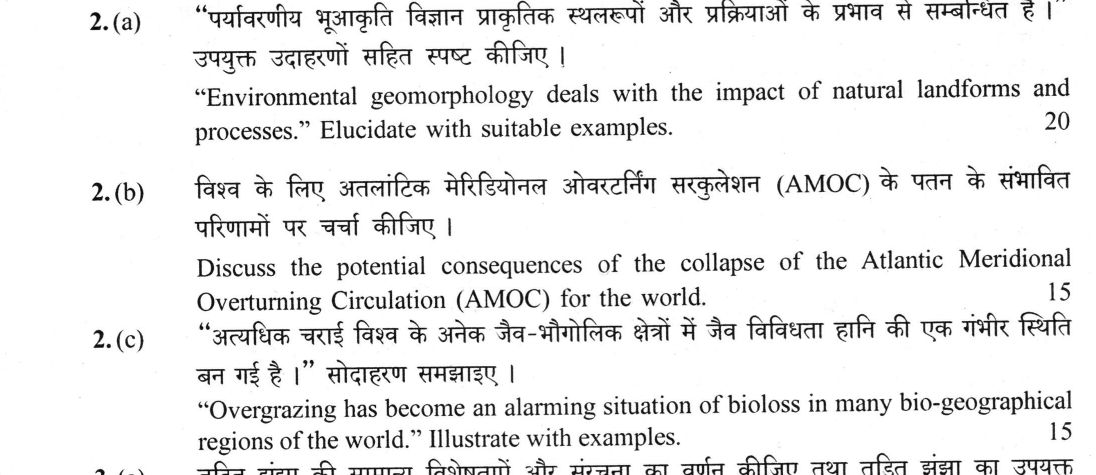
(a) "Environmental geomorphology deals with the impact of natural landforms and processes." Elucidate with suitable examples. (20…
"Environmental geomorphology deals with the impact of natural landforms and processes." Elucidate with suitable examples. 20 marks
Discuss the potential consequences of the collapse of the Atlantic Meridional Overturning Circulation (AMOC) for the world. 15 marks
"Overgrazing has become an alarming situation of bioloss in many bio-geographical regions of the world." Illustrate with examples. 15 marks
हिंदी में प्रश्न पढ़ें
"पर्यावरणीय भूआकृति विज्ञान प्राकृतिक स्थलरूपों और प्रक्रियाओं के प्रभाव से सम्बन्धित है ।" उपयुक्त उदाहरणों सहित स्पष्ट कीजिए । (20 अंक)
विश्व के लिए अटलांटिक मेरिडियोनल ओवरटर्निंग सरकुलेशन (AMOC) के पतन के संभावित परिणामों पर चर्चा कीजिए । (15 अंक)
"अत्यधिक चराई विश्व के अनेक जैव-भौगोलिक क्षेत्रों में जैव विविधता हानि की एक गंभीर स्थिति बन गई है ।" सोदाहरण समझाइए । (15 अंक)
Model answer
Drafted with AI by UPSC Answer Check against this question's marking rubric, to the expected length. UPSC does not publish answers for Mains — this is one way to score well, not an official key. How we build rubrics and answers.
(a) Environmental geomorphology
Environmental geomorphology, as framed by D. R. Coates (1971), applies geomorphology to the interaction between landforms, geomorphic processes and human use of the environment. Its core concern is how natural landforms and processes shape habitats, resources and hazards — and how human modification of landforms feeds back on those processes.
Mechanism and Impact:
- Erosion and Deposition: Natural processes like fluvial erosion and deposition shape the landscape. For example, the Kosi has shifted about 120 km westward over the last two centuries, and its 2008 avulsion at Kusaha reset wetlands, buried fields under sand and affected about three million people; bank erosion by the Ganga in Malda and Murshidabad similarly destroys villages and farmland.
- Landslides and Debris Flows: In mountainous regions, steep gradients and heavy rainfall trigger landslides. Himalayan debris fans often bury agricultural terraces, leading to the loss of arable land and displacement of communities. The Wayanad (Mundakkai–Chooralmala) debris flows of 30 July 2024 and land subsidence at Joshimath (2023) show how slope processes govern the safety of settlements.
- Coastal Processes: Coastal dune breaching and erosion can lead to the salinisation of freshwater systems. In the Sundarbans, coastal erosion and landform changes — islands such as Ghoramara have lost much of their area — threaten the fragile deltaic ecosystem and human settlements.
- Glacial Processes: Glacial lake outburst floods (GLOFs) are a critical environmental hazard. The South Lhonak lake in Sikkim (2023) demonstrated how glacial processes can act as sudden disasters, threatening downstream infrastructure and ecosystems; it destroyed the Teesta III (Chungthang) dam.
- Resources: Landforms also set resource potential — flood plains and alluvial fans hold productive aquifers and soils, while karst terrain controls groundwater and exposes foundations to sinkhole collapse.
Conclusion: Environmental geomorphology is essential for understanding how physical landform features dictate environmental consequences, from resource availability to natural hazard susceptibility.
(b) Consequences of AMOC collapse
The Atlantic Meridional Overturning Circulation (AMOC) is a large-scale system of ocean currents, often called the "conveyor belt," that transports warm water northward and cold water southward. Its collapse would have profound global consequences.
Consequences of Collapse:
- Climate Cooling: A collapse would lead to significant cooling in the North Atlantic and Europe, resulting in colder winters and altered storm tracks.
- Monsoon Shifts: The Inter-Tropical Convergence Zone (ITCZ) would shift southward. This would weaken the Sahel and Indian monsoons, leading to droughts in these regions and increased rainfall in the Southern Hemisphere.
- Sea Level Rise: The collapse would raise sea level along the US east coast and around the North Atlantic, because a weaker Gulf Stream relaxes the sea-surface slope that it maintains across the current, adding a dynamic rise of several tens of centimetres to global sea-level rise.
- Ecosystem Impact: North Atlantic deoxygenation and changes in temperature would disrupt marine ecosystems, affecting fish stocks and biodiversity.
- Global Feedbacks: Through the bipolar seesaw the Southern Hemisphere would warm, tropical rainfall belts over the Amazon would shift, and North Atlantic uptake of CO₂ would weaken, amplifying warming.
Conclusion: IPCC AR6 finds the AMOC very likely to weaken this century but has medium confidence that it will not collapse abruptly before 2100, while early-warning studies (Ditlevsen and Ditlevsen, 2023; van Westen et al., 2024) suggest a tipping point may be closer. Because the system shows hysteresis, a collapse would be effectively irreversible on human timescales, making its impacts on global temperature and precipitation severe and long-lasting.
(c) Overgrazing and bioloss
Overgrazing occurs when livestock density exceeds the carrying capacity of the land, leading to bioloss (loss of biodiversity and ecosystem services).
Mechanism of Bioloss:
- Vegetation Loss: Continuous grazing reduces phytomass (plant biomass), leading to soil exposure.
- Soil Degradation: The loss of vegetation cover leads to the formation of a hard soil crust, reducing water infiltration and increasing erosion.
- Woody Encroachment: In some regions, the removal of grasses leads to the dominance of woody shrubs, altering the ecosystem structure.
Regional Examples:
- Sahel (Africa): Overgrazing has contributed to desertification, reducing the productivity of the grasslands and threatening the livelihoods of pastoralists.
- Deccan Plateau (India): Sheep and goat grazing on commons has led to the degradation of grasslands and loss of native plant species.
- Patagonia (South America): Overgrazing by sheep has altered the steppe vegetation, leading to soil erosion and loss of native fauna.
- Inner Mongolia (China): Overgrazing has caused the degradation of the steppe, contributing to dust storms and loss of biodiversity.
- Banni grasslands (Kutch, India): Heavy grazing, combined with the spread of invasive Prosopis juliflora, has shrunk the cover of palatable grasses in what was once Asia's finest tropical grassland.
Overgrazing is a major driver of bioloss, driven by socio-economic factors like sedentarisation of pastoralists. Effective management requires balancing stocking density with the land's carrying capacity to restore ecosystem health.
How this answer will be evaluated
Framework: Concept or mechanism > Diagram > Regional example > Application
What earns full marks: Clear mechanism explanation, specific examples, labelled diagrams, and strong linkages between physical processes and human/environmental consequences.
Evaluation rubric
Each sub-part is marked on its own, against the marks and word limit printed on the paper.
- (a) Define environmental geomorphology and elucidate the impact of landforms/processes with examples. 20 marks
explain— definition/context → points in order → small example → short close
Must cover
- Define environmental geomorphology as the study of landform-process impact
- Explain the mechanism of a specific natural process (e.g., erosion, deposition)
- Provide a suitable example of landform impact on environment
- Link physical landform features to environmental consequences
Loses marks
- Description without explaining the geomorphological mechanism
- Treating environmental geomorphology only as human impact on landforms, ignoring the impact of natural landforms and processes that the statement stresses
- Generic examples without specific regional or process details
Earns more
- Include a labelled diagram of the landform or process
- Mention specific regional examples (e.g., Himalayan landslides, river deltas)
- Discuss the interaction between landforms and human activities
- Reference specific geomorphological terms (e.g., alluvial fan, moraine)
Extra mark
- Cite a specific recent disaster related to landform processes
- Include a sketch map showing the location of the example
- (b) Discuss the potential consequences of AMOC collapse for the world. 15 marks
discuss— intro → 3-4 dimensions → example → balanced close
Must cover
- Explain the basic mechanism of AMOC (conveyor belt circulation)
- Identify 3-4 dimensions of consequences (climate, agriculture, ecosystems)
- Provide examples of regional impacts (e.g., European cooling, monsoon shifts)
- Conclude with a balanced view on the likelihood and timescale
Loses marks
- Overly technical oceanographic details without clear consequences
- Description without linking to global climate impacts
- Presenting collapse as certain or imminent, ignoring the IPCC AR6 assessment and the scientific uncertainty
Earns more
- Include a simple diagram of the AMOC circulation
- Mention specific climate zones affected (e.g., North Atlantic, Sahel)
- Discuss impacts on global temperature and precipitation patterns
- Reference potential feedback loops in the climate system
Extra mark
- Cite a specific recent study or report on AMOC weakening
- Include a map showing the AMOC pathway and affected regions
- (c) Illustrate how overgrazing causes bioloss in bio-geographical regions with examples. 15 marks
explain— definition/context → points in order → small example → short close
Must cover
- Define overgrazing and its relationship to bioloss
- Explain the mechanism of vegetation loss and soil degradation
- Provide examples from specific bio-geographical regions (e.g., Sahel, Deccan)
- Link overgrazing to loss of biodiversity and ecosystem services
Loses marks
- Description without explaining the ecological mechanism
- Generic examples without specific regional or species details
- Blaming livestock numbers alone while ignoring drivers such as sedentarisation, shrinking commons or invasive species
Earns more
- Include a diagram showing the overgrazing-bioloss cycle
- Mention specific species or vegetation types affected
- Discuss the socio-economic factors driving overgrazing
- Reference specific conservation or management approaches
Extra mark
- Cite a specific recent case study of overgrazing and bioloss
- Include a map showing the location of the example region
What "Elucidate" is asking you to do
Make a stated proposition plain and then prove it with instances. Elucidate stems almost always carry a claim or a named concept, and very often the words “with examples” or “with suitable diagrams” — the illustration is part of the directive, not decoration.
Structure that answers it
Plain-language statement of what the proposition means → the part that is obscure, resolved → first illustration → second illustration → why the proposition holds
Where marks are lost
Adding terminology; elucidate rewards removing it. The commoner loss is a clean explanation with no example, when the stem asked for examples.
Practice this exact question
Write your answer and it is marked point by point against the model answer above — what you covered, what you missed, what you got wrong.
Evaluate my answer →More from Geography 2026 Paper I
- Q1 Answer the following in about 150 words each : (a) What is 'Helical' flow ? How Helical f…
- Q2 (a) "Environmental geomorphology deals with the impact of natural landforms and processes…
- Q3 (a) Describe the general characteristics and structure of a thunderstorm and suggest suit…
- Q4 (a) How does the annual variations in temperature and precipitation influence plants grow…
- Q5 Answer the following in about 150 words each : (a) “Systematic Geography is essentially a…