Paper I — Q4
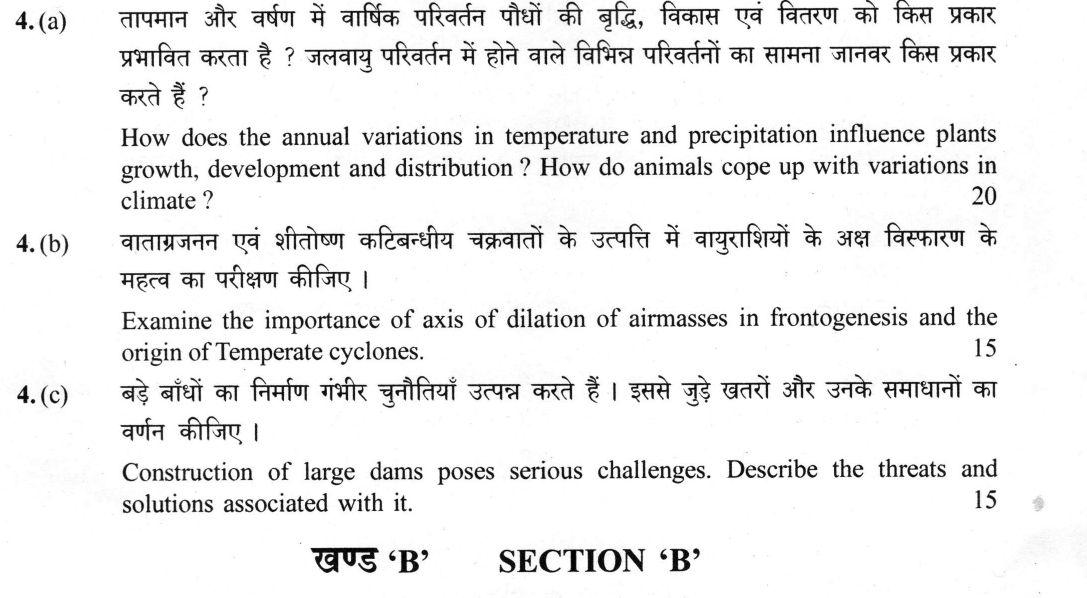
(a) How does the annual variations in temperature and precipitation influence plants growth, development and distribution ? How…
How does the annual variations in temperature and precipitation influence plants growth, development and distribution ? How do animals cope up with variations in climate ? 20 marks
Examine the importance of axis of dilation of airmasses in frontogenesis and the origin of Temperate cyclones. 15 marks
Construction of large dams poses serious challenges. Describe the threats and solutions associated with it. 15 marks
हिंदी में प्रश्न पढ़ें
तापमान और वर्षण में वार्षिक परिवर्तन पौधों की वृद्धि, विकास एवं वितरण को किस प्रकार प्रभावित करता है ? जलवायु में होने वाले विभिन्न परिवर्तनों का सामना जानवर किस प्रकार करते हैं ? (20 अंक)
वाताग्रजनन एवं शीतोष्ण कटिबन्धीय चक्रवातों के उत्पत्ति में वायुराशियों के अक्ष विस्फारण के महत्व का परीक्षण कीजिए । (15 अंक)
बड़े बाँधों का निर्माण गंभीर चुनौतियां उत्पन्न करते हैं । इससे जुड़े खतरों और उनके समाधानों का वर्णन कीजिए । (15 अंक)
Model answer
Drafted with AI by UPSC Answer Check against this question's marking rubric, to the expected length. UPSC does not publish answers for Mains — this is one way to score well, not an official key. How we build rubrics and answers.
(a) Climatic rhythm, plants and animals
Annual variations in temperature and precipitation dictate plant growth, development, and distribution by establishing seasonal rhythms that trigger specific physiological responses. Each species has cardinal temperatures (minimum, optimum, maximum), and day–night alternation (thermoperiodism) also shapes growth. Growth is governed by Growing Degree-Days (GDD), which accumulate only when temperatures exceed the base threshold; this dictates the length of the growing season. Development is controlled by vernalisation (cold exposure) and photoperiodism, as demonstrated by W. W. Garner and H. A. Allard (1920), where day length triggers flowering. Distribution is mapped using Robert Whittaker’s (1975) biome diagram on temperature and precipitation axes and Leslie Holdridge’s Life Zones (1947), built on biotemperature, annual precipitation and the potential evapotranspiration ratio; C. W. Thornthwaite’s (1948) moisture index likewise shows that effective precipitation, not rainfall totals, sets moisture availability. Liebig’s law of the minimum and Shelford’s law of tolerance (1913) explain why the most limiting seasonal factor — winter frost or summer drought — fixes range limits. The 10°C warmest-month isotherm marks the polar forest limit (tree line), while Christen Raunkiaer’s (1934) life-form classes (e.g., phanerophytes vs. hemicryptophytes) reflect how plants position their buds to survive seasonal extremes.
Animals cope with these variations through physiological and behavioural strategies. Physiologically, homeotherms follow Bergmann’s rule (1847)—larger bodies in cold climates, lowering the surface-area-to-volume ratio—and Allen’s rule (1877)—shorter extremities in cold regions to minimize heat loss. Hibernation, aestivation, torpor and diapause carry animals through harsh seasons — marmots and bears among homeotherms, frogs, lizards and insects among poikilotherms — while species like the kangaroo rat and camel exhibit extreme water economy. Behaviourally, animals migrate to track seasonal resources, such as the Arctic tern or the Siberian crane (which last reached Keoladeo in 2002). Other strategies include nocturnality, burrowing, and huddling (e.g., emperor penguins) to regulate body temperature and conserve energy.
(b) Axis of dilatation, frontogenesis and temperate cyclones
The importance of the axis of dilatation in frontogenesis lies in its role as the kinematic mechanism for concentrating temperature gradients. In a deformation field, the axis of dilatation (outflow) stretches isotherms, while the axis of contraction (inflow) compresses them. Sverre Petterssen (1936) formalized this using Tor Bergeron’s (1928) frontogenetical function, stating that frontogenesis occurs when the angle between isotherms and the axis of dilatation is less than 45°. If the angle exceeds 45°, frontolysis occurs. This kinematic sharpening of the gradient is the prerequisite for the polar front theory proposed by Jacob Bjerknes (1919) and the Bergen School (J. Bjerknes and Solberg, 1922).
The origin of temperate cyclones is explained by the wave theory, where the front created by the deformation field becomes the seat of a wave cyclone. As the front sharpens, the system becomes baroclinically unstable. Jule Charney (1947) and Eric Eady (1949) demonstrated that this instability allows the system to extract potential energy from the horizontal temperature gradient, converting it into kinetic energy. This process is further driven by upper-air Rossby waves and the divergence of the polar-front jet stream, as described in Sutcliffe’s (1947) development theory. While the deformation field explains the concentration of the gradient, it does not explain the energy source; the energy is derived from baroclinic instability. The result is the classic cyclone life cycle: incipient wave, open wave, occlusion, and decay.
(c) Large dams: threats and solutions
The construction of large dams poses serious challenges that span social, geomorphic, ecological, and safety domains. Socially, large-scale displacement is a primary threat, as seen in the Sardar Sarovar project (Narmada Bachao Andolan) and the Three Gorges Dam. Geomorphically, dams cause reservoir sedimentation and downstream sediment starvation, leading to delta retreat, a critical issue for the Nile delta due to the Aswan High Dam. Ecologically, they disrupt riverine habitats and fish migration. Economically and politically, large dams often suffer cost and time overruns and can fuel inter-state disputes (Cauvery, Mullaperiyar) and international ones (the Grand Ethiopian Renaissance Dam on the Blue Nile, projects on the Mekong). Safety threats include reservoir-induced seismicity, such as the Koyna earthquake (11 December 1967, magnitude 6.3), and catastrophic failures like the Machchhu-II dam (Morbi, 1979). Recently, the South Lhonak GLOF (4 October 2023) highlighted the threat of glacial outburst floods to downstream structures like the Teesta-III Chungthang dam.
Solutions must be concrete and institutional. The World Commission on Dams (2000) emphasized the need for options assessment and demand management over large-scale storage. Engineering solutions include sediment flushing and the implementation of environmental flows, such as the Ganga e-flow notification (2018). Legal and institutional frameworks are vital for safety and rehabilitation; India’s Dam Safety Act 2021 established the National Dam Safety Authority to monitor high-risk dams. The Dam Rehabilitation and Improvement Project (DRIP) addresses structural decay, while the LARR Act 2013 ensures rehabilitation and resettlement, and hydropower policy adds benefit-sharing through 12% free power to the host state. The EIA Notification 2006 mandates rigorous environmental impact assessments before construction, ensuring that ecological and social costs are weighed against benefits.
How this answer will be evaluated
Evaluation rubric
Each sub-part is marked on its own, against the marks and word limit printed on the paper.
- (a) Two distinct questions, both compulsory. First, how annual variation in temperature and precipitation influences plant growth, development AND distribution -- all three verbs must be addressed, and the seasonal or annual rhythm, not merely the mean, must be used. Second, how animals cope with climatic variation -- which needs both physiological and behavioural strategies. Roughly equal treatment is expected. 20 marks
Must cover
- Cardinal temperatures; growing degree-days; vernalisation; thermoperiodism
- Photoperiodism -- W. W. Garner and H. A. Allard (1920)
- Tree line and the 10 degrees C warmest-month isotherm (Koppen's polar forest limit)
- Effective precipitation and potential evapotranspiration; C. W. Thornthwaite (1948) moisture index
- Robert Whittaker's (1975) biome diagram on temperature and precipitation axes; Leslie Holdridge's Life Zones (1947)
- Christen Raunkiaer's (1934) life-form classes: phanerophytes, chamaephytes, hemicryptophytes, cryptophytes, therophytes
- Liebig's law of the minimum; Shelford's law of tolerance (1913)
- Bergmann's rule (1847); Allen's rule (1877); hibernation, aestivation, torpor, diapause; kangaroo rat and camel water economy
Loses marks
- Answering only the plant half and leaving the animal half -- an explicit second question -- unanswered or reduced to two lines
- Writing about mean annual temperature and total rainfall only, ignoring the 'annual variation' the question specifies, so seasonality, growing season and phenology never appear
- Covering growth and distribution but not development (flowering, vernalisation, photoperiod, maturation), although all three words are in the question
- Naming no scheme or law, so the answer has no authority: Whittaker, Holdridge, Raunkiaer, Bergmann and Allen are the names the examiner looks for
- Inverting Bergmann's or Allen's rule (claiming smaller bodies or longer extremities in cold climates)
- Treating precipitation totals as equivalent to moisture availability, without evapotranspiration
Earns more
- Gives animal physiological strategies: homeothermy versus poikilothermy, Bergmann's (1847) and Allen's (1877) rules, insulation and brown fat, countercurrent heat exchange, evaporative cooling, the water economy of the kangaroo rat and camel, hibernation, aestivation, torpor and diapause, moulting, salt glands, acclimatisation
- Gives animal behavioural and ecological strategies with named examples: migration (Arctic tern, Siberian crane at Keoladeo, Serengeti wildebeest, Himalayan altitudinal movement), nocturnality, burrowing, huddling of emperor penguins, caching and pre-winter fattening, breeding synchrony, phenological mismatch under warming
- (b) 'Examine the importance' of one specific kinematic concept -- the axis of dilatation in a deformation field -- for two things: frontogenesis, and the origin of temperate (extratropical) cyclones. The answer must define the deformation field and its axes, state Petterssen's angular criterion, and then show how the front so created becomes the seat of a wave cyclone. Examine implies weighing what the concept explains against what it leaves out. 15 marks
Must cover
- Deformation or col field; axis of dilatation (outflow) and axis of contraction (inflow)
- The 45-degree criterion: frontogenesis below 45 degrees between isotherms and the axis of dilatation, frontolysis above it
- Tor Bergeron (1928) -- frontogenesis and the frontogenetical function; Sverre Petterssen (1936; 'Weather Analysis and Forecasting', 1956)
- Polar front theory -- Jacob Bjerknes (1919); Jacob Bjerknes and Halvor Solberg (1922), Bergen School founded by Vilhelm Bjerknes
- Baroclinic instability -- Jule Charney (1947), Eric Eady (1949); Sutcliffe (1947) development theory; Rossby waves (1939)
- Occlusion; warm and cold sector; polar-front jet divergence
Loses marks
- Inverting the criterion -- claiming frontogenesis when the isotherms lie at more than 45 degrees to the axis of dilatation
- Confusing the axis of dilatation with the axis of contraction, or describing convergence along the dilatation axis
- Writing a general description of the life cycle of a temperate cyclone and never mentioning the deformation field or the axis of dilatation at all, which is the actual subject of the question
- Omitting the second half -- the origin of temperate cyclones -- and answering only on frontogenesis
- Explaining the cyclone purely at the surface, with no upper-air divergence, jet stream or baroclinic instability, so the deepening is left unexplained
- Attributing the polar front theory to Petterssen or to Rossby instead of to the Bjerkneses and Solberg of the Bergen School
Earns more
- Links frontogenesis to the origin of temperate cyclones through the polar-front/wave theory of J. Bjerknes (1919) and J. Bjerknes and Solberg (1922) -- incipient wave, open wave, occlusion, decay -- with the upper-air controls (Rossby waves, jet-stream divergence, Sutcliffe's 1947 development theory, Charney 1947 and Eady 1949 baroclinic instability)
- Examines the limits of the kinematic argument: it explains concentration of the gradient but not the energy source; neglects ageostrophic secondary circulation, latent heat and friction; superseded in part by Q-vector/semigeostrophic theory and by the Shapiro-Keyser (1990) alternative to classical occlusion
- (c) 'Describe the threats and solutions associated with' large dams -- a two-part, roughly balanced answer. Threats must be classified (social, geomorphic and hydrological, ecological, safety, economic and political) and evidenced with named dams; solutions must be concrete (engineering, environmental-flow, legal and institutional), not a list of pieties. 15 marks
Must cover
- World Commission on Dams, 'Dams and Development' (2000)
- Sardar Sarovar and the Narmada Bachao Andolan (Medha Patkar); Three Gorges displacement
- Reservoir sedimentation and downstream sediment starvation -- Aswan High Dam and the Nile delta
- Reservoir-induced seismicity -- Koyna, 11 December 1967 (about magnitude 6.3)
- Dam failure -- Machchhu-II (Morbi) 1979; South Lhonak GLOF of 4 October 2023 and the Teesta-III Chungthang dam
- Dam Safety Act 2021 and the National Dam Safety Authority; Dam Rehabilitation and Improvement Project
- Environmental flows (Ganga e-flow notification, 2018); LARR Act 2013; EIA Notification 2006
Loses marks
- Listing threats only and offering no solutions, or offering solutions as vague slogans ('sustainable planning', 'people's participation') without a named statute, instrument or technique
- Naming no dam at all, so the answer cannot be checked; generic phrases such as 'many Indian dams' earn nothing
- Confusing reservoir-induced seismicity with tectonic earthquakes, or claiming that dams cause earthquakes anywhere irrespective of geology
- Ignoring the geomorphic consequences downstream -- sediment starvation, delta retreat, channel incision -- which are the distinctively geographical part of the answer
- Presenting a one-sided polemic that never concedes the storage, irrigation, flood-moderation and power benefits, which weakens the 'describe' demand
Earns more
- Economic and political threats: cost and time overrun and weak benefit realisation; inter-state disputes (Cauvery, Mullaperiyar, Krishna) and international ones (Indus Waters Treaty and Kishanganga/Ratle, GERD on the Blue Nile, Mekong)
- Engineering and planning solutions: options assessment and demand management, watershed and small-storage alternatives, catchment treatment and sediment flushing/sluicing/dredging, mandated environmental flows (Ganga e-flow notification, 2018), fish passes, basin-level cumulative impact assessment, decommissioning
- Legal and institutional solutions: Dam Safety Act 2021 with the National Dam Safety Authority, the Dam Rehabilitation and Improvement Project, LARR Act 2013 with benefit sharing (twelve per cent free power, local area development fund), EIA Notification 2006, participatory irrigation management, and the World Commission on Dams' (2000) seven strategic priorities
What "How" is asking you to do
Set out the route by which the outcome comes about, step by step. Many how stems ask how one thing affects another, and there the channel of transmission is precisely what is being marked.
Structure that answers it
Starting condition → step → step → outcome reached → the conditions the route depends on
Where marks are lost
Answering why it happens instead of how, the commonest single misread in the paper. An answer full of causes and significance that never traces the mechanism has answered a different question.
Practice this exact question
Write your answer and it is marked point by point against the model answer above — what you covered, what you missed, what you got wrong.
Evaluate my answer →More from Geography 2026 Paper I
- Q1 Answer the following in about 150 words each : (a) What is 'Helical' flow ? How Helical f…
- Q2 (a) "Environmental geomorphology deals with the impact of natural landforms and processes…
- Q3 (a) Describe the general characteristics and structure of a thunderstorm and suggest suit…
- Q4 (a) How does the annual variations in temperature and precipitation influence plants grow…
- Q5 Answer the following in about 150 words each : (a) “Systematic Geography is essentially a…
- Q6 (a) Discuss the Geometry of Land Values in Urban Community and delimiting the Central Bus…
- Q7 (a) What are the main concerns of radical geography ? Describe the salient features and o…