Paper I — Q1
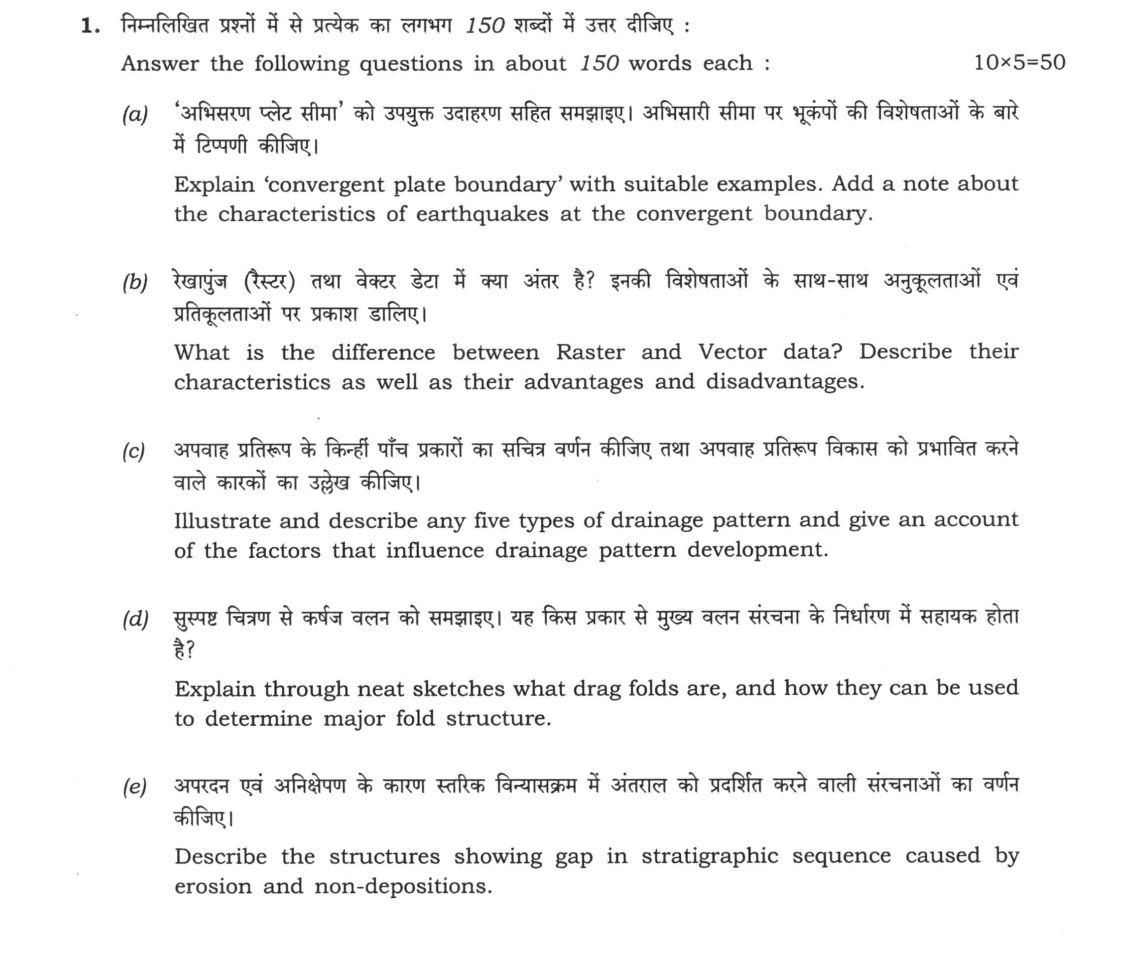
Answer the following questions in about 150 words each: (a) Explain 'convergent plate boundary' with suitable examples. Add a…
Answer the following questions in about 150 words each:
Explain 'convergent plate boundary' with suitable examples. Add a note about the characteristics of earthquakes at the convergent boundary. 10 marks
What is the difference between Raster and Vector data? Describe their characteristics as well as their advantages and disadvantages. 10 marks
Illustrate and describe any five types of drainage pattern and give an account of the factors that influence drainage pattern development. 10 marks
Explain through neat sketches what drag folds are, and how they can be used to determine major fold structure. 10 marks
Describe the structures showing gap in stratigraphic sequence caused by erosion and non-depositions. 10 marks
हिंदी में प्रश्न पढ़ें
निम्नलिखित प्रश्नों में से प्रत्येक का लगभग 150 शब्दों में उत्तर दीजिए :
'अभिसरण प्लेट सीमा' को उपयुक्त उदाहरण सहित समझाइए। अभिसारी सीमा पर भूकंपों की विशेषताओं के बारे में टिप्पणी कीजिए। (10 अंक)
रेखापुंज (रैस्टर) तथा वेक्टर डेटा में क्या अंतर है? इनकी विशेषताओं के साथ-साथ अनुकूलताओं एवं प्रतिकूलताओं पर प्रकाश डालिए। (10 अंक)
अपवाह प्रतिरूप के किन्हीं पाँच प्रकारों का सचित्र वर्णन कीजिए तथा अपवाह प्रतिरूप विकास को प्रभावित करने वाले कारकों का उल्लेख कीजिए। (10 अंक)
सुस्पष्ट चित्रण से कर्षण वलन को समझाइए। यह किस प्रकार से मुख्य वलन संरचना के निर्धारण में सहायक होता है? (10 अंक)
अपरदन एवं अनिशेषण के कारण स्तरीय विन्यासक्रम में अंतराल को प्रदर्शित करने वाली संरचनाओं का वर्णन कीजिए। (10 अंक)
Model answer
Written by UPSC Answer Check against this question's marking rubric, to the 150-word length. UPSC does not publish answers for Mains — this is one way to score well, not an official key.
(a) Convergent plate boundary. A convergent boundary occurs where lithospheric plates collide, causing one plate to be forced beneath another or crust to shorten. In oceanic–continental convergence, dense oceanic lithosphere subducts beneath lighter continental crust, producing a volcanic arc and mountain belt, as in the Andes where the Nazca Plate subducts beneath South America. In oceanic–oceanic convergence, subduction forms an island arc, as in the Mariana and Aleutian arcs. In continental–continental convergence, neither plate readily subducts; crust thickens, folds and faults, as in the Himalaya where India collides with Asia. The subducting slab bends into the mantle, defining a Wadati-Benioff zone of inclined seismicity. The inclined seismic zone records the geometry of the subducting slab. Earthquakes at such boundaries are frequent, often strong, and may be shallow to deep; deep-focus events occur within the cold, brittle slab. Subduction can also generate tsunamis through seafloor displacement.
(b) Raster and vector data. Raster data represent the Earth as a grid of cells, each holding a value such as elevation, temperature, or spectral reflectance. It is well suited to continuous phenomena and remote-sensing imagery, where every pixel is sampled. Its advantages are simple storage, easy overlay, and rapid processing of large areas; disadvantages include loss of precision at boundaries, larger files for high resolution, and scale-dependent detail. Vector data represent discrete features as points, lines, and polygons, with coordinates and topology defining adjacency, connectivity, and containment. They are ideal for roads, rivers, administrative boundaries, and mapped geology. Advantages include compact storage for sparse features, exact geometry, and efficient network analysis; disadvantages include complex data capture, difficulty representing continuous fields, and topology maintenance. In GIS, raster supports image classification and surface modelling, while vector supports cadastral mapping and spatial querying. Raster is better for continuous surface modelling; vector for precise boundary mapping.
(c) Drainage patterns. Drainage pattern is the arrangement of streams controlled by structure, lithology, relief, climate, base level, and time. Dendritic patterns, like branches of a tree, develop on uniform, homogeneous rock with little structural control; the Ganga plain shows a dendritic network. Trellis patterns occur where parallel resistant ridges are cut by cross-valleys, commonly in folded regions; the Chambal region is a classic Indian example. Radial patterns radiate from a central high, such as a volcanic dome or structural uplift; the Narmada valley region is often cited. Rectangular patterns develop along intersecting faults or joints, giving right-angle bends, as in many faulted crystalline terrains. Parallel patterns occur on uniform slopes or tilted strata, with streams flowing side by side, as on the Western Ghats escarpment. Lithology controls resistance, structure controls orientation, relief and base level control gradient, while climate and vegetation affect runoff and erosion. Base-level fall can rejuvenate streams and modify the pattern.
(d) Drag folds. A drag fold is a small, asymmetric fold formed in a weak layer by shear during development of a larger fold. In a neat sketch, draw a major fold with an incompetent shale layer sandwiched between competent beds. The sketch should show the major hinge, dragged minor hinges, and competent beds. On the limbs, the shale is dragged into small folds whose hinges are inclined toward the direction of movement. If the small folds have a Z-shape, the upper plate moved to the right; if S-shaped, it moved to the left. The asymmetry is strongest near the major hinge and diminishes away from it. Because drag folds record the sense of shear on the limbs, they help determine the vergence of the major fold, identify overturned or recumbent folds, and infer thrust or nappe transport. They are especially useful where the major fold is eroded or buried, because the minor folds preserve the kinematic history of the deformation.
(e) Unconformities. Structures showing a gap in the stratigraphic sequence are unconformities, surfaces of erosion or non-deposition. They record uplift, erosion, or interrupted sedimentation. An angular unconformity occurs when older beds are tilted or folded, eroded, and overlain by younger horizontal beds; the erosional surface and angular discordance are diagnostic. A disconformity separates parallel strata but represents a hiatus caused by erosion or non-deposition; it may be marked by a paleosol, channel, or fossil gap. A nonconformity separates sedimentary rocks from crystalline or metamorphic basement, as at the Eparchaean Unconformity of Tirupati, where Cuddapah sedimentary rocks rest on Archean crystalline basement. A paraconformity is a subtle conformable contact where deposition was interrupted without obvious erosion, recognised mainly by missing fossils or radiometric ages. Field criteria include an erosional surface, basal conglomerate, weathered horizon, paleosol, and stratigraphic or fossil gap. Such surfaces are economically important because they can trap hydrocarbons, host mineral deposits, or define aquifer boundaries.
What "Explain" is asking you to do
Make the working of something clear — what sets it off, what follows from what, and what it produces. Explain is the Commission's mechanism word: it dominates the technical papers and the “explain why” stems, where the marks sit in the causal chain and not in the label.
Structure that answers it
State what it is → the initiating condition → the chain of cause, step by step → an instance where it plays out → what the chain produces
Where marks are lost
Describing what something looks like instead of why it works that way. Naming the stages without linking them reads as description too.
How this answer will be evaluated
Approach
Framework: Geology Paper 1: Define > Process > Field/Petrographic Evidence > Indian Example. (a) explain: definition/context > points in order > small example > short close | (b) compare: paired headings or table > key differences > significance > conclusion | (c) describe: define > structure or process in order > labelled diagram > significance | (d) explain: definition/context > points in order > small example > short close | (e) describe: define > structure or process in order > labelled diagram > significance Full marks: All parts with Indian examples, precise terminology, and required sketches/diagrams
Key points expected
- Define convergent plate boundary
- Provide suitable examples (e.g., Himalaya, Andes)
- Note characteristics of earthquakes at boundary
- Link to Indian context (e.g., Himalayan oration)
- Define Raster data
- Define Vector data
- List advantages and disadvantages of each
- Describe characteristics of both
Evaluation rubric
Each sub-part is marked on its own, against the marks and word limit printed on the paper.
- (a) Definition of convergent boundary, examples, and earthquake characteristics. · 150 words
explain— definition/context → points in order → small example → short close
Must cover
- Define convergent plate boundary
- Provide suitable examples (e.g., Himalaya, Andes)
- Note characteristics of earthquakes at boundary
- Link to Indian context (e.g., Himalayan oration)
Loses marks
- Generic description without Indian example
- Missing earthquake characteristics
Earns more
- Mention subduction zone mechanics
- Distinguish shallow vs deep focus quakes
- Reference specific Indian seismic zones
Extra mark
- Specific Indian seismic event example
- Precise depth range of quakes
- (b) Differences between Raster and Vector data with pros/cons. · 150 words
compare— paired headings or table → key differences → significance → conclusion
Must cover
- Define Raster data
- Define Vector data
- List advantages and disadvantages of each
- Describe characteristics of both
Loses marks
- Confusing Raster and Vector definitions
- Missing advantages/disadvantages
Earns more
- Mention specific GIS applications
- Reference data resolution or scale
- Link to Indian mapping projects
Extra mark
- Specific Indian GIS project example
- Precise technical terminology
- (c) Five drainage patterns with influencing factors. · 150 words
describe— define → structure or process in order → labelled diagram → significance
Must cover
- Illustrate five types of drainage patterns
- Describe each pattern
- Account for factors influencing development
- Provide Indian examples where relevant
Loses marks
- Missing illustrations or sketches
- Generic description without Indian context
Earns more
- Mention specific Indian river systems
- Reference geological controls
- Link to Indian physiographic regions
Extra mark
- Specific Indian river basin example
- Precise geological formation names
- (d) Drag folds definition, sketches, and use in fold structure. · 150 words
explain— definition/context → points in order → small example → short close
Must cover
- Define drag folds
- Provide neat sketches
- Explain how they determine major fold structure
- Link to Indian geological examples
Loses marks
- Missing sketches or diagrams
- Generic description without Indian example
Earns more
- Mention specific Indian fold regions
- Reference structural geology principles
- Link to Indian craton or basin
Extra mark
- Specific Indian fold structure example
- Precise structural terminology
- (e) Structures showing stratigraphic gaps from erosion/non-deposition. · 150 words
describe— define → structure or process in order → labelled diagram → significance
Must cover
- Describe structures showing gaps
- Explain erosion causes
- Explain non-deposition causes
- Provide Indian stratigraphic examples
Loses marks
- Missing Indian stratigraphic example
- Confusing erosion and non-deposition
Earns more
- Mention specific Indian formations
- Reference stratigraphic age
- Link to Indian geological history
Extra mark
- Specific Indian formation name
- Precise stratigraphic age
Practice this exact question
Write your answer and it is marked point by point against the model answer above — what you covered, what you missed, what you got wrong.
Evaluate my answer →More from Geology 2022 Paper I
- Q1 Answer the following questions in about 150 words each: (a) Explain 'convergent plate bou…
- Q2 (a) Discuss in detail the notion of 'continental drift' and the theories of plate tectoni…
- Q3 (a) Describe the geomorphic landforms produced by structural, weathering, erosional and d…
- Q4 (a) Illustrate the common brittle-ductile shear zone structures. Using the stress ellipso…