Paper I — Q2
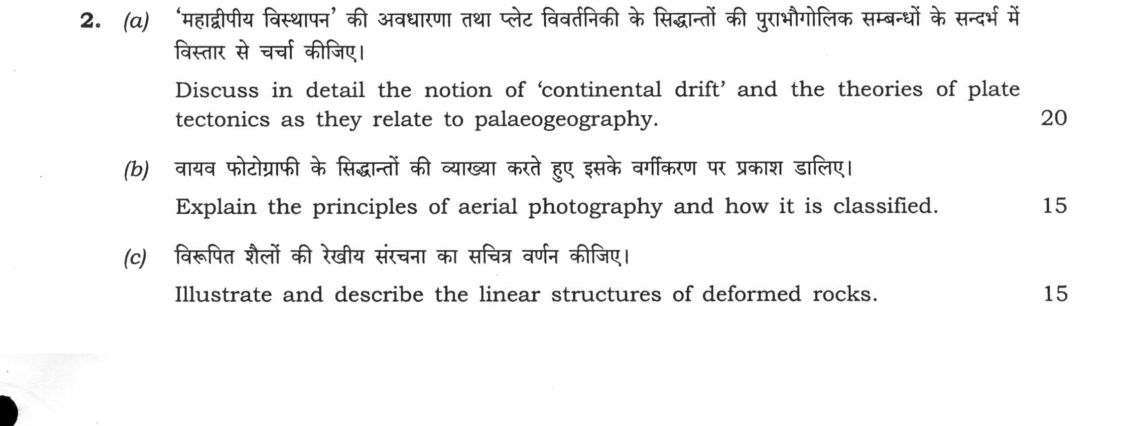
(a) Discuss in detail the notion of 'continental drift' and the theories of plate tectonics as they relate to palaeogeography…
Discuss in detail the notion of 'continental drift' and the theories of plate tectonics as they relate to palaeogeography. 20 marks
Explain the principles of aerial photography and how it is classified. 15 marks
Illustrate and describe the linear structures of deformed rocks. 15 marks
हिंदी में प्रश्न पढ़ें
'महाद्वीपीय विस्थापन' की अवधारणा तथा प्लेट विवर्तनिकी के सिद्धांतों की पुराभौगोलिक संबंधों के संदर्भ में विस्तार से चर्चा कीजिए। (20 अंक)
वायव फोटोग्राफी के सिद्धांतों की व्याख्या करते हुए इसके वर्गीकरण पर प्रकाश डालिए। (15 अंक)
विक्षिप्त शैलों की रेखीय संरचना का सचित्र वर्णन कीजिए। (15 अंक)
Model answer
Written by UPSC Answer Check against this question's marking rubric, to the expected length. UPSC does not publish answers for Mains — this is one way to score well, not an official key.
The three topics link structural geology and remote sensing: drift and plate tectonics explain large-scale palaeogeography, aerial photography maps its surface expressions, and linear structures record deformation.
Continental drift and plate tectonics. Wegener’s continental drift proposed that continents once formed Pangaea and have drifted apart. Evidence included the jigsaw fit of South America and Africa, fossil correlations such as Glossopteris and Mesosaurus across Gondwana, and palaeoclimatic indicators like glacial striations and coal deposits in now tropical regions. The idea was initially rejected because no mechanism was accepted. Plate tectonics supplied mechanisms: mantle convection, slab pull, ridge push, and transform motion. Seafloor spreading, supported by young oceanic crust and symmetrical magnetic stripes, linked drift to plate tectonics. Divergent boundaries create oceanic crust at mid-ocean ridges; convergent boundaries consume it at trenches, producing subduction, collision and orogeny; transform boundaries accommodate lateral slip. This makes plate tectonics a dynamic framework: it explains not only present boundaries but also past reconstructions, rates of drift, and the timing of mountain building. Indian examples include the Himalayan collision zone where the Indian plate has converged with Eurasia, the Andaman-Nicobar subduction zone, and the diffuse Indo-Australian plate boundary, a broad zone of deformation rather than a simple transform. Palaeomagnetic data, including Apparent Polar Wander Paths from Deccan Trap basalts, support India’s northward movement and Gondwana reconstruction. The Wilson cycle and supercontinent cycles—Rodinia, Gondwana, Pangea—show repeated assembly and breakup. Palaeogeography thus uses fit, fossils, climate, magnetics and plate kinematics to restore past positions, ocean basins and collision timing.
Aerial photography. Aerial photography records the Earth’s surface from aircraft; related remote-sensing images use other platforms. Its principles include stereoscopic vision, which gives three-dimensional perception from overlapping images; parallax, the apparent displacement used to estimate heights and relief; scale, the ratio of image distance to ground distance; resolution, the ability to distinguish adjacent features; and overlap, usually 60 per cent longitudinal and 20 to 30 per cent lateral, needed for stereoscopy and coverage. Classification is by platform: terrestrial, aerial and space; by tilt: vertical and oblique; by film or sensor: panchromatic, infrared and false-colour composite; and by scale: large, medium and small. These classifications help select the right image for structural mapping, lineament detection and thematic interpretation. In India, GSI aerial surveys have been used for geological mapping and mineral targeting, while Landsat and IRS satellite imagery have helped map lineaments in the Dharwar craton. Bhuvan integrates such datasets for geological and remote-sensing analysis.
Linear structures. Linear structures are elongated features in rocks. Primary lineations include bedding and flow cleavage, formed during deposition or magmatic flow; they may be inherited and later deformed. Secondary lineations are deformational: fold axes, intersection lineations, mineral lineations, mullions and boudin axes. They are important strain markers and kinematic indicators: their orientation, plunge and associated asymmetry help determine the direction of shortening, extension and transport. A simple sketch would show a folded bed with a fold axis, a planar foliation cut by a mineral lineation, and boudinaged layers with long axes parallel to extension. In maps, lineaments may be mapped from aerial or satellite images, then verified in the field. In India, E-W trending lineaments in the Singhbhum shear zone mark the shear-zone trend, and associated E-W stretching lineations would indicate E-W transport; N-S trending lineations in the Aravalli fold belt reflect fold axes and shortening directions; and mineral lineations in the Kerala khondalite belt indicate transport direction during ductile shear. Together, these structures help reconstruct palaeostresses and plate-boundary evolution.
Thus, integrating palaeogeographic reconstructions, remote-sensing classification and structural lineations provides a way forward for mapping crustal evolution and guiding mineral exploration.
What "Discuss" is asking you to do
Lay the issue out from more than one side — how it arose, what is claimed for it, what is held against it, and where it now stands. UPSC attaches discuss to broad topics with several live dimensions, so coverage of the dimensions earns more than the strength of your opinion.
Structure that answers it
Set the issue up → the case as it is made → the case against → the dimension both sides leave out → where the balance now lies
Where marks are lost
Listing facts with no thread between them, or arguing one side throughout and calling it a discussion.
How this answer will be evaluated
Approach
Framework: Geology Paper 1: Define > Process > Evidence > Indian Example. (a) discuss: intro > 3-4 dimensions > example > balanced close | (b) explain: definition/context > points in order > small example > short close | (c) describe: define > structure or process in order > labelled diagram > significance Full marks: Precise definitions, clear mechanisms, specific Indian examples, labelled diagrams, and accurate terminology.
Key points expected
- Wegener's evidence: fit, fossils, paleoclimate, geology
- Mechanism: convection, seafloor spreading, subduction
- Palaeogeographic reconstruction: Pangaea, Gondwana, Laurasia
- Indian example: Gondwana breakup, Deccan Traps, Himalayan collision
- Principles: perspective, scale, overlap, stereo-pair
- Classification: oblique vs vertical
- Classification: low, medium, high altitude
- Application in geological mapping
Evaluation rubric
Each sub-part is marked on its own, against the marks and word limit printed on the paper.
- (a) Detailed discussion of continental drift and plate tectonics in the context of palaeogeography. 20 marks
discuss— intro → 3-4 dimensions → example → balanced close
Must cover
- Wegener's evidence: fit, fossils, paleoclimate, geology
- Mechanism: convection, seafloor spreading, subduction
- Palaeogeographic reconstruction: Pangaea, Gondwana, Laurasia
- Indian example: Gondwana breakup, Deccan Traps, Himalayan collision
Loses marks
- Generic description without specific evidence
- Missing link to palaeogeography
- No Indian example provided
Earns more
- Mention of specific fossil evidence (e.g., Glossopteris)
- Reference to magnetic reversal evidence
- Sketch of Pangaea reconstruction
- Link to specific Indian basins (e.g., Godavari)
Extra mark
- Specific age of Deccan Traps (66 Ma)
- Mention of specific Indian craton (e.g., Dharwar)
- (b) Explanation of aerial photography principles and its classification. 15 marks
explain— definition/context → points in order → small example → short close
Must cover
- Principles: perspective, scale, overlap, stereo-pair
- Classification: oblique vs vertical
- Classification: low, medium, high altitude
- Application in geological mapping
Loses marks
- Confusing aerial with satellite photography
- Missing classification criteria
- No application to geology
Earns more
- Mention of specific camera types
- Reference to specific Indian survey (e.g., Survey of India)
- Sketch of camera geometry
- Link to specific geological feature mapping
Extra mark
- Specific scale example (e.g., 1:10,000)
- Mention of specific Indian project (e.g., Remote Sensing Zone)
- (c) Illustration and description of linear structures in deformed rocks. 15 marks
describe— define → structure or process in order → labelled diagram → significance
Must cover
- Definition of linear structures (lineations)
- Types: fold axes, crenulation, stretching
- Formation mechanism: ductile deformation
- Illustration: labelled diagram of lineation
Loses marks
- Confusing linear with planar structures
- Missing illustration/diagram
- No link to deformation mechanism
Earns more
- Mention of specific rock type (e.g., gneiss)
- Reference to specific Indian region (e.g., Aravalli)
- Link to tectonic stress direction
- Mention of specific mineral alignment (e.g., mica)
Extra mark
- Specific Indian example (e.g., Aravalli lineament)
- Mention of specific structural feature (e.g., shear zone)
Practice this exact question
Write your answer and it is marked point by point against the model answer above — what you covered, what you missed, what you got wrong.
Evaluate my answer →More from Geology 2022 Paper I
- Q1 Answer the following questions in about 150 words each: (a) Explain 'convergent plate bou…
- Q2 (a) Discuss in detail the notion of 'continental drift' and the theories of plate tectoni…
- Q3 (a) Describe the geomorphic landforms produced by structural, weathering, erosional and d…
- Q4 (a) Illustrate the common brittle-ductile shear zone structures. Using the stress ellipso…
- Q5 Answer the following questions in about 150 words each: (a) Diagrammatically explain the…