Paper I — Q7
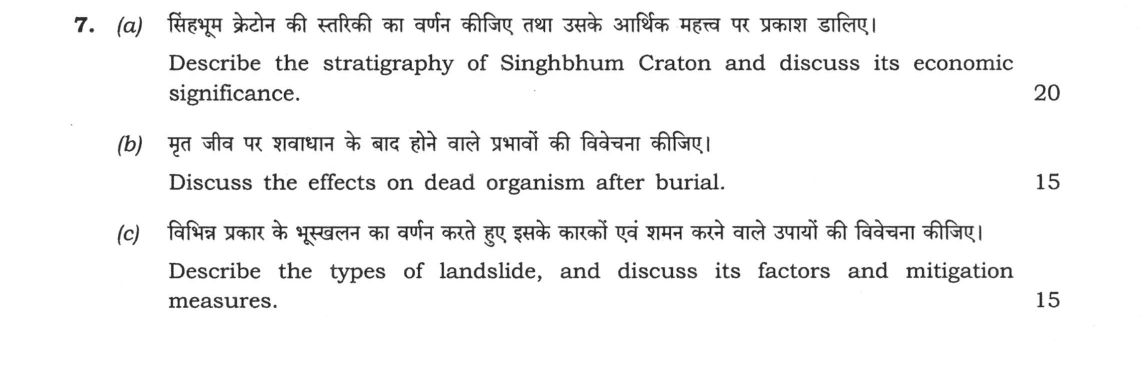
(a) Describe the stratigraphy of Singhbhum Craton and discuss its economic significance. (20 marks) (b) Discuss the effects on…
Describe the stratigraphy of Singhbhum Craton and discuss its economic significance. 20 marks
Discuss the effects on dead organism after burial. 15 marks
Describe the types of landslide, and discuss its factors and mitigation measures. 15 marks
हिंदी में प्रश्न पढ़ें
सिंहभूम क्रेटन की स्तरीकी का वर्णन कीजिए तथा उसके आर्थिक महत्व पर प्रकाश डालिए। (20 अंक)
मृत जीव पर शवाधान के बाद होने वाले प्रभावों की विवेचना कीजिए। (15 अंक)
विभिन्न प्रकार के भूस्खलन का वर्णन करते हुए इसके कारकों एवं शमन करने वाले उपायों की विवेचना कीजिए। (15 अंक)
Model answer
Written by UPSC Answer Check against this question's marking rubric, to the expected length. UPSC does not publish answers for Mains — this is one way to score well, not an official key.
Singhbhum Craton The Singhbhum Craton in Jharkhand–Odisha is a Precambrian nucleus that records a largely unidirectional Archaean to Proterozoic evolution, from about 3.8 Ga to 1.0 Ga. Its basement is the Older Metamorphic Group (OMG), a high-grade gneissic suite, overlain by the Older Metamorphic Tonalite Gneiss (OMTG). The 2.7 Ga Singhbhum Granite intrudes this basement, and the 2.5 Ga Iron Ore Group (IOG) and Dhanjori Group represent Archaean supracrustal metasediments. The Kolhan Group is a separate younger Proterozoic cover sequence that rests unconformably on the eroded Singhbhum Granite and older rocks such as the IOG, not on the Dhanjori Group; the Dalma Group, a Proterozoic metasedimentary sequence, and the 1.0 Ga Newer Dolerite dykes complete the younger succession. The Singhbhum Shear Zone is a major structural boundary that localises deformation and mineralisation. Economically, the craton is central to India’s mineral security. The BIFs of the Badampahar–Gorumahisani–Suleipat belt supply iron ore for the steel industry; chromite occurs at Sukinda and supports ferrochrome production; the Singhbhum Shear Zone hosts shear-zone-hosted hydrothermal/vein-type Cu–Mo deposits such as Mosabani and Rakha, not porphyry systems; uranium mineralisation is also linked to the shear zone; and manganese and bauxite occur in associated formations. These resources make the craton important for steel, ferrochrome, base metals, energy and aluminium sectors. The succession is therefore a key to understanding the timing of iron-ore deposition, shear-zone metallogeny and Proterozoic cover development.
Post-burial effects After burial, a dead organism enters taphonomy, from biostratinomy to fossil diagenesis. First, biostratinomy controls transport, orientation, sorting and initial exposure; physical agents such as water and wind, together with scavenging and bioturbation, modify the assemblage. Soft tissues decay by microbial action, producing gases, autolysis and selective preservation of hard parts; microbial decay pathways include aerobic decomposition, anaerobic sulphate reduction and methanogenesis. In the sediment, compaction and pressure solution reduce pore space and flatten remains, while early diagenesis alters minerals. Authigenic mineralization may replace or coat the organism: pyritization in anoxic muds, phosphatization in phosphate-rich settings, and silicification where silica is available. Dissolution and replacement can destroy original material and substitute silica, calcite, pyrite or phosphate. If decay is rapid, burial is fast, oxygen is low, and sediment is fine-grained, exceptional preservation in Konservat-Lagerstätten can retain soft tissues, feathers, skin or stomach contents. These processes determine whether a body is destroyed, partially preserved, or fossilised. Under normal conditions, only resistant shells, bones, teeth or mineralised tissues survive as fossils.
Landslides Landslides are mass movements classified by Varnes according to mode of movement and material into falls, topples, slides, spreads, flows and complex movements. Falls are free-falling rock or debris; topples involve forward rotation about a pivot; slides include rotational slides along curved surfaces and translational slides along planar surfaces; spreads are lateral spreading of weak material; flows involve fluid-like movement of saturated debris; complex landslides combine two or more movement types, often in weathered slopes. In India, the 1998 Malpa landslide in Himachal Pradesh, the 2013 Kedarnath debris flows, and rotational slides at Munnar in weathered Dharwar schists of the Western Ghats illustrate these types. Causal factors are geological, topographic, climatic and anthropogenic: shear zones, weak weathered schists, steep escarpments, intense monsoon rainfall, road cutting and deforestation. Mitigation requires hazard zonation mapping, drainage control, rock bolting, benching and retaining structures, bio-engineering, slope monitoring and early warning systems, with land-use regulation in susceptible zones. In India, such measures are supported by Geological Survey of India hazard zonation maps and state disaster management frameworks. Thus, the craton’s stratigraphy explains its mineral wealth, post-burial taphonomy explains fossil quality, and landslide classification guides hazard management.
What "Describe" is asking you to do
Give a full, ordered account of the thing named — its parts, stages or mechanism — in the sequence in which it actually exists or occurs. Most describe questions come from the science optionals, where the marks sit in correct technical detail and, where the stem says so, a labelled diagram.
Structure that answers it
One-line identification of the subject → the parts or stages in their real order, each with its defining detail → labelled diagram where the subject is structural → closing line on function or significance
Where marks are lost
Loose general prose where the examiner is ticking named parts, correct terminology and their sequence; and in the General Studies papers, turning to evaluation before the description is finished.
How this answer will be evaluated
Approach
Framework: Geology Paper 1: Define > Process > Field/Petrographic Evidence > Indian Example. (a) describe: define > structure or process in order > labelled diagram > significance | (b) discuss: intro > 3-4 dimensions > example > balanced close | (c) describe: define > structure or process in order > labelled diagram > significance Full marks: Precise stratigraphy, specific mineralization, clear diagenetic processes, and detailed landslide classification with Indian examples.
Key points expected
- Identify Singhbhum as an Archaean greenstone belt
- List key formations: Singhbhum Group, Chiria, Chotanagpur Gneiss
- Link stratigraphy to iron ore (BIF) and bauxite deposits
- Mention specific economic minerals: hematite, magnetite, bauxite
- Define diagenesis and taphonomy
- Describe physical changes: compaction, cementation
- Describe chemical changes: mineral replacement, dissolution
- Mention the role of groundwater and pressure
Evaluation rubric
Each sub-part is marked on its own, against the marks and word limit printed on the paper.
- (a) Stratigraphic sequence of Singhbhum Craton and its economic mineralization. 20 marks
describe— define → structure or process in order → labelled diagram → significance
Must cover
- Identify Singhbhum as an Archaean greenstone belt
- List key formations: Singhbhum Group, Chiria, Chotanagpur Gneiss
- Link stratigraphy to iron ore (BIF) and bauxite deposits
- Mention specific economic minerals: hematite, magnetite, bauxite
Loses marks
- Generic description of cratons without naming Singhbhum
- Missing the link between stratigraphy and economic deposits
- Confusing Singhbhum with other Indian cratons (e.g., Dharwar)
Earns more
- Mention specific iron ore fields (e.g., Noamundi, Ghatshila)
- Reference the Singhbhum Shear Zone
- Mention the age of the craton (Archaean)
Extra mark
- Draw a simplified stratigraphic column of the craton
- Mention the specific iron ore company (SAIL)
- (b) Diagenetic and taphonomic changes in dead organisms post-burial. 15 marks
discuss— intro → 3-4 dimensions → example → balanced close
Must cover
- Define diagenesis and taphonomy
- Describe physical changes: compaction, cementation
- Describe chemical changes: mineral replacement, dissolution
- Mention the role of groundwater and pressure
Loses marks
- Confusing diagenesis with metamorphism
- Missing the chemical aspect of fossilization
- Generic description without specific geological processes
Earns more
- Mention specific diagenetic minerals (e.g., calcite, silica)
- Reference the concept of 'permineralization'
- Mention the role of bacteria in early diagenesis
Extra mark
- Draw a diagram showing stages of fossilization
- Mention a specific Indian fossil example (e.g., Megalodon)
- (c) Classification of landslides, causative factors, and mitigation strategies. 15 marks
describe— define → structure or process in order → labelled diagram → significance
Must cover
- Classify landslides (e.g., rockfall, slide, flow)
- List causative factors: slope, water, vegetation, seismicity
- Describe mitigation measures: drainage, retaining walls, afforestation
- Mention the role of geology in landslide susceptibility
Loses marks
- Missing the classification of landslides
- Generic mitigation measures without specific engineering solutions
- Confusing landslides with other mass wasting processes
Earns more
- Mention specific Indian landslide-prone areas (e.g., Himalayas, Western Ghats)
- Reference the 'Landslide Hazard Zonation' concept
- Mention the role of the National Disaster Management Authority (NDMA)
Extra mark
- Draw a cross-section of a typical landslide
- Mention a specific Indian landslide event (e.g., 2013 Uttarakhand)
Practice this exact question
Write your answer and it is marked point by point against the model answer above — what you covered, what you missed, what you got wrong.
Evaluate my answer →More from Geology 2022 Paper I
- Q4 (a) Illustrate the common brittle-ductile shear zone structures. Using the stress ellipso…
- Q5 Answer the following questions in about 150 words each: (a) Diagrammatically explain the…
- Q6 (a) Elucidate the evolutionary trend of Hominidae with examples of Indian occurrence. (20…
- Q7 (a) Describe the stratigraphy of Singhbhum Craton and discuss its economic significance.…
- Q8 (a) Give an account of interpretation of groundwater chemical quality through various gra…