Paper I — Q3
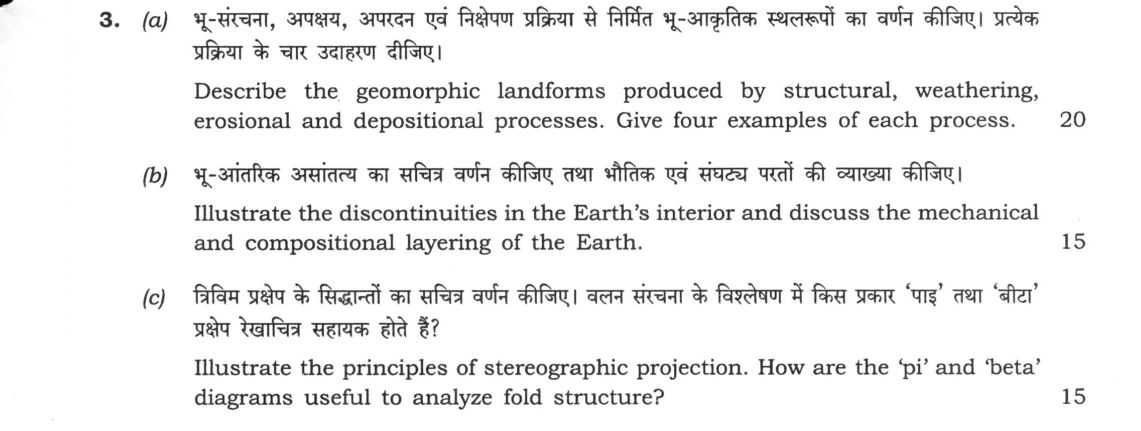
(a) Describe the geomorphic landforms produced by structural, weathering, erosional and depositional processes. Give four…
Describe the geomorphic landforms produced by structural, weathering, erosional and depositional processes. Give four examples of each process. 20 marks
Illustrate the discontinuities in the Earth's interior and discuss the mechanical and compositional layering of the Earth. 15 marks
Illustrate the principles of stereographic projection. How are the 'pi' and 'beta' diagrams useful to analyze fold structure? 15 marks
हिंदी में प्रश्न पढ़ें
भू-संरचना, अपक्षय, अपरदन एवं निक्षेपण प्रक्रिया से निर्मित भू-आकृतिक स्थलरूपों का वर्णन कीजिए। प्रत्येक प्रक्रिया के चार उदाहरण दीजिए। (20 अंक)
भू-आंतरिक असांतत्य का सचित्र वर्णन कीजिए तथा भौतिक एवं संघट्य परतों की व्याख्या कीजिए। (15 अंक)
त्रिविम प्रक्षेप के सिद्धांतों का सचित्र वर्णन कीजिए। वलन संरचना के विश्लेषण में किस प्रकार 'पाई' तथा 'बीटा' प्रक्षेप रेखाचित्र सहायक होते हैं? (15 अंक)
Model answer
Written by UPSC Answer Check against this question's marking rubric, to the expected length. UPSC does not publish answers for Mains — this is one way to score well, not an official key.
Geomorphic landforms record tectonics, climate, rock resistance and time; a block diagram would show uplifted strata, residual forms, valleys and ridges, and deposits.
Structural landforms arise where deformation or faulting changes relief. Fold mountains form by compressional folding, e.g. Himalayas and Alps. Fault scarps form by displacement along normal or strike-slip faults, e.g. Satpura fault scarp and Dead Sea scarp. Rift valleys form by extensional down-dropping between normal faults, e.g. Narmada-Son rift and East African Rift. Block mountains form by uplift of fault-bounded horsts, e.g. Aravalli and Black Forest.
Weathering landforms are residual forms produced by chemical, mechanical and biological breakdown in situ. Tors are isolated granite blocks left after surrounding rock is removed, e.g. Dartmoor and Aravalli granite tors. Inselbergs are isolated hills rising from plains, e.g. Socotra and Machu Picchu. Exfoliation domes form by sheet-like peeling of granitic rock, e.g. Half Dome and Uluru. Tafoni are honeycomb cavities in resistant rock, e.g. Himalayan quartzite and desert sandstone.
Erosional landforms are carved by rivers, glaciers, wind and solution. River valleys are V-shaped or entrenched channels, e.g. Ganga and Indus valleys. Cirques are amphitheatre-shaped glacier headwalls, e.g. Himalayan and Alpine cirques. Yardangs are wind-sculpted ridges in arid plains, e.g. Badain Jaran and Thar margin. Zeugens are residual limestone masses left after surrounding strata are dissolved, e.g. Black Forest zeugen.
Depositional landforms are built by transported material. Deltas form where rivers enter standing water, e.g. Ganga-Brahmaputra and Nile deltas. Alluvial fans form where streams spread on gentle slopes, e.g. Indus piedmont and Thar fan. Moraines are ridges of glacial till, e.g. Himalayan and Alpine moraines. Dunes are wind-built sand forms, e.g. Thar and Sahara dunes.
Discontinuities and layering. A labelled cross-section shows seismic discontinuities where P- and S-wave velocities change. The Mohorovičić discontinuity, at about 5–10 km beneath oceans and 35 km beneath continents, separates crust from mantle. The Gutenberg discontinuity at 2,900 km separates mantle from liquid outer core; S-waves are absent below it. The Lehmann discontinuity at about 5,150 km marks the solid inner core. The 410–660 km transition zone records mineral phase changes in the upper mantle. Compositionally, the crust is silica-alumina, the mantle is ultramafic Mg-Fe silicate, and the core is Fe-Ni. Mechanically, the rigid lithosphere comprises crust and uppermost mantle; the asthenosphere is dominantly solid, ductile, with only minor melt in the low-velocity zone; the mesosphere is the solid but plastic lower mantle; the outer core is liquid and convecting; the inner core is solid. They explain seismic wave behaviour and relate to Indian geothermal provinces, e.g. Himalayan and Eastern Ghats, where heat flow and crustal structure control geothermal gradients.
Stereographic projection and fold analysis. Stereographic projection transfers planes and lines from a sphere to a flat net, usually lower-hemisphere. The primitive circle represents the horizontal plane; N–S great circles are meridians; other planes are great circles, and their poles are plotted 90° from the plane. A stereonet with primitive, meridians and small circles is used to plot bedding, foliation and lineations. In a pi diagram, poles to bedding planes of a cylindrical fold are plotted; if the fold is cylindrical, they lie on a small circle, and the pole to that small circle gives the fold axis and its plunge. In a beta diagram, intersection lineations between bedding and foliation are plotted; their common great circle or pole gives the fold axis orientation. The number of lineations from n planes grows as n(n−1)/2, a binomial increase, not exponential. Such analysis aids structural mapping in fold belts like the Himalayas by determining axial planes, plunge and sense of folding from field data.
Thus, landforms record surface processes, discontinuities reveal Earth's mechanical state, and stereographic methods quantify the structures that control both.
What "Describe" is asking you to do
Give a full, ordered account of the thing named — its parts, stages or mechanism — in the sequence in which it actually exists or occurs. Most describe questions come from the science optionals, where the marks sit in correct technical detail and, where the stem says so, a labelled diagram.
Structure that answers it
One-line identification of the subject → the parts or stages in their real order, each with its defining detail → labelled diagram where the subject is structural → closing line on function or significance
Where marks are lost
Loose general prose where the examiner is ticking named parts, correct terminology and their sequence; and in the General Studies papers, turning to evaluation before the description is finished.
How this answer will be evaluated
Approach
Framework: Geology Paper 1: Define > Process > Field/Petrographic Evidence > Indian Example. (a) describe: define > structure or process in order > labelled diagram > significance | (b) explain: definition/context > points in order > small example > short close | (c) explain: definition/context > points in order > small example > short close Full marks: Precise definitions, 4+ examples per process, clear diagrams, specific Indian examples, and accurate technical terminology.
Key points expected
- Four distinct examples for structural landforms
- Four distinct examples for weathering landforms
- Four distinct examples for erosional landforms
- Four distinct examples for depositional landforms
- Identification of Moho, Gutenberg, and Lehmann discontinuities
- Distinction between compositional layers (Crust, Mantle, Core)
- Distinction between mechanical layers (Lithosphere, Asthenosphere)
- Diagram showing depth and discontinuities
Evaluation rubric
Each sub-part is marked on its own, against the marks and word limit printed on the paper.
- (a) Define and list four examples of landforms for structural, weathering, erosional, and depositional processes. 20 marks
describe— define → structure or process in order → labelled diagram → significance
Must cover
- Four distinct examples for structural landforms
- Four distinct examples for weathering landforms
- Four distinct examples for erosional landforms
- Four distinct examples for depositional landforms
Loses marks
- Generic descriptions without specific landform names
- Confusing weathering with erosion
- Missing examples for any of the four processes
Earns more
- Labelled sketches of specific landforms
- Mention of specific Indian examples (e.g., Deccan Traps)
- Clear distinction between weathering and erosion
- Reference to specific rock types involved
Extra mark
- Mention of specific stratigraphic age of formation
- Link to economic mineral deposits
- (b) Illustrate Earth's interior discontinuities and discuss mechanical and compositional layering. 15 marks
explain— definition/context → points in order → small example → short close
Must cover
- Identification of Moho, Gutenberg, and Lehmann discontinuities
- Distinction between compositional layers (Crust, Mantle, Core)
- Distinction between mechanical layers (Lithosphere, Asthenosphere)
- Diagram showing depth and discontinuities
Loses marks
- Confusing mechanical and compositional layering
- Missing key discontinuities (Moho, Gutenberg)
- No diagram or sketch provided
Earns more
- Mention of seismic wave velocity changes
- Reference to specific Indian craton (e.g., Dharwar)
- Explanation of P-wave and S-wave behavior
- Mention of specific mineral composition (e.g., Olivine)
Extra mark
- Reference to specific seismic survey data
- Mention of specific Indian geological formation
- (c) Illustrate stereographic projection principles and explain utility of pi and beta diagrams for fold analysis. 15 marks
explain— definition/context → points in order → small example → short close
Must cover
- Principles of stereographic projection (Wulff net)
- Definition and use of 'pi' (pole) diagram
- Definition and use of 'beta' (great circle) diagram
- Application to analyzing fold structure
Loses marks
- Confusing pi and beta diagrams
- No explanation of how diagrams analyze folds
- Missing principles of stereographic projection
Earns more
- Sketch of Wulff net with plotted data
- Explanation of how poles define fold axes
- Mention of specific Indian fold belt (e.g., Himalayas)
- Reference to specific mineral composition of folded rocks
Extra mark
- Mention of specific stratigraphic age of folded formation
- Link to economic mineral deposit in folded structure
Practice this exact question
Write your answer and it is marked point by point against the model answer above — what you covered, what you missed, what you got wrong.
Evaluate my answer →More from Geology 2022 Paper I
- Q1 Answer the following questions in about 150 words each: (a) Explain 'convergent plate bou…
- Q2 (a) Discuss in detail the notion of 'continental drift' and the theories of plate tectoni…
- Q3 (a) Describe the geomorphic landforms produced by structural, weathering, erosional and d…
- Q4 (a) Illustrate the common brittle-ductile shear zone structures. Using the stress ellipso…
- Q5 Answer the following questions in about 150 words each: (a) Diagrammatically explain the…
- Q6 (a) Elucidate the evolutionary trend of Hominidae with examples of Indian occurrence. (20…