Paper I — Q5
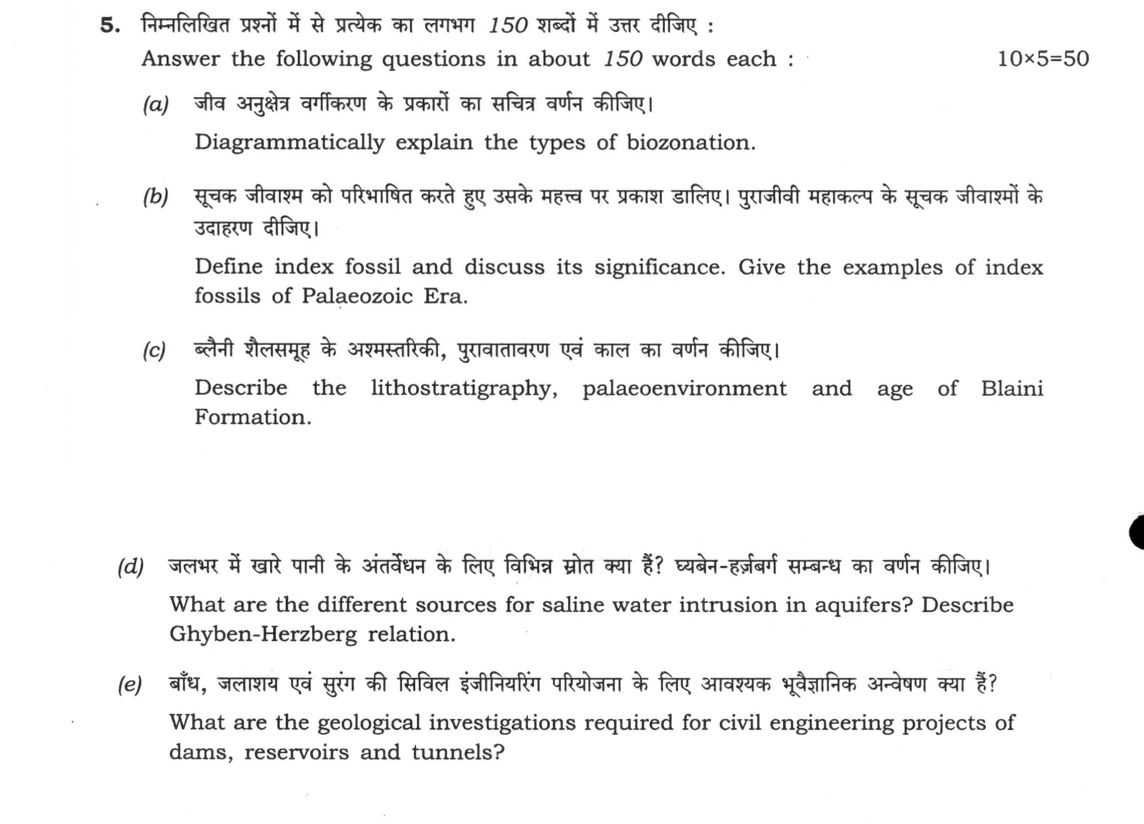
Answer the following questions in about 150 words each: (a) Diagrammatically explain the types of biozonation. (10 marks) (b)…
Answer the following questions in about 150 words each:
Diagrammatically explain the types of biozonation. 10 marks
Define index fossil and discuss its significance. Give the examples of index fossils of Palaeozoic Era. 10 marks
Describe the lithostratigraphy, palaeoenvironment and age of Blaini Formation. 10 marks
What are the different sources for saline water intrusion in aquifers? Describe Ghyben-Herzberg relation. 10 marks
What are the geological investigations required for civil engineering projects of dams, reservoirs and tunnels? 10 marks
हिंदी में प्रश्न पढ़ें
निम्नलिखित प्रश्नों में से प्रत्येक का लगभग 150 शब्दों में उत्तर दीजिए :
जीव अनुक्षेत्र वर्गीकरण के प्रकारों का सचित्र वर्णन कीजिए। (10 अंक)
सूचक जीवाश्म को परिभाषित करते हुए उसके महत्व पर प्रकाश डालिए। पुराजीवी महाकल्प के सूचक जीवाश्मों के उदाहरण दीजिए। (10 अंक)
ब्लैनी शैलसमूह के अश्मस्तरीकी, पुरावातावरण एवं काल का वर्णन कीजिए। (10 अंक)
जलभर में खारे पानी के अंतर्वेशन के लिए विभिन्न स्रोत क्या हैं? घ्यबेन-हर्जबर्ग सम्बन्ध का वर्णन कीजिए। (10 अंक)
बाँध, जलाशय एवं सुरंग की सिविल इंजीनियरिंग परियोजना के लिए आवश्यक भूवैज्ञानिक अन्वेषण क्या हैं? (10 अंक)
Model answer
Written by UPSC Answer Check against this question's marking rubric, to the 150-word length. UPSC does not publish answers for Mains — this is one way to score well, not an official key.
(a) Types of Biozonation
Biozonation involves classifying stratigraphic successions into biozones based on their fossil content.
`` Stratigraphic | Interval Concurrent-Range Assemblage Acme Column | Zone Zone Zone Zone ▲ | [Taxon B ] |Taxon 1| |Species A| | | │ | [ FAD ] | ▲ | |Species B| | |███| | (Peak │ | | | | │ | |Species C| | |███| | Abundance) │ | | | |───┼───| <Over- |Species D| | | | | │ | [Taxon A ] | │ | lap |(Distinct | | | │ | [ LAD ] | ▼ | | Assort- | | | │ | |Taxon 2| | ment) | | | ``
Taxon Range Zone represents the total horizontal and vertical stratigraphic range of a single taxon. Concurrent Range Zone is defined by the overlapping stratigraphic range of two or more specified taxa. Interval Zone represents the strata between two distinct biostratigraphic surfaces, such as First Appearance Datums (FAD) or Last Appearance Datums (LAD). Assemblage Zone (Cenozone) is defined by a distinctive, natural association of three or more contemporaneous fossil taxa. Acme/Abundance Zone captures the stratigraphic interval characterized by the maximum numerical abundance of a particular taxon. Lineage Zone (Phylozone) represents a continuous segment of an evolutionary lineage bound by successive morphogenetic changes.
(b) Index Fossils and Palaeozoic Examples
An index fossil is a fossilized organism possessing a narrow stratigraphic (vertical) range, broad geographic (horizontal) distribution, high abundance, rapid evolutionary turnover, and distinct morphological features independent of sedimentary facies.
Index fossils are vital for high-resolution biostratigraphic correlation across isolated depositional basins, precise relative dating of sedimentary strata, delineating standard chronostratigraphic stage boundaries, and recognizing global sedimentation breaks or mass extinctions.
Key index fossils of the Palaeozoic Era include:
- Cambrian: Agnostid and polymerid trilobites (e.g., Olenellus, Paradoxides, Redlichia) defining standard Cambrian stages.
- Ordovician to Silurian: Planktonic graptolites (e.g., Nemagraptus gracilis, Monograptus) showing rapid astogenetic evolution.
- Devonian: Pelagic goniatites (e.g., Manticoceras) and conodont elements (e.g., Palmatolepis).
- Carboniferous to Permian: Large benthic foraminifera known as fusulinids (e.g., Fusulina, Schwagerina), which allow precise zonal subdivision of late Palaeozoic marine strata.
(c) Blaini Formation: Lithostratigraphy, Palaeoenvironment, and Age
The Blaini Formation forms a key regional marker horizon in the Mussoorie and Krol Belts of the Lesser Himalaya, unconformably overlying the Jaunsar Group and underlying the Infra-Krol Formation.
Lithostratigraphy: It consists of a basal, matrix-supported diamictite (Tilloid) with striations and dropstones, followed by intercalations of bleached/purple pyritiferous shales and pink quartzites, a second diamictite unit, and an uppermost cap carbonate unit consisting of finely laminated, pink to buff-coloured dolomite.
Palaeoenvironment: The diamictites reflect glacio-marine sedimentation characterized by ice-rafted debris and subaqueous debrites deposited during a major glacial advance. The overlying cap dolomite records a rapid sea-level rise and sudden carbonate precipitation under warm, alkaline conditions following global deglaciation (Snowball Earth aftermath).
Age: It is assigned a Terminal Cryogenian to basal Ediacaran age (~635 Ma), correlated globally with the Marinoan glaciation based on the diagnostic cap carbonate and negative δ¹³C isotopic signatures.
(d) Sources of Saline Water Intrusion and Ghyben-Herzberg Relation
Saline water intrusion into fresh aquifers arises from:
- Excessive coastal pumping inducing lateral inland encroachment of seawater.
- Upconing of deep-seated stagnant connate brines beneath heavily pumped wellfields.
- Subsurface leaching and dissolution of buried evaporite or halite beds.
- Infiltration of concentrated saline irrigation return flows and seawater flooding in estuarine zones.
The Ghyben-Herzberg relation defines the hydrostatic equilibrium between immiscible fresh groundwater (ρ_f ≈ 1.000 g/cm³) and denser saltwater (ρₛ ≈ 1.025 g/cm³) in unconfined coastal aquifers.
At any point along the stationary freshwater-saltwater interface at depth z below mean sea level, total hydrostatic pressure exerted by freshwater of total height (h + z) balances the saltwater column of height z:
ρₛ · g · z = ρ_f · g · (h + z)
ρₛ z - ρ_f z = ρ_f h implies z = (ρ_f)/(ρₛ - ρ_f) h
Substituting typical densities:
z = 1.000/(1.025 - 1.000) h = 40 h
Thus, for every metre of freshwater head (h) maintained above sea level, a fresh groundwater column extends approximately 40 metres (z) below sea level.
(e) Geological Investigations for Civil Engineering Projects
Engineering geological investigations establish site safety, optimize structural design, and prevent catastrophic failures.
Surface and Subsurface Exploration: Detailed geological and structural mapping (scale 1:1000 to 1:5000) documents rock type, strike, dip, faults, shear zones, joints, and unconformities. Exploratory core drilling, borehole logging, and geophysical surveys (seismic refraction for bedrock depth and electrical resistivity for shear zones/cavities) determine subsurface geometry.
Dam Foundations: In-situ rock mechanics tests assess uniaxial compressive strength, shear strength, and modulus of deformation. Lugeon packer permeability tests evaluate seepage potential to design grout curtains and prevent toe sliding along low-angle discontinuity planes.
Reservoirs: Investigations evaluate rim stability against slope failures, reservoir-induced seismicity (RIS), and water-tightness to prevent leakage through buried palaeochannels, faults, or karstic limestone cavities.
Tunnels: Hydrogeological profiling predicts tunnel water inrush and overbreak. Rock mass classification schemes—Bieniawski’s Rock Mass Rating (RMR) and Barton’s Q-system—quantify rock quality, in-situ rock stress (squeezing/popping), and determine appropriate support systems (shotcrete, rock bolts, steel ribs).
What "Explain" is asking you to do
Make the working of something clear — what sets it off, what follows from what, and what it produces. Explain is the Commission's mechanism word: it dominates the technical papers and the “explain why” stems, where the marks sit in the causal chain and not in the label.
Structure that answers it
State what it is → the initiating condition → the chain of cause, step by step → an instance where it plays out → what the chain produces
Where marks are lost
Describing what something looks like instead of why it works that way. Naming the stages without linking them reads as description too.
How this answer will be evaluated
Approach
Framework: Geological Stratigraphy and Engineering Geology. (a) explain: definition/context > points in order > small example > short close | (b) discuss: intro > 3-4 dimensions > example > balanced close | (c) describe: definition/context > points in order > small example > short close | (d) describe: definition/context > points in order > small example > short close | (e) describe: definition/context > points in order > small example > short close Full marks: Precise diagrams, correct Indian examples, and accurate formulas.
Key points expected
- Biozonation types (TRZ, Interval)
- Index fossils (Trilobites, Graptolites)
- Blaini Formation (Proterozoic, Red beds)
- Ghyben-Herzberg (h=40d)
- Engineering Geology (RMR, Seismicity)
Evaluation rubric
Each sub-part is marked on its own, against the marks and word limit printed on the paper.
- (a) Diagrammatic classification of biozones based on fossil occurrence. 10 marks · 150 words
explain— definition/context → points in order → small example → short close
Must cover
- Diagram showing stratigraphic column
- Taxon Range Zone (TRZ)
- Interval Zone (Iz)
- Abundance/Association Zone
Loses marks
- Text-only description without diagram
- Confusing biozones with litho-zones
Earns more
- Clear distinction between Interval and Taxon Range
- Labeling of fossil A, B, C in diagram
- Mention of 'Concurrent Range Zone'
Extra mark
- Sketch of 'Superposition Zone'
- (b) Definition of index fossils, their utility, and specific Palaeozoic examples. 10 marks · 150 words
discuss— intro → 3-4 dimensions → example → balanced close
Must cover
- Definition: short range, wide distribution
- Significance: Correlation and Age dating
- Example: Trilobites (Cambrian)
- Example: Graptolites (Ordovician/Silurian)
Loses marks
- Listing fossils without stating their specific age
- Ignoring the 'significance' part of the question
Earns more
- Example: Ammonoids (Devonian)
- Mention of 'Guide Fossils' vs 'Index Fossils'
- Reference to 'Standard Sections'
Extra mark
- Mention of 'Fossil Assemblage' concept
- (c) Lithology, environment, and age of the Blaini Formation. 10 marks · 150 words
describe— definition/context → points in order → small example → short close
Must cover
- Lithology: Red beds, sandstones, shales
- Age: Late Proterozoic (Neoproterozoic)
- Environment: Fluvial / Alluvial plain
- Location: Spiti Valley, Himachal Pradesh
Loses marks
- Confusing with 'Krol' or 'Shamsheri' formations
- Missing the specific age (Proterozoic)
Earns more
- Mention of 'Banded Iron Formations' (BIF)
- Reference to 'Trans-Himalayan' region
- Mention of 'Glacial' deposits (if applicable to specific section)
Extra mark
- Mention of 'Krol Formation' relationship
- (d) Sources of saline intrusion and the Ghyben-Herzberg equation. 10 marks · 150 words
describe— definition/context → points in order → small example → short close
Must cover
- Sources: Over-pumping, sea-level rise
- Ghyben-Herzberg Relation: h = 40d
- Concept: Fresh-salt water interface
- Diagram of interface depth
Loses marks
- Writing the formula without defining variables
- Ignoring the 'sources' part of the question
Earns more
- Mention of 'Coastal Aquifers'
- Explanation of density difference (1025 vs 1000)
- Mention of 'Upconing'
Extra mark
- Mention of 'Tidal fluctuations' effect
- (e) Geological investigations for dams, reservoirs, and tunnels. 10 marks · 150 words
describe— definition/context → points in order → small example → short close
Must cover
- Dam: Foundation rock quality, seepage
- Reservoir: Seismicity, leakage potential
- Tunnel: Rock mass rating (RMR), stress
- Method: Boreholes, geophysics
Loses marks
- Generic 'site investigation' without specific project needs
- Ignoring the 'tunnel' specific requirements
Earns more
- Mention of 'Joint orientation' for tunnels
- Mention of 'Slope stability' for reservoirs
- Reference to 'Core logging'
Extra mark
- Mention of 'In-situ testing' (CPT, SPT)
Practice this exact question
Write your answer and it is marked point by point against the model answer above — what you covered, what you missed, what you got wrong.
Evaluate my answer →More from Geology 2022 Paper I
- Q2 (a) Discuss in detail the notion of 'continental drift' and the theories of plate tectoni…
- Q3 (a) Describe the geomorphic landforms produced by structural, weathering, erosional and d…
- Q4 (a) Illustrate the common brittle-ductile shear zone structures. Using the stress ellipso…
- Q5 Answer the following questions in about 150 words each: (a) Diagrammatically explain the…
- Q6 (a) Elucidate the evolutionary trend of Hominidae with examples of Indian occurrence. (20…
- Q7 (a) Describe the stratigraphy of Singhbhum Craton and discuss its economic significance.…
- Q8 (a) Give an account of interpretation of groundwater chemical quality through various gra…