Paper I — Q6
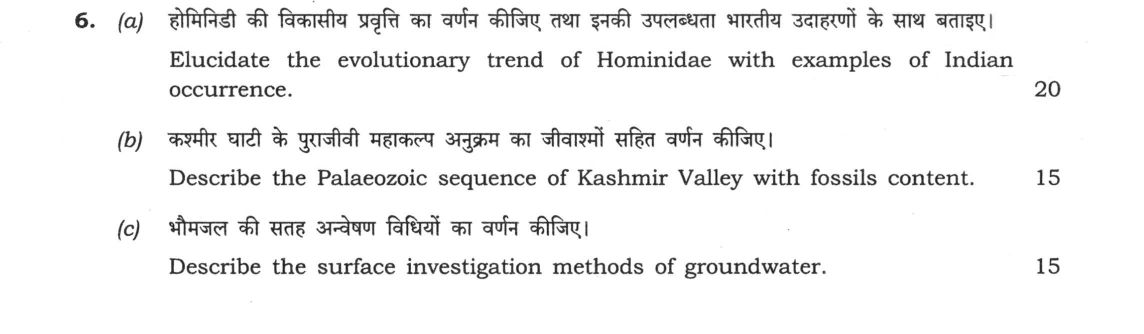
(a) Elucidate the evolutionary trend of Hominidae with examples of Indian occurrence. (20 marks) (b) Describe the Palaeozoic…
Elucidate the evolutionary trend of Hominidae with examples of Indian occurrence. 20 marks
Describe the Palaeozoic sequence of Kashmir Valley with fossils content. 15 marks
Describe the surface investigation methods of groundwater. 15 marks
हिंदी में प्रश्न पढ़ें
होमिनिडी की विकासीय प्रवृत्ति का वर्णन कीजिए तथा इनकी उपलब्धता भारतीय उदाहरणों के साथ बताइए। (20 अंक)
कश्मीर घाटी के पुराजीवी महाकल्प अनुक्रम का जीवाश्मों सहित वर्णन कीजिए। (15 अंक)
भूमजल की सतह अन्वेषण विधियों का वर्णन कीजिए। (15 अंक)
Model answer
Written by UPSC Answer Check against this question's marking rubric, to the expected length. UPSC does not publish answers for Mains — this is one way to score well, not an official key.
(a) The evolutionary trend relevant to Hominidae is a shift from quadrupedal Miocene apes to obligate bipedal, encephalized hominins, with increasing brain size, tool use and cultural complexity. The trend is not a single straight line but a branching pattern with regional variations. In the Miocene, dryopithecine-like apes such as Dryopithecus show a cranial capacity of about 400–500 cc and arboreal/quadrupedal habits. In the Pliocene, Australopithecus marks the decisive milestone of habitual bipedalism, while brain size remains small, roughly 400–500 cc. Homo habilis, with a larger brain of about 600–750 cc and stone tools, shows increasing reliance on culture. Homo erectus combines fully modern limb proportions, longer-distance bipedalism, fire use and a cranial capacity of about 800–1100 cc. Homo sapiens completes the trend with a cranial capacity around 1300–1400 cc, advanced language and symbolic behaviour. Indian occurrences are sparse but important. The Miocene Siwalik Hills of India preserve hominoid fossils such as Ramapithecus and Sivapithecus, which illustrate Asian hominoid radiation rather than direct human ancestry. The key Indian hominin fossil is the Hathnora calvarium from the Narmada Valley, assigned to Homo erectus, with a cranial capacity near 1100 cc and a Pleistocene age; it places India within the global dispersal of erectus. Later human occupation is recorded at Palaeolithic sites such as Bhimbetka in India and Neolithic sites such as Mehrgarh in Pakistan, but these are archaeological, not hominid fossil, occurrences.
(b) The Palaeozoic sequence of the Kashmir Valley records a long marine to shallow-marine history, overlain by Permian volcanic and clastic units, and is deformed by later Himalayan tectonism. The lower part comprises Cambrian to Silurian shales, siltstones and sandstones, commonly fossiliferous; because many units are lithologically similar, fossils are essential for age control. Cambrian beds contain trilobites; Ordovician and Silurian shales are marked by graptolites, which provide biostratigraphic control. The Devonian succession includes shales and sandstones with fish remains and early brachiopods, indicating a marine environment. The Carboniferous is represented by limestones, shales and sandstones bearing brachiopods such as Productus and Spirifer, and other marker fossils such as Fenestella; these help correlate the sequence regionally. The Permian is dominated by the Muth Quartzite and associated clastics, interbedded with Panjal Volcanics. Fossils in the Permian include fusulinids and, in associated sediments, the temnospondyl amphibian Trematops; Trematops is correctly a Permian amphibian, not a Devonian fish. The sequence shows a transition from Palaeozoic marine sedimentation to late Palaeozoic volcanic activity, with fossils providing the main chronological framework.
(c) Surface investigation of groundwater begins with geological mapping, which identifies aquifer-bearing formations, faults, lineaments, springs and drainage patterns. Geological mapping also records weathering profiles and unconsolidated deposits that control recharge and storage. Remote sensing using satellite imagery and aerial photographs enhances this by mapping lineaments, structural controls, vegetation moisture and recharge zones, especially in inaccessible terrain. Geophysical methods provide subsurface information without drilling: electrical resistivity profiling distinguishes clay, weathered rock, fractured bedrock and water-bearing zones, helping define aquifer geometry and depth to fresh water; seismic refraction estimates velocities and depths to hard bedrock. Hydrogeological surveys integrate field data from wells, springs, water levels and water quality to infer aquifer extent and flow. Tracer studies, using natural or artificial tracers, indicate groundwater flow direction and residence time. Pumping tests are not surface methods; they are well-based aquifer tests used after surface reconnaissance to estimate transmissivity and storage. Together, these surface methods locate potential aquifers, guide drilling and support sustainable groundwater management. In sum, the fossil record, Palaeozoic stratigraphy and surface hydrogeological methods show how geological evidence is used to reconstruct evolution, correlate sequences and locate groundwater.
What "Elucidate" is asking you to do
Make a stated proposition plain and then prove it with instances. Elucidate stems almost always carry a claim or a named concept, and very often the words “with examples” or “with suitable diagrams” — the illustration is part of the directive, not decoration.
Structure that answers it
Plain-language statement of what the proposition means → the part that is obscure, resolved → first illustration → second illustration → why the proposition holds
Where marks are lost
Adding terminology; elucidate rewards removing it. The commoner loss is a clean explanation with no example, when the stem asked for examples.
How this answer will be evaluated
Approach
Framework: Geology, Paper 1. (a) explain: definition/context > points in order > small example > short close | (b) describe: define > structure or process in order > labelled diagram > significance | (c) describe: define > structure or process in order > labelled diagram > significance Full marks: Comprehensive, accurate, with specific examples and diagrams.
Key points expected
- Chronological sequence of Hominidae evolution
- Morphological changes (bipedalism, brain size)
- Named Indian fossil occurrences
- Stratigraphic age of Indian sites
- Stratigraphic sequence of Palaeozoic rocks
- Fossil content of each unit
- Age of formations
- Lithological description
Evaluation rubric
Each sub-part is marked on its own, against the marks and word limit printed on the paper.
- (a) Evolutionary trend of Hominidae with Indian examples. 20 marks
explain— definition/context → points in order → small example → short close
Must cover
- Chronological sequence of Hominidae evolution
- Morphological changes (bipedalism, brain size)
- Named Indian fossil occurrences
- Stratigraphic age of Indian sites
Loses marks
- Generic description without Indian examples
- Missing chronological sequence
Earns more
- Sketch of evolutionary tree
- Comparison of specific species
- Geological context of Indian sites
Extra mark
- Specific site coordinates
- Detailed stratigraphic column
- (b) Palaeozoic sequence of Kashmir Valley with fossils. 15 marks
describe— define → structure or process in order → labelled diagram → significance
Must cover
- Stratigraphic sequence of Palaeozoic rocks
- Fossil content of each unit
- Age of formations
- Lithological description
Loses marks
- Missing fossil content
- Incorrect stratigraphic order
Earns more
- Sketch of stratigraphic column
- Specific fossil names
- Tectonic context
Extra mark
- Detailed lithological logs
- Specific fossil illustrations
- (c) Surface investigation methods of groundwater. 15 marks
describe— define → structure or process in order → labelled diagram → significance
Must cover
- List of surface investigation methods
- Principle of each method
- Application to groundwater
- Advantages/limitations
Loses marks
- Generic description without specifics
- Missing application to groundwater
Earns more
- Sketch of method setup
- Specific examples
- Comparison of methods
Extra mark
- Detailed diagrams
- Specific case studies
Practice this exact question
Write your answer and it is marked point by point against the model answer above — what you covered, what you missed, what you got wrong.
Evaluate my answer →More from Geology 2022 Paper I
- Q3 (a) Describe the geomorphic landforms produced by structural, weathering, erosional and d…
- Q4 (a) Illustrate the common brittle-ductile shear zone structures. Using the stress ellipso…
- Q5 Answer the following questions in about 150 words each: (a) Diagrammatically explain the…
- Q6 (a) Elucidate the evolutionary trend of Hominidae with examples of Indian occurrence. (20…
- Q7 (a) Describe the stratigraphy of Singhbhum Craton and discuss its economic significance.…
- Q8 (a) Give an account of interpretation of groundwater chemical quality through various gra…