Paper I — Q4
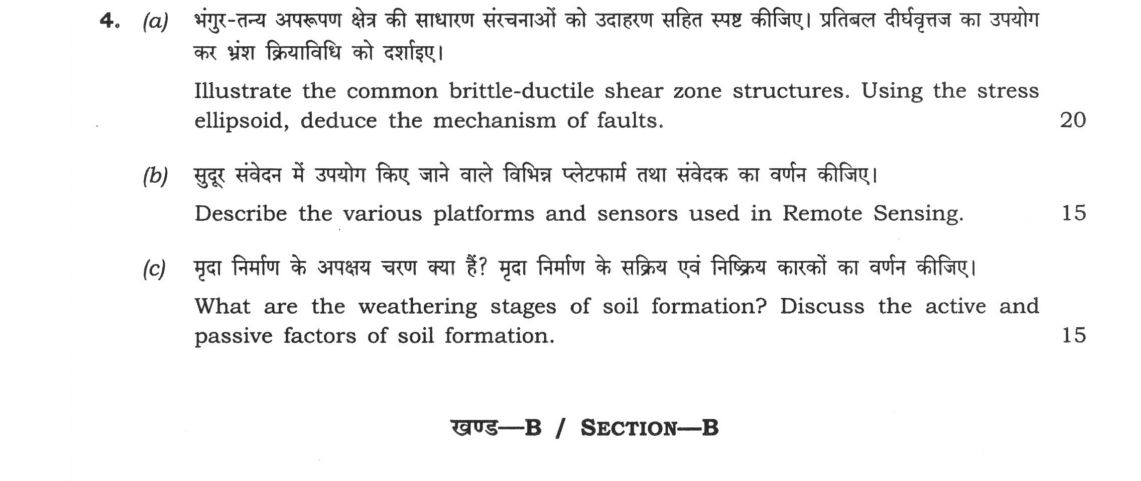
(a) Illustrate the common brittle-ductile shear zone structures. Using the stress ellipsoid, deduce the mechanism of faults. (20…
Illustrate the common brittle-ductile shear zone structures. Using the stress ellipsoid, deduce the mechanism of faults. 20 marks
Describe the various platforms and sensors used in Remote Sensing. 15 marks
What are the weathering stages of soil formation? Discuss the active and passive factors of soil formation. 15 marks
हिंदी में प्रश्न पढ़ें
भंगुर-तन्य अपरूपण क्षेत्र की साधारण संरचनाओं को उदाहरण सहित स्पष्ट कीजिए। प्रतिबल दीर्घवृत्तज का उपयोग कर भंश क्रियाविधि को दर्शाइए। (20 अंक)
सुदूर संवेदन में उपयोग किए जाने वाले विभिन्न प्लेटफॉर्म तथा संवेदक का वर्णन कीजिए। (15 अंक)
मृदा निर्माण के अपक्षय चरण क्या हैं? मृदा निर्माण के सक्रिय एवं निष्क्रिय कारकों का वर्णन कीजिए। (15 अंक)
Model answer
Written by UPSC Answer Check against this question's marking rubric, to the expected length. UPSC does not publish answers for Mains — this is one way to score well, not an official key.
Brittle–ductile shear zones and fault mechanics. Brittle–ductile shear zones are strain localisation surfaces in which temperature, pressure and rock strength control whether grains fracture or flow. The upper crust is usually brittle, while deeper conditions favour ductile flow; the transition is often recorded by mixed cataclastic and mylonitic fabrics. In brittle regimes, cataclasis produces cataclasite, in which crushed grains form a fine matrix; with larger angular fragments it becomes fault breccia; and where frictional heating generates melt, pseudotachylyte forms. In ductile regimes, plastic flow and recrystallisation produce mylonites: protomylonite has porphyroclasts in a finer matrix, mylonite shows strong foliation and recrystallised grains, and ultramylonite is very fine-grained with little porphyroclast. The transition is marked by grain-size reduction, S–C fabrics, mica fish and recrystallised quartz, as in the Satpura and Himalayan shear zones. In India, the Satpura shear zone and the Himalayan Main Central Thrust preserve such mixed fabrics. In a stress ellipsoid, σ1 > σ2 > σ3, and faults form where shear stress on a plane exceeds friction, usually at about 30° to σ1. For normal faults, σ1 is vertical and σ3 horizontal; the fault dips steeply, about 60°, and the hanging wall slips down dip, as in the Narmada–Son rift. For reverse or thrust faults, σ3 is vertical and σ1 horizontal; the fault dips shallowly, about 30°, and the upper block is pushed up, as in the Himalayan compressional front. For strike-slip faults, σ1 and σ3 are horizontal and σ2 vertical; the fault is vertical and its horizontal trace is oblique, commonly about 30° to σ1, producing lateral slip, as in transform settings.
Remote sensing platforms and sensors. Remote sensing uses platforms to carry sensors across the electromagnetic spectrum. Ground-based systems include spectroradiometers, field cameras and LiDAR; aerial platforms include balloons, manned aircraft and UAVs; spaceborne platforms include low Earth orbit, geostationary, sun-synchronous and polar orbits. Optical sensors may be panchromatic, such as Cartosat-3, multispectral, such as Resourcesat LISS, or hyperspectral, recording many narrow bands. Thermal infrared sensors measure emitted heat and support land-surface temperature studies. Microwave sensors include active SAR, which transmits pulses and receives backscatter, as in RISAT, and passive radiometers, which receive natural microwave emission, as on Oceansat. LiDAR measures laser returns to map topography and vegetation. A practical comparison is that optical sensors need daylight and are cloud-limited, SAR works day and night through clouds, thermal sensors detect emitted heat, and LiDAR gives high-resolution elevation. ISRO’s Bhuvan and NRSC distribute such data for geological and disaster applications.
Soil weathering and formation factors. Soil formation proceeds through weathering stages. First, physical disintegration breaks rock by thermal expansion, frost wedging, root wedging and unloading without changing mineral chemistry. Second, chemical decomposition alters minerals by hydrolysis, oxidation and carbonation; feldspars break down to clay minerals and soluble ions. Third, synthesis of clay minerals, such as kaolinite, illite and montmorillonite, creates cohesive horizons. Fourth, profile development produces O, A, B, C and R horizons: organic litter, topsoil, subsoil, weathered regolith and bedrock. Indian examples include laterite in the Western Ghats, red soils of the Deccan, black soils from Deccan basalts, and alluvial soils of the Ganga plain. Active factors are dynamic agents that change with time: climate controls temperature and monsoon rainfall; organisms, including roots, microbes and termites, add organic matter and mix soil; relief and time drive erosion, deposition and maturation. Passive factors are inherited templates: parent material, such as basalt, sandstone or limestone, supplies minerals, while topography, including slope, aspect and drainage, controls thickness and drainage. Together, shear-zone structures, remote-sensing platforms and soil weathering stages show how structural geology, Earth observation and pedology combine to interpret deformation, map resources and assess land suitability.
What "Illustrate" is asking you to do
Carry the point with concrete cases rather than assert it, so the examples do the work of proving it. In the technical papers illustrate is often literal — a labelled diagram, a map, a graph — and an answer without the figure has not complied with the instruction.
Structure that answers it
The point stated → example 1 with the feature it demonstrates → example 2 → example 3 or the required diagram → what the set of examples establishes
Where marks are lost
Examples named and then abandoned. A case listed without the sentence showing what it demonstrates is marked as recall of information, not as illustration.
How this answer will be evaluated
Approach
Framework: Geology Paper 1: Define > Process > Field/Petrographic Evidence > Indian Example. (a) explain: definition/context > points in order > small example > short close | (b) describe: define > structure or process in order > labelled diagram > significance | (c) discuss: intro > 3-4 dimensions > example > balanced close Full marks: Precise structural sketches, named Indian examples, clear causal chains, and accurate technical terminology.
Key points expected
- Sketch brittle-ductile shear zone structures
- Draw stress ellipsoid with principal axes
- Deduce faulting mechanism from ellipsoid
- Link shear sense to fault type
- Define remote sensing platforms
- List active and passive sensors
- Describe sensor types (optical, radar)
- Mention spatial and spectral resolution
Evaluation rubric
Each sub-part is marked on its own, against the marks and word limit printed on the paper.
- (a) Sketch brittle-ductile shear structures and deduce faulting via stress ellipsoid. 20 marks
explain— definition/context → points in order → small example → short close
Must cover
- Sketch brittle-ductile shear zone structures
- Draw stress ellipsoid with principal axes
- Deduce faulting mechanism from ellipsoid
- Link shear sense to fault type
Loses marks
- Missing stress ellipsoid diagram
- No link between ellipsoid and faulting
- Generic description without structural context
Earns more
- Mention specific shear zone (e.g., NKF)
- Label sigma 1, sigma 2, sigma 3
- Show transition from brittle to ductile
- Mention Mohr-Coulomb failure criterion
Extra mark
- Name specific Indian shear zone (e.g., NKF)
- Mention specific fault type (e.g., reverse fault)
- (b) List remote sensing platforms and sensors with their functions. 15 marks
describe— define → structure or process in order → labelled diagram → significance
Must cover
- Define remote sensing platforms
- List active and passive sensors
- Describe sensor types (optical, radar)
- Mention spatial and spectral resolution
Loses marks
- No distinction between platforms and sensors
- Missing active vs passive sensor types
- Generic description without specific examples
Earns more
- Name specific satellites (e.g., Landsat, Cartosat)
- Mention specific sensors (e.g., LISS, SAR)
- Explain difference between active and passive
- Mention specific applications (e.g., mapping)
Extra mark
- Name specific Indian satellite (e.g., Cartosat-1)
- Mention specific sensor (e.g., LISS-III)
- (c) Explain weathering stages and active/passive soil formation factors. 15 marks
discuss— intro → 3-4 dimensions → example → balanced close
Must cover
- List weathering stages (physical, chemical, biological)
- Define active factors (climate, organisms)
- Define passive factors (parent material, time)
- Link weathering to soil profile development
Loses marks
- Missing distinction between active and passive factors
- No link between weathering and soil formation
- Generic description without specific examples
Earns more
- Mention specific weathering processes (e.g., hydrolysis)
- Explain role of climate in weathering
- Mention specific soil types (e.g., laterite)
- Link to Indian soil formation (e.g., Deccan traps)
Extra mark
- Name specific Indian soil type (e.g., laterite)
- Mention specific parent material (e.g., Deccan traps)
Practice this exact question
Write your answer and it is marked point by point against the model answer above — what you covered, what you missed, what you got wrong.
Evaluate my answer →More from Geology 2022 Paper I
- Q1 Answer the following questions in about 150 words each: (a) Explain 'convergent plate bou…
- Q2 (a) Discuss in detail the notion of 'continental drift' and the theories of plate tectoni…
- Q3 (a) Describe the geomorphic landforms produced by structural, weathering, erosional and d…
- Q4 (a) Illustrate the common brittle-ductile shear zone structures. Using the stress ellipso…
- Q5 Answer the following questions in about 150 words each: (a) Diagrammatically explain the…
- Q6 (a) Elucidate the evolutionary trend of Hominidae with examples of Indian occurrence. (20…
- Q7 (a) Describe the stratigraphy of Singhbhum Craton and discuss its economic significance.…