Paper II — Q1
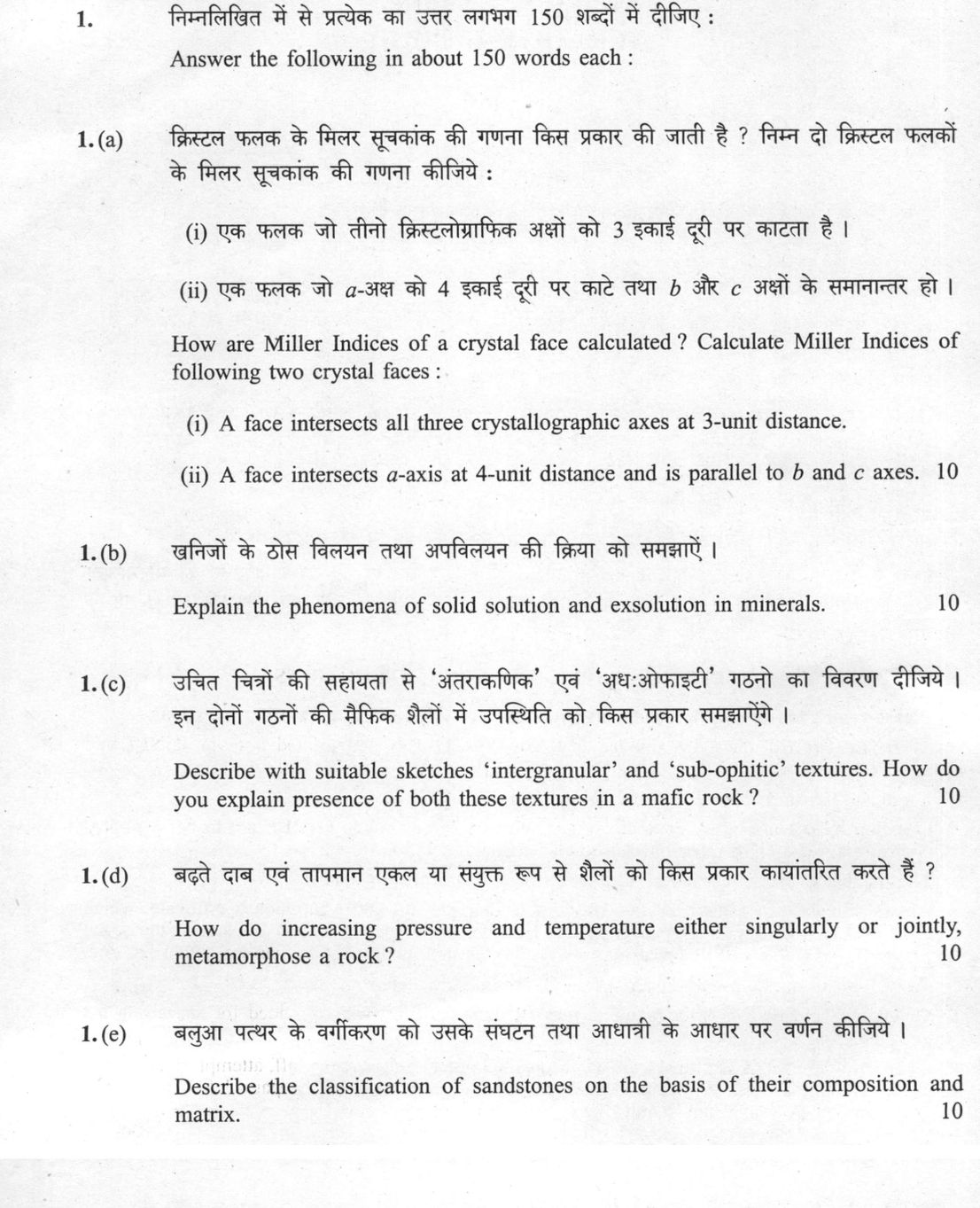
Answer the following in about 150 words each: (a) How are Miller Indices of a crystal face calculated ? Calculate Miller Indices…
Answer the following in about 150 words each:
How are Miller Indices of a crystal face calculated ? Calculate Miller Indices of following two crystal faces : A face intersects all three crystallographic axes at 3-unit distance.
A face intersects a-axis at 4-unit distance and is parallel to b and c axes. 10 marks
Explain the phenomena of solid solution and exsolution in minerals. 10 marks
Describe with suitable sketches 'intergranular' and 'sub-ophitic' textures. How do you explain presence of both these textures in a mafic rock ? 10 marks
How do increasing pressure and temperature either singularly or jointly, metamorphose a rock ? 10 marks
Describe the classification of sandstones on the basis of their composition and matrix. 10 marks
हिंदी में प्रश्न पढ़ें
निम्नलिखित में से प्रत्येक का उत्तर लगभग 150 शब्दों में दीजिए :
क्रिस्टल फलक के मिलर सूचकांक की गणना किस प्रकार की जाती है ? निम्न दो क्रिस्टल फलकों के मिलर सूचकांक की गणना कीजिए : एक फलक जो तीनों क्रिस्टलोग्राफिक अक्षों को 3 इकाई दूरी पर काटता है ।
एक फलक जो a-अक्ष को 4 इकाई दूरी पर काटे तथा b और c अक्षों के समानांतर हो । (10 अंक)
खनिजों के ठोस विलयन तथा अपविलयन की क्रिया को समझाएं । (10 अंक)
उचित चित्रों की सहायता से 'अंतरकणिक' एवं 'अधःओफाइटी' गठनों का विवरण दीजिए । इन दोनों गठनों की मैफिक शैलों में उपस्थिति को किस प्रकार समझाएंगे । (10 अंक)
बढ़ते दाब एवं तापमान एकल या संयुक्त रूप से शैलों को किस प्रकार कायांतरित करते हैं ? (10 अंक)
बलुआ पत्थर के वर्गीकरण को उसके संघटन तथा आधात्री के आधार पर वर्णन कीजिए । (10 अंक)
Model answer
Written by UPSC Answer Check against this question's marking rubric, to the 150-word length. UPSC does not publish answers for Mains — this is one way to score well, not an official key.
(a) Miller indices describe the orientation of a crystal face relative to the crystallographic axes. Let the intercepts made by the face on the a, b and c axes, measured in axial units, be p, q and r. The method is:
- Determine the intercepts p, q and r.
- Take the reciprocals 1/p, 1/q and 1/r.
- Clear fractions by multiplying by a suitable common factor.
- Reduce the resulting numbers to the smallest integers h, k and l.
- Enclose them in parentheses as (hkl). Negative intercepts are shown by a bar over the index. A face parallel to an axis has infinite intercept, so its reciprocal is zero.
(i) The face intersects all three axes at 3-unit distance. Thus p = 3, q = 3 and r = 3. Reciprocals are 1/3 : 1/3 : 1/3. Multiplying by 3 gives 1 : 1 : 1. Therefore the Miller indices are (111).
(ii) The face intersects the a-axis at 4-unit distance and is parallel to the b and c axes. Thus p = 4, q = ∞ and r = ∞. Reciprocals are 1/4 : 0 : 0. Multiplying by 4 gives 1 : 0 : 0. Therefore the Miller indices are (100).
(b) A solid solution is a single homogeneous crystalline phase in which two or more components are mixed at the lattice scale. Its composition can vary without changing the basic crystal structure. Substitution may be simple, as Mg²⁺ ↔ Fe²⁺ in olivine, Mg₂SiO₄–Fe₂SiO₄; coupled, as Na⁺ + Si⁴⁺ ↔ Ca²⁺ + Al³⁺ in plagioclase; or interstitial, where small atoms or ions occupy voids in the structure. Solid solution is favoured by similar ionic radius and charge, high temperature, suitable crystal structure and, in some cases, pressure. Common examples occur in olivine, pyroxene, amphibole, feldspar and garnet.
Exsolution is the unmixing of an originally homogeneous solid solution into two or more distinct phases on cooling or pressure change. At high temperature, entropy favours mixing. On cooling, the solvus is crossed and diffusion separates the components into lamellae, blebs or patches within a host. It is a solid-state process, not melting. Examples are perthite, where albite lamellae separate from K-feldspar; antiperthite; augite with pigeonite lamellae; and ilmenite–hematite intergrowths. Exsolution textures indicate slow cooling from a high-temperature homogeneous state and help reconstruct thermal history. Thus, solid solution is the mixed state, while exsolution is its later separation.
(c) Intergranular texture: in a mafic rock, plagioclase occurs as randomly oriented laths, and pyroxene fills the angular interstitial spaces between them. The pyroxene does not enclose the plagioclase laths; it merely occupies the remaining pore space. A sketch would show elongated plagioclase rectangles with pyroxene in the wedges and gaps between them.
Sub-ophitic texture: here pyroxene forms larger crystals that partially enclose earlier-formed plagioclase laths. The plagioclase laths are partly embedded in pyroxene, but many still protrude outside; the enclosure is incomplete. In true ophitic texture, plagioclase laths are completely enclosed by pyroxene. A sketch would show a large, irregular pyroxene crystal with several plagioclase laths partly inside and partly outside its boundary.
Both textures may occur in the same mafic rock because plagioclase and pyroxene crystallize nearly simultaneously from the same magma. If plagioclase nucleates first and grows as laths, later pyroxene simply fills the interstices, producing intergranular texture. If pyroxene begins to crystallize before plagioclase growth is complete, it can partially envelop the laths, giving sub-ophitic texture. Local differences in nucleation density, cooling rate, undercooling, melt composition and timing of crystallization can therefore produce both textures together in a dolerite, gabbro or basalt.
(d) Increasing temperature alone promotes solid-state diffusion, recrystallization, grain growth and metamorphic reactions. At constant pressure, hydrous and clay minerals break down, and new anhydrous assemblages form. For example, in pelitic rocks, clay → chlorite → biotite → garnet → staurolite → kyanite/sillimanite with rising temperature. In calcareous rocks, calcite + quartz → wollastonite + CO₂ at high temperature. Temperature thus controls reaction rate and metamorphic grade.
Increasing pressure alone favours denser minerals and high-pressure polymorphs. Examples are quartz → coesite, calcite → aragonite, and basalt/gabbro → eclogite, where plagioclase + pyroxene change to garnet + omphacite. Pressure also influences dehydration and recrystallization, especially under differential stress, producing foliation and preferred mineral orientation.
When pressure and temperature increase jointly, as in regional metamorphism during burial and tectonism, the stable mineral assemblage is fixed by both variables. The P–T path determines the facies series: low-P/high-T Buchan type with andalusite and cordierite; medium-P Barrovian type with kyanite, staurolite and garnet; high-P/low-T blueschist type with glaucophane and lawsonite; and high-P eclogite type. Thus shale may pass through slate → phyllite → schist → gneiss, while basalt may pass through greenschist → amphibolite → eclogite. Pressure and temperature are therefore independent intensive controls on metamorphism.
(e) Sandstones are classified using framework composition and matrix content. Matrix is fine-grained clay or silt, generally less than 0.03 mm, occurring between framework grains. A basic division is:
- Arenite: matrix below the boundary; clean, well-winnowed sandstone. In Pettijohn/Dott the boundary is about 10% matrix; in Folk it is about 15%.
- Wacke: matrix above that boundary; poorly sorted, matrix-rich sandstone.
In Pettijohn’s classification, arenites include quartz arenite, subarkose, sublitharenite, arkose and litharenite. Quartz arenite contains more than about 90–95% quartz and is supermature. Arkose is rich in feldspar, commonly derived from granite. Litharenite is rich in rock fragments. Wackes include quartz wacke, feldspathic wacke and lithic wacke; lithic wacke is commonly called greywacke.
Folk’s classification uses quartz, feldspar and rock fragments for arenites and treats matrix separately. Dott’s scheme recognises quartz arenite, feldspathic arenite, lithic arenite and greywacke. The matrix reflects depositional energy and diagenesis: clean arenites indicate high-energy, winnowed environments, whereas wackes indicate rapid deposition, turbidity currents and low-energy basins. Composition reflects provenance and maturity: quartz-rich sandstones are recycled and mature; feldspar-rich sandstones are arkosic and granitic; lithic-rich sandstones are volcanic or metamorphic in source. Thus, both composition and matrix are essential for sandstone classification.
What "Calculate" is asking you to do
Apply the standard formula or schedule to data the question has already supplied — a table of readings, cost records, a balance sheet — and produce the number. The method is rarely in doubt; the marks sit in the named intermediate quantities, each of which has to appear as a labelled line.
Structure that answers it
Data as given → formula or standard treatment, named → substitution → each intermediate, labelled → result with units
Where marks are lost
Omitting an intermediate the marking scheme pays for separately, or rounding at an intermediate line so the final figure drifts. In commerce and accountancy, any figure in a statement that no numbered working note supports is treated as unearned.
How this answer will be evaluated
Approach
Framework: Geology Paper 2 Method: Define > Process > Field/Petrographic Evidence > Indian Example. (a) calculate: given > formula > substitution > result with units > interpretation | (b) explain: definition/context > points in order > small example > short close | (c) describe: define > structure or process in order > labelled diagram > significance | (d) explain: definition/context > points in order > small example > short close | (e) describe: define > structure or process in order > labelled diagram > significance Full marks: Precise definitions, correct calculations, labelled sketches, Indian examples, clear causal chains.
Key points expected
- Method: intercepts, reciprocals, clear fractions
- Face (i) calculation: 1/3, 1/3, 1/3 -> (111)
- Face (ii) calculation: 1/4, 1/∞, 1/∞ -> (100)
- Correct notation of final indices
- Definition of solid solution (isomorphism)
- Definition of exsolution (unmixing)
- Role of temperature in solubility
- Example: Biotite exsolving to muscovite + ilmenite
Evaluation rubric
Each sub-part is marked on its own, against the marks and word limit printed on the paper.
- (a) Miller Indices calculation method and specific indices for two faces. 10 marks · 150 words
calculate— given → formula → substitution → result with units → interpretation
Must cover
- Method: intercepts, reciprocals, clear fractions
- Face (i) calculation: 1/3, 1/3, 1/3 -> (111)
- Face (ii) calculation: 1/4, 1/∞, 1/∞ -> (100)
- Correct notation of final indices
Loses marks
- Missing reciprocal step in method
- Incorrect indices for either face
Earns more
- Sketch of axes and intercepts
- Explanation of infinity for parallel axes
Extra mark
- Mention of specific mineral symmetry
- (b) Mechanism of solid solution and exsolution in minerals. 10 marks · 150 words
explain— definition/context → points in order → small example → short close
Must cover
- Definition of solid solution (isomorphism)
- Definition of exsolution (unmixing)
- Role of temperature in solubility
- Example: Biotite exsolving to muscovite + ilmenite
Loses marks
- Confusing solid solution with mechanical mixture
- No mention of temperature dependence
Earns more
- Mention of cation size/charge compatibility
- Reference to Indian pegmatites or granites
Extra mark
- Phase diagram sketch of miscibility gap
- (c) Intergranular and sub-ophitic textures with sketches and mafic rock context. 10 marks · 150 words
describe— define → structure or process in order → labelled diagram → significance
Must cover
- Definition of intergranular texture
- Definition of sub-ophitic texture
- Sketches showing plagioclase-pyroxene relationship
- Explanation of crystallization sequence in mafic rock
Loses marks
- Missing sketches or unlabelled diagrams
- Confusing sub-ophitic with ophitic
Earns more
- Mention of specific mafic rock (e.g., Gabbro)
- Reference to Indian Deccan Traps or similar
Extra mark
- Detailed sketch of ophitic vs sub-ophitic
- (d) Effect of pressure and temperature on rock metamorphism. 10 marks · 150 words
explain— definition/context → points in order → small example → short close
Must cover
- Effect of pressure (foliation, density)
- Effect of temperature (recrystallization, new minerals)
- Combined effect (metamorphic facies)
- Example of metamorphic rock (e.g., Schist, Gneiss)
Loses marks
- Treating pressure and temperature as independent
- No mention of mineral changes
Earns more
- Mention of specific metamorphic belt in India
- Reference to P-T conditions (e.g., Barrovian)
Extra mark
- P-T diagram sketch
- (e) Classification of sandstones by composition and matrix. 10 marks · 150 words
describe— define → structure or process in order → labelled diagram → significance
Must cover
- Classification by composition (Quartz, Arkose, Greywacke)
- Classification by matrix (Clastic, Chemical)
- Definition of matrix (clay, carbonate, silica)
- Example of sandstone type
Loses marks
- Confusing matrix with cement
- No mention of composition types
Earns more
- Mention of specific Indian sandstone formation
- Reference to maturity (textural/chemical)
Extra mark
- Sketch of sandstone types
Practice this exact question
Write your answer and it is marked point by point against the model answer above — what you covered, what you missed, what you got wrong.
Evaluate my answer →More from Geology 2022 Paper II
- Q1 Answer the following in about 150 words each: (a) How are Miller Indices of a crystal fac…
- Q2 (a) Describe the crystallographic, physical, optical and chemical properties of garnet gr…
- Q3 (a) What are different types of metamorphism and what are their controlling factors ? Sta…
- Q4 (a) What do you understand by sedimentary depositional environment ? Describe fluvial env…