Paper II — Q4
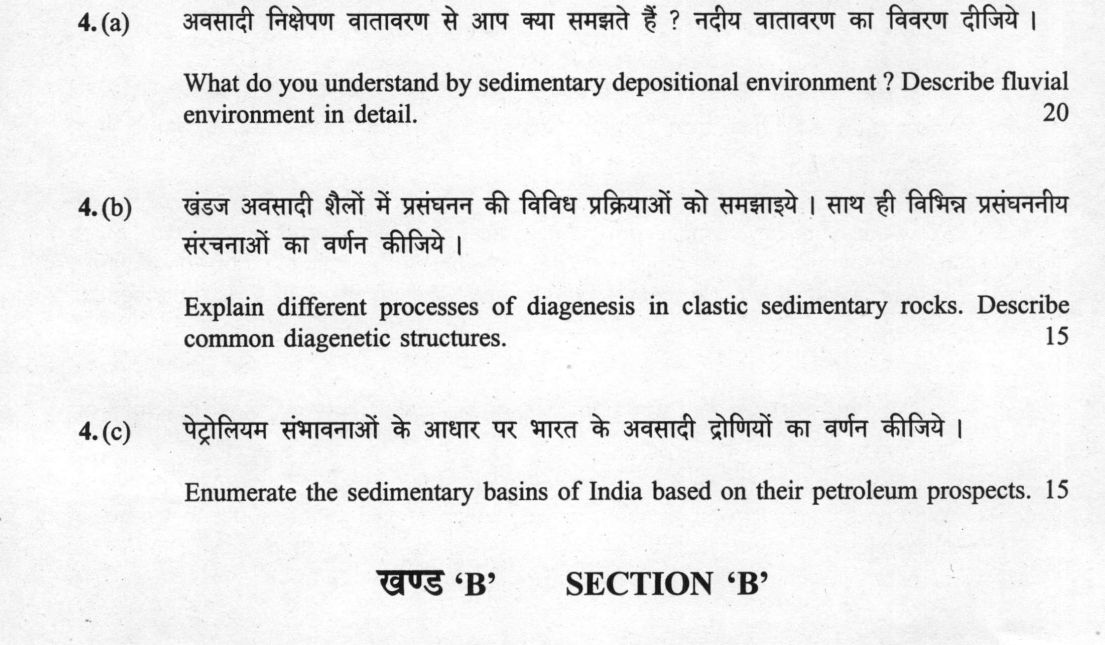
(a) What do you understand by sedimentary depositional environment ? Describe fluvial environment in detail. (20 marks) (b)…
What do you understand by sedimentary depositional environment ? Describe fluvial environment in detail. 20 marks
Explain different processes of diagenesis in clastic sedimentary rocks. Describe common diagenetic structures. 15 marks
Enumerate the sedimentary basins of India based on their petroleum prospects. 15 marks
हिंदी में प्रश्न पढ़ें
अवसादी निक्षेपण वातावरण से आप क्या समझते हैं ? नदीय वातावरण का विवरण दीजिये । (20 अंक)
खंडज अवसादी शैलों में प्रसंधन की विविध प्रक्रियाओं को समझाइये । साथ ही विभिन्न प्रसंधननीय संरचनाओं का वर्णन कीजिये । (15 अंक)
पेट्रोलियम संभावनाओं के आधार पर भारत के अवसादी द्रोणियों का वर्णन कीजिये । (15 अंक)
What "Describe" is asking you to do
Give a full, ordered account of the thing named — its parts, stages or mechanism — in the sequence in which it actually exists or occurs. Most describe questions come from the science optionals, where the marks sit in correct technical detail and, where the stem says so, a labelled diagram.
Structure that answers it
One-line identification of the subject → the parts or stages in their real order, each with its defining detail → labelled diagram where the subject is structural → closing line on function or significance
Where marks are lost
Loose general prose where the examiner is ticking named parts, correct terminology and their sequence; and in the General Studies papers, turning to evaluation before the description is finished.
How this answer will be evaluated
Approach
Framework: Geology Paper 2: Define > Process > Field/Petrographic Evidence > Indian Example. (a) describe: define > structure or process in order > labelled diagram > significance | (b) explain: definition/context > points in order > small example > short close | (c) enumerate: list the items in order > one line each > no commentary Full marks: Comprehensive, well-structured answers with precise terminology, labelled diagrams, and specific Indian examples.
Key points expected
- Define sedimentary depositional environment
- Describe fluvial environment components (channel, floodplain, etc.)
- Explain fluvial processes (erosion, transport, deposition)
- Provide a labelled diagram of a fluvial system
- Define diagenesis in clastic sedimentary rocks
- Explain key diagenetic processes (compaction, cementation, etc.)
- Describe common diagenetic structures (e.g., cement, porosity)
- Provide a small example or diagram
Evaluation rubric
Each sub-part is marked on its own, against the marks and word limit printed on the paper.
- (a) Define sedimentary depositional environment and detail the fluvial environment. 20 marks
describe— define → structure or process in order → labelled diagram → significance
Must cover
- Define sedimentary depositional environment
- Describe fluvial environment components (channel, floodplain, etc.)
- Explain fluvial processes (erosion, transport, deposition)
- Provide a labelled diagram of a fluvial system
Loses marks
- Generic description without specific fluvial components
- Missing or unlabelled diagram
- No Indian example provided
Earns more
- Mention specific fluvial facies (e.g., point bar, oxbow lake)
- Discuss sedimentary structures (cross-bedding, ripple marks)
- Link to Indian examples (e.g., Ganga-Brahmaputra basin)
- Mention stratigraphic age of fluvial deposits
Extra mark
- Name a specific Indian fluvial formation
- Include a phase diagram of fluvial processes
- (b) Explain diagenetic processes in clastic rocks and describe common structures. 15 marks
explain— definition/context → points in order → small example → short close
Must cover
- Define diagenesis in clastic sedimentary rocks
- Explain key diagenetic processes (compaction, cementation, etc.)
- Describe common diagenetic structures (e.g., cement, porosity)
- Provide a small example or diagram
Loses marks
- Confusing diagenesis with metamorphism
- Missing description of diagenetic structures
- No example or diagram provided
Earns more
- Mention specific minerals involved in cementation
- Discuss impact on porosity and permeability
- Link to economic deposits (e.g., reservoir rocks)
- Provide an Indian example of diagenetic rocks
Extra mark
- Name a specific Indian diagenetic formation
- Include a petrographic thin-section image
- (c) List sedimentary basins of India based on petroleum prospects. 15 marks
enumerate— list the items in order → one line each → no commentary
Must cover
- List major sedimentary basins of India
- Order basins by petroleum prospect (high to low)
- Provide one line of substance for each basin
Loses marks
- Listing basins without ordering by prospect
- Excessive commentary instead of enumeration
- Missing major basins (e.g., Krishna-Godavari, Assam)
Earns more
- Mention specific petroleum fields within basins
- Discuss geological factors affecting prospects
- Provide a map or table of basins
- Mention current production status
Extra mark
- Name a specific petroleum field in a basin
- Include a map of Indian sedimentary basins
Model answer coming soon
Every evaluation on this site is marked against a verified model answer. This question's answer is still being written; evaluation opens the moment it lands.
More from Geology 2022 Paper II
- Q1 Answer the following in about 150 words each: (a) How are Miller Indices of a crystal fac…
- Q2 (a) Describe the crystallographic, physical, optical and chemical properties of garnet gr…
- Q3 (a) What are different types of metamorphism and what are their controlling factors ? Sta…
- Q4 (a) What do you understand by sedimentary depositional environment ? Describe fluvial env…
- Q5 Answer the following in about 150 words each: (a) What are the major changes in the proce…
- Q6 (a) Explain the processes by which sediment hosted Pb-Zn deposits are formed. Describe th…
- Q7 (a) In a bauxite exploration, 12 vertical boreholes were drilled in square grid pattern a…