Paper II — Q8
(a) Give the classification of landslides and discuss the causes of landslide. (20 marks) (b) What is the structure of the Earth…
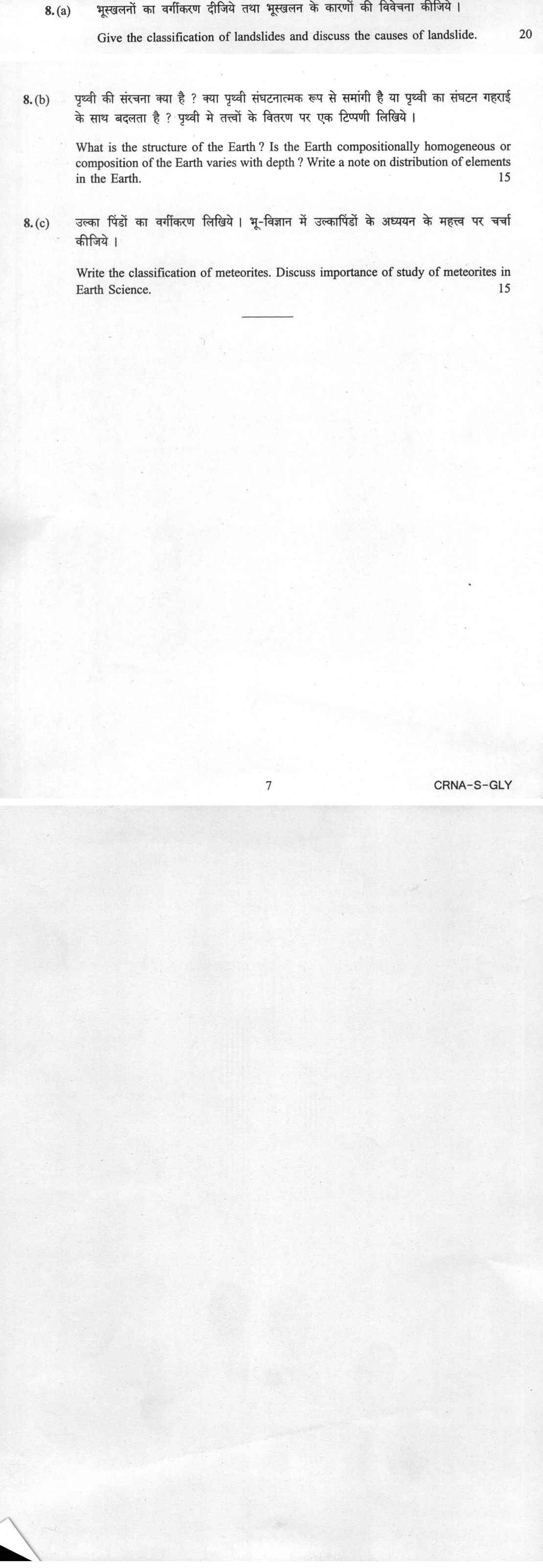
Give the classification of landslides and discuss the causes of landslide. 20 marks
What is the structure of the Earth ? Is the Earth compositionally homogeneous or composition of the Earth varies with depth ? Write a note on distribution of elements in the Earth. 15 marks
Write the classification of meteorites. Discuss importance of study of meteorites in Earth Science. 15 marks
हिंदी में प्रश्न पढ़ें
भूस्खलनों का वर्गीकरण दीजिये तथा भूस्खलन के कारणों की विवेचना कीजिये। (20 अंक)
पृथ्वी की संरचना क्या है ? क्या पृथ्वी संघटनात्मक रूप से समांगी है या पृथ्वी का संघटन गहराई के साथ बदलता है ? पृथ्वी में तत्वों के वितरण पर एक टिप्पणी लिखिये । (15 अंक)
उल्का पिंडों का वर्गीकरण लिखिये । भू-विज्ञान में उल्कापिंडों के अध्ययन के महत्व पर चर्चा कीजिये । (15 अंक)
Model answer
Written by UPSC Answer Check against this question's marking rubric, to the expected length. UPSC does not publish answers for Mains — this is one way to score well, not an official key.
Classification and Causes of Landslides
The Cruden and Varnes classification system categorizes mass movements by combining the type of movement—fall, topple, slide (rotational or translational), lateral spread, flow, and complex—with the nature of the material, which comprises bedrock, coarse debris, or fine-grained earth. Failures range geometrically from shallow translational slides, where failure occurs along a shallow planar boundary parallel to the slope, to deep-seated rotational slumps governed by curved shear surfaces.
`` [Cruden & Varnes Classification Matrix] Movement Type Material | Bedrock | Debris | Earth -------------------------|--------------|--------------|------------- Fall / Topple | Rock Fall | Debris Fall | Earth Topple Slide (Rotational/Planar)| Rock Slide | Debris Slide | Earth Slump Lateral Spread | Rock Spread | Debris Spread| Earth Spread Flow | Rock Flow | Debris Flow | Earth Flow ``
Landslide initiation results from internal preparatory factors and external triggers. Geological causes include unfavourable joint sets, daylighting foliation or bedding planes, shear zones, and lithological contrasts. Geomorphological drivers involve slope oversteepening through fluvial toe erosion and tectonic uplift. Dynamic triggers include sudden pore-water pressure spikes from intense rainfall and cyclic shear stresses during earthquakes. Anthropogenic interventions—such as unscientific slope cutting for infrastructure, deforestation, and uncontrolled drainage discharge—severely reduce slope factor of safety.
In India, the geodynamically active Himalayas frequently experience deep-seated rockslides and debris flows triggered by cloudbursts and seismicity, as observed during the 2013 Kedarnath disaster and the Kinnaur rock avalanches in Himachal Pradesh. Conversely, the Western Ghats are prone to shallow regolith failures and debris flows along transport corridors, typified by the Ambenali Ghat and Malin failures during monsoon downpours.
Earth's Structure and Elemental Distribution
Earth is compositionally and mechanically heterogeneous, stratified into distinct concentric shells separated by first-order seismic discontinuities.
`` [Surface] ---- Crust: Continental (Granodioritic) / Oceanic (Basaltic) ~35 km ---- Mohorovičić Discontinuity Upper Mantle (Peridotite: Olivine + Pyroxene) 660 km ---- Transition Zone Discontinuity Lower Mantle (Bridgmanite + Ferropericlase) 2890 km ---- Gutenberg Discontinuity (Core-Mantle Boundary) Outer Core (Liquid Fe-Ni + light elements: S, O, Si) 5150 km ---- Lehmann Discontinuity [6371 km] ---- Inner Core (Solid crystalline Fe-Ni alloy) ``
The Earth varies systematically in composition with depth due to gravitational settling during accretion and core differentiation. Goldschmidt’s geochemical classification outlines this distribution: Lithophile elements, possessing strong affinity for oxygen, partitioned into the silicate crust and mantle (SiO₂, Al_2O₃, CaO, Na_2O, K_2O, MgO). Siderophile and chalcophile elements partitioned into the iron-nickel core (Fe, Ni, Co, Au, platinum-group elements, and sulfur).
Consequently, the bulk Earth is dominated by Iron (~32.1%), Oxygen (~30.1%), Silicon (~15.1%), and Magnesium (~13.9%). In contrast, the continental crust is enriched in lighter, incompatible elements following the order: Oxygen (~46.6%) > Silicon (~27.7%) > Aluminium (~8.1%) > Iron (~5.0%) > Calcium > Sodium > Potassium > Magnesium, illustrating progressive magmatic fractionation from a chondritic primitive mantle.
Classification and Importance of Meteorites
Meteorites are broadly grouped into three primary classes based on their silicate-to-metal ratio:
Stony Meteorites: Comprise Chondrites and Achondrites. Chondrites are primitive, undifferentiated aggregates containing spherical chondrules, sub-classified into Carbonaceous (CI, CM), Ordinary (H, L, LL), and Enstatite (EH, EL) groups across petrologic grades 1 to 6 (denoting degrees of aqueous alteration and thermal metamorphism). Achondrites are differentiated igneous crustal/mantle rocks devoid of chondrules, including HED (howardite-eucrite-diogenite from 4 Vesta), SNC (Martian), and lunar meteorites.
Stony-Iron Meteorites: Contain subequal proportions of silicates and Fe-Ni metal, divided into Pallasites (olivine crystals set in an Fe-Ni matrix) and Mesosiderites (brecciated silicates mixed with metal).
Iron Meteorites: Composed almost entirely of Fe-Ni alloys (kamacite and taenite), classified structurally by their Widmanstätten patterns (Hexahedrites, Octahedrites, Ataxites) and chemically via trace elements (Ga, Ge, Ir), representing disrupted planetary cores exhibiting varied shock metamorphism stages.
The study of meteorites is fundamental to Earth Science. Radiometric dating (e.g., ²⁰⁷Pb-²⁰⁶Pb) of Calcium-Aluminium-rich Inclusions (CAIs) in chondrites provides the definitive age of the solar system and Earth at 4.567 billion years. Chondritic meteorites represent pristine solar nebula condensates, serving as the benchmark for calculating the Bulk Silicate Earth (BSE) composition. Achondrites and iron meteorites offer tangible analogues for core segregation and early crustal evolution. Furthermore, organic-rich carbonaceous chondrites, such as the Murchison meteorite containing extraterrestrial amino acids and nucleobases, provide insights into prebiotic volatile delivery to early Earth, while metal-rich asteroids remain targets for strategic nickel-iron and platinum-group element exploration.
Integrated geochemical and geophysical analysis of these planetary materials, alongside continuous geohazard assessment of dynamic surface processes, forms the cornerstone of modern Earth and planetary sciences.
What "Discuss" is asking you to do
Lay the issue out from more than one side — how it arose, what is claimed for it, what is held against it, and where it now stands. UPSC attaches discuss to broad topics with several live dimensions, so coverage of the dimensions earns more than the strength of your opinion.
Structure that answers it
Set the issue up → the case as it is made → the case against → the dimension both sides leave out → where the balance now lies
Where marks are lost
Listing facts with no thread between them, or arguing one side throughout and calling it a discussion.
How this answer will be evaluated
Approach
Framework: Geology Paper 2: Define > Process > Field/Petrographic Evidence > Indian Example. (a) discuss: intro > 3-4 dimensions > example > balanced close | (b) explain: definition/context > points in order > small example > short close | (c) explain: definition/context > points in order > small example > short close Full marks: Precise classification, clear causal chain, named Indian examples, and accurate petrographic/structural details.
Key points expected
- Classification by type (e.g., falls, slides, flows)
- Classification by rate of movement
- Causal factors: gravity, water, slope, geology
- Named Indian landslide example (e.g., Dehradun, Uttarakhand)
- Layers: Crust, Mantle, Core (Inner/Outer)
- Discontinuity surfaces (Moho, Gutenberg, Lehmann)
- Compositional variation (silicate vs. metallic)
- Distribution of elements (Fe, Ni, O, Si)
Evaluation rubric
Each sub-part is marked on its own, against the marks and word limit printed on the paper.
- (a) Classification of landslides and a detailed discussion of their causes. 20 marks
discuss— intro → 3-4 dimensions → example → balanced close
Must cover
- Classification by type (e.g., falls, slides, flows)
- Classification by rate of movement
- Causal factors: gravity, water, slope, geology
- Named Indian landslide example (e.g., Dehradun, Uttarakhand)
Loses marks
- Generic description without classification
- Missing Indian example
- Confusing landslide with rockfall
Earns more
- Mechanism of failure (shear plane)
- Role of seismic activity in triggering
- Human-induced factors (deforestation, construction)
Extra mark
- Sketch of a rotational slide
- Reference to specific geological formation
- (b) Earth's structure, compositional variation with depth, and element distribution. 15 marks
explain— definition/context → points in order → small example → short close
Must cover
- Layers: Crust, Mantle, Core (Inner/Outer)
- Discontinuity surfaces (Moho, Gutenberg, Lehmann)
- Compositional variation (silicate vs. metallic)
- Distribution of elements (Fe, Ni, O, Si)
Loses marks
- Claiming Earth is homogeneous
- Missing discontinuity surfaces
- No mention of element distribution
Earns more
- Seismic evidence (P and S waves)
- Density profile of the Earth
- Magnetic field generation in outer core
Extra mark
- Sketch of Earth's internal structure
- Mention of specific mineral assemblages
- (c) Classification of meteorites and their importance in Earth Science. 15 marks
explain— definition/context → points in order → small example → short close
Must cover
- Classification: Stoney, Iron, Stony-iron
- Sub-types (Chondrites, Achondrites)
- Importance: Origin of solar system
- Importance: Age of Earth (radiometric dating)
Loses marks
- Missing classification
- No link to Earth Science
- Confusing meteorite with meteor
Earns more
- Cosmochemical evidence
- Impact cratering and extinction events
- Comparison with terrestrial rocks
Extra mark
- Named Indian meteorite fall
- Mention of specific meteorite type (e.g., H4 chondrite)
Practice this exact question
Write your answer and it is marked point by point against the model answer above — what you covered, what you missed, what you got wrong.
Evaluate my answer →More from Geology 2022 Paper II
- Q5 Answer the following in about 150 words each: (a) What are the major changes in the proce…
- Q6 (a) Explain the processes by which sediment hosted Pb-Zn deposits are formed. Describe th…
- Q7 (a) In a bauxite exploration, 12 vertical boreholes were drilled in square grid pattern a…
- Q8 (a) Give the classification of landslides and discuss the causes of landslide. (20 marks)…