Paper II — Q6
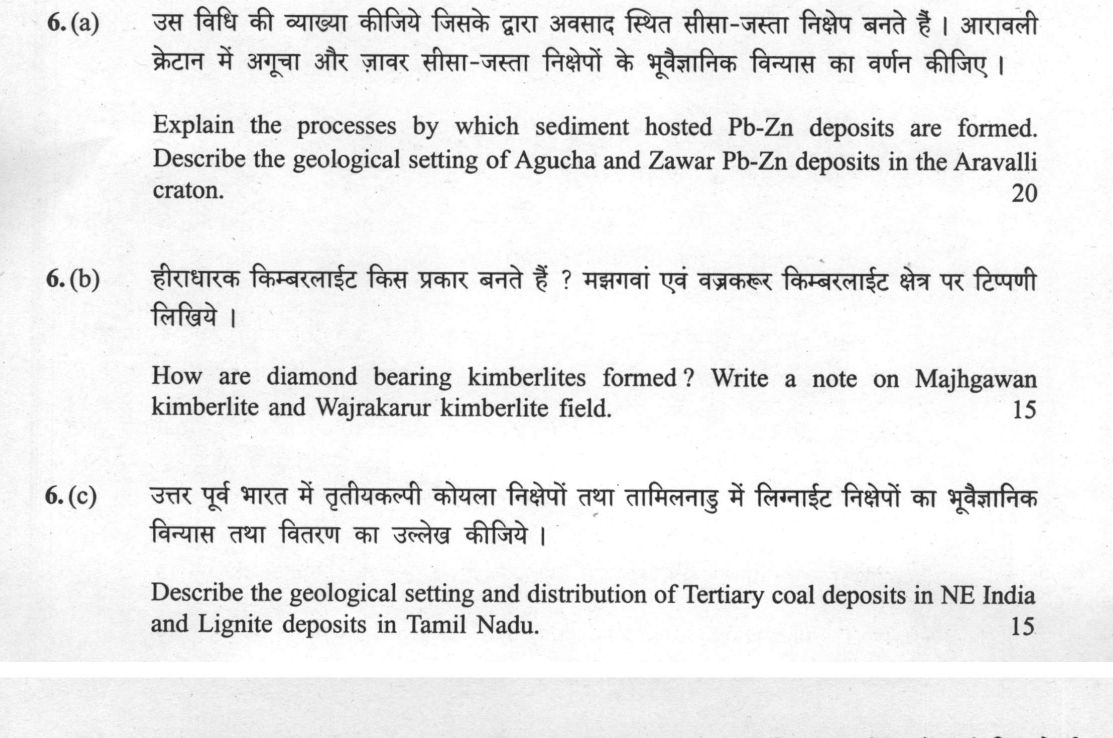
(a) Explain the processes by which sediment hosted Pb-Zn deposits are formed. Describe the geological setting of Agucha and Zawar…
Explain the processes by which sediment hosted Pb-Zn deposits are formed. Describe the geological setting of Agucha and Zawar Pb-Zn deposits in the Aravalli craton. 20 marks
How are diamond bearing kimberlites formed ? Write a note on Majhgawan kimberlite and Wajrakarur kimberlite field. 15 marks
Describe the geological setting and distribution of Tertiary coal deposits in NE India and Lignite deposits in Tamil Nadu. 15 marks
हिंदी में प्रश्न पढ़ें
उस विधि की व्याख्या कीजिए जिसके द्वारा अवसाद स्थित सीसा-जस्ता निक्षेप बनते हैं । आरावली क्रेटान में अगुचा और जावर सीसा-जस्ता निक्षेपों के भूवैज्ञानिक विन्यास का वर्णन कीजिए । (20 अंक)
हीराधारक किम्बरलाइट किस प्रकार बनते हैं ? मझगवां एवं वज्रकरुर किम्बरलाइट क्षेत्र पर टिप्पणी लिखिए । (15 अंक)
उत्तर पूर्व भारत में तृतीयकपी कोयला निक्षेपों तथा तामिलनाडु में लिग्नाइट निक्षेपों का भूवैज्ञानिक विन्यास तथा वितरण का उल्लेख कीजिए । (15 अंक)
Model answer
Written by UPSC Answer Check against this question's marking rubric, to the expected length. UPSC does not publish answers for Mains — this is one way to score well, not an official key.
India’s economic mineral wealth includes sediment-hosted Pb-Zn, diamond-bearing kimberlites and Tertiary coal/lignite, each controlled by distinct basin, mantle and sedimentary processes.
Sediment-hosted Pb-Zn and the Aravalli craton Sediment-hosted Pb-Zn deposits form when metal-rich fluids are expelled from sedimentary basins and precipitate sulfides in carbonate or shale hosts. The causal sequence is source, transport and trap: burial and heating generate brines, faults provide conduits, and carbonate-shale interfaces provide chemical traps. In the SEDEX model, extensional or back-arc basins generate high-temperature, metal-rich brines that rise through faults and precipitate at the seafloor as massive sulfide exhalations; rapid cooling and mixing with seawater cause sulfide precipitation, often producing thick, massive orebodies. SEDEX deposits are commonly associated with volcanic-sedimentary successions. In the MVT model, basin dewatering and brine expulsion from evaporite or shale-rich sequences drive low-temperature, chloride-rich brines along faults; when they meet carbonate rocks, redox and carbonate dissolution reactions replace limestone and dolomite with galena and sphalerite, commonly in vein and replacement forms. MVT deposits are typically hosted in carbonate platforms. In both models, sulfide precipitation is triggered by changes in temperature, pH, redox, or sulfate reduction. The Aravalli craton provides the Proterozoic Delhi Supergroup carbonate-shale host rocks, faulted and folded, that focus these fluids. The Delhi Supergroup includes dolomitic limestones, shales and sandstones, providing varied host lithologies. Later deformation created fault-controlled pathways and structural traps. Agucha, in the Bhilwara belt, is a world-class SEDEX deposit where exhalative sulfides are hosted in carbonate-shale sequences. Zawar, in Udaipur district, is an MVT-type deposit in carbonate rocks, formed by basin-brine replacement and vein filling.
Diamond-bearing kimberlites Diamond-bearing kimberlites form when small-degree mantle melting occurs at depths greater than 150 km in the lithospheric mantle. CO2-H2O volatile fluxing lowers the solidus and creates highly volatile-rich, buoyant melts. These melts ascend rapidly as diatremes, carrying diamonds and lithospheric mantle xenoliths; rapid ascent and decompression prevent diamond destruction and preserve them in the kimberlite. Kimberlites are among the fastest ascending magmas, so they can transport diamonds from mantle depths without prolonged residence at lower pressures. Diamonds crystallize at high pressure in the mantle and are transported as xenocrysts, while mantle xenoliths record the pressure-temperature history of the source. Majhgawan, in Panna district, is India’s only diamond-producing mine; it is a Cretaceous kimberlite pipe whose structure and mantle xenoliths record deep mantle sampling. Wajrakarur, in Khammam district, Andhra Pradesh, is a multiple-pipe kimberlite field, representing a cluster of kimberlite pipes rather than a single producing pipe. This shows that diamond exploration in India must consider regional mapping of multiple pipes.
Tertiary coal in NE India and lignite in Tamil Nadu Tertiary coal in NE India occurs in the foreland basin fill of the Assam-Arakan basin and in the Eocene and Oligocene sequences of the region. In Meghalaya, the Garo, Khasi and Jaintia hills coalfields are hosted mainly in the Eocene Jaintia Group, whereas in Assam coal occurs in the Oligocene Barail Group, including the Tikak Parbat Formation. The deposits form a discontinuous belt from Makum in Assam to Dilli-Jeypore in Meghalaya, reflecting deltaic, fluvial and shallow marine sedimentation in a tectonically active basin. Structural control by basin margins and faults makes the coal seams discontinuous. Many seams are high-sulfur and oil-prone because of organic matter deposited under reducing, marine-influenced conditions. In Tamil Nadu, lignite is concentrated in the Cuddalore Formation, of Miocene-Pliocene age, in a shallow marine-lagoonal environment. The Cuddalore Formation records transgressive-regressive marine cycles, with lignite in lagoonal swamps. The Neyveli deposit is the largest lignite field in India, and the broader Ariyalur-Pondicherry belt contains important shallow lignite seams. Neyveli is exploited by Neyveli Lignite Corporation. Together, these deposits show how sedimentary basins, mantle processes and Tertiary sedimentation control India’s mineral security.
What "Explain" is asking you to do
Make the working of something clear — what sets it off, what follows from what, and what it produces. Explain is the Commission's mechanism word: it dominates the technical papers and the “explain why” stems, where the marks sit in the causal chain and not in the label.
Structure that answers it
State what it is → the initiating condition → the chain of cause, step by step → an instance where it plays out → what the chain produces
Where marks are lost
Describing what something looks like instead of why it works that way. Naming the stages without linking them reads as description too.
How this answer will be evaluated
Approach
Framework: Geology, Paper 2. (a) explain: definition/context > points in order > small example > short close | (b) explain: definition/context > points in order > small example > short close | (c) describe: define > structure or process in order > labelled diagram > significance Full marks: Precise geological terminology, specific Indian examples, clear diagrams.
Key points expected
- Processes: hydrothermal, diagenetic, or basin brine origin
- Geological setting: Aravalli craton, Proterozoic age
- Specifics: Agucha (Bhilwara) and Zawar (Udaipur) locations
- Host rocks: dolomites, limestones, or quartzites
- Formation: deep mantle origin, rapid ascent
- Majhgawan: location (Madhya Pradesh), geological context
- Wajrakarur: location (Telangana), geological context
- Petrography: olivine, chromite, diamond inclusions
Evaluation rubric
Each sub-part is marked on its own, against the marks and word limit printed on the paper.
- (a) Processes of sediment-hosted Pb-Zn formation and geological setting of Agucha/Zawar. 20 marks
explain— definition/context → points in order → small example → short close
Must cover
- Processes: hydrothermal, diagenetic, or basin brine origin
- Geological setting: Aravalli craton, Proterozoic age
- Specifics: Agucha (Bhilwara) and Zawar (Udaipur) locations
- Host rocks: dolomites, limestones, or quartzites
Loses marks
- Generic description without naming Agucha or Zawar
- Confusing sediment-hosted with magmatic deposits
Earns more
- Mention of specific ore minerals (galena, sphalerite)
- Reference to structural controls (folds, faults)
- Distinction between Agucha and Zawar settings
Extra mark
- Sketch of cross-section showing orebodies
- Mention of specific stratigraphic units (e.g., Bhilwara Group)
- (b) Formation of diamond-bearing kimberlites and notes on Majhgawan/Wajrakarur. 15 marks
explain— definition/context → points in order → small example → short close
Must cover
- Formation: deep mantle origin, rapid ascent
- Majhgawan: location (Madhya Pradesh), geological context
- Wajrakarur: location (Telangana), geological context
- Petrography: olivine, chromite, diamond inclusions
Loses marks
- Confusing kimberlite with other ultramafic rocks
- Missing specific details on Majhgawan or Wajrakarur
Earns more
- Mention of kimberlite pipe structure
- Reference to specific mineral assemblages (e.g., spinel)
Extra mark
- Sketch of kimberlite pipe cross-section
- Mention of specific diamond recovery methods
- (c) Geological setting and distribution of Tertiary coal (NE India) and Lignite (TN). 15 marks
describe— define → structure or process in order → labelled diagram → significance
Must cover
- NE India: Tertiary age, specific basins (e.g., Raniganj)
- Tamil Nadu: Lignite deposits, specific locations (e.g., Neyveli)
- Geological setting: sedimentary basins, structural controls
- Distribution: map-based or regional description
Loses marks
- Confusing Tertiary coal with older (e.g., Gondwana) coal
- Missing specific locations for NE India or TN
Earns more
- Mention of specific coal/lignite grades
- Reference to specific geological formations
Extra mark
- Sketch of geological cross-section
- Mention of specific mining methods
Practice this exact question
Write your answer and it is marked point by point against the model answer above — what you covered, what you missed, what you got wrong.
Evaluate my answer →More from Geology 2022 Paper II
- Q3 (a) What are different types of metamorphism and what are their controlling factors ? Sta…
- Q4 (a) What do you understand by sedimentary depositional environment ? Describe fluvial env…
- Q5 Answer the following in about 150 words each: (a) What are the major changes in the proce…
- Q6 (a) Explain the processes by which sediment hosted Pb-Zn deposits are formed. Describe th…
- Q7 (a) In a bauxite exploration, 12 vertical boreholes were drilled in square grid pattern a…
- Q8 (a) Give the classification of landslides and discuss the causes of landslide. (20 marks)…