Paper II — Q5
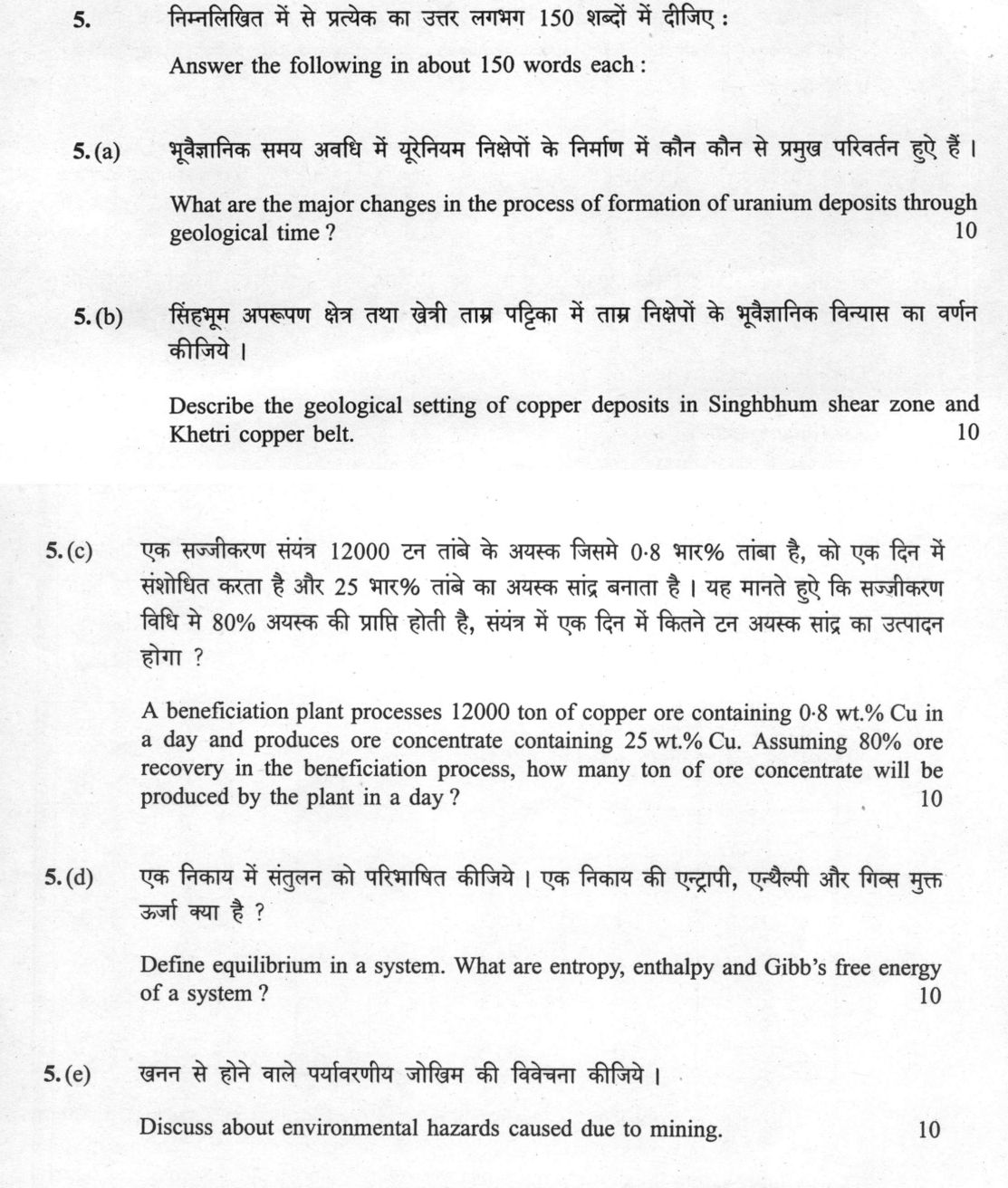
Answer the following in about 150 words each: (a) What are the major changes in the process of formation of uranium deposits…
Answer the following in about 150 words each:
What are the major changes in the process of formation of uranium deposits through geological time ? 10 marks
Describe the geological setting of copper deposits in Singhbhum shear zone and Khetri copper belt. 10 marks
A beneficiation plant processes 12000 ton of copper ore containing 0·8 wt.% Cu in a day and produces ore concentrate containing 25 wt.% Cu. Assuming 80% ore recovery in the beneficiation process, how many ton of ore concentrate will be produced by the plant in a day ? 10 marks
Define equilibrium in a system. What are entropy, enthalpy and Gibb's free energy of a system ? 10 marks
Discuss about environmental hazards caused due to mining. 10 marks
हिंदी में प्रश्न पढ़ें
निम्नलिखित में से प्रत्येक का उत्तर लगभग 150 शब्दों में दीजिए :
भूवैज्ञानिक समय अवधि में यूरेनियम निक्षेपों के निर्माण में कौन कौन से प्रमुख परिवर्तन हुए हैं । (10 अंक)
सिंहभूम अपरूपण क्षेत्र तथा खेत्री ताम्र पट्टिका में ताम्र निक्षेपों के भूवैज्ञानिक विन्यास का वर्णन कीजिये । (10 अंक)
एक सज्जीकरण संयंत्र 12000 टन तांबे के अयस्क जिसमें 0·8 भार% तांबा है, को एक दिन में संशोधित करता है और 25 भार% तांबे का अयस्क सांद्र बनाता है । यह मानते हुए कि सज्जीकरण विधि में 80% अयस्क की प्राप्ति होती है, संयंत्र में एक दिन में कितने टन अयस्क सांद्र का उत्पादन होगा ? (10 अंक)
एक निकाय में संतुलन को परिभाषित कीजिए । एक निकाय की एन्ट्रापी, एन्थैल्पी और गिब्स मुक्त ऊर्जा क्या है ? (10 अंक)
खनन से होने वाले पर्यावरणीय जोखिम की विवेचना कीजिए । (10 अंक)
Model answer
Written by UPSC Answer Check against this question's marking rubric, to the 150-word length. UPSC does not publish answers for Mains — this is one way to score well, not an official key.
(a) Evolution of Uranium Deposits through Geological Time
The temporal evolution of uranium deposits is intimately linked to the oxygenation of Earth's atmosphere and hydrosphere. During the anoxic Archean and early Paleoproterozoic (>2.4 Ga), uranium remained in its reduced, insoluble tetravalent state (U⁴⁺). It was transported mechanically as detrital grains, forming quartz-pebble conglomerate placer deposits, exemplified by the Witwatersrand Basin in South Africa and Elliot Lake in Canada.
Following the Great Oxidation Event (GOE, ~2.4–2.2 Ga), the rise of atmospheric oxygen converted uranium into the highly soluble hexavalent uranyl ion (UO₂²⁺). This enabled widespread chemical transport by oxidizing groundwaters and hydrothermal fluids, leading to high-grade Proterozoic unconformity-related deposits at the interface of basement rocks and oxidized cover sediments, such as the Athabasca Basin (Canada) and comparable settings in India's Cuddapah Basin.
In the Phanerozoic, the proliferation of land plants supplied abundant organic reductants in terrestrial sedimentary basins. This promoted the formation of low-temperature, sandstone-hosted roll-front and tabular deposits (e.g., the Colorado Plateau and Mahadek Basin in Meghalaya), marking a transition from physical placer concentrations to redox-controlled geochemical traps.
(b) Geological Setting of Singhbhum and Khetri Copper Deposits
The Singhbhum Shear Zone (SSZ) in eastern India is a 200-km-long, arcuate ductile shear zone situated within an Archean granite-greenstone terrane. Mineralization is localized along thrust contacts within deformed chlorite-biotite-quartz schists and metavolcanics of the Chaibasa and Dhanjori formations. It exhibits Iron-Oxide-Copper-Gold (IOCG) affinities, where chalcopyrite occurs intimately associated with apatite-magnetite and uraninite. Hydrothermal fluids and thermal gradients were driven by the intrusive Singhbhum Granite, with mineralization strictly controlled by structural shear fabric.
In contrast, the Khetri Copper Belt in Rajasthan occupies a NE–SW-trending zone within the Proterozoic North Delhi Fold Belt. Mineralization is hosted in multiply-deformed, amphibolite-facies metasediments of the Delhi Supergroup, primarily garnetiferous chlorite schists, quartzites, and phyllites of the Alwar and Ajabgarh Groups. Chalcopyrite and pyrrhotite occur as stratabound disseminations, stringers, and vein fillings within reverse faults, hinge zones of tight folds, and brittle-ductile shear zones, representing a structurally controlled, metamorphosed sediment-hosted deposit.
(c) Mass Balance Calculation for Copper Beneficiation
The daily tonnage of copper ore concentrate produced is determined through metallurgical mass balance:
- Copper mass contained in the daily feed: Cu_feed = 12000 tons × 0.8/100 = 96.0 tons
- Copper mass recovered into the concentrate at 80% recovery: Cu_recovered = 96.0 tons × 80/100 = 76.8 tons
- Total mass of concentrate produced at 25 wt.% Cu grade: Mass of concentrate = (76.8 tons)/0.25 = 307.2 tons
The beneficiation plant produces 307.2 tons of copper ore concentrate per day.
(d) Thermodynamic Equilibrium, Entropy, Enthalpy, and Gibbs Free Energy
Thermodynamic Equilibrium is the state of a system in which all intensive properties (temperature, pressure, chemical potential) are uniform and no spontaneous driving force or net energy transfer occurs, defined by a minimum in Gibbs free energy (Δ G = 0) at constant T and P.
Enthalpy (H = U + PV) denotes the total heat content of a system at constant pressure. In geological systems, the change in enthalpy (Δ H) dictates whether metamorphic reactions or magma crystallization processes are exothermic (Δ H < 0) or endothermic (Δ H > 0).
Entropy (S) quantifies the degree of microscopic randomness or energy dispersion in a system. Spontaneous natural transformations lead to an increase in total entropy (Δ S > 0).
Gibbs Free Energy (G = H - TS) combines enthalpy, entropy, and absolute temperature into a single thermodynamic potential. The sign of Δ G serves as the fundamental criterion for reaction spontaneity (Δ G < 0) and governs mineral phase stability boundaries and reaction univariant curves on petrogenetic grids.
(e) Environmental Hazards Caused by Mining
Mining activities induce severe multi-dimensional environmental degradations across physical, biological, and human spheres.
Acid Mine Drainage (AMD) represents a major geochemical hazard, caused by the atmospheric oxidation of exposed sulfide minerals (mainly pyrite), producing low-pH sulfuric acid leachates enriched in heavy metals such as cadmium, lead, and arsenic at base-metal mining sites like Zawar and Khetri.
Underground extraction leads to critical land subsidence and long-burning subsurface fires, prominently seen in the Jharia Coalfield, whereas open-cast mining triggers massive deforestation, topsoil erosion, and loss of biodiversity.
Airborne fugitive dust containing respirable crystalline silica causes chronic occupational diseases such as silicosis among workers in Rajasthan's quartz and sandstone belts. Furthermore, structural failures of tailings dams and unlined disposal ponds result in heavy-metal siltation of river basins.
Mitigating these hazards demands strict implementation of Progressive and Final Mine Closure Plans under Indian Bureau of Mines (IBM) guidelines, lined tailings management, concurrent afforestation, and zero-effluent discharge protocols.
What "Discuss" is asking you to do
Lay the issue out from more than one side — how it arose, what is claimed for it, what is held against it, and where it now stands. UPSC attaches discuss to broad topics with several live dimensions, so coverage of the dimensions earns more than the strength of your opinion.
Structure that answers it
Set the issue up → the case as it is made → the case against → the dimension both sides leave out → where the balance now lies
Where marks are lost
Listing facts with no thread between them, or arguing one side throughout and calling it a discussion.
How this answer will be evaluated
Approach
(a) trace: start point > the stages in sequence > end point > what changed | (b) describe: define > structure or process in order > labelled diagram > significance | (c) calculate: given > formula > substitution > result with units > interpretation | (d) define: precise definition > the distinguishing feature > one example | (e) discuss: intro > 3-4 dimensions > example > balanced close Full marks: Precise, specific, and well-structured answers with Indian examples and correct calculations.
Key points expected
- Archean unconformity-type deposits (e.g., Jharia, Jaduguda)
- Proterozoic sedimentary basins (e.g., Sandur, Bhandara)
- Cenozoic roll-front and calcrete deposits
- Link to tectonic or redox front changes
- Singhbhum: Shear zone, BIF, Archaean greenstone
- Khetri: Proterozoic sandstone, unconformity, shear
- Mineralogy: Chalcocite, bornite, chalcopyrite
- Structural control (faults, shear zones)
Evaluation rubric
Each sub-part is marked on its own, against the marks and word limit printed on the paper.
- (a) Chronological evolution of uranium deposit formation mechanisms. 10 marks · 150 words
trace— start point → the stages in sequence → end point → what changed
Must cover
- Archean unconformity-type deposits (e.g., Jharia, Jaduguda)
- Proterozoic sedimentary basins (e.g., Sandur, Bhandara)
- Cenozoic roll-front and calcrete deposits
- Link to tectonic or redox front changes
Loses marks
- Generic description without geological time scale
- Omission of Indian examples
Earns more
- Mention of specific Indian basins (Vindhyan, Cretaceous)
- Reference to specific mineralogy (pitchblende, uraninite)
Extra mark
- Sketch of unconformity-type deposit geometry
- Specific stratigraphic ages (e.g., 1.6 Ga)
- (b) Geological setting of copper deposits in Singhbhum and Khetri. 10 marks · 150 words
describe— define → structure or process in order → labelled diagram → significance
Must cover
- Singhbhum: Shear zone, BIF, Archaean greenstone
- Khetri: Proterozoic sandstone, unconformity, shear
- Mineralogy: Chalcocite, bornite, chalcopyrite
- Structural control (faults, shear zones)
Loses marks
- Confusing Singhbhum and Khetri settings
- Missing structural control details
Earns more
- Mention of specific formations (e.g., Khetri Sandstone)
- Reference to hydrothermal vs. sedimentary origin
Extra mark
- Sketch of shear zone mineralization
- Mention of specific ore bodies (e.g., Khetri, Singhbhum)
- (c) Mass of ore concentrate produced per day. 10 marks · 150 words
calculate— given → formula → substitution → result with units → interpretation
Must cover
- Given: 12000 ton ore, 0.8% Cu, 25% Cu conc, 80% recovery
- Formula: Mass of Cu in ore = Mass of Cu in conc
- Substitution: 12000 * 0.008 * 0.8 = x * 0.25
- Result: 307.2 ton
Loses marks
- Incorrect formula or substitution
- Missing units in final answer
Earns more
- Clear step-by-step calculation
- Units included in final answer
Extra mark
- Check of mass balance (tailings mass)
- Interpretation of recovery percentage
- (d) Definitions of equilibrium, entropy, enthalpy, Gibbs free energy. 10 marks · 150 words
define— precise definition → the distinguishing feature → one example
Must cover
- Equilibrium: State of no net change in properties
- Entropy: Measure of disorder or energy dispersal
- Enthalpy: Total heat content of system
- Gibbs free energy: Energy available for work at constant T, P
Loses marks
- Vague or incorrect definitions
- Missing mathematical expressions
Earns more
- Mathematical expressions (S, H, G)
- Link to spontaneity (ΔG < 0)
Extra mark
- Example of equilibrium in a geological system
- Reference to second law of thermodynamics
- (e) Environmental hazards caused by mining. 10 marks · 150 words
discuss— intro → 3-4 dimensions → example → balanced close
Must cover
- Water pollution (acid mine drainage, heavy metals)
- Air pollution (dust, toxic gases)
- Land degradation (subsidence, deforestation)
- Biodiversity loss and habitat destruction
Loses marks
- Generic description without specific hazards
- Omission of Indian examples
Earns more
- Specific examples (e.g., Jharia coal fire, Kolar gold mine)
- Mention of remediation measures
Extra mark
- Reference to specific environmental laws (e.g., EIA Act)
- Case study of a specific mining disaster
Practice this exact question
Write your answer and it is marked point by point against the model answer above — what you covered, what you missed, what you got wrong.
Evaluate my answer →More from Geology 2022 Paper II
- Q2 (a) Describe the crystallographic, physical, optical and chemical properties of garnet gr…
- Q3 (a) What are different types of metamorphism and what are their controlling factors ? Sta…
- Q4 (a) What do you understand by sedimentary depositional environment ? Describe fluvial env…
- Q5 Answer the following in about 150 words each: (a) What are the major changes in the proce…
- Q6 (a) Explain the processes by which sediment hosted Pb-Zn deposits are formed. Describe th…
- Q7 (a) In a bauxite exploration, 12 vertical boreholes were drilled in square grid pattern a…
- Q8 (a) Give the classification of landslides and discuss the causes of landslide. (20 marks)…