Paper II — Q7
(a) In a bauxite exploration, 12 vertical boreholes were drilled in square grid pattern along 3 E-W traverses, at an interval of…
In a bauxite exploration, 12 vertical boreholes were drilled in square grid pattern along 3 E-W traverses, at an interval of 100 m. Thickness of bauxite and assay value determined from borehole samples are given in the above table. Density of bauxite is 2·6 g/cm³. Calculate the tonnage and average grade of bauxite in the ore body by extended area method. 20 marks
What are the drilling techniques adopted in mineral exploration ? What is exploratory mining and its application ? 15 marks
How is geochemical anomaly recognised from frequency distribution plot of concentration of indicator elements in samples collected during a bedrock geochemical survey ? 15 marks
हिंदी में प्रश्न पढ़ें
एक बॉक्साइट गवेषण में, 100 मीटर के अंतराल पर 3 पूर्व-पश्चिम मालरेखा में वर्ग ग्रिड पैटर्न में 12 उद्वार्धर वेधछिद्र प्रवेशन किये जाते हैं। वेधछिद्र से प्राप्त बॉक्साइट की मोटाई एवं आमापन मूल्य नीचे सारणी में दर्शाई गई है। बॉक्साइट का घनत्व 2·6 ग्राम/घन सेमी है। विस्तारित क्षेत्र विधि द्वारा अयस्क पिंड में टन भार और बॉक्साइट की औसत कोटि की गणना कीजिये। (20 अंक)
खनिज गवेषण में प्रवेशन की कौन सी विधियों का उपयोग किया जाता है ? खोजपूर्ण खनन क्या होता है और उसकी उपयोगिता क्या है ? (15 अंक)
एक संस्तर शैल के भू-रासायनिक सर्वेक्षण के समय एकत्र किये गये नमूनों में संकेतक तत्त्वों की सांद्रता के आवृत्ति वितरण आलेख से भू-रासायनिक विसंगति को कैसे पहचाना जाता है ? (15 अंक)
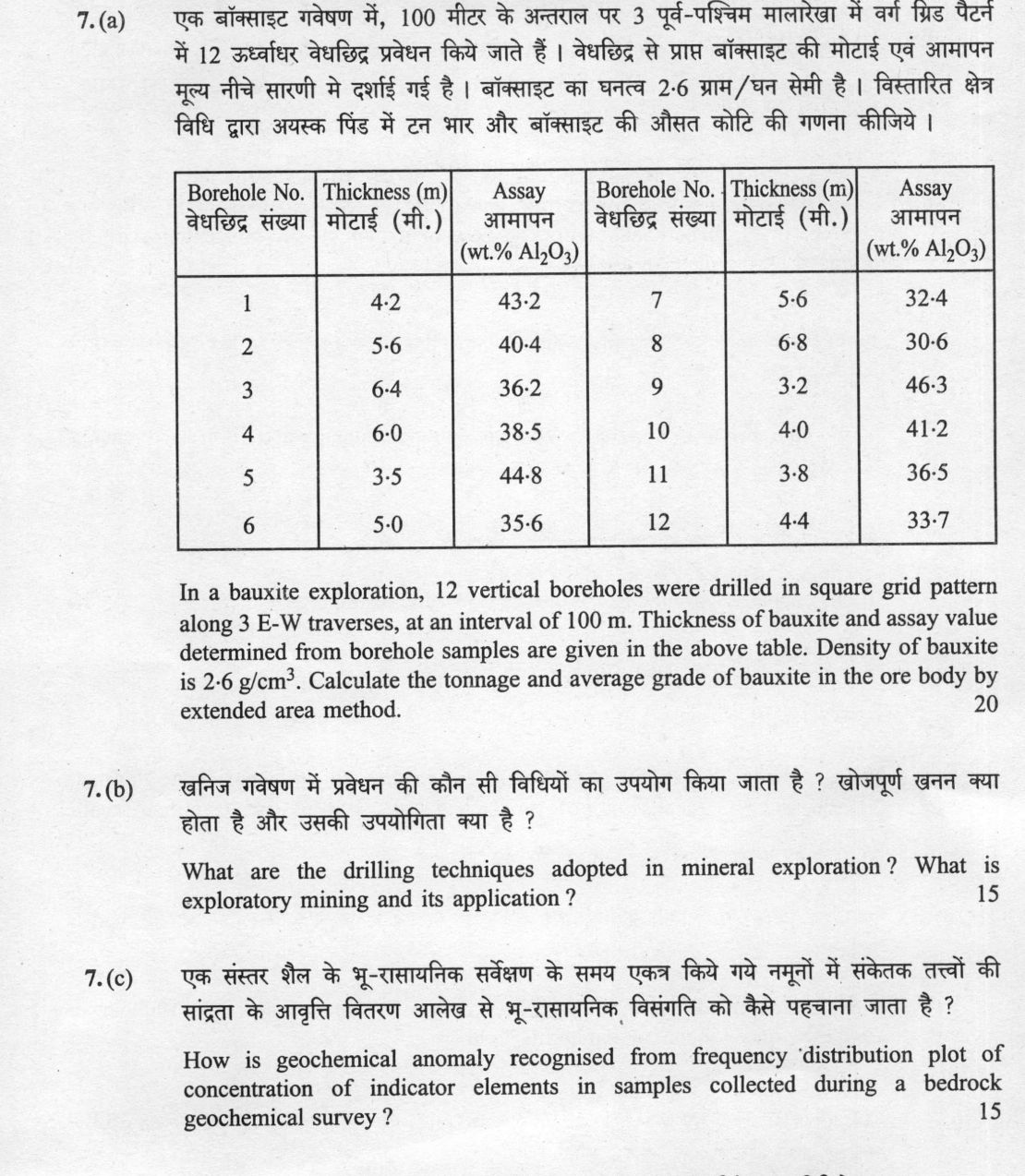
The figure this question refers to, in words
The question paper is a scan and the diagram did not survive as text. This is the figure as read from the original page — every component, value and label — so the question can be worked from the text below.
(a) Table listing borehole data: Columns: Borehole No., Thickness (m), Assay (wt.% Al2O3), Borehole No., Thickness (m), Assay (wt.% Al2O3) Row 1: 1, 4.2, 43.2, 7, 5.6, 32.4 Row 2: 2, 5.6, 40.4, 8, 6.8, 30.6 Row 3: 3, 6.4, 36.2, 9, 3.2, 46.3 Row 4: 4, 6.0, 38.5, 10, 4.0, 41.2 Row 5: 5, 3.5, 44.8, 11, 3.8, 36.5 Row 6: 6, 5.0, 35.6, 12, 4.4, 33.7
Model answer
Written by UPSC Answer Check against this question's marking rubric, to the expected length. UPSC does not publish answers for Mains — this is one way to score well, not an official key.
(a) By the extended-area method, each borehole is given an area of influence equal to the square-grid cell, including half-interval extension beyond the outermost boreholes. Area per borehole = 100 m × 100 m = 10,000 m². Total ore-body area = 12 × 10,000 = 120,000 m².
Sum of bauxite thickness: Σtᵢ = 4.2 + 5.6 + 6.4 + 6.0 + 3.5 + 5.0 + 5.6 + 6.8 + 3.2 + 4.0 + 3.8 + 4.4 = 58.5 m. Average thickness = 58.5/12 = 4.875 m.
Volume = total area × average thickness = 120,000 × 4.875 = 585,000 m³.
Density = 2.6 g/cm³ = 2.6 t/m³. Tonnage = volume × density = 585,000 × 2.6 = 1,521,000 tonnes ≈ 1.521 million tonnes.
For average grade, because all boreholes have equal area of influence and density is constant, the grade must be weighted by thickness: Average grade = Σ(tᵢgᵢ) / Σtᵢ.
Compute Σ(tᵢgᵢ): 4.2×43.2 = 181.44 5.6×40.4 = 226.24 6.4×36.2 = 231.68 6.0×38.5 = 231.00 3.5×44.8 = 156.80 5.0×35.6 = 178.00 5.6×32.4 = 181.44 6.8×30.6 = 208.08 3.2×46.3 = 148.16 4.0×41.2 = 164.80 3.8×36.5 = 138.70 4.4×33.7 = 148.28
Sum = 181.44 + 226.24 + 231.68 + 231.00 + 156.80 + 178.00 + 181.44 + 208.08 + 148.16 + 164.80 + 138.70 + 148.28 = 2194.62 m·wt%.
Average grade = 2194.62/58.5 = 37.5149 ≈ 37.51 wt% Al₂O₃. Validity: constant density, no dilution, and vertical thickness treated as true thickness.
(b) Drilling techniques adopted in mineral exploration depend on target depth, rock type, sample quality, terrain and budget.
- Auger drilling: shallow unconsolidated soil/saprolite; used for geochemical sampling.
- Rotary drilling: direct rotary uses mud/water; reverse circulation (RC) returns cuttings through a dual-wall pipe, giving cleaner bulk samples.
- Diamond core drilling: recovers continuous core; best for ore-grade estimation, structure, density and resource classification; wireline systems increase speed.
- Percussion drilling: cable-tool or down-the-hole hammer; produces chips, useful in hard rock and shallow-to-medium depths.
- Rotary air blast (RAB) and air-core drilling: rapid, low-cost reconnaissance in shallow dry ground.
- Sonic drilling: high recovery in unconsolidated formations.
- Directional and underground drilling: from adits/declines/underground workings; defines deep orebodies with less surface disturbance.
Exploratory mining is limited-scale excavation or development undertaken specifically to explore, bulk-sample and verify a mineral deposit, not for regular production. It includes pitting, trenching, adits, shafts, declines, drifts, crosscuts, raises and winzes. Its applications are: confirming continuity and grade of ore; collecting bulk samples for beneficiation and metallurgical tests; studying structure, rock mechanics and groundwater; classifying reserves; selecting a mining method; and reducing risk before feasibility and mine planning.
(c) In a bedrock geochemical survey, concentrations of indicator elements are plotted as frequency distribution histograms or cumulative-frequency/probability plots. A single log-normal population generally represents background. Anomalous samples form a second, higher-concentration population, producing bimodality or an upper-tail break.
Recognition is done by:
- Histogram/mode method: if bimodal, the high-concentration mode is anomalous; threshold lies at the minimum between the two modes.
- Cumulative-frequency plot: background values plot as a straight line on log-probability paper; anomalous values cause upward inflection. The intersection of fitted background and anomalous lines gives the threshold.
- Statistical method: compute background mean and standard deviation after excluding outliers. For normal data, threshold T = mean + 2σ or mean + 3σ. For log-normal data, T = geometric mean × (geometric standard deviation)², or use median + 2MAD.
- Box-plot/Tukey method: values above Q3 + 1.5×IQR are treated as anomalous.
In bedrock surveys, anomalies must also be checked against lithology, alteration, structure and sampling density, because weak or displaced anomalies may require multi-element contour maps for confirmation.
What "Calculate" is asking you to do
Apply the standard formula or schedule to data the question has already supplied — a table of readings, cost records, a balance sheet — and produce the number. The method is rarely in doubt; the marks sit in the named intermediate quantities, each of which has to appear as a labelled line.
Structure that answers it
Data as given → formula or standard treatment, named → substitution → each intermediate, labelled → result with units
Where marks are lost
Omitting an intermediate the marking scheme pays for separately, or rounding at an intermediate line so the final figure drifts. In commerce and accountancy, any figure in a statement that no numbered working note supports is treated as unearned.
How this answer will be evaluated
Approach
(a) calculate: given > formula > substitution > result with units > interpretation | (b) describe: define > structure or process in order > labelled diagram > significance | (c) explain: definition/context > points in order > small example > short close Full marks: Shows complete understanding with correct calculations, clear definitions, and relevant examples.
Key points expected
- Calculate total bauxite thickness for each borehole
- Compute weighted average grade using thickness as weight
- Determine area of influence for each borehole
- Convert volume to tonnage using density 2.6 g/cm³
- Name at least 3 drilling techniques (e.g., rotary, diamond, core)
- Define exploratory mining as shallow excavation for ore body
- State one application of exploratory mining
- Distinguish between drilling and mining methods
Evaluation rubric
Each sub-part is marked on its own, against the marks and word limit printed on the paper.
- (a) Compute tonnage and average grade using the extended area method. 20 marks
calculate— given → formula → substitution → result with units → interpretation
Must cover
- Calculate total bauxite thickness for each borehole
- Compute weighted average grade using thickness as weight
- Determine area of influence for each borehole
- Convert volume to tonnage using density 2.6 g/cm³
Loses marks
- Uses simple average instead of weighted average
- Forgets to convert density units (g/cm³ to t/m³)
- Incorrect area assignment for corner/edge boreholes
Earns more
- Correctly identifies grid spacing as 100m
- Shows step-by-step calculation for at least one borehole
- Presents final answer with correct units (tonnes, wt%)
Extra mark
- Includes a sketch of the 3x4 grid pattern
- States assumptions about ore body boundaries
- (b) List drilling techniques and define exploratory mining with applications. 15 marks
describe— define → structure or process in order → labelled diagram → significance
Must cover
- Name at least 3 drilling techniques (e.g., rotary, diamond, core)
- Define exploratory mining as shallow excavation for ore body
- State one application of exploratory mining
- Distinguish between drilling and mining methods
Loses marks
- Confuses exploration drilling with production drilling
- Fails to define exploratory mining clearly
- Lists techniques without explaining their purpose
Earns more
- Mentions specific drill types (e.g., NQ, HQ core sizes)
- Explains when exploratory mining is preferred over drilling
- References Indian mining code provisions if applicable
Extra mark
- Includes a simple sketch of a diamond drill rig
- Names a specific Indian mine where exploratory mining was used
- (c) Describe how geochemical anomalies are identified from frequency plots. 15 marks
explain— definition/context → points in order → small example → short close
Must cover
- Explain that anomalies appear as deviations from background
- Describe the shape of a normal frequency distribution
- Identify how anomalous values shift the distribution
- Mention the use of log-normal or normal probability plots
Loses marks
- Fails to distinguish between background and anomaly
- Does not mention the role of statistical distribution
- Confuses geochemical with geophysical anomalies
Earns more
- Draws a simple frequency distribution curve
- Explains the concept of background vs. anomaly
- Mentions statistical methods (e.g., mean + 2SD)
Extra mark
- References a specific Indian geochemical survey
- Includes a labelled diagram of a frequency plot
Practice this exact question
Write your answer and it is marked point by point against the model answer above — what you covered, what you missed, what you got wrong.
Evaluate my answer →More from Geology 2022 Paper II
- Q4 (a) What do you understand by sedimentary depositional environment ? Describe fluvial env…
- Q5 Answer the following in about 150 words each: (a) What are the major changes in the proce…
- Q6 (a) Explain the processes by which sediment hosted Pb-Zn deposits are formed. Describe th…
- Q7 (a) In a bauxite exploration, 12 vertical boreholes were drilled in square grid pattern a…
- Q8 (a) Give the classification of landslides and discuss the causes of landslide. (20 marks)…