Paper II — Q3
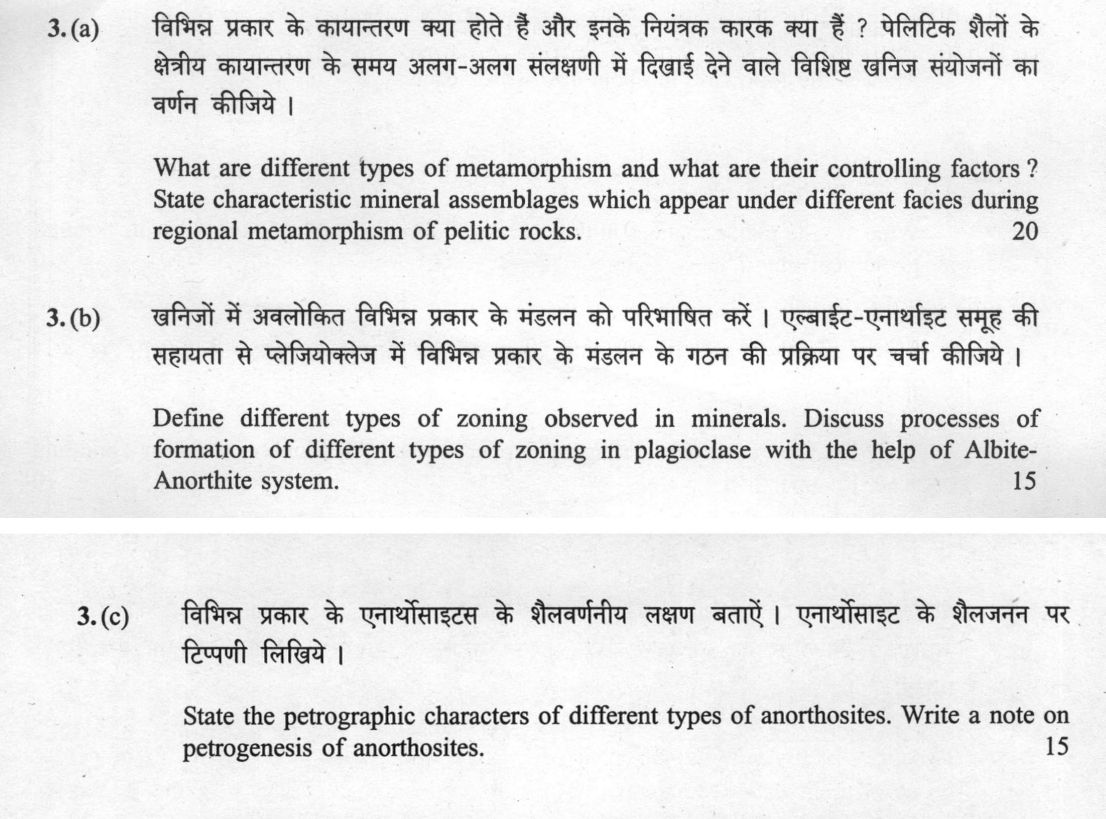
(a) What are different types of metamorphism and what are their controlling factors ? State characteristic mineral assemblages…
What are different types of metamorphism and what are their controlling factors ? State characteristic mineral assemblages which appear under different facies during regional metamorphism of pelitic rocks. 20 marks
Define different types of zoning observed in minerals. Discuss processes of formation of different types of zoning in plagioclase with the help of Albite-Anorthite system. 15 marks
State the petrographic characters of different types of anorthosites. Write a note on petrogenesis of anorthosites. 15 marks
हिंदी में प्रश्न पढ़ें
विभिन्न प्रकार के कायांतरण क्या होते हैं और इनके नियंत्रक कारक क्या हैं ? पैलिटिक शैलों के क्षेत्रीय कायांतरण के समय अलग-अलग संलक्षणी में दिखाई देने वाले विशिष्ट खनिज संयोजनों का वर्णन कीजिये । (20 अंक)
खनिजों में अवलोकित विभिन्न प्रकार के मंडलन को परिभाषित करें । एल्बाइट-एनार्थाइट समूह की सहायता से प्लेजियोक्लेज में विभिन्न प्रकार के मंडलन के गठन की प्रक्रिया पर चर्चा कीजिये । (15 अंक)
विभिन्न प्रकार के एनाथोसाइट्स के शैलवर्णीय लक्षण बताएं । एनाथोसाइट के शैलजनन पर टिप्पणी लिखिये । (15 अंक)
Model answer
Written by UPSC Answer Check against this question's marking rubric, to the expected length. UPSC does not publish answers for Mains — this is one way to score well, not an official key.
Metamorphism, facies and pelite assemblages. Metamorphism is the solid-state transformation of rocks by heat, pressure, stress and fluids. The main types are contact, regional, dynamic, hydrothermal, ocean-floor, burial and impact/shock metamorphism. Contact metamorphism is dominated by heat from an intrusion; regional metamorphism reflects large-scale P–T–t changes in orogens; dynamic metamorphism is controlled by shear and faulting; hydrothermal metamorphism by fluid-rock reaction; ocean-floor metamorphism occurs at low T and high P, producing blueschist or eclogite assemblages; burial metamorphism reflects increasing lithostatic pressure; impact/shock metamorphism records sudden pressure and temperature spikes. The controlling factors are pressure, temperature, time, differential stress, fluid composition and rock composition. Fluids lower the solidus and promote reaction. In regional pelites, the Barrovian sequence, represented on ACF/AKF diagrams by univariant reaction curves, records progressive metamorphism. The chlorite zone (greenschist facies, ~300–450°C) contains chlorite, muscovite, plagioclase and quartz; the biotite zone adds biotite; the garnet zone adds almandine garnet; the staurolite zone adds staurolite; the kyanite zone adds kyanite. These assemblages pass from greenschist to amphibolite facies. Sillimanite first appears by the polymorphic transition from kyanite or andalusite at the sillimanite isograd; at higher T, about 650–700°C, the second sillimanite isograd is marked by muscovite + quartz → sillimanite + K-feldspar + H2O, i.e. muscovite breakdown. In granulite facies pelites, high T (typically ~700–900°C, not UHT >900°C) stabilizes sillimanite, garnet, K-feldspar and often orthopyroxene, while kyanite and staurolite are no longer stable.
Zoning in plagioclase. Zoning is compositional variation within a crystal. Normal zoning has a more An-rich core and Ab-rich rim; reverse zoning has an An-rich rim; oscillatory zoning shows repeated compositional bands; sector zoning has different compositions in different crystal sectors. In the Albite–Anorthite system, plagioclase forms a continuous solid solution; the liquidus and solidus converge at the end-members, and tie-lines connect coexisting melt and crystal. During fractional crystallization along Bowen’s reaction series, an early An-rich core forms, and the residual melt becomes Ab-rich, producing normal zoning. Reverse zoning may form when a more mafic, An-rich melt is mixed in, or when pressure rises, stabilizing more An-rich plagioclase. Oscillatory zoning records repeated changes in melt composition, temperature, pressure or growth rate, often due to magma mixing or convection. Sector zoning in plagioclase forms when different crystal faces or sectors grow under locally different melt conditions, or when rapid growth and variable diffusion cause different faces to incorporate different An or trace elements; it can also be produced by local fluid or melt pockets at the crystal surface. Slow cooling and fast diffusion tend to homogenize compositions, whereas rapid cooling preserves sharp zoning. Resorption and sieve textures show that crystals can be partially dissolved or modified by later melts.
Anorthosites: characters and petrogenesis. Anorthosites are coarse-grained rocks with >90% plagioclase, usually An-rich. Archean massif-type anorthosites are massive, cumulate, calcic (An>90), with minor clinopyroxene, magnetite/ilmenite and sometimes Fe–Ti oxide ores. Proterozoic anorthosite–mangerite–charnockite–rapakivi suite anorthosites show antiperthitic plagioclase, rapakivi textures, mangerite and charnockite associations, and Fe–Ti oxide mineralization. Layered-intrusion anorthosites occur as cumulate layers with ophitic or intercumulate textures, Fe–Ti oxide layers, and are associated with mafic–ultramafic sequences. Petrogenetically, Archean calcic anorthosites formed by crystal accumulation and flotation of plagioclase from basaltic or tholeiitic magmas, emplaced as crystal mushes in Archean crust. Proterozoic AMCR-suite anorthosites are linked to post-orogenic extension and plagioclase flotation/mush emplacement. Layered-intrusion anorthosites formed in situ by crystal settling, fractionation and magma recharge in layered mafic intrusions, as in the Bushveld and Stillwater complexes, where anorthosite layers record plagioclase cumulate formation. Indian examples include the Archean Sittampundi and Proterozoic Bolangir anorthosites. Together, metamorphic facies, plagioclase zoning and anorthosite textures record P–T–t paths, magma evolution and crustal differentiation.
What "Discuss" is asking you to do
Lay the issue out from more than one side — how it arose, what is claimed for it, what is held against it, and where it now stands. UPSC attaches discuss to broad topics with several live dimensions, so coverage of the dimensions earns more than the strength of your opinion.
Structure that answers it
Set the issue up → the case as it is made → the case against → the dimension both sides leave out → where the balance now lies
Where marks are lost
Listing facts with no thread between them, or arguing one side throughout and calling it a discussion.
How this answer will be evaluated
Approach
Framework: Geology Paper 2: Define > Process > Field/Petrographic Evidence > Indian Example. (a) explain: definition/context > points in order > small example > short close | (b) discuss: intro > 3-4 dimensions > example > balanced close | (c) describe: define > structure or process in order > labelled diagram > significance Full marks: Precise mineral assemblages, clear phase diagrams, and specific Indian examples (e.g., Aravalli, Amba).
Key points expected
- List types: Regional, Contact, Dynamic, Hydrothermal, Impact
- Identify controlling factors: T, P, Fluids, Time, Stress
- Name pelitic facies: Greenschist, Amphibolite, Granulite
- List characteristic minerals: Chlorite, Biotite, Garnet, Kyanite, Sillimanite
- Define types: Normal, Reverse, Oscillatory, Sector
- Explain Albite-Anorthite solid solution behavior
- Link zoning to changing T/P or melt composition
- Describe crystal growth process (nucleation vs. growth)
Evaluation rubric
Each sub-part is marked on its own, against the marks and word limit printed on the paper.
- (a) Classify metamorphism types, identify controlling factors, and list mineral assemblages for pelitic facies. 20 marks
explain— definition/context → points in order → small example → short close
Must cover
- List types: Regional, Contact, Dynamic, Hydrothermal, Impact
- Identify controlling factors: T, P, Fluids, Time, Stress
- Name pelitic facies: Greenschist, Amphibolite, Granulite
- List characteristic minerals: Chlorite, Biotite, Garnet, Kyanite, Sillimanite
Loses marks
- Confusing contact aureoles with regional facies
- Missing the role of fluids in metamorphism
Earns more
- Sketch of P-T facies diagram
- Mention of Barrovian sequence
- Reference to Indian Schist Belts (e.g., Aravalli)
Extra mark
- Specific Indian example of facies (e.g., Kyanite in Aravalli)
- (b) Define zoning types and explain plagioclase zoning formation using the Albite-Anorthite system. 15 marks
discuss— intro → 3-4 dimensions → example → balanced close
Must cover
- Define types: Normal, Reverse, Oscillatory, Sector
- Explain Albite-Anorthite solid solution behavior
- Link zoning to changing T/P or melt composition
- Describe crystal growth process (nucleation vs. growth)
Loses marks
- Failing to link zoning to the phase diagram
- Confusing zoning with exsolution
Earns more
- Sketch of Albite-Anorthite phase diagram
- Mention of core-rim vs. oscillatory textures
- Reference to specific Indian granites (e.g., Chotanagpur)
Extra mark
- Specific Indian occurrence of zoned plagioclase
- (c) Describe petrographic characters of anorthosites and explain their petrogenesis. 15 marks
describe— define → structure or process in order → labelled diagram → significance
Must cover
- Define anorthosite (plagioclase >90%)
- Describe texture: Ophitic, Hypidiomorphic, Granular
- Explain petrogenesis: Fractional crystallization of basaltic magma
- Mention role of gravity settling (cumulate formation)
Loses marks
- Confusing anorthosite with gabbro
- Missing the fractional crystallization mechanism
Earns more
- Sketch of ophitic texture
- Mention of specific Indian anorthosite (e.g., Amba, Chhattisgarh)
- Reference to layered intrusions
Extra mark
- Specific Indian example (e.g., Amba anorthosite)
Practice this exact question
Write your answer and it is marked point by point against the model answer above — what you covered, what you missed, what you got wrong.
Evaluate my answer →More from Geology 2022 Paper II
- Q1 Answer the following in about 150 words each: (a) How are Miller Indices of a crystal fac…
- Q2 (a) Describe the crystallographic, physical, optical and chemical properties of garnet gr…
- Q3 (a) What are different types of metamorphism and what are their controlling factors ? Sta…
- Q4 (a) What do you understand by sedimentary depositional environment ? Describe fluvial env…
- Q5 Answer the following in about 150 words each: (a) What are the major changes in the proce…
- Q6 (a) Explain the processes by which sediment hosted Pb-Zn deposits are formed. Describe th…