Paper II — Q2
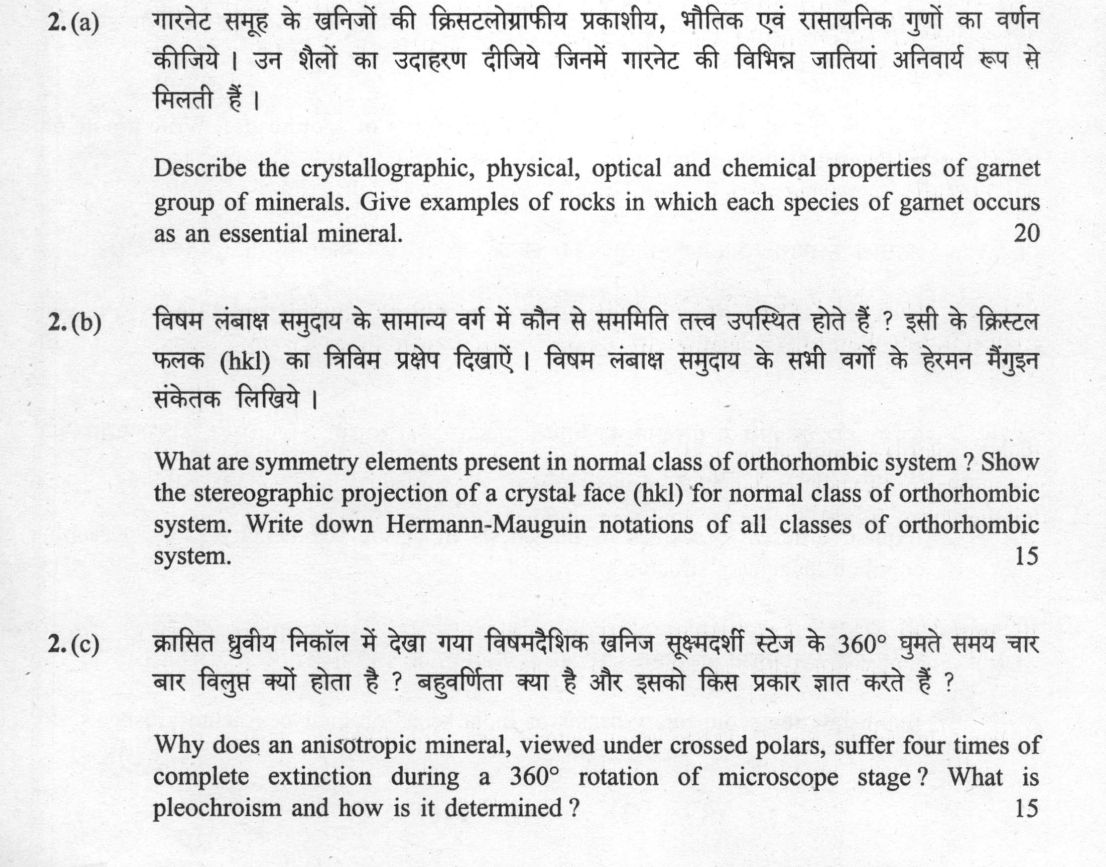
(a) Describe the crystallographic, physical, optical and chemical properties of garnet group of minerals. Give examples of rocks…
Describe the crystallographic, physical, optical and chemical properties of garnet group of minerals. Give examples of rocks in which each species of garnet occurs as an essential mineral. 20 marks
What are symmetry elements present in normal class of orthorhombic system ? Show the stereographic projection of a crystal face (hkl) for normal class of orthorhombic system. Write down Hermann-Mauguin notations of all classes of orthorhombic system. 15 marks
Why does an anisotropic mineral, viewed under crossed polars, suffer four times of complete extinction during a 360° rotation of microscope stage ? What is pleochroism and how is it determined ? 15 marks
हिंदी में प्रश्न पढ़ें
गारनेट समूह के खनिजों की क्रिस्टलोग्राफीय प्रकाशीय, भौतिक एवं रासायनिक गुणों का वर्णन कीजिये । उन शैलों का उदाहरण दीजिये जिनमें गारनेट की विभिन्न जातियां अनिवार्य रूप से मिलती हैं । (20 अंक)
विषम लंबाक्ष समुदाय के सामान्य वर्ग में कौन से सममिति तत्व उपस्थित होते हैं ? इसी के क्रिस्टल फलक (hkl) का त्रिविम प्रक्षेप दिखाइए । विषम लंबाक्ष समुदाय के सभी वर्गों के हेरमन मौगुइन संकेतक लिखिये । (15 अंक)
क्रांसित ध्रुवीय निकाल में देखा गया विषमदैशिक खनिज सूक्ष्मदर्शी स्टेज के 360° घुमते समय चार बार विलुप्त क्यों होता है ? बहुवर्णिता क्या है और इसको किस प्रकार ज्ञात करते हैं ? (15 अंक)
Model answer
Written by UPSC Answer Check against this question's marking rubric, to the expected length. UPSC does not publish answers for Mains — this is one way to score well, not an official key.
(a) Garnet group. Garnet is a nesosilicate group of isometric minerals with the general formula X3Y2Si3O12, where X = Mg, Fe2+, Mn or Ca and Y = Al, Fe3+, Cr or V. The six principal end-members are pyrope Mg3Al2Si3O12, almandine Fe3Al2Si3O12, spessartine Mn3Al2Si3O12, grossular Ca3Al2Si3O12, andradite Ca3Fe2Si3O12 and uvarovite Ca3Cr2Si3O12. Crystallographically, garnets crystallize in the isometric system and commonly occur as {110} dodecahedra and {211} trapezohedra, often euhedral but sometimes rounded. Physically, they have hardness 6.5-7.5, specific gravity 3.4-4.3, no cleavage, conchoidal fracture, vitreous lustre and variable colour; specific gravity and refractive index vary with composition. Optically, they are isotropic, have high refractive index 1.74-1.89, high relief and no birefringence. Chemically, they form solid-solution series by substitution among the X and Y cations. Pyrope occurs as an essential mineral in pyrope peridotites and eclogites, for example pyrope eclogites of the Western Ghats. Almandine is essential in almandine schists and gneisses of Rajasthan and Karnataka. Spessartine is essential in manganese-rich kodurite of the Eastern Ghats. Grossular is essential in grossular marbles and skarns at the Rajmahal trap contact. Andradite is essential in andradite skarns and contact-metamorphic rocks. Uvarovite is essential in uvarovite skarns, chromite-rich skarns in which it is a principal mineral.
(b) Orthorhombic normal class. The orthorhombic system has three mutually perpendicular unequal axes. Its normal class, mmm, has the full Hermann-Mauguin symbol 2/m 2/m 2/m. The symmetry elements are three 2-fold rotation axes along a, b and c, three mirror planes perpendicular to these axes, and a centre of symmetry. To show the stereographic projection of a general face (hkl), draw the primitive circle. If the pole of the upper face (hkl) is at (x,y) inside the circle, the four upper-hemisphere poles are at (x,y), (-x,y), (x,-y) and (-x,-y) inside. The four lower-hemisphere poles, with l negative, are plotted outside the primitive circle on the corresponding radial lines, at greater distances from the centre, not directly beneath the upper poles. This gives a symmetric pattern of four points inside and four points outside the primitive circle. The three orthorhombic classes in Hermann-Mauguin notation are 222 (disphenoidal), mm2 (pyramidal) and mmm (bipyramidal or normal).
(c) Extinction and pleochroism. Under crossed polars, the polarizer and analyzer are at 90°. An anisotropic mineral splits the incident light into two mutually perpendicular rays, the fast and slow rays, whose vibration directions are fixed in the crystal. Complete extinction occurs when one of these vibration directions is parallel to the polarizer and therefore perpendicular to the analyzer, so the emergent light is blocked. Because the two vibration directions are perpendicular, this condition is met at 0°, 90°, 180° and 270° relative to the principal vibration directions, giving four complete extinctions in one 360° rotation. Maximum brightness occurs at 45° to the vibration directions, and the 90° periodicity explains the repeated extinction. Isotropic minerals do not split light and remain extinct throughout. Pleochroism is the property of an anisotropic mineral to show different colours depending on the vibration direction of light, due to differential absorption. It is determined by observing a thin section under a single polarizer while rotating the stage; the colours at the extinction positions and at 45° positions are recorded, and the directions of maximum and minimum absorption are identified. Uniaxial minerals show dichroism, two colours, perpendicular to the optic axis, while biaxial minerals may show trichroism, three colours, along the three principal vibration directions. Thus, garnet is an isotropic nesosilicate with composition-dependent physical and optical properties, orthorhombic normal class is defined by mmm symmetry, and anisotropy is recognized by four extinctions and pleochroic colours.
What "Describe" is asking you to do
Give a full, ordered account of the thing named — its parts, stages or mechanism — in the sequence in which it actually exists or occurs. Most describe questions come from the science optionals, where the marks sit in correct technical detail and, where the stem says so, a labelled diagram.
Structure that answers it
One-line identification of the subject → the parts or stages in their real order, each with its defining detail → labelled diagram where the subject is structural → closing line on function or significance
Where marks are lost
Loose general prose where the examiner is ticking named parts, correct terminology and their sequence; and in the General Studies papers, turning to evaluation before the description is finished.
How this answer will be evaluated
Approach
Framework: Geology, Paper 2. (a) describe: define > structure or process in order > labelled diagram > significance | (b) describe: define > structure or process in order > labelled diagram > significance | (c) explain: definition/context > points in order > small example > short close Full marks: Comprehensive, accurate, with Indian examples and clear diagrams.
Key points expected
- Crystallographic properties (isometric system, cubic habit)
- Physical properties (hardness 6.5-7.5, specific gravity, cleavage)
- Optical properties (isotropic, high refractive index)
- Chemical properties (general formula X3Y2(SiO4)3)
- Symmetry elements of normal class (3 axes, 3 planes, center)
- Stereographic projection of a crystal face (hkl)
- Hermann-Mauguin notations for all orthorhombic classes
- Identification of the normal class (mmm)
Evaluation rubric
Each sub-part is marked on its own, against the marks and word limit printed on the paper.
- (a) Systematic account of garnet group properties and rock associations. 20 marks
describe— define → structure or process in order → labelled diagram → significance
Must cover
- Crystallographic properties (isometric system, cubic habit)
- Physical properties (hardness 6.5-7.5, specific gravity, cleavage)
- Optical properties (isotropic, high refractive index)
- Chemical properties (general formula X3Y2(SiO4)3)
Loses marks
- Confusing garnet with other silicate groups
- Missing the chemical formula or general composition
- Failing to link species to specific rock types
Earns more
- List of species (Almandine, Pyrope, Spessartine, Grossular, Andradite, Uvarovite)
- Rock examples for each species (e.g., Almandine in gneiss)
- Mention of pleochroism (or lack thereof) and luster
- Reference to Indian occurrences (e.g., Chikmagalur, Karnataka)
Extra mark
- Specific Indian locality for a garnet species
- Mention of economic importance (gemstones vs industrial)
- (b) Symmetry elements, stereographic projection, and notations for orthorhombic system. 15 marks
describe— define → structure or process in order → labelled diagram → significance
Must cover
- Symmetry elements of normal class (3 axes, 3 planes, center)
- Stereographic projection of a crystal face (hkl)
- Hermann-Mauguin notations for all orthorhombic classes
- Identification of the normal class (mmm)
Loses marks
- Incorrect symmetry elements (e.g., adding 4-fold axis)
- Missing or incorrect stereographic projection
- Confusing Hermann-Mauguin with Schoenflies notation
Earns more
- Correct labeling of axes (a, b, c) in projection
- Mention of interaxial angles (90 degrees)
- Clear distinction between normal and other classes
- Accurate drawing of the stereographic net
Extra mark
- Mention of specific mineral examples for orthorhombic system
- Reference to Indian orthorhombic mineral occurrences
- (c) Reason for extinction in anisotropic minerals and definition of pleochroism. 15 marks
explain— definition/context → points in order → small example → short close
Must cover
- Explanation of 4 extinctions in 360° rotation
- Definition of pleochroism
- Method of determining pleochroism (conoscopic/biconoscopic)
- Link to anisotropy and optical properties
Loses marks
- Confusing extinction with interference colors
- Failing to explain the 4-fold nature of extinction
- Incorrect definition of pleochroism
Earns more
- Mention of vibration directions and polarizer/analyzer
- Explanation of why extinction occurs (parallelism)
- Distinction between uniaxial and biaxial extinction
- Reference to Indian minerals showing pleochroism
Extra mark
- Specific example of a pleochroic mineral (e.g., biotite)
- Mention of pleochroic colors (e.g., brown, green)
Practice this exact question
Write your answer and it is marked point by point against the model answer above — what you covered, what you missed, what you got wrong.
Evaluate my answer →More from Geology 2022 Paper II
- Q1 Answer the following in about 150 words each: (a) How are Miller Indices of a crystal fac…
- Q2 (a) Describe the crystallographic, physical, optical and chemical properties of garnet gr…
- Q3 (a) What are different types of metamorphism and what are their controlling factors ? Sta…
- Q4 (a) What do you understand by sedimentary depositional environment ? Describe fluvial env…
- Q5 Answer the following in about 150 words each: (a) What are the major changes in the proce…