Paper I — Q1
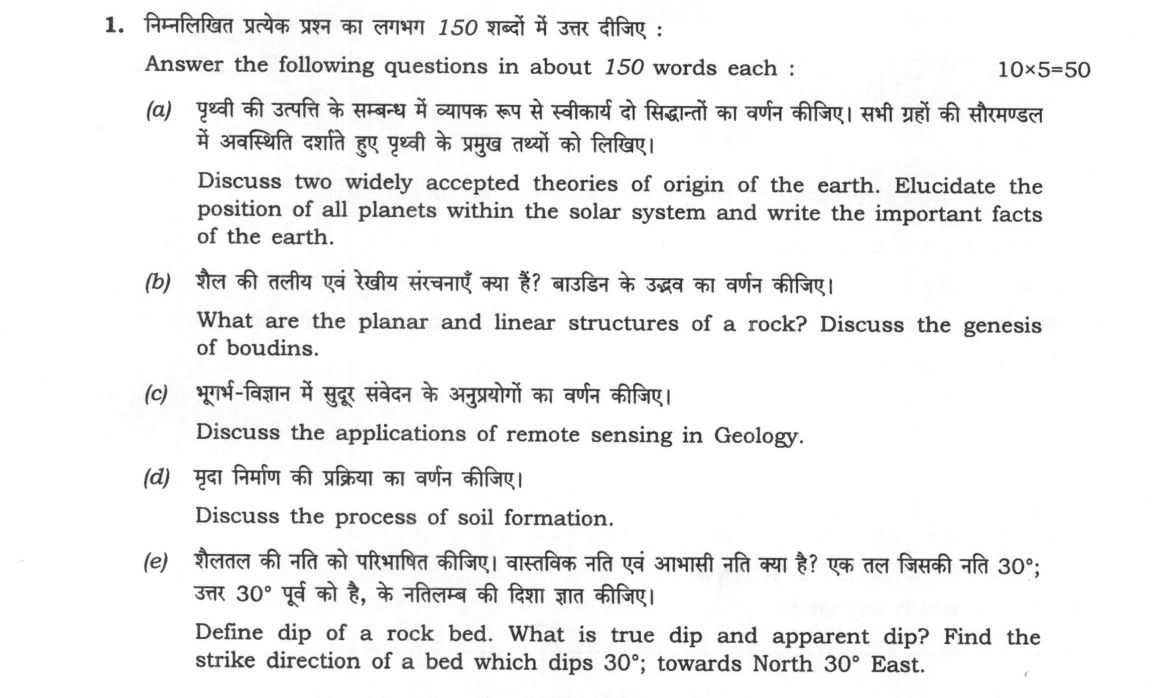
Answer the following questions in about 150 words each: (a) Discuss two widely accepted theories of origin of the earth…
Answer the following questions in about 150 words each:
Discuss two widely accepted theories of origin of the earth. Elucidate the position of all planets within the solar system and write the important facts of the earth. 10 marks
What are the planar and linear structures of a rock? Discuss the genesis of boudins. 10 marks
Discuss the applications of remote sensing in Geology. 10 marks
Discuss the process of soil formation. 10 marks
Define dip of a rock bed. What is true dip and apparent dip? Find the strike direction of a bed which dips 30° towards North 30° East. 10 marks
हिंदी में प्रश्न पढ़ें
निम्नलिखित प्रत्येक प्रश्न का लगभग 150 शब्दों में उत्तर दीजिए :
पृथ्वी की उत्पत्ति के संबंध में व्यापक रूप से स्वीकार्य दो सिद्धांतों का वर्णन कीजिए। सभी ग्रहों की सौरमंडल में अवस्थिति दर्शाते हुए पृथ्वी के प्रमुख तथ्यों को लिखिए। (10 अंक)
शैल की तलीय एवं रेखीय संरचनाएं क्या हैं? बाउडिन के उद्भव का वर्णन कीजिए। (10 अंक)
भूगर्भ-विज्ञान में सुदूर संवेदन के अनुप्रयोगों का वर्णन कीजिए। (10 अंक)
मृदा निर्माण की प्रक्रिया का वर्णन कीजिए। (10 अंक)
शैलतल की नति को परिभाषित कीजिए। वास्तविक नति एवं आभासी नति क्या है? एक तल जिसकी नति 30°; उत्तर 30° पूर्व को है, के नतिलम्ब की दिशा ज्ञात कीजिए। (10 अंक)
Model answer
Written by UPSC Answer Check against this question's marking rubric, to the 150-word length. UPSC does not publish answers for Mains — this is one way to score well, not an official key.
(a) The origin of Earth is best explained by accretion theories tied to the early Solar System. The Nebular Hypothesis, associated with Kant and Laplace, holds that the Sun and planets condensed from a rotating cloud of gas and dust; as it cooled and contracted, material flattened into a disc and coalesced into planets. The Planetesimal Hypothesis, advanced by Moulton and Chamberlin, explains that small solid bodies, planetesimals, formed first in the disc and later collided and accreted into planets. The nebular model emphasises a continuous disc, whereas the planetesimal model emphasises discrete solid bodies that grew by collisions. Both are accepted because they explain how solid planets formed from solar material, while the planetesimal model better explains the irregularities in early accretion. The planets, in order from the Sun, are Mercury, Venus, Earth, Mars, Jupiter, Saturn, Uranus and Neptune; the first four are small rocky terrestrial planets, and the last four are large gas or ice giants. Earth is the third planet and is unique in density (about 5.51 g/cm³), a thick nitrogen-oxygen atmosphere, a stable hydrosphere with 71 per cent surface water, a strong magnetic field, active plate tectonics, and life.
(b) Planar structures are surfaces in rocks, including bedding, foliation, cleavage, joints and faults. Planar structures may be primary, inherited from deposition or crystallisation, or secondary, produced by deformation. Bedding records sedimentation, foliation reflects directed pressure in metamorphic rocks, cleavage is a repeated parting, joints are fractures without slip, and faults are displacement surfaces. Linear structures are elongated features such as lineation, fold axes and mineral streaks; lineation may be formed by stretched minerals, flow in igneous rocks, or shearing. Boudinage is a ductile extensional structure. Boudins form when a competent layer is stretched parallel to its length in a weaker matrix. As extension continues, the layer necks, thins and finally breaks into isolated blocks, while the matrix fills the gaps. The process is common in extensional terrains, fold hinges and shear zones, and the boudin spacing and shape help estimate strain.
(c) Remote sensing uses sensors on satellites, aircraft and drones to collect electromagnetic data. In geology it supports lithological mapping by distinguishing rock types through spectral signatures, structural analysis by mapping lineaments, faults and folds, and mineral exploration through alteration minerals such as clays, iron oxides and sulphates. ASTER shortwave infrared data are useful for hydrothermal alteration, while lineament maps guide drilling. Multispectral and radar data are useful under cloud cover, especially for monsoon-affected regions. In India, the Geological Survey of India and ISRO use Landsat, Sentinel, ASTER and thermal data for mineral prospecting, groundwater mapping, landslide monitoring in the Himalaya and Western Ghats, and coastal zone management. It also aids hazard assessment, urban geology and resource inventory.
(d) Soil formation is a slow pedogenic process in which parent material is transformed into a layered profile. Soil formation begins with weathering of parent rock. Mechanical weathering breaks rock into fragments by temperature change, frost, root action and unloading; chemical weathering alters minerals by hydrolysis, oxidation and carbonation. Organic matter accumulates as humus, and biological activity mixes, transports, leaches and enriches the profile. With time, horizons develop: O is organic litter, A is humus-rich topsoil, B is subsoil with accumulation of clays or iron, C is weathered parent material, and R is bedrock. Climate, parent rock, topography, time and organisms control rate and type; for example, hot humid Indian conditions favour laterite, while flat alluvial plains develop thick soils.
(e) Dip is the maximum angle of inclination of a rock bed measured perpendicular to strike. True dip is this maximum angle; apparent dip is the angle measured in any other direction, usually on a map, and is always less than true dip unless it coincides with true dip. It is smaller because the measured section is oblique to the true dip line. The strike line is horizontal and defines the trend of the bed on the map. If a bed dips 30° towards North 30° East, the dip direction is 30° azimuth. Strike is perpendicular to dip direction, so add and subtract 90°: 30° + 90° = 120°, and 30° - 90° = -60°, equivalent to 300°. Thus the strike is N60°W - S60°E, with azimuths 300° and 120°.
Together these topics show that Earth studies combine origin, structure, surface processes and measurement. A balanced approach uses field observation, structural geometry and remote sensing to interpret rocks, soils and hazards. This integrated reading is essential for mapping resources, understanding hazards and guiding geological practice, national policy and sustainable development in India.
What "Discuss" is asking you to do
Lay the issue out from more than one side — how it arose, what is claimed for it, what is held against it, and where it now stands. UPSC attaches discuss to broad topics with several live dimensions, so coverage of the dimensions earns more than the strength of your opinion.
Structure that answers it
Set the issue up → the case as it is made → the case against → the dimension both sides leave out → where the balance now lies
Where marks are lost
Listing facts with no thread between them, or arguing one side throughout and calling it a discussion.
How this answer will be evaluated
Approach
Framework: Geological Process-Structure-Application Framework. (a) discuss: intro > 3-4 dimensions > example > balanced close | (b) discuss: intro > 3-4 dimensions > example > balanced close | (c) discuss: intro > 3-4 dimensions > example > balanced close | (d) discuss: intro > 3-4 dimensions > example > balanced close | (e) discuss: intro > 3-4 dimensions > example > balanced close Full marks: Precise definitions, correct calculations, named Indian examples, clear sketches.
Key points expected
- Nebular vs Planetesimal hypothesis
- Planetary order: Mercury, Venus, Earth, Mars, Jupiter, Saturn, Uranus, Neptune
- Planar structures: foliation, cleavage, schistosity
- Linear structures: lineation, stretching, fold axes
- Boudinage: extensional deformation, necking, separation
- Remote sensing: lithology, structure, minerals, Indian examples
- Soil formation: parent material, climate, biota, time, topography
- Dip: angle from horizontal, true vs apparent
- Strike: perpendicular to dip, N 60° W / S 60° E
Evaluation rubric
Each sub-part is marked on its own, against the marks and word limit printed on the paper.
- (a) Compare two origin theories, list planetary order, and state Earth's key physical parameters. 10 marks · 150 words
discuss— intro → 3-4 dimensions → example → balanced close
Must cover
- Nebular hypothesis (Laplace/Kant) details
- Planetesimal hypothesis (Chamberlin/Moores) details
- Correct order of 8 planets from Sun
- Earth's radius, mass, or density
Loses marks
- Confusing origin of solar system with origin of life
- Listing planets in wrong order
Earns more
- Mention of Kuiper Belt or Oort Cloud
- Differentiation of terrestrial vs gas giants
- Comparison of Earth's density to solar average
Extra mark
- Reference to recent exoplanet discoveries
- Mention of specific isotopic evidence for origin
- (b) Define planar/linear structures and explain the mechanical process of boudinage. 10 marks · 150 words
discuss— intro → 3-4 dimensions → example → balanced close
Must cover
- Definition of planar structures (foliation, cleavage)
- Definition of linear structures (lineation, stretching)
- Mechanism of boudinage (extension vs compression)
- Sketch of boudin formation
Loses marks
- Confusing boudins with folds
- Missing the sketch of the process
Earns more
- Mention of ductile vs brittle deformation
- Reference to specific rock types (e.g., granite in schist)
- Explanation of strain ellipsoid
Extra mark
- Reference to specific Indian shear zone (e.g., Satpura)
- Mention of specific mineral lineation (e.g., quartz)
- (c) List specific geological applications of remote sensing with Indian examples. 10 marks · 150 words
discuss— intro → 3-4 dimensions → example → balanced close
Must cover
- Lithological mapping using spectral signatures
- Structural mapping (lineaments, faults)
- Mineral exploration (alteration zones)
- Indian example (e.g., Bhima basin or Deccan)
Loses marks
- Generic description without specific geological application
- Missing Indian example
Earns more
- Mention of specific sensors (Landsat, ASTER, Cartosat)
- Discussion of multispectral vs hyperspectral data
- Reference to GIS integration
Extra mark
- Mention of specific mineral deposit found via RS
- Reference to specific Indian mission (e.g., ISRO)
- (d) Explain the pedogenic process from parent material to soil profile. 10 marks · 150 words
discuss— intro → 3-4 dimensions → example → balanced close
Must cover
- Role of parent material (bedrock/residual)
- Role of climate (weathering, leaching)
- Role of biota (roots, microbes)
- Formation of soil horizons (O, A, B, C)
Loses marks
- Confusing soil formation with erosion
- Missing the role of biota
Earns more
- Mention of specific weathering processes (chemical/physical)
- Reference to soil classification (e.g., USDA)
- Discussion of time factor
Extra mark
- Reference to specific Indian soil type (e.g., Black cotton)
- Mention of specific pedogenic process (e.g., laterization)
- (e) Define dip, distinguish true/apparent dip, and calculate strike from given dip. 10 marks · 150 words
discuss— intro → 3-4 dimensions → example → balanced close
Must cover
- Definition of dip (angle from horizontal)
- Distinction between true and apparent dip
- Calculation of strike (perpendicular to dip)
- Correct strike direction (N 60° W / S 60° E)
Loses marks
- Confusing strike with dip direction
- Incorrect calculation of strike
Earns more
- Sketch of dip and strike relationship
- Explanation of why apparent dip is less than true dip
- Mention of dip circle usage
Extra mark
- Reference to specific geological map symbol
- Mention of specific Indian formation with this dip
Practice this exact question
Write your answer and it is marked point by point against the model answer above — what you covered, what you missed, what you got wrong.
Evaluate my answer →More from Geology 2024 Paper I
- Q1 Answer the following questions in about 150 words each: (a) Discuss two widely accepted t…
- Q2 (a) Discuss the intensity and magnitude scale commonly used to assess seismic damage. Wri…
- Q3 (a) Discuss in detail, with diagrams, the landforms and features resulting from depositio…
- Q4 (a) Describe fold geometry. Illustrate various types of folds on the basis of their symme…