Paper I — Q4
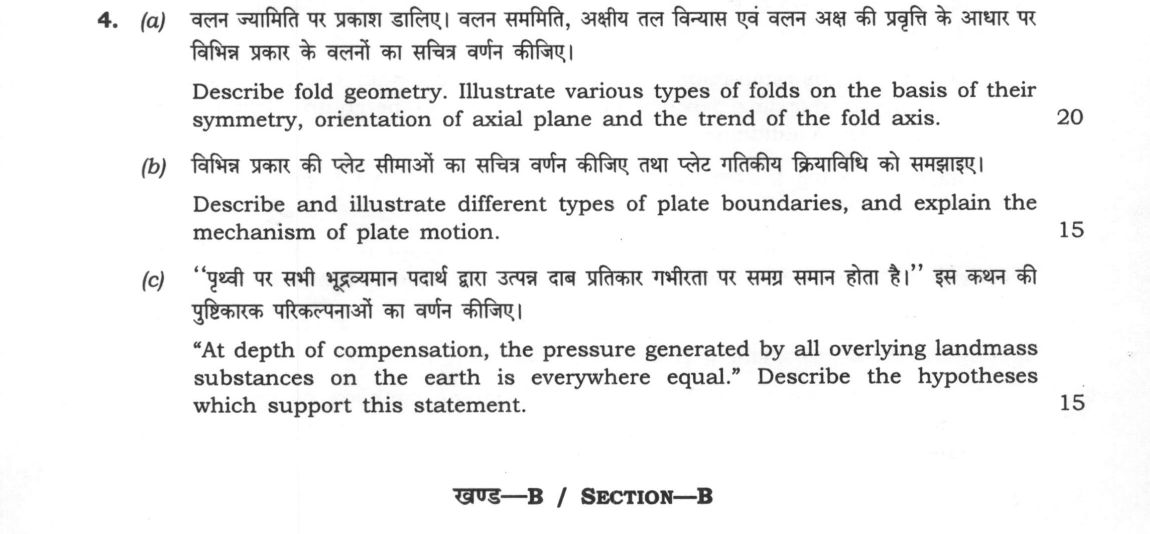
(a) Describe fold geometry. Illustrate various types of folds on the basis of their symmetry, orientation of axial plane and the…
Describe fold geometry. Illustrate various types of folds on the basis of their symmetry, orientation of axial plane and the trend of the fold axis. 20 marks
Describe and illustrate different types of plate boundaries, and explain the mechanism of plate motion. 15 marks
"At depth of compensation, the pressure generated by all overlying landmass substances on the earth is everywhere equal." Describe the hypotheses which support this statement. 15 marks
हिंदी में प्रश्न पढ़ें
वलन ज्यामिति पर प्रकाश डालिए। वलन सममिति, अक्षीय तल विन्यास एवं वलन अक्ष की प्रवृत्ति के आधार पर विभिन्न प्रकार के वलनों का सचित्र वर्णन कीजिए। (20 अंक)
विभिन्न प्रकार की प्लेट सीमाओं का सचित्र वर्णन कीजिए तथा प्लेट गतिकीय क्रियाविधि को समझाइए। (15 अंक)
"पृथ्वी पर सभी भूद्रव्यमान पदार्थ द्वारा उत्पन्न दाब प्रतिकार गभीरता पर समग्र समान होता है।" इस कथन की पृष्ठकारक परिकल्पनाओं का वर्णन कीजिए। (15 अंक)
Model answer
Written by UPSC Answer Check against this question's marking rubric, to the expected length. UPSC does not publish answers for Mains — this is one way to score well, not an official key.
(a) Fold geometry A fold is a bend in rock layers produced by ductile compression. Its geometry is defined by the hinge line, the limbs, the axial plane that bisects the interlimb angle, and the fold axis, the line of intersection of axial planes of successive folds. Wavelength, amplitude, limb dip and interlimb angle quantify its shape; tight folds have small interlimb angles, open folds large. In a sketch, symmetrical folds have limbs dipping equally; asymmetrical folds have one steeper limb; overturned folds have one limb dipping past vertical; recumbent folds lie nearly horizontal. By axial-plane orientation, folds are upright (axial plane vertical), inclined (axial plane tilted) or recumbent (axial plane horizontal). By symmetry, they are symmetrical, asymmetrical, overturned or recumbent. By trend of the fold axis, the axis may be horizontal, inclined or nearly vertical; trend is the map direction of the axis, not merely its plunge. Non-plunging folds have horizontal axes and map out as parallel, open curves; plunging folds have inclined axes with a definite trend, e.g. north- or south-plunging, producing closed or teardrop map patterns. The Aravalli fold belt shows asymmetric and overturned folds with regional ENE–WSW trends.
(b) Plate boundaries and motion Plate boundaries are where lithospheric plates interact. Divergent boundaries, such as mid-ocean ridges and continental rifts, separate as mantle upwelling creates new crust, forming rift valleys and axial troughs; a sketch shows plates moving apart over rising asthenosphere. Convergent boundaries occur where plates collide: oceanic-continental or oceanic-oceanic subduction produces trenches, volcanic arcs and deep-focus earthquakes; continental-continental collision produces thickened crust and mountain belts. Transform boundaries are lateral strike-slip faults, such as the San Andreas, accommodating parallel motion. Transform boundaries do not create or destroy crust. Plate motion is driven mainly by slab pull, the sinking of dense oceanic lithosphere, and ridge push, the gravitational sliding of elevated ridge material; mantle drag and convection in the asthenosphere provide basal traction. The Himalayan orogeny records the convergent boundary between the Indian and Eurasian plates, where the Indo-Australian plate underthrusts and crustal shortening thickens the Himalaya.
(c) Isostatic hypotheses The statement expresses isostatic equilibrium: at a depth of compensation, the vertical pressure of overlying columns is equal. The depth of compensation is commonly placed in the upper mantle. Airy’s hypothesis explains this by vertical thickness variation: crust of uniform density floats in denser mantle, so mountains have deep roots; pressure equality is achieved when the weight of the root balances the elevation. Airy predicts roots beneath mountains. Pratt’s hypothesis explains it by lateral density variation in crust of uniform thickness; high terrain has lower average density, and equality at depth D below sea level is written ρ(D+h)=constant, where h is surface elevation. Pratt predicts low-density crust beneath high terrain. Hayford-Bowie refined these by defining a finite depth of compensation below which thickness and density variations are averaged out, so columns of different thickness and density can be in equilibrium; Bowie further allowed elastic bending of the crust, so compensation may be flexural as well as vertical. Joly’s hypothesis treated the crust as an elastic plate over a viscous mantle; loads cause local flexure, and pressure equalisation occurs through elastic rebound and lateral transmission of stress. Joly's flexural model explains why sedimentary basins can remain depressed. Geodetic evidence, such as deflection of the vertical and isostatic residuals, and gravimetric evidence, such as Bouguer anomalies and isostatic reductions, show that compensated regions have small residual gravity anomalies, supporting equal pressure at compensation depth. The Ganga basin illustrates sediment loading causing isostatic depression, with subsidence balancing the added weight.
Fold geometry records compressional strain at convergent plate boundaries, while isostatic adjustment compensates crustal thickening and loading; together they explain Earth's dynamic equilibrium.
What "Describe" is asking you to do
Give a full, ordered account of the thing named — its parts, stages or mechanism — in the sequence in which it actually exists or occurs. Most describe questions come from the science optionals, where the marks sit in correct technical detail and, where the stem says so, a labelled diagram.
Structure that answers it
One-line identification of the subject → the parts or stages in their real order, each with its defining detail → labelled diagram where the subject is structural → closing line on function or significance
Where marks are lost
Loose general prose where the examiner is ticking named parts, correct terminology and their sequence; and in the General Studies papers, turning to evaluation before the description is finished.
How this answer will be evaluated
Approach
Framework: Geology Paper 1: Define > Process > Field/Petrographic Evidence > Indian Example. (a) describe: define > structure or process in order > labelled diagram > significance | (b) describe: define > structure or process in order > labelled diagram > significance | (c) describe: define > structure or process in order > labelled diagram > significance Full marks: Precise definitions, labelled diagrams, named Indian examples, clear causal chains
Key points expected
- Define fold geometry (hinge, limb, axial plane, axis)
- Classify by symmetry (symmetrical, asymmetrical, isoclinal)
- Classify by axial plane (upright, inclined, recumbent)
- Classify by axis trend (plunging, non-plunging)
- Describe divergent, convergent, and transform boundaries
- Illustrate each boundary type with a diagram
- Explain mechanism of plate motion (convection, slab pull)
- Link boundaries to geological features (ridges, trenches)
Evaluation rubric
Each sub-part is marked on its own, against the marks and word limit printed on the paper.
- (a) Define fold geometry and classify folds by symmetry, axial plane, and axis trend with diagrams. 20 marks
describe— define → structure or process in order → labelled diagram → significance
Must cover
- Define fold geometry (hinge, limb, axial plane, axis)
- Classify by symmetry (symmetrical, asymmetrical, isoclinal)
- Classify by axial plane (upright, inclined, recumbent)
- Classify by axis trend (plunging, non-plunging)
Loses marks
- Missing diagrams or sketches
- Confusing axial plane with fold axis
- Generic description without classification
Earns more
- Labelled cross-sections for each fold type
- Mention of fold interference patterns
- Link to tectonic stress direction
Extra mark
- Reference to specific Indian fold belt (e.g., Narmada-Son)
- Mention of specific rock type (e.g., Aravalli schists)
- (b) Illustrate plate boundary types and explain the mechanism driving plate motion. 15 marks
describe— define → structure or process in order → labelled diagram → significance
Must cover
- Describe divergent, convergent, and transform boundaries
- Illustrate each boundary type with a diagram
- Explain mechanism of plate motion (convection, slab pull)
- Link boundaries to geological features (ridges, trenches)
Loses marks
- Missing illustrations of boundaries
- Confusing transform with divergent boundaries
- No explanation of driving mechanism
Earns more
- Mention of specific plate (e.g., Indian Plate)
- Explanation of slab pull vs ridge push
- Reference to subduction zones
Extra mark
- Reference to Himalayan collision (Indian-Eurasian)
- Mention of specific trench (e.g., Java Trench)
- (c) Describe hypotheses supporting the statement on pressure equality at depth of compensation. 15 marks
describe— define → structure or process in order → labelled diagram → significance
Must cover
- Explain Airy's hypothesis (isostasy)
- Explain Pratt's hypothesis (isostasy)
- Define depth of compensation
- Compare the two hypotheses
Loses marks
- Confusing Airy and Pratt hypotheses
- No mention of depth of compensation
- Generic description without specific hypotheses
Earns more
- Diagram illustrating Airy vs Pratt models
- Mention of Mohorovičić discontinuity
- Reference to specific craton (e.g., Deccan)
Extra mark
- Mention of specific Indian basin (e.g., Ganga Basin)
- Reference to specific geological survey data
Practice this exact question
Write your answer and it is marked point by point against the model answer above — what you covered, what you missed, what you got wrong.
Evaluate my answer →More from Geology 2024 Paper I
- Q1 Answer the following questions in about 150 words each: (a) Discuss two widely accepted t…
- Q2 (a) Discuss the intensity and magnitude scale commonly used to assess seismic damage. Wri…
- Q3 (a) Discuss in detail, with diagrams, the landforms and features resulting from depositio…
- Q4 (a) Describe fold geometry. Illustrate various types of folds on the basis of their symme…
- Q5 Answer the following questions in about 150 words each: (a) Define species and explain ho…
- Q6 (a) Elucidate the evolutionary trend of Proboscidea with examples. (20 marks) (b) Describ…
- Q7 (a) Discuss the merits and limitations of different methods of stratigraphic analysis in…