Paper I — Q8
(a) Explain the concept of drainage basin morphometry. How do morphometric parameters influence the groundwater conditions of an…
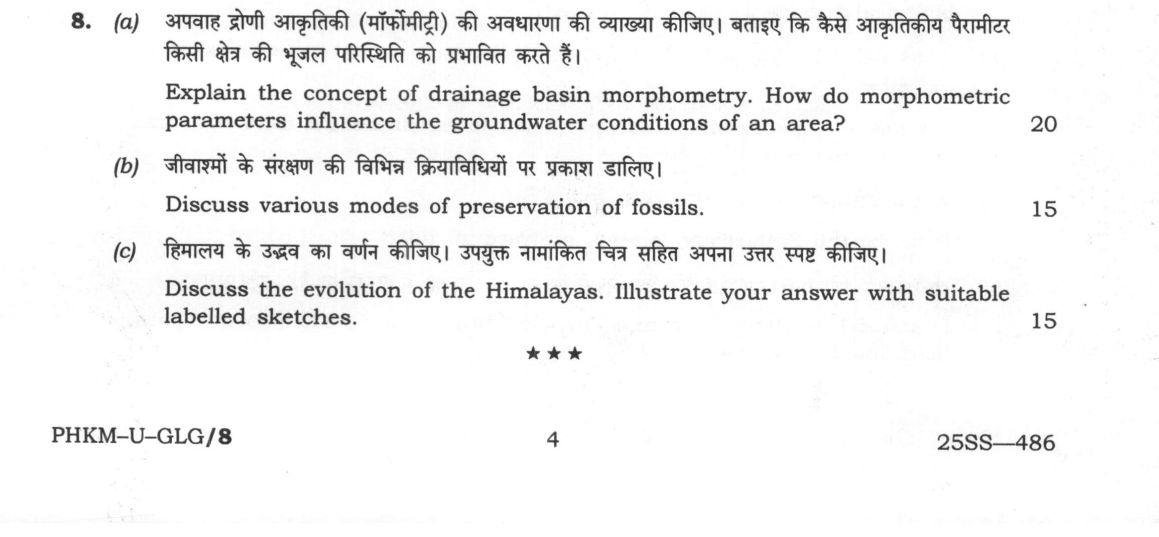
Explain the concept of drainage basin morphometry. How do morphometric parameters influence the groundwater conditions of an area? 20 marks
Discuss various modes of preservation of fossils. 15 marks
Discuss the evolution of the Himalayas. Illustrate your answer with suitable labelled sketches. 15 marks
हिंदी में प्रश्न पढ़ें
अपवाह क्षेत्री आकृतिकी (मॉर्फोमीट्री) की अवधारणा की व्याख्या कीजिए। बताइए कि कैसे आकृतिकीय पैरामीटर किसी क्षेत्र की भूजल परिस्थिति को प्रभावित करते हैं। (20 अंक)
जीवाश्मों के संरक्षण की विभिन्न क्रियाविधियों पर प्रकाश डालिए। (15 अंक)
हिमालय के उद्भव का वर्णन कीजिए। उपयुक्त नामांकित चित्र सहित अपना उत्तर स्पष्ट कीजिए। (15 अंक)
Model answer
Written by UPSC Answer Check against this question's marking rubric, to the expected length. UPSC does not publish answers for Mains — this is one way to score well, not an official key.
Drainage Basin Morphometry and Groundwater Conditions
Drainage basin morphometry involves the quantitative evaluation of the geometric and spatial characteristics of a fluvial basin, classified into linear, areal, and relief parameters. Linear parameters include stream order (u), stream length (Lᵤ), and bifurcation ratio (R_b). Areal parameters comprise drainage density (D_d), stream frequency (Fₛ), elongation ratio (Rₑ), and form factor (R_f). Relief parameters include basin relief (H) and ruggedness number (Rₙ). Horton’s Laws of Stream Numbers and Stream Lengths establish that stream order relates inversely to stream count and directly to mean length via geometric progressions, providing a predictive framework for regional discharge and subsurface recharge.
Morphometric parameters exert a direct causal control on hydrogeology by governing the partition between surface runoff and infiltration:
- Drainage Density (D_d) and Lithology: D_d measures total stream length per unit basin area. Low D_d (< 2 km/km²) reflects high subsurface permeability and coarse-grained lithology, which decelerates overland flow and maximizes infiltration into aquifers, as observed in the unconfined aquifers of the Indo-Gangetic Plains. Conversely, high D_d (> 5 km/km²) indicates impermeable bedrock or dense clayey substrates promoting rapid overland runoff, observed in the hard-rock terrains of the Deccan Traps.
- Bifurcation Ratio (R_b): Basins with normal R_b (3.0–5.0) indicate structurally undisturbed, homogeneous lithologies with extended hydrograph peaks that foster steady aquifer recharge. Abnormally high R_b values signify fault-controlled, steep drainage networks where rapid flash-flow minimizes aquifer recharge time.
- Form Factor (R_f) and Basin Shape: Elongated basins (low R_f) generate flattened, prolonged runoff hydrographs, significantly enhancing percolation and reducing aquifer vulnerability to depletion compared to circular basins (high R_f) that concentrate flood peaks.
Modes of Preservation of Fossils
Fossil preservation represents the taphonomic transition of organic remains into the lithosphere, bifurcated into body fossils (direct anatomical remains) and ichnofossils (biogenic sedimentary structures like tracks, trails, and burrows). The dominant modes include:
- Unaltered Preservation: Retention of original composition without chemical change, including soft-tissue mummification, entombment in amber, or freezing.
- Permineralization and Petrification: Infilling of internal cellular or skeletal pores by mineral-bearing groundwater (silica, calcite, iron oxides) without destroying primary microstructure, typical of the Neogene Siwalik vertebrate bonebeds.
- Replacement and Recrystallization: Molecule-by-molecule substitution of original mineralogy by secondary minerals (e.g., pyritization, silicification) or inversion of unstable polymorphs into stable phases (aragonite to calcite), preserving micro-morphology as seen in Proterozoic Vindhyan stromatolites.
- Carbonization (Distillation): Anaerobic compaction driving off volatile elements (O, H, N), leaving a residual carbon film outlining anatomical details of soft tissues and flora.
- Molds and Casts: Dissolution of skeletal elements leaves an external/internal mold, subsequently filled by sediments to produce a cast.
Taphonomic pathways governed by rapid burial, low biological activity, and anoxia yield exceptional conservation deposits known as Lagerstätten.
Evolution of the Himalayas
The Himalayan orogen evolved through progressive closure of the Neotethys Ocean following the Late Cretaceous northward drift and subsequent Eocene collision (~55–50 Ma) of the Indian Craton with the Eurasian Plate.
`` [N] Tethyan Sedimentary Zone ======================================= STDS (South Tibetan Detachment System) Higher Himalayan Crystallines (HHC) --------------------------------------- MCT (Main Central Thrust) Lesser Himalayan Duplex Belt --------------------------------------- MBT (Main Boundary Thrust) Sub-Himalaya (Siwalik Group) --------------------------------------- MFT (Main Frontal Thrust) Indo-Gangetic Foreland Basin [S] ``
Mechanically explained by Argand’s indenter model and critical taper wedge theory, convergence was accommodated along south-vergent, crustal-scale thrust systems:
- Trans-Himalayan / Suture Zone: Closure of the Tethyan realm marked by the Indus-Tsangpo Suture Zone (ITSZ) and Ladakh batholith.
- Greater Himalaya (HHC): High-grade metamorphic core exhumed between the basal ductile Main Central Thrust (MCT) and the top South Tibetan Detachment System (STDS). Shearing along the MCT generated inverted metamorphism, wherein higher-grade metamorphic zones (kyanite-sillimanite) overlie lower-grade zones (garnet-biotite).
- Lesser and Sub-Himalaya: Continued southward propagation produced a foreland-progressing duplex thrust system across the Main Boundary Thrust (MBT) and Main Frontal Thrust (MFT), incorporating molasses of the Siwalik Group into the active deformation front.
Integrating quantitative morphometry, taphonomic dynamics, and tectonic wedge kinematics provides vital insights into landscape evolution, natural resource distribution, and seismotectonic hazards in active mountain belts.
What "Explain" is asking you to do
Make the working of something clear — what sets it off, what follows from what, and what it produces. Explain is the Commission's mechanism word: it dominates the technical papers and the “explain why” stems, where the marks sit in the causal chain and not in the label.
Structure that answers it
State what it is → the initiating condition → the chain of cause, step by step → an instance where it plays out → what the chain produces
Where marks are lost
Describing what something looks like instead of why it works that way. Naming the stages without linking them reads as description too.
How this answer will be evaluated
Approach
Framework: Geology Paper 1: Define > Process > Field/Petrographic Evidence > Indian Example. (a) explain: definition/context > points in order > small example > short close | (b) discuss: intro > 3-4 dimensions > example > balanced close | (c) discuss: intro > 3-4 dimensions > example > balanced close Full marks: Comprehensive, well-structured, with precise terminology, Indian examples, and clear sketches.
Key points expected
- Define drainage basin morphometry
- List key parameters (e.g., relief, density, texture)
- Explain influence of parameters on groundwater
- Provide a specific Indian example
- Identify at least 3-4 modes of preservation
- Explain the process for each mode
- Provide examples for each mode
- Maintain a balanced discussion
Evaluation rubric
Each sub-part is marked on its own, against the marks and word limit printed on the paper.
- (a) Define drainage basin morphometry and link specific parameters to groundwater conditions. 20 marks
explain— definition/context → points in order → small example → short close
Must cover
- Define drainage basin morphometry
- List key parameters (e.g., relief, density, texture)
- Explain influence of parameters on groundwater
- Provide a specific Indian example
Loses marks
- Generic description without Indian example
- Missing causal link between parameter and groundwater
- No definition of morphometry
Earns more
- Mention Horton's or Strahler's classification
- Link relief to recharge rate
- Link drainage density to aquifer type
- Reference a specific Indian basin (e.g., Narmada, Godavari)
Extra mark
- Include a small sketch of a drainage pattern
- Cite a specific study or statistic on Indian groundwater
- (b) Discuss various modes of fossil preservation with examples. 15 marks
discuss— intro → 3-4 dimensions → example → balanced close
Must cover
- Identify at least 3-4 modes of preservation
- Explain the process for each mode
- Provide examples for each mode
- Maintain a balanced discussion
Loses marks
- Listing modes without explanation
- No examples provided
- Confusing preservation with fossilization
Earns more
- Mention permineralization, replacement, compression
- Reference specific Indian fossil sites (e.g., Mhow, Satpura)
- Explain taphonomic processes
- Differentiate between body and trace fossils
Extra mark
- Include a small diagram of a preservation process
- Name a specific famous Indian fossil (e.g., Megalodon, Dinosaur)
- (c) Discuss the evolution of the Himalayas with labelled sketches. 15 marks
discuss— intro → 3-4 dimensions → example → balanced close
Must cover
- Describe the tectonic evolution of the Himalayas
- Include suitable labelled sketches
- Explain the collision process
- Mention key geological features
Loses marks
- Missing labelled sketches
- No mention of plate tectonics
- Generic description without specific geological terms
Earns more
- Reference the Indian and Eurasian plates
- Mention the Tethys Ocean
- Explain the role of subduction
- Reference specific geological formations (e.g., Siwaliks)
Extra mark
- Include a cross-section of the Himalayan orogeny
- Mention specific ages of collision (e.g., 50 Ma)
Practice this exact question
Write your answer and it is marked point by point against the model answer above — what you covered, what you missed, what you got wrong.
Evaluate my answer →More from Geology 2024 Paper I
- Q5 Answer the following questions in about 150 words each: (a) Define species and explain ho…
- Q6 (a) Elucidate the evolutionary trend of Proboscidea with examples. (20 marks) (b) Describ…
- Q7 (a) Discuss the merits and limitations of different methods of stratigraphic analysis in…
- Q8 (a) Explain the concept of drainage basin morphometry. How do morphometric parameters inf…