Paper I — Q3
(a) Discuss in detail, with diagrams, the landforms and features resulting from deposition by rivers. (20 marks) (b) Describe…
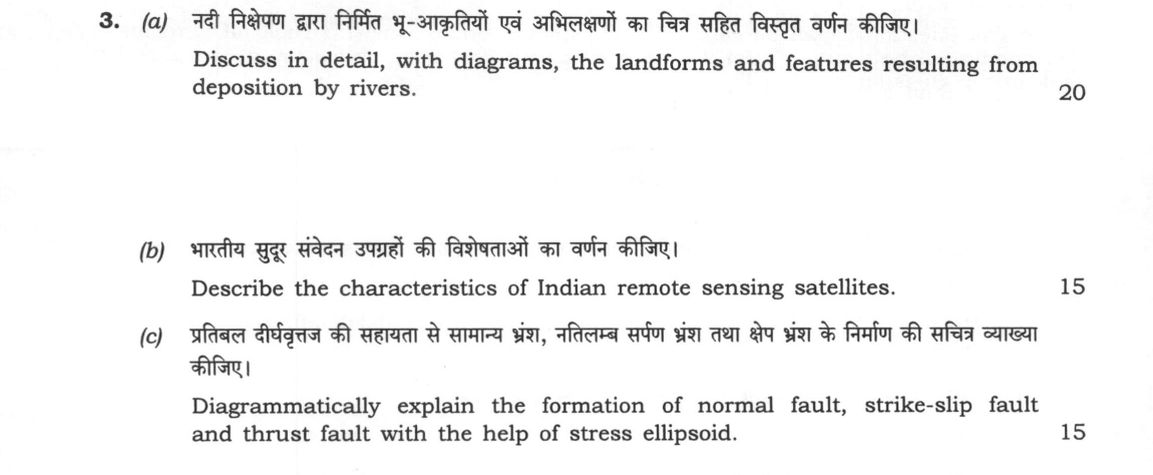
Discuss in detail, with diagrams, the landforms and features resulting from deposition by rivers. 20 marks
Describe the characteristics of Indian remote sensing satellites. 15 marks
Diagrammatically explain the formation of normal fault, strike-slip fault and thrust fault with the help of stress ellipsoid. 15 marks
हिंदी में प्रश्न पढ़ें
नदी निक्षेपण द्वारा निर्मित भू-आकृतियों एवं अभिलक्षणों का चित्र सहित विस्तृत वर्णन कीजिए। (20 अंक)
भारतीय सूदूर संवेदन उपग्रहों की विशेषताओं का वर्णन कीजिए। (15 अंक)
प्रतिबल दीर्घवृत्तज की सहायता से सामान्य भ्रंश, नतिलम्ब सर्पण भ्रंश तथा क्षेप भ्रंश के निर्माण की सचित्र व्याख्या कीजिए। (15 अंक)
Model answer
Written by UPSC Answer Check against this question's marking rubric, to the expected length. UPSC does not publish answers for Mains — this is one way to score well, not an official key.
Rivers deposit sediment where competence and capacity fall, so fluvial landforms record channel energy, sediment supply, and base level. Fluvial deposition. In-channel deposits are dominated by bedload: point bars build on inner meanders, channel bars include longitudinal, transverse and oblique forms in braided or high-energy reaches, and riffle–pool sequences reflect alternating coarse riffles and fine pools. In meandering rivers, lateral erosion and point-bar accretion produce scroll bars; in braided rivers, bar migration and channel switching produce braid bars and avulsion surfaces. Overbank deposits are finer: natural levees line channels with sand and silt, crevasse splays radiate where levees breach, and floodplains accumulate mud and organic matter. Floodplain deposits often show fining-upward sequences: sand in levee and splay, silt and mud in backswamp. Diagram 1 (meander scroll) would show abandoned channels and crescentic point-bar deposits; Diagram 2 (levee–backswamp) would show a raised sand levee, lower backswamp with fine silts, and a crevasse splay; Diagram 3 (terrace staircase) would show stepped remnants of former floodplains. Terraces are primarily erosional remnants of old floodplains, underlain by fluvial deposits, produced when base level falls or tectonic uplift incises the alluvium. Downstream fining occurs because stream power and competence decrease; hydraulic sorting keeps coarse grains in channels and fines on floodplains. Base-level rise causes aggradation, while fall causes incision and terrace formation. Alluvial fans form where gradient drops at mountain fronts; fan dynamics include progradation, avulsion, lobe stacking and fining-upward deposits. The Kosi megafan is a fluvial megafan built mainly by braided river processes, with radial drainage, channel avulsion, lobe progradation and fan surface aggradation, not a debris-flow fan. Deltas are major river deposits at base level, where distributaries split, sediment progrades, and lobes switch; deltaic deposits show progradational clinoforms and fining-upward sequences, as in the Ganga–Brahmaputra and Mahanadi deltas. Indo-Gangetic plains illustrate extensive alluvial deposition, terraces, fans and deltas.
Indian remote sensing satellites. IRS-1C/1D carried LISS-III (5.8 m, 8 bands) and PAN (2.35 m) with about 24 h revisit. Resourcesat-1/2 added LISS-IV (5.8 m) and AWiFS (8 m, 8 bands) for agriculture, soil moisture and wasteland mapping. LISS-III/IV and AWiFS use visible, near-infrared and shortwave-infrared bands. Cartosat-1 is a dedicated stereoscopic satellite (2.5 m) for DEMs; Cartosat-2 (1 m) and Cartosat-3 (0.5 m multispectral, 0.25 m PAN) are high-resolution mapping satellites, not primarily stereo, with about 24 h revisit. RISAT-1/2 X-band SAR provides all-weather data. These sensors support groundwater exploration, flood/drought monitoring, disaster management and land-use mapping.
Faults and stress ellipsoid. Anderson’s model uses σ1>σ2>σ3 as the stress ellipsoid axes, with σ1 the long axis and σ3 the short axis. The Mohr circle’s centre represents mean stress; failure occurs when it touches the envelope. In a normal fault, σ1 is vertical and σ3 horizontal; the fault plane dips steeply, the Mohr circle touches the failure envelope at relatively low shear stress, and focal mechanisms show extensional quadrants; the Sohan fault is an Indian example. In a thrust fault, σ1 is horizontal and σ3 vertical; the fault is a low-angle reverse plane, the Mohr circle is shifted to high normal stress, and focal mechanisms show compression; the Main Boundary Thrust exemplifies this. In a strike-slip fault, σ1 and σ3 are horizontal while the intermediate axis σ2 is vertical; the fault plane is vertical, the Mohr circle plots intermediate normal stress, and focal mechanisms show shear; the Kutch strike-slip system illustrates it. Fault plane solutions identify P, T and N axes: T-axis for normal, P-axis for thrust, N-axis vertical for strike-slip. These correspond to divergent, convergent and transform plate settings. Thus, fluvial forms, satellite mapping and fault mechanics together link sedimentation, surface processes and tectonic stress.
What "Discuss" is asking you to do
Lay the issue out from more than one side — how it arose, what is claimed for it, what is held against it, and where it now stands. UPSC attaches discuss to broad topics with several live dimensions, so coverage of the dimensions earns more than the strength of your opinion.
Structure that answers it
Set the issue up → the case as it is made → the case against → the dimension both sides leave out → where the balance now lies
Where marks are lost
Listing facts with no thread between them, or arguing one side throughout and calling it a discussion.
How this answer will be evaluated
Approach
Framework: Geology, Paper 1. (a) discuss: intro > 3-4 dimensions > example > balanced close | (b) describe: define > structure or process in order > labelled diagram > significance | (c) explain: definition/context > points in order > small example > short close Full marks: Comprehensive diagrams, precise technical terminology, specific examples, clear causal chains
Key points expected
- Diagram of meander development to oxbow lake
- Diagram of delta formation (arcuate/cuspate)
- Explanation of floodplain and levee formation
- Description of alluvial fan and barchan dunes
- List of major satellite series (IRS, Cartosat, Resourcesat)
- Description of sensor types (optical, SAR, thermal)
- Mention of spatial and spectral resolution
- Explanation of orbital parameters (sun-synchronous)
Evaluation rubric
Each sub-part is marked on its own, against the marks and word limit printed on the paper.
- (a) Detailed discussion of fluvial depositional landforms with diagrams. 20 marks
discuss— intro → 3-4 dimensions → example → balanced close
Must cover
- Diagram of meander development to oxbow lake
- Diagram of delta formation (arcuate/cuspate)
- Explanation of floodplain and levee formation
- Description of alluvial fan and barchan dunes
Loses marks
- Confusing erosional with depositional features
- Missing diagrams for major landforms
- Generic description without specific landform names
Earns more
- Mention of point bars and cut banks
- Reference to braided river deposits
- Explanation of sediment sorting and grading
- Mention of river terraces
Extra mark
- Example of Ganga-Brahmaputra delta
- Example of Indus alluvial fan
- (b) Characteristics of Indian remote sensing satellites. 15 marks
describe— define → structure or process in order → labelled diagram → significance
Must cover
- List of major satellite series (IRS, Cartosat, Resourcesat)
- Description of sensor types (optical, SAR, thermal)
- Mention of spatial and spectral resolution
- Explanation of orbital parameters (sun-synchronous)
Loses marks
- Confusing Indian with foreign satellites
- Missing technical specifications
- Generic description without specific satellite names
Earns more
- Specific examples like Cartosat-2 or Resourcesat-2
- Mention of ISRO's role in development
- Reference to specific applications (agriculture, mapping)
- Comparison of different satellite capabilities
Extra mark
- Mention of specific launch dates
- Reference to specific mission objectives
- (c) Diagrammatic explanation of fault types using stress ellipsoid. 15 marks
explain— definition/context → points in order → small example → short close
Must cover
- Diagram of normal fault with stress ellipsoid
- Diagram of thrust fault with stress ellipsoid
- Diagram of strike-slip fault with stress ellipsoid
- Explanation of principal stress directions
Loses marks
- Missing stress ellipsoid in diagrams
- Confusing fault types
- Missing principal stress directions
Earns more
- Clear labeling of hanging wall and footwall
- Explanation of fault plane dip
- Mention of specific fault examples
- Clear distinction between fault types
Extra mark
- Reference to specific Indian fault examples
- Mention of specific stress regimes
Practice this exact question
Write your answer and it is marked point by point against the model answer above — what you covered, what you missed, what you got wrong.
Evaluate my answer →More from Geology 2024 Paper I
- Q1 Answer the following questions in about 150 words each: (a) Discuss two widely accepted t…
- Q2 (a) Discuss the intensity and magnitude scale commonly used to assess seismic damage. Wri…
- Q3 (a) Discuss in detail, with diagrams, the landforms and features resulting from depositio…
- Q4 (a) Describe fold geometry. Illustrate various types of folds on the basis of their symme…
- Q5 Answer the following questions in about 150 words each: (a) Define species and explain ho…
- Q6 (a) Elucidate the evolutionary trend of Proboscidea with examples. (20 marks) (b) Describ…