Paper I — Q2
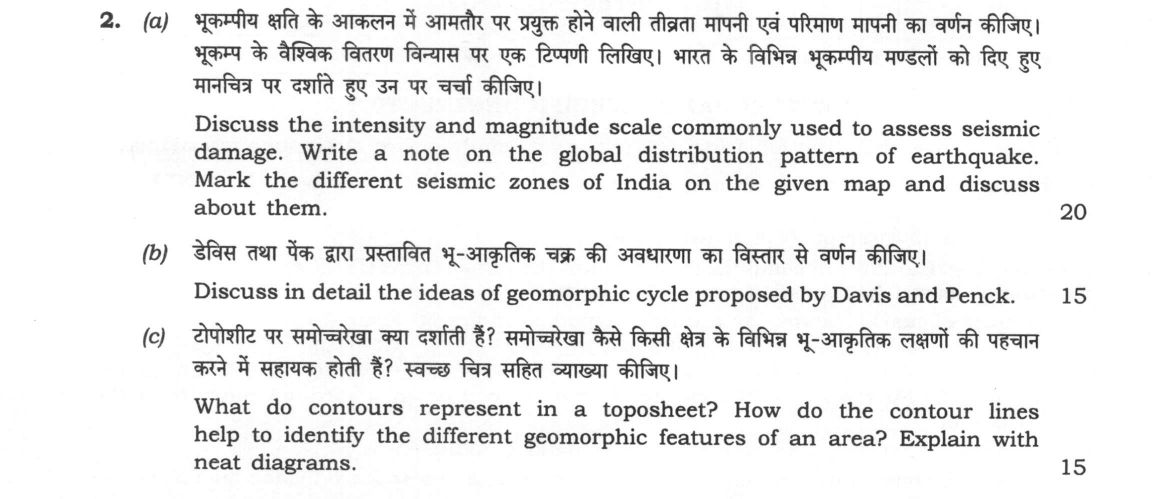
(a) Discuss the intensity and magnitude scale commonly used to assess seismic damage. Write a note on the global distribution…
Discuss the intensity and magnitude scale commonly used to assess seismic damage. Write a note on the global distribution pattern of earthquake. Mark the different seismic zones of India on the given map and discuss about them. 20 marks
Discuss in detail the ideas of geomorphic cycle proposed by Davis and Penck. 15 marks
What do contours represent in a toposheet? How do the contour lines help to identify the different geomorphic features of an area? Explain with neat diagrams. 15 marks
हिंदी में प्रश्न पढ़ें
भूकंपीय क्षति के आकलन में आमतौर पर प्रयुक्त होने वाली तीव्रता मापनी एवं परिमाण मापनी का वर्णन कीजिए। भूकंप के वैश्विक वितरण विन्यास पर एक टिप्पणी लिखिए। भारत के विभिन्न भूकंपीय मंडलों को दिए हुए मानचित्र पर दर्शाते हुए उन पर चर्चा कीजिए। (20 अंक)
डेविस तथा पैंक द्वारा प्रस्तावित भू-आकृतिक चक्र की अवधारणा का विस्तार से वर्णन कीजिए। (15 अंक)
टोपोशीट पर समोचरेखा क्या दर्शाती हैं? समोचरेखा कैसे किसी क्षेत्र के विभिन्न भू-आकृतिक लक्षणों की पहचान करने में सहायक होती हैं? स्वच्छ चित्र सहित व्याख्या कीजिए। (15 अंक)
Model answer
Written by UPSC Answer Check against this question's marking rubric, to the expected length. UPSC does not publish answers for Mains — this is one way to score well, not an official key.
Seismic hazard is assessed by separating the size of the earthquake from the damage it produces. Magnitude and intensity. Magnitude is a base-10 logarithmic measure of earthquake size, not directly kinetic energy. Richter local magnitude (M_L) is based on maximum amplitude of recorded waves, while moment magnitude (M_w) is based on seismic moment, i.e. fault area × slip × rigidity; energy released is estimated from magnitude through empirical relations, with each unit increase implying about tenfold amplitude and 31.6-fold energy. Intensity scales, such as Modified Mercalli and MSK-64, use Roman numerals to describe observed shaking, structural damage, and human effects at a place; they are site-specific and therefore more useful for damage assessment.
Global distribution. Earthquakes are concentrated along plate boundaries. The Circum-Pacific belt, the Alpide or Mediterranean-Himalayan belt, and the Mid-oceanic ridge system contain most seismicity. The Circum-Pacific belt has the highest frequency and largest magnitudes due to oceanic plate subduction; the Alpide belt includes the Himalaya and is linked to India-Eurasia collision; mid-oceanic ridges have shallow, smaller events. Intraplate earthquakes are rare but important in India, where the Indian plate's collision with Eurasia and inherited crustal weaknesses control seismicity.
Seismic zones of India. IS 1893 (Part 1): 2016 divides India into Zones II–V. On the given map, mark Zone V as narrow, discontinuous high-risk bands along specified parts of J&K and Ladakh, the high Himalayan parts of Himachal Pradesh and Uttarakhand, Sikkim, North Bihar, most of the Northeast, Andaman & Nicobar, and Kutch; mark Zone IV in adjacent parts of Himachal Pradesh, Uttarakhand, Ladakh, and the Koyna-Warna region; mark Zone III in Punjab, Kerala, Latur, parts of Uttar Pradesh, Madhya Pradesh and Maharashtra; and mark Zone II in the remaining Deccan and low-risk areas. Zone V is not a continuous state-wide area; Ladakh is mostly Zone IV except specified Zone V parts. Zone IV surrounds Zone V in the Himalayan arc. Zone V includes parts of Kashmir and Assam; 2001 Bhuj occurred in Kutch, while the 2015 Nepal-Gorkha earthquake caused high intensities across Nepal and northern India.
Davis and Penck. Davis’s geomorphic cycle links erosion to a base level and a graded profile. In youth, relief is high and drainage is immature; in maturity, slopes are subdued and valleys widen; in old age, a peneplain forms. Uplift can renew the cycle. Its criticisms are that it assumes static uplift, is time-dependent rather than process-based, and treats stages as universal. Penck’s model emphasizes simultaneous crustal movement and erosion, with slopes retreating in parallel and development waxing and waning. It focuses on slope forms and endogenetic-exogenetic interaction rather than fixed stages.
Contours. Contours are lines joining points of equal elevation; the contour interval is the vertical difference between successive lines, and horizontal equivalent is the horizontal ground distance between successive contours. The interval is chosen according to map scale and relief; a small interval gives detailed relief, while a large interval generalizes it. A neat diagram of concentric closed contours shows a hill, while hachured closed contours show a depression. V-shaped contours pointing upstream indicate valleys; U-shaped contours radiating from a summit indicate spurs. Closely spaced contours show steep slopes, widely spaced contours gentle slopes; overlapping contours indicate cliffs. Ridge lines appear as contours bending around high ground, saddles as a dip between two high points, terraces as flat contour bands, and alluvial fans as fan-shaped spacing; drainage patterns follow the V-contours. In the diagrams, label the stream in the V, the summit in closed contours, and the cliff where contours merge. Thus, seismic scales, zonation, landform cycles, and contour reading together link tectonic forces with surface form and hazard.
What "Discuss" is asking you to do
Lay the issue out from more than one side — how it arose, what is claimed for it, what is held against it, and where it now stands. UPSC attaches discuss to broad topics with several live dimensions, so coverage of the dimensions earns more than the strength of your opinion.
Structure that answers it
Set the issue up → the case as it is made → the case against → the dimension both sides leave out → where the balance now lies
Where marks are lost
Listing facts with no thread between them, or arguing one side throughout and calling it a discussion.
How this answer will be evaluated
Approach
Framework: Geology, Paper 1. (a) discuss: intro > 3-4 dimensions > example > balanced close | (b) discuss: intro > 3-4 dimensions > example > balanced close | (c) explain: definition/context > points in order > small example > short close Full marks: Comprehensive, accurate, with detailed diagrams and Indian examples.
Key points expected
- Distinguish Richter magnitude from Mercalli intensity
- Identify global seismic belts (Pacific, Alpide)
- Mark and name Indian seismic zones on map
- Link zones to specific tectonic features
- Explain Davis's three stages (youth, maturity, old age)
- Describe Penck's peneplain concept
- Contrast the two models
- Include labelled diagrams of cycles
Evaluation rubric
Each sub-part is marked on its own, against the marks and word limit printed on the paper.
- (a) Compare intensity vs magnitude scales, global distribution, and Indian seismic zones. 20 marks
discuss— intro → 3-4 dimensions → example → balanced close
Must cover
- Distinguish Richter magnitude from Mercalli intensity
- Identify global seismic belts (Pacific, Alpide)
- Mark and name Indian seismic zones on map
- Link zones to specific tectonic features
Loses marks
- Confusing magnitude with intensity
- Missing map or unlabelled zones
- Generic description without Indian context
Earns more
- Mention specific earthquake events (e.g., 2001 Bhuj)
- Reference IS 1893 classification
- Explain plate boundary types
Extra mark
- Specific magnitude of historical Indian quakes
- Detailed map labeling of fault lines
- (b) Detail Davis and Penck's geomorphic cycle theories. 15 marks
discuss— intro → 3-4 dimensions → example → balanced close
Must cover
- Explain Davis's three stages (youth, maturity, old age)
- Describe Penck's peneplain concept
- Contrast the two models
- Include labelled diagrams of cycles
Loses marks
- Missing diagrams
- Confusing Davis and Penck concepts
- No comparison between the two
Earns more
- Mention 'cycle of erosion' terminology
- Reference specific landforms for each stage
- Discuss limitations of the theories
Extra mark
- Mention specific Indian examples of peneplains
- Reference modern critiques of the models
- (c) Explain contour representation and identification of geomorphic features. 15 marks
explain— definition/context → points in order → small example → short close
Must cover
- Define contour lines and their properties
- Explain how contours show elevation and slope
- Identify specific features (ridges, valleys, cliffs)
- Provide neat diagrams of contour patterns
Loses marks
- Missing diagrams
- Incorrect identification of features
- No explanation of contour properties
Earns more
- Mention contour interval and index contours
- Explain closed contours for hills/depressions
- Reference toposheet symbols
Extra mark
- Specific toposheet example
- Detailed explanation of contour spacing
Practice this exact question
Write your answer and it is marked point by point against the model answer above — what you covered, what you missed, what you got wrong.
Evaluate my answer →More from Geology 2024 Paper I
- Q1 Answer the following questions in about 150 words each: (a) Discuss two widely accepted t…
- Q2 (a) Discuss the intensity and magnitude scale commonly used to assess seismic damage. Wri…
- Q3 (a) Discuss in detail, with diagrams, the landforms and features resulting from depositio…
- Q4 (a) Describe fold geometry. Illustrate various types of folds on the basis of their symme…
- Q5 Answer the following questions in about 150 words each: (a) Define species and explain ho…