Paper I — Q7
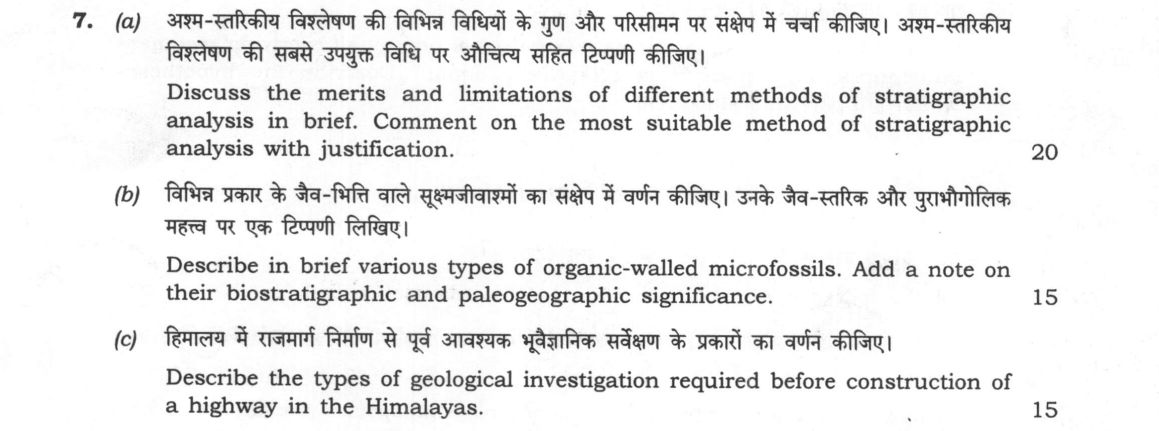
(a) Discuss the merits and limitations of different methods of stratigraphic analysis in brief. Comment on the most suitable…
Discuss the merits and limitations of different methods of stratigraphic analysis in brief. Comment on the most suitable method of stratigraphic analysis with justification. 20 marks
Describe in brief various types of organic-walled microfossils. Add a note on their biostratigraphic and paleogeographic significance. 15 marks
Describe the types of geological investigation required before construction of a highway in the Himalayas. 15 marks
हिंदी में प्रश्न पढ़ें
अश्म-स्तरीय विश्लेषण की विभिन्न विधियों के गुण और परिसीमन पर संक्षेप में चर्चा कीजिए। अश्म-स्तरीय विश्लेषण की सबसे उपयुक्त विधि पर औचित्य सहित टिप्पणी कीजिए। (20 अंक)
विभिन्न प्रकार के जैव-भित्ति वाले सूक्ष्मजीवाश्मों का संक्षेप में वर्णन कीजिए। उनके जैव-स्तरीय और पुराभौगोलिक महत्व पर एक टिप्पणी लिखिए। (15 अंक)
हिमालय में राजमार्ग निर्माण से पूर्व आवश्यक भूवैज्ञानिक सर्वेक्षण के प्रकारों का वर्णन कीजिए। (15 अंक)
Model answer
Written by UPSC Answer Check against this question's marking rubric, to the expected length. UPSC does not publish answers for Mains — this is one way to score well, not an official key.
Stratigraphic methods. Stratigraphic analysis rests on superposition, original horizontality and faunal/lithological succession, but no single method is universally adequate. Lithostratigraphy divides rocks on lithology and facies; its merit is direct field applicability for mapping, engineering and reservoir work, but it is local, facies-dependent and can mislead where lateral facies changes occur. Biostratigraphy uses fossils for relative age and correlation; it is highly time-diagnostic and gives high-resolution zones, but it depends on preservation, is facies-controlled, and absence of fossils may be taphonomic rather than age-related; it is less effective in the Precambrian because macrofossils are sparse, although microfossils such as acritarchs are useful. Chronostratigraphy defines time-rock units—systems, series and stages—anchored by GSSPs and calibrated by geochronological and astrochronological methods; it provides a global time framework, but its application requires correlation to dated horizons and is not always directly observable in outcrop. Magnetostratigraphy uses magnetic polarity reversals; it is globally correlatable and valuable for boundary intervals and deep-sea sequences, but it needs oriented samples, reliable remanent magnetism, and is difficult in folded, metamorphosed or thermally altered rocks. Sequence stratigraphy interprets genetic packages controlled by relative sea-level, eustasy, tectonics and sediment supply; it is useful for basin analysis, reservoir and trap prediction, but surfaces can be subjective and require high-resolution data. The most suitable method is therefore an integrated approach: biostratigraphy is generally the best single method for Phanerozoic fossiliferous rocks, magnetostratigraphy is preferred for boundary and interval correlation, and lithostratigraphy or sequence stratigraphy is added according to rock type, age and correlation need. In Indian basins, biostratigraphy often anchors Gondwana and Tethyan correlations, while magnetostratigraphy helps where fossils are absent.
Organic-walled microfossils. Organic-walled microfossils are small, resistant microfossils preserved in organic matter. Acritarchs are non-mineralized, mostly marine microfossils of uncertain affinity, ranging from the Precambrian through the Phanerozoic and especially important for Precambrian-Cambrian and Paleozoic sequences. They are particularly useful in organic-rich shales and for Precambrian-Cambrian boundary work. Chitinozoans are small organic-walled microfossils of uncertain biological affinity, ranging mainly from the Ordovician to the Devonian and exceptionally useful in Gondwana sequences. Dinoflagellate cysts are organic-walled cysts of dinoflagellates, common in Mesozoic and Cenozoic marine rocks, and are used for biostratigraphy, palaeoenvironmental reconstruction and thermal maturity assessment. Spores and pollen are terrestrial organic-walled microfossils, from the Ordovician to the Holocene, used for terrestrial correlation, palaeoclimate and palaeovegetation studies. In Indian Gondwana basins, chitinozoans and spore-pollen assemblages are key for inter-basin correlation and palaeoclimate. Their biostratigraphic significance lies in high-resolution zonation, first appearance datums and provincial assemblages; for example, Permian Gondwana floral provinces and Cretaceous Indian endemic dinoflagellate assemblages help reconstruct palaeogeography and inter-basin correlation.
Himalayan highway investigations. Before highway construction in the Himalayas, investigations must combine terrain analysis, geological mapping, remote sensing and GIS to identify lineaments, lithology, drainage and landslide-prone zones. Slope stability requires kinematic analysis, SMR classification, rock mass rating such as RMR and Q-system, and landslide susceptibility zonation. Geotechnical boreholes, trial pits and in-situ tests should verify subsurface conditions, while environmental impact assessment should be integrated with alignment planning. Seismic hazard evaluation is essential because the Himalayan seismic belt is a young orogen with neo-tectonic activity and active faults; seismic zoning, fault mapping and liquefaction assessment guide alignment and design. Drainage and hydrological studies must assess flood risk, glacial lake outburst flood (GLOF) potential, debris flows and groundwater. Tunnel feasibility studies should examine rock mass, jointing, stress, water ingress and ventilation. Because the ecology is fragile, environmentally sensitive alignment selection is needed to avoid ecologically sensitive areas, active fault zones and high GLOF corridors, and to minimize cut-and-fill. Thus, integrated stratigraphic approaches and multidisciplinary geological investigation are indispensable for safe, sustainable Himalayan highway construction.
What "Discuss" is asking you to do
Lay the issue out from more than one side — how it arose, what is claimed for it, what is held against it, and where it now stands. UPSC attaches discuss to broad topics with several live dimensions, so coverage of the dimensions earns more than the strength of your opinion.
Structure that answers it
Set the issue up → the case as it is made → the case against → the dimension both sides leave out → where the balance now lies
Where marks are lost
Listing facts with no thread between them, or arguing one side throughout and calling it a discussion.
How this answer will be evaluated
Approach
Framework: Geology Paper 1: Define > Process > Field/Petrographic Evidence > Indian Example. (a) discuss: intro > 3-4 dimensions > example > balanced close | (b) describe: define > structure or process in order > labelled diagram > significance | (c) describe: define > structure or process in order > labelled diagram > significance Full marks: Precise method names, specific Indian examples, clear justification, and detailed hazard analysis.
Key points expected
- Merits and limitations of lithostratigraphy
- Merits and limitations of biostratigraphy
- Merits and limitations of chronostratigraphy
- Justification for the most suitable method
- Definition of organic-walled microfossils
- Types: Acritarchs, Prasinophytes, Dinoflagellates
- Biostratigraphic significance (zoning, age dating)
- Paleogeographic significance (environmental indicators)
Evaluation rubric
Each sub-part is marked on its own, against the marks and word limit printed on the paper.
- (a) Compare merits/limitations of stratigraphic methods and justify the most suitable one. 20 marks
discuss— intro → 3-4 dimensions → example → balanced close
Must cover
- Merits and limitations of lithostratigraphy
- Merits and limitations of biostratigraphy
- Merits and limitations of chronostratigraphy
- Justification for the most suitable method
Loses marks
- Generic description without specific method names
- Missing the justification for the 'most suitable' method
- No mention of limitations for any method
Earns more
- Mention of magnetostratigraphy or chemostratigraphy
- Reference to Indian stratigraphic examples (e.g., Deccan, Gondwana)
- Discussion of unconformities or facies changes
- Balanced conclusion on method selection
Extra mark
- Specific Indian formation names (e.g., Vindhyan, Cretaceous)
- Reference to specific index fossils or magnetic reversals
- (b) Describe organic-walled microfossils and their biostratigraphic/paleogeographic significance. 15 marks
describe— define → structure or process in order → labelled diagram → significance
Must cover
- Definition of organic-walled microfossils
- Types: Acritarchs, Prasinophytes, Dinoflagellates
- Biostratigraphic significance (zoning, age dating)
- Paleogeographic significance (environmental indicators)
Loses marks
- Confusing organic-walled with calcareous microfossils
- Missing the paleogeographic significance
- No specific types named
Earns more
- Mention of specific genera (e.g., Gonyaulacoid, Micrasterites)
- Reference to specific Indian basins (e.g., Krishna-Godavari)
- Distinction between marine and freshwater forms
- Mention of preservation conditions (anoxic)
Extra mark
- Specific Indian occurrence (e.g., Cretaceous of KG basin)
- Reference to specific stratigraphic age (e.g., Jurassic, Cretaceous)
- (c) Describe geological investigations required for highway construction in the Himalayas. 15 marks
describe— define → structure or process in order → labelled diagram → significance
Must cover
- Geological mapping and reconnaissance
- Seismic hazard assessment (faults, zones)
- Slope stability and landslide investigation
- Hydrogeological and drainage analysis
Loses marks
- Generic investigation list not specific to Himalayas
- Missing seismic or slope stability components
- No mention of specific hazards (landslides, earthquakes)
Earns more
- Mention of specific Himalayan hazards (e.g., Gorkha fault)
- Reference to specific investigation techniques (e.g., SPT, CPT)
- Discussion of rock mechanics and engineering geology
- Mention of environmental impact assessment
Extra mark
- Specific Himalayan highway example (e.g., NH-1, NH-310)
- Reference to specific geological formations (e.g., Siwalik, Lesser Himalaya)
Practice this exact question
Write your answer and it is marked point by point against the model answer above — what you covered, what you missed, what you got wrong.
Evaluate my answer →More from Geology 2024 Paper I
- Q4 (a) Describe fold geometry. Illustrate various types of folds on the basis of their symme…
- Q5 Answer the following questions in about 150 words each: (a) Define species and explain ho…
- Q6 (a) Elucidate the evolutionary trend of Proboscidea with examples. (20 marks) (b) Describ…
- Q7 (a) Discuss the merits and limitations of different methods of stratigraphic analysis in…
- Q8 (a) Explain the concept of drainage basin morphometry. How do morphometric parameters inf…