Paper I — Q6
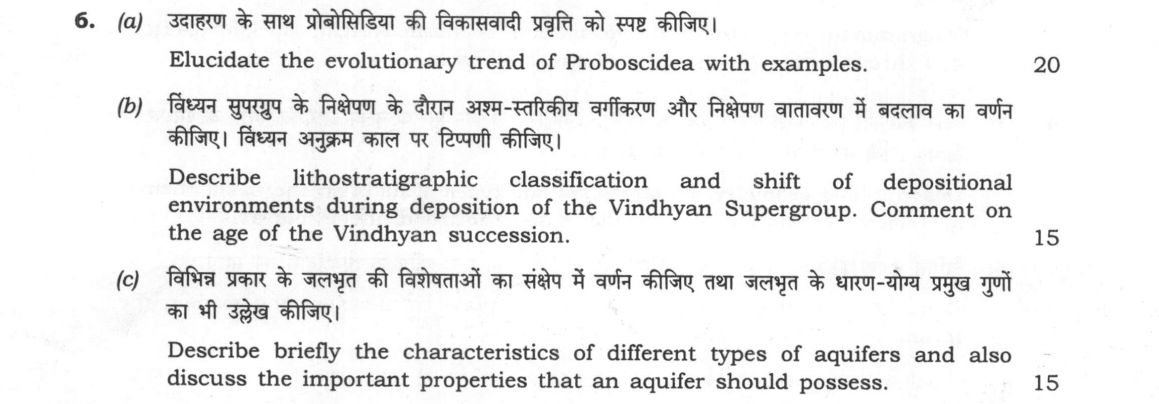
(a) Elucidate the evolutionary trend of Proboscidea with examples. (20 marks) (b) Describe lithostratigraphic classification and…
Elucidate the evolutionary trend of Proboscidea with examples. 20 marks
Describe lithostratigraphic classification and shift of depositional environments during deposition of the Vindhyan Supergroup. Comment on the age of the Vindhyan succession. 15 marks
Describe briefly the characteristics of different types of aquifers and also discuss the important properties that an aquifer should possess. 15 marks
हिंदी में प्रश्न पढ़ें
उदाहरण के साथ प्रोबोसिडिया की विकासवादी प्रवृत्ति को स्पष्ट कीजिए। (20 अंक)
विंध्यन सुपरग्रुप के निक्षेपण के दौरान अश्म-स्तरीय वर्गीकरण और निक्षेपण वातावरण में बदलाव का वर्णन कीजिए। विंध्यन अनुक्रम काल पर टिप्पणी कीजिए। (15 अंक)
विभिन्न प्रकार के जलभृत की विशेषताओं का संक्षेप में वर्णन कीजिए तथा जलभृत के धारण-योग्य प्रमुख गुणों का भी उल्लेख कीजिए। (15 अंक)
Model answer
Written by UPSC Answer Check against this question's marking rubric, to the expected length. UPSC does not publish answers for Mains — this is one way to score well, not an official key.
(a) Proboscidea Proboscidea is best understood as a Cenozoic radiation in which a short, muscular proboscis and incisor tusks were modified for feeding, defence and display. A non-linear grade sequence, not a single ancestral line, is: Moeritherium (semi-aquatic, short trunk, no prominent tusks) → deinotheriids such as Deinotherium (lower tusks, side branch) → gomphotheres such as Gomphotherium (upper tusks, side branch) → elephantids including modern Elephas and Loxodonta and extinct Mammuthus (mammoths). The main trends are elongation of the trunk, reduction/loss of premolars, development of tusks from incisors, and progressive molar hypsodonty. Early moeritheriids were probably aquatic/semi-aquatic, feeding on submerged or low vegetation; later forms moved to terrestrial environments. Tusks shifted from lower tusks in Deinotherium to upper tusks in Gomphotherium and elephantids, allowing browsing, digging, stripping and combat. High-crowned molars with complex enamel folds indicate a shift from soft browsing to abrasive grassland feeding, driven by Miocene–Pliocene aridification and climate change. Indian examples include Elephas hysudricus from the Siwaliks, Stegodon with upper tusks and folded molars, and Palaeoloxodon from Hathnora, showing feeding-height stratification and adaptation to open habitats.
(b) Vindhyan Supergroup The Vindhyan Supergroup is lithostratigraphically divided into Lower and Upper Vindhyan. The Lower Vindhyan, represented by the Semri Group, includes Kajrahat Limestone, Porcellanite and Semri Limestone; its carbonate ramp and shallow marine facies indicate a warm, low-energy sea. The Upper Vindhyan comprises the Kaimur, Rewa and Bhander Groups. The Kaimur Group shows fluvial, deltaic and lacustrine sandstones, shales and limestones; the Rewa Group records braided fluvial and lacustrine sandstones and shales; the Bhander Group is dominated by aeolian sandstones and ephemeral-lake red beds. A schematic facies shift is: Semri carbonate ramp → Kaimur–Rewa fluvial-deltaic-lacustrine → Bhander aeolian-ephemeral lake. The Lower–Upper Vindhyan boundary is marked by the Great Vindhyan Unconformity, a regional uplift and erosional surface, not a proven basin inversion. Age remains debated. Rb–Sr and some detrital zircon data support a Mesoproterozoic framework (ca. 1.6–1.0 Ga), with older components in the late Paleoproterozoic (ca. 1.7–1.6 Ga), while carbon-isotope excursions and Ediacaran fossils in some upper units support a Neoproterozoic (Tonian–Ediacaran) age. The succession therefore records a long Proterozoic history with facies changes from marine to continental.
(c) Aquifers An aquifer is a saturated porous formation that stores and transmits water. An unconfined aquifer has a water table at its upper surface; the Bhabhar zone is a typical unconfined aquifer. A perched aquifer is a small saturated body above a regional water table, separated by an aquitard. A confined aquifer is bounded above and below by low-permeability layers; it is not automatically artesian. It becomes artesian only when the piezometric head rises above the ground surface or top of the aquifer, as in some Ganga–Yamuna doab wells. A semi-confined or leaky aquifer allows vertical leakage through an aquitard. Important properties are porosity, which measures void space; permeability, expressed as hydraulic conductivity K, which controls flow rate; specific yield, the fraction of water released by gravity, which should be high; specific retention, which should be low for good yield; storage coefficient, which controls release under confined conditions; and transmissivity T = K × saturated thickness, which measures transmission capacity. Darcy’s law, q = –K dh/dl, applies under laminar, saturated, steady flow in a homogeneous, isotropic porous medium with incompressible water and constant K. High porosity alone is insufficient; an optimal aquifer needs high permeability, high specific yield, adequate storage, and low vulnerability to contamination.
Thus, the three topics require integrating form, facies and flow: Proboscidea shows adaptive radiation, the Vindhyan records Proterozoic facies change and age uncertainty, and aquifer assessment depends on porosity, permeability, yield and vulnerability.
What "Elucidate" is asking you to do
Make a stated proposition plain and then prove it with instances. Elucidate stems almost always carry a claim or a named concept, and very often the words “with examples” or “with suitable diagrams” — the illustration is part of the directive, not decoration.
Structure that answers it
Plain-language statement of what the proposition means → the part that is obscure, resolved → first illustration → second illustration → why the proposition holds
Where marks are lost
Adding terminology; elucidate rewards removing it. The commoner loss is a clean explanation with no example, when the stem asked for examples.
How this answer will be evaluated
Approach
Framework: Geology Paper 1: Define > Process > Field/Petrographic Evidence > Indian Example. (a) explain: definition/context > points in order > small example > short close | (b) describe: define > structure or process in order > labelled diagram > significance | (c) describe: define > structure or process in order > labelled diagram > significance Full marks: Comprehensive, specific, and well-structured with Indian examples and diagrams.
Key points expected
- Mention key morphological changes (e.g., dentition, proboscis)
- Provide specific examples of fossil taxa
- Show chronological sequence of evolution
- Link to environmental changes
- Define lithostratigraphic classification of Vindhyan Supergroup
- Describe the shift in depositional environments
- Comment on the age of the Vindhyan succession
- Provide specific examples of formations
Evaluation rubric
Each sub-part is marked on its own, against the marks and word limit printed on the paper.
- (a) Evolutionary trend of Proboscidea with examples. 20 marks
explain— definition/context → points in order → small example → short close
Must cover
- Mention key morphological changes (e.g., dentition, proboscis)
- Provide specific examples of fossil taxa
- Show chronological sequence of evolution
- Link to environmental changes
Loses marks
- Generic description without specific examples
- Missing chronological sequence
- No link to environmental changes
Earns more
- Mention specific Indian fossil sites
- Include a simple evolutionary tree
- Discuss the role of climate change
- Mention specific geological periods
Extra mark
- Reference to specific Indian craton or basin
- Mention of specific mineral composition
- (b) Lithostratigraphic classification and shift of depositional environments of Vindhyan Supergroup. 15 marks
describe— define → structure or process in order → labelled diagram → significance
Must cover
- Define lithostratigraphic classification of Vindhyan Supergroup
- Describe the shift in depositional environments
- Comment on the age of the Vindhyan succession
- Provide specific examples of formations
Loses marks
- Generic description without specific examples
- Missing shift in depositional environments
- No comment on the age of the succession
Earns more
- Mention specific Indian craton or basin
- Include a simple stratigraphic column
- Discuss the role of tectonic activity
- Mention specific mineral composition
Extra mark
- Reference to specific Indian craton or basin
- Mention of specific mineral composition
- (c) Characteristics of different types of aquifers and important properties. 15 marks
describe— define → structure or process in order → labelled diagram → significance
Must cover
- Define different types of aquifers
- Describe the characteristics of each type
- Discuss the important properties of an aquifer
- Provide specific examples of aquifers
Loses marks
- Generic description without specific examples
- Missing characteristics of each type
- No discussion of important properties
Earns more
- Mention specific Indian aquifer systems
- Include a simple diagram of aquifer types
- Discuss the role of recharge and discharge
- Mention specific mineral composition
Extra mark
- Reference to specific Indian craton or basin
- Mention of specific mineral composition
Practice this exact question
Write your answer and it is marked point by point against the model answer above — what you covered, what you missed, what you got wrong.
Evaluate my answer →More from Geology 2024 Paper I
- Q3 (a) Discuss in detail, with diagrams, the landforms and features resulting from depositio…
- Q4 (a) Describe fold geometry. Illustrate various types of folds on the basis of their symme…
- Q5 Answer the following questions in about 150 words each: (a) Define species and explain ho…
- Q6 (a) Elucidate the evolutionary trend of Proboscidea with examples. (20 marks) (b) Describ…
- Q7 (a) Discuss the merits and limitations of different methods of stratigraphic analysis in…
- Q8 (a) Explain the concept of drainage basin morphometry. How do morphometric parameters inf…