Paper I — Q5
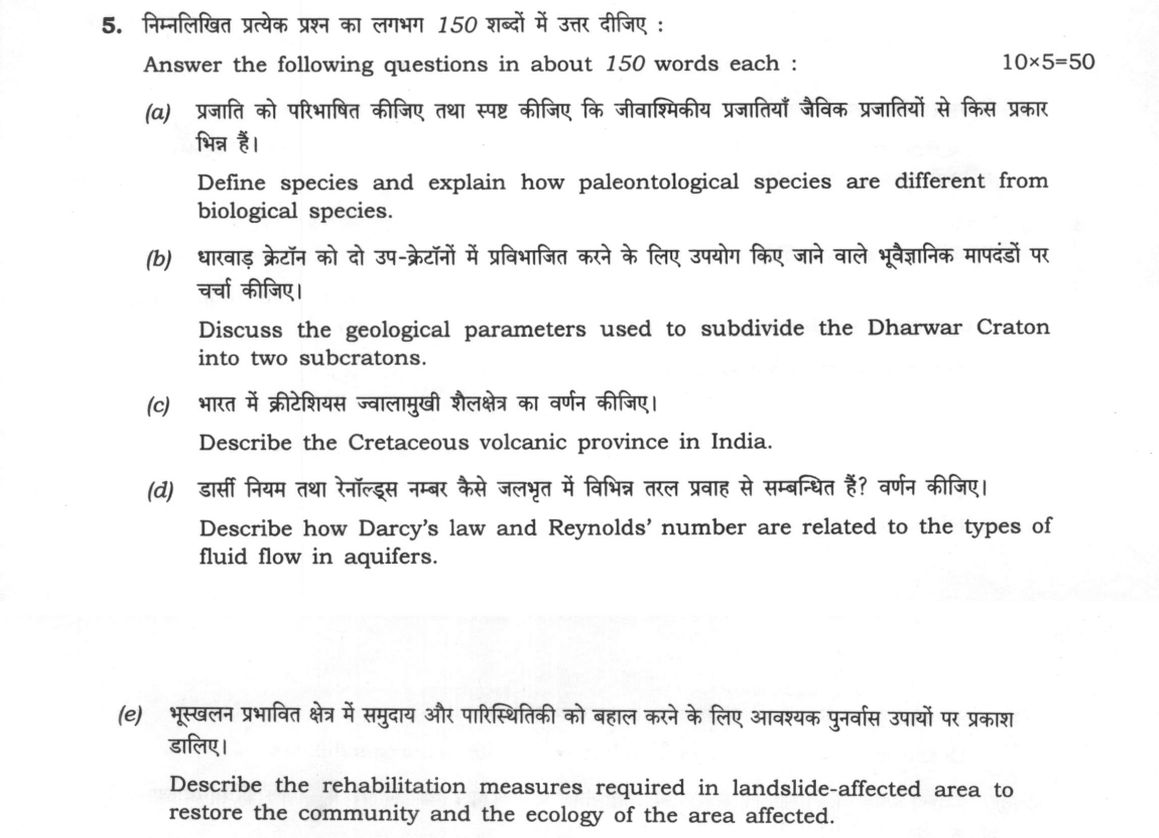
Answer the following questions in about 150 words each: (a) Define species and explain how paleontological species are different…
Answer the following questions in about 150 words each:
Define species and explain how paleontological species are different from biological species. 10 marks
Discuss the geological parameters used to subdivide the Dharwar Craton into two subcratons. 10 marks
Describe the Cretaceous volcanic province in India. 10 marks
Describe how Darcy's law and Reynolds' number are related to the types of fluid flow in aquifers. 10 marks
Describe the rehabilitation measures required in landslide-affected area to restore the community and the ecology of the area affected. 10 marks
हिंदी में प्रश्न पढ़ें
निम्नलिखित प्रत्येक प्रश्न का लगभग 150 शब्दों में उत्तर दीजिए :
प्रजाति को परिभाषित कीजिए तथा स्पष्ट कीजिए कि जीवाश्मिकीय प्रजातियाँ जैविक प्रजातियों से किस प्रकार भिन्न हैं। (10 अंक)
धारवाड़ क्रैटन को दो उप-क्रैटनों में प्रविभाजित करने के लिए उपयोग किए जाने वाले भूवैज्ञानिक मापदंडों पर चर्चा कीजिए। (10 अंक)
भारत में क्रीटेशियस ज्वालामुखी शैलक्षेत्र का वर्णन कीजिए। (10 अंक)
डार्सी नियम तथा रेनॉल्ड्स नम्बर कैसे जलभृत में विभिन्न तरल प्रवाह से सम्बन्धित हैं? वर्णन कीजिए। (10 अंक)
भूस्खलन प्रभावित क्षेत्र में समुदाय और पारिस्थितिकी को बहाल करने के लिए आवश्यक पुनर्वास उपायों पर प्रकाश डालिए। (10 अंक)
Model answer
Written by UPSC Answer Check against this question's marking rubric, to the 150-word length. UPSC does not publish answers for Mains — this is one way to score well, not an official key.
Species and paleospecies. A species is a basic unit of biological classification; in Mayr's biological species concept, it is a group of actually or potentially interbreeding natural populations that are reproductively isolated from other such groups. This definition depends on living organisms, gene flow, and observable reproductive barriers. Paleontological species are inferred from fossils, where interbreeding cannot be tested directly. They are therefore usually defined as morphospecies, based on consistent anatomical, shell, tooth, or skeletal differences, and as chronospecies when a lineage changes through time. The temporal dimension is central: a paleospecies is a name given to a fossil form within a defined stratigraphic interval, and its boundaries may be revised as new fossils appear. This distinction is important in fossil records where only hard parts are preserved. Thus, biological species stress reproductive isolation among living populations, while paleontological species stress morphology, ancestry, and time, with less certainty about gene flow.
Dharwar subcratons. The Dharwar Craton is subdivided into Western and Eastern Dharwar Craton using structural, lithological, and geochronological parameters. The Western Dharwar Craton is dominated by older 3.0–3.4 Ga tonalite–trondhjemite–granodiorite gneisses, with associated greenstone belts that are largely E–W trending. It represents an older crustal block with strong E–W lineations and fold axes. The Eastern Dharwar Craton is characterised by younger 2.5–2.7 Ga juvenile crust, with N–S trending structures and a different lithological assemblage. The Kolar schist belt lies in this eastern part and records later deformation and metamorphism. The contrast in age, trend, and rock type shows that the two subcratons are not merely regional variations but distinct crustal domains separated by a major structural boundary. In practice, the boundary is traced where the E–W greenstone trend changes to N–S, and where zircon ages shift from older TTG to younger granitoid ages. These parameters are used together in mapping.
Cretaceous volcanic province. The Cretaceous volcanic province in India is the Deccan Traps, a large flood-basalt province developed near the Cretaceous–Paleogene boundary, about 67–64 Ma. It covers much of the Deccan Syneclise in peninsular India and is petrologically dominated by tholeiitic basalts. The stratigraphy is commonly divided into three subgroups: the Lower Kalsubai subgroup, the Middle Lonavala subgroup, and the Upper Wai subgroup. These subgroups show variations in lava thickness, flow type, and minor volcanic units, but together form a thick sequence of stacked basalt flows. The three subgroups are described from their vertical succession and lithological changes. The province is linked to the Rajmahal and Sylhet traps, which are considered coeval or related flood-basalt occurrences separated by later rifting and seafloor spreading. The Deccan Traps are therefore described as a major Cretaceous–Paleogene volcanic province with broad areal extent, tholeiitic composition, and a threefold stratigraphic subdivision.
Darcy's law and Reynolds' number. Darcy's law describes laminar flow of water through porous media. It is written as v = -K/μ × dh/dl, where v is flow velocity, K is permeability, μ is fluid viscosity, and dh/dl is the hydraulic gradient. The negative sign shows that flow is from higher to lower hydraulic head. In aquifers, Darcy's law is useful because groundwater usually moves slowly through pore spaces, so the flow is laminar and proportional to the head difference. Reynolds' number, Re = ρvd/μ, is used to test whether that assumption is valid. It compares inertial forces to viscous forces, using fluid density ρ, characteristic velocity v, particle or pore diameter d, and viscosity μ. In groundwater flow, laminar conditions are generally maintained when Re is below the critical range of about 1–10. Above this range, flow may become transitional or turbulent, and Darcy's linear relation may no longer describe the aquifer accurately.
Landslide rehabilitation. Rehabilitation of a landslide-affected area is described in stages that restore both the community and the ecology. Structural measures are used first to stabilise the slope: retaining walls, check dams, drainage channels, slope grading, and anchoring reduce pore pressure and prevent further movement. Bioengineering measures are then applied to bind the soil and rebuild vegetation, using vetiver grass, shrubs, and native afforestation suited to the local slope and rainfall. In Western Ghats or Himalayan cases, these measures are combined with terracing, plantation of native species, and protection of residual soil. Community restoration includes safe resettlement, access roads, water supply, livelihood support, and early warning systems so that people can return or relocate safely. Ecological restoration is completed by re-establishing native plant cover, protecting water sources, and monitoring slope stability and vegetation recovery over time. The sequence is described as emergency stabilisation, slope treatment, community restoration, and ecological recovery.
What "Describe" is asking you to do
Give a full, ordered account of the thing named — its parts, stages or mechanism — in the sequence in which it actually exists or occurs. Most describe questions come from the science optionals, where the marks sit in correct technical detail and, where the stem says so, a labelled diagram.
Structure that answers it
One-line identification of the subject → the parts or stages in their real order, each with its defining detail → labelled diagram where the subject is structural → closing line on function or significance
Where marks are lost
Loose general prose where the examiner is ticking named parts, correct terminology and their sequence; and in the General Studies papers, turning to evaluation before the description is finished.
How this answer will be evaluated
Approach
Framework: Geology Paper 1: Define > Process > Field/Petrographic Evidence > Indian Example. (a) explain: definition/context > points in order > small example > short close | (b) discuss: intro > 3-4 dimensions > example > balanced close | (c) describe: define > structure or process in order > labelled diagram > significance | (d) describe: define > structure or process in order > labelled diagram > significance | (e) describe: define > structure or process in order > labelled diagram > significance Full marks: Precise definitions, specific Indian examples, clear causal chains, and correct terminology.
Key points expected
- Precise definition of biological species (reproductive isolation)
- Definition of paleontological species (morphological distinctness)
- Explanation of why biological concept fails for fossils
- Mention of morphological criteria in paleontology
- Identification of Eastern and Western Dharwar Cratons
- Mention of the 'Bastar Craton' or 'Bastar Supergroup' as the boundary
- Contrast in tectonic style (e.g., collisional vs. extensional)
- Difference in metamorphic grade or age (e.g., 2.5 Ga vs 2.7 Ga)
Evaluation rubric
Each sub-part is marked on its own, against the marks and word limit printed on the paper.
- (a) Definition of species and distinction between paleontological and biological concepts. · 150 words
explain— definition/context → points in order → small example → short close
Must cover
- Precise definition of biological species (reproductive isolation)
- Definition of paleontological species (morphological distinctness)
- Explanation of why biological concept fails for fossils
- Mention of morphological criteria in paleontology
Loses marks
- Confusing 'genus' with 'species'
- Failing to mention reproductive isolation for biological species
- Treating the two concepts as identical
Earns more
- Reference to 'morphospecies' or 'taxon'
- Mention of 'ring species' or 'hybridization' as biological complications
- Reference to 'cladistics' or 'phylogenetic species concept'
Extra mark
- Specific example of a fossil species (e.g., *Homo erectus*)
- Mention of 'operational taxonomic unit' (OTU)
- (b) Geological parameters distinguishing the Eastern and Western Dharwar Cratons. · 150 words
discuss— intro → 3-4 dimensions → example → balanced close
Must cover
- Identification of Eastern and Western Dharwar Cratons
- Mention of the 'Bastar Craton' or 'Bastar Supergroup' as the boundary
- Contrast in tectonic style (e.g., collisional vs. extensional)
- Difference in metamorphic grade or age (e.g., 2.5 Ga vs 2.7 Ga)
Loses marks
- Failing to name the two subcratons
- Confusing Dharwar with the Singhbhum Craton
- Generic description without specific geological parameters
Earns more
- Mention of 'Bastar Craton' as the separating unit
- Reference to 'Greenstone Belts' distribution
- Mention of 'Archean' vs 'Proterozoic' age differences
Extra mark
- Sketch of the Dharwar Craton showing the two subcratons
- Mention of specific mineral belts (e.g., iron ore in East)
- (c) Description of the Cretaceous volcanic province in India (Deccan Traps). · 150 words
describe— define → structure or process in order → labelled diagram → significance
Must cover
- Identification of the Deccan Traps
- Mention of the 'K-Pg boundary' or 'end-Cretaceous' timing
- Description of the lava flows (basaltic, flood basalts)
- Mention of the 'Deccan Volcanic Province' extent
Loses marks
- Confusing Cretaceous with Jurassic volcanism
- Failing to mention the Deccan Traps by name
- Describing it as a single event rather than a province
Earns more
- Mention of 'flood basalts' or 'fissure eruptions'
- Reference to the 'Deccan Intertrappean beds'
- Mention of the 'Chagos-Lakshadweep Ridge' connection
Extra mark
- Mention of the 'K-Pg extinction' link
- Specific mention of 'Deccan Traps' thickness (e.g., 2000m)
- (d) Relationship between Darcy's law, Reynolds' number, and fluid flow types in aquifers. · 150 words
describe— define → structure or process in order → labelled diagram → significance
Must cover
- Definition of Darcy's law (linear flow)
- Definition of Reynolds' number (Re) as a flow regime indicator
- Explanation of 'laminar flow' (low Re) and Darcy's applicability
- Explanation of 'turbulent flow' (high Re) and Darcy's failure
Loses marks
- Confusing Darcy's law with the continuity equation
- Failing to link Reynolds' number to flow type
- Claiming Darcy's law applies to all flow types
Earns more
- Mention of 'critical Reynolds number' (e.g., Re < 1 for laminar)
- Reference to 'non-Darcy flow' or 'Forchheimer equation'
- Mention of 'fractured aquifers' as high Re examples
Extra mark
- Sketch of the Q vs. h relationship (linear vs. non-linear)
- Mention of 'eddy viscosity' in turbulent flow
- (e) Rehabilitation measures for landslide-affected areas (community and ecology). · 150 words
describe— define → structure or process in order → labelled diagram → significance
Must cover
- Mention of 'community rehabilitation' (resettlement, livelihoods)
- Mention of 'ecological restoration' (vegetation, soil stabilization)
- Description of 'engineering measures' (drainage, retaining walls)
- Mention of 'monitoring' or 'early warning systems'
Loses marks
- Focusing only on engineering and ignoring community/ecology
- Generic description without specific measures
- Failing to distinguish between immediate and long-term measures
Earns more
- Reference to 'National Disaster Management Authority' (NDMA) guidelines
- Mention of 'bio-engineering' (e.g., vetiver grass)
- Reference to 'landslide hazard zonation'
Extra mark
- Specific example of a landslide rehabilitation project (e.g., in Uttarakhand)
- Mention of 'community-based disaster risk reduction' (CBDRR)
Practice this exact question
Write your answer and it is marked point by point against the model answer above — what you covered, what you missed, what you got wrong.
Evaluate my answer →More from Geology 2024 Paper I
- Q2 (a) Discuss the intensity and magnitude scale commonly used to assess seismic damage. Wri…
- Q3 (a) Discuss in detail, with diagrams, the landforms and features resulting from depositio…
- Q4 (a) Describe fold geometry. Illustrate various types of folds on the basis of their symme…
- Q5 Answer the following questions in about 150 words each: (a) Define species and explain ho…
- Q6 (a) Elucidate the evolutionary trend of Proboscidea with examples. (20 marks) (b) Describ…
- Q7 (a) Discuss the merits and limitations of different methods of stratigraphic analysis in…
- Q8 (a) Explain the concept of drainage basin morphometry. How do morphometric parameters inf…