Paper II — Q1
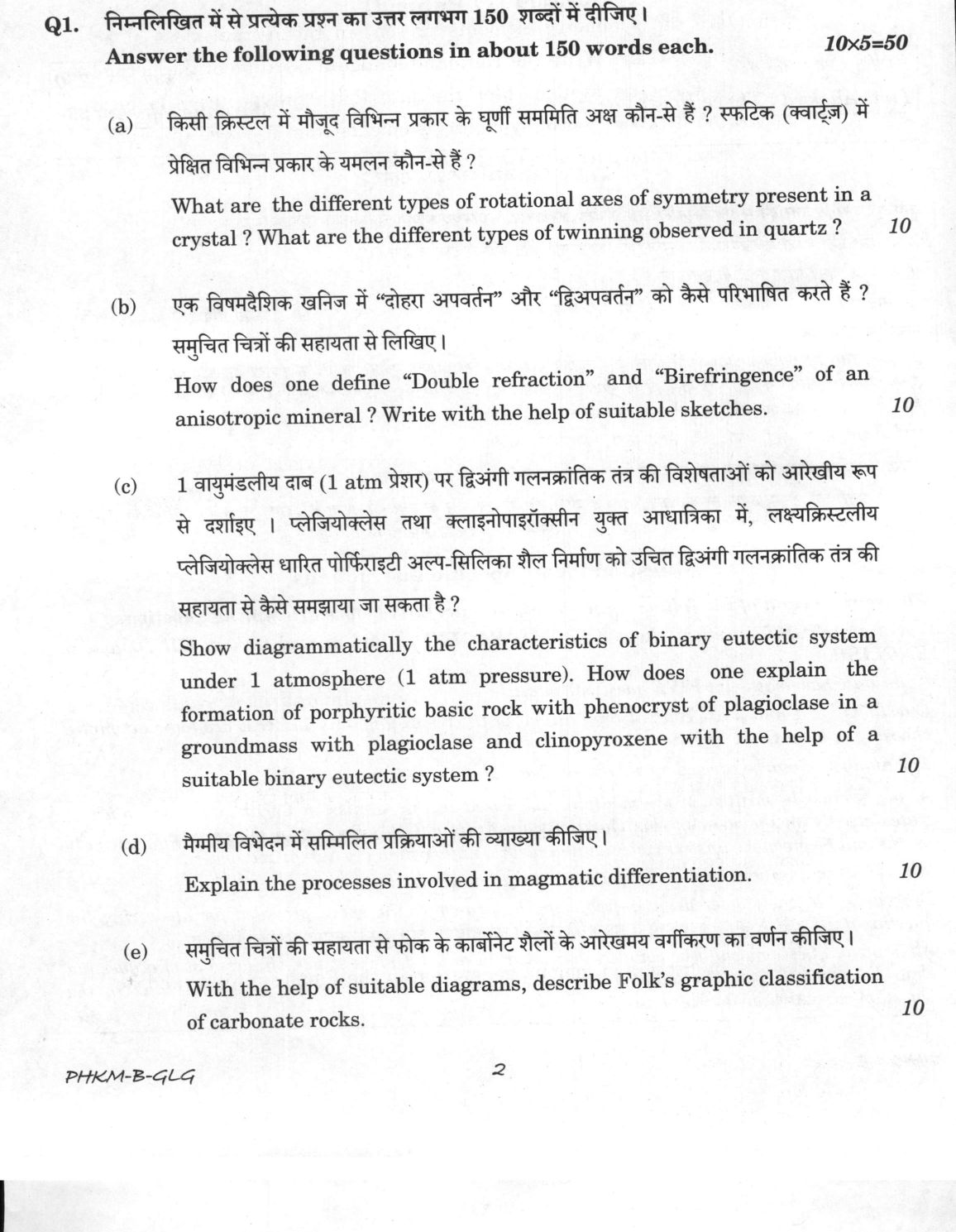
Answer the following questions in about 150 words each. (a) What are the different types of rotational axes of symmetry present…
Answer the following questions in about 150 words each.
What are the different types of rotational axes of symmetry present in a crystal ? What are the different types of twinning observed in quartz ? 10 marks
How does one define "Double refraction" and "Birefringence" of an anisotropic mineral ? Write with the help of suitable sketches. 10 marks
Show diagrammatically the characteristics of binary eutectic system under 1 atmosphere (1 atm pressure). How does one explain the formation of porphyritic basic rock with phenocryst of plagioclase in a groundmass with plagioclase and clinopyroxene with the help of a suitable binary eutectic system ? 10 marks
Explain the processes involved in magmatic differentiation. 10 marks
With the help of suitable diagrams, describe Folk's graphic classification of carbonate rocks. 10 marks
हिंदी में प्रश्न पढ़ें
निम्नलिखित में से प्रत्येक प्रश्न का उत्तर लगभग 150 शब्दों में दीजिए।
किसी क्रिस्टल में मौजूद विभिन्न प्रकार के घूर्णी सममिति अक्ष कौन-से हैं ? स्फटिक (क्वार्ट्ज) में प्रेक्षित विभिन्न प्रकार के यमलन कौन-से हैं ? (10 अंक)
एक विषमदैशिक खनिज में "दोहरा अपवर्तन" और "द्विअपवर्तन" को कैसे परिभाषित करते हैं ? समुचित चित्रों की सहायता से लिखिए। (10 अंक)
1 वायुमंडलीय दाब (1 atm प्रेशर) पर द्विअंगी गलनांकांतिक तंत्र की विशेषताओं को आरेखीय रूप से दर्शाइए । प्लेजियोक्लेस तथा क्लाइनोपाइरॉक्सीन युक्त आधात्रिका में, लक्ष्यक्रिस्टलीय प्लेजियोक्लेस धारित पोरफिराइटी अल्प-सिलिका शैल निर्माण को उचित द्विअंगी गलनांकांतिक तंत्र की सहायता से कैसे समझाया जा सकता है ? (10 अंक)
मैग्मीय विभेदन में सम्मिलित प्रक्रियाओं की व्याख्या कीजिए। (10 अंक)
समुचित चित्रों की सहायता से फोक के कार्बोनेट शैलों के आरेखमय वर्गीकरण का वर्णन कीजिए। (10 अंक)
Model answer
Written by UPSC Answer Check against this question's marking rubric, to the 150-word length. UPSC does not publish answers for Mains — this is one way to score well, not an official key.
(a) Rotational axes and quartz twinning. A crystal may possess proper rotational axes of symmetry of order 1, 2, 3, 4 and 6 only. A 1-fold axis is the identity operation; a 2-fold axis requires a 180° rotation, a 3-fold axis 120°, a 4-fold axis 90°, and a 6-fold axis 60° for the form to repeat. Five-fold and higher than six-fold axes are absent because of the crystallographic restriction: they cannot be combined with translational periodicity to fill space without gaps or overlaps. Quartz, being trigonal, has a 3-fold axis parallel to the c-axis. Twinning in quartz occurs by three laws. Dauphiné-law twins are electrical twins, commonly contact twins in hydrothermal or volcanic quartz, and show characteristic electrical properties. Brazil-law twins are optical twins, usually penetration twins in metamorphic quartz, recognized by their interference figure. Japan-law twins are rare contact twins. These twins record growth or deformation history.
(b) Double refraction and birefringence. Double refraction is the splitting of a single incident light ray into two rays when it enters an anisotropic mineral whose refractive index varies with direction. The two rays, ordinary and extraordinary, are plane-polarized with mutually perpendicular vibrations. The ordinary ray obeys Snell's law and has a constant refractive index, nω; the extraordinary ray has a direction-dependent index, nε. Birefringence is the difference between the refractive indices of these rays, written δ = |nε − nω| for a uniaxial mineral, or the maximum minus minimum index for a biaxial mineral. A suitable sketch shows the uniaxial indicatrix as an ellipsoid of revolution with two equal axes nω and a unique axis nε; a ray entering obliquely splits into ordinary and extraordinary rays. If nε > nω the mineral is uniaxial positive, if nε < nω it is uniaxial negative. Birefringence controls interference colours and extinction under crossed polars.
(c) Binary eutectic system and porphyritic basic rock. At 1 atm, a binary eutectic phase diagram has two liquidus curves descending from the melting points of pure components A and B to a minimum eutectic point. Below the liquidus, fields are A + liquid, B + liquid, and, at the eutectic isotherm, liquid transforms into A + B. The horizontal eutectic line and the lever rule give the proportions of phases. To explain a porphyritic basic rock with plagioclase phenocrysts and a plagioclase-clinopyroxene groundmass, treat plagioclase as A and clinopyroxene as B. On cooling, the melt first crosses the plagioclase liquidus; plagioclase crystallizes and grows as phenocrysts. The residual liquid becomes enriched in the pyroxene-forming components and moves toward the eutectic composition. At the eutectic temperature, the remaining liquid solidifies simultaneously as interlocking plagioclase and clinopyroxene. If this final crystallization is rapid or quenched, a fine-grained eutectic groundmass is preserved around the earlier phenocrysts, producing a porphyritic basalt or gabbro.
(d) Magmatic differentiation. Magmatic differentiation is the change in composition of a cooling magma by physical and chemical processes. Fractional crystallization is central: as temperature falls, minerals crystallize in the order of Bowen's reaction series. Early olivine, pyroxene and calcic plagioclase remove Mg, Fe and Ca, while the residual melt becomes enriched in Si, Al, Na, K and volatiles, evolving from basalt toward andesite, dacite or rhyolite. Crystal settling allows dense crystals to sink, separating them from the melt; in layered mafic intrusions it can produce cumulate layers. Filter pressing occurs when a crystal framework forms and expels interstitial liquid. Gas streaming carries volatile-rich fluids and dissolved elements away from the magma. Liquid immiscibility can separate a silicate melt from an immiscible second liquid, such as a carbonatitic melt. Assimilation happens when country rock is heated, melted and mixed with the magma, modifying its chemistry. Together these processes generate the range of igneous rocks from a single parent melt.
(e) Folk's graphic classification of carbonate rocks. Folk's classification separates carbonate rocks by allochems, matrix and textural maturity. Allochems include intraclasts, ooids, bioclasts or fossils, and peloids; matrix is micrite or sparite. The graphic ternary diagram has three corners: intraclasts, ooids and bioclasts. Peloids are not a fourth vertex; they are micritic grains and are recorded separately. The eight major rock names are intraclastic, oolitic, bioclastic, intraclastic-oolitic, intraclastic-bioclastic, oolitic-bioclastic, intraclastic-oolitic-bioclastic, and peloidal. The ternary fields are read by plotting the relative proportions of the three allochems; the dominant corner or side gives the rock name. Matrix content and grain support then define grainstone, packstone, wackestone and mudstone: grain-supported clean grains are grainstones, grain-supported with micrite are packstones, mud-supported grains are wackestones, and mud-rich rocks are mudstones. Well-sorted, rounded, clean grains indicate textural maturity, whereas micrite-rich, poorly sorted grains indicate immaturity. This scheme links grain type, matrix and diagenetic history.
What "Explain" is asking you to do
Make the working of something clear — what sets it off, what follows from what, and what it produces. Explain is the Commission's mechanism word: it dominates the technical papers and the “explain why” stems, where the marks sit in the causal chain and not in the label.
Structure that answers it
State what it is → the initiating condition → the chain of cause, step by step → an instance where it plays out → what the chain produces
Where marks are lost
Describing what something looks like instead of why it works that way. Naming the stages without linking them reads as description too.
How this answer will be evaluated
Approach
Framework: Geology Paper 2: Define > Process > Field/Petrographic Evidence > Indian Example. (a) enumerate: list the items in order > one line each > no commentary | (b) define: precise definition > the distinguishing feature > one example | (c) describe: define > structure or process in order > labelled diagram > significance | (d) explain: definition/context > points in order > small example > short close | (e) describe: define > structure or process in order > labelled diagram > significance Full marks: Precise definitions, accurate diagrams, specific Indian examples, clear causal chains.
Key points expected
- List 1, 2, 3, 4, 6-fold axes
- Identify Brazil law twinning
- Identify Dauphiné law twinning
- Identify Lamellar twinning
- Define double refraction (splitting)
- Define birefringence (difference)
- Sketch ray splitting in anisotropic medium
- Label ordinary and extraordinary rays
Evaluation rubric
Each sub-part is marked on its own, against the marks and word limit printed on the paper.
- (a) List crystallographic axes and quartz twinning types. 10 marks · 150 words
enumerate— list the items in order → one line each → no commentary
Must cover
- List 1, 2, 3, 4, 6-fold axes
- Identify Brazil law twinning
- Identify Dauphiné law twinning
- Identify Lamellar twinning
Loses marks
- Confusing axes with planes
- Missing specific quartz laws
Earns more
- Mention optical rotation direction
- Sketch of twin lamellae
Extra mark
- Reference to specific Indian quartz locality
- (b) Define double refraction and birefringence with sketches. 10 marks · 150 words
define— precise definition → the distinguishing feature → one example
Must cover
- Define double refraction (splitting)
- Define birefringence (difference)
- Sketch ray splitting in anisotropic medium
- Label ordinary and extraordinary rays
Loses marks
- No sketches provided
- Confusing refraction with reflection
Earns more
- Mention refractive indices (No, Ne)
- Reference to interference colors
Extra mark
- Example of Indian anisotropic mineral
- (c) Diagram binary eutectic and explain porphyritic rock formation. 10 marks · 150 words
describe— define → structure or process in order → labelled diagram → significance
Must cover
- Draw binary eutectic phase diagram
- Label liquidus and eutectic point
- Explain phenocryst formation (plagioclase)
- Explain groundmass formation (eutectic)
Loses marks
- Incorrect phase diagram shape
- Failing to link diagram to rock texture
Earns more
- Mention specific eutectic temperature
- Link to specific rock type (e.g., gabbro)
Extra mark
- Reference to Indian basic rock formation
- (d) Explain processes of magmatic differentiation. 10 marks · 150 words
explain— definition/context → points in order → small example → short close
Must cover
- Define magmatic differentiation
- Explain fractional crystallization
- Explain magma mixing
- Explain assimilation
Loses marks
- Generic description without processes
- Missing key mechanisms
Earns more
- Mention Bowen's reaction series
- Reference to specific Indian pluton
Extra mark
- Link to economic mineral deposit
- (e) Describe Folk's graphic classification of carbonates. 10 marks · 150 words
describe— define → structure or process in order → labelled diagram → significance
Must cover
- Draw Folk's classification triangle
- Define allochems and matrix
- Define grain-supported vs matrix-supported
- List specific rock names (e.g., grainstone)
Loses marks
- Incorrect triangle labels
- Confusing with Dunham classification
Earns more
- Mention specific allochem types
- Reference to Indian carbonate formation
Extra mark
- Example of specific Indian carbonate rock
Practice this exact question
Write your answer and it is marked point by point against the model answer above — what you covered, what you missed, what you got wrong.
Evaluate my answer →More from Geology 2024 Paper II
- Q1 Answer the following questions in about 150 words each. (a) What are the different types…
- Q2 (a) What are the symmetry elements present in the normal class of an isometric system ? W…
- Q3 (a) Describe the mineral reactions in prograde metamorphism of argillaceous sedimentary r…
- Q4 (a) Discuss the various factors that control the composition of sandstone. (15 marks) (b)…