Paper II — Q8
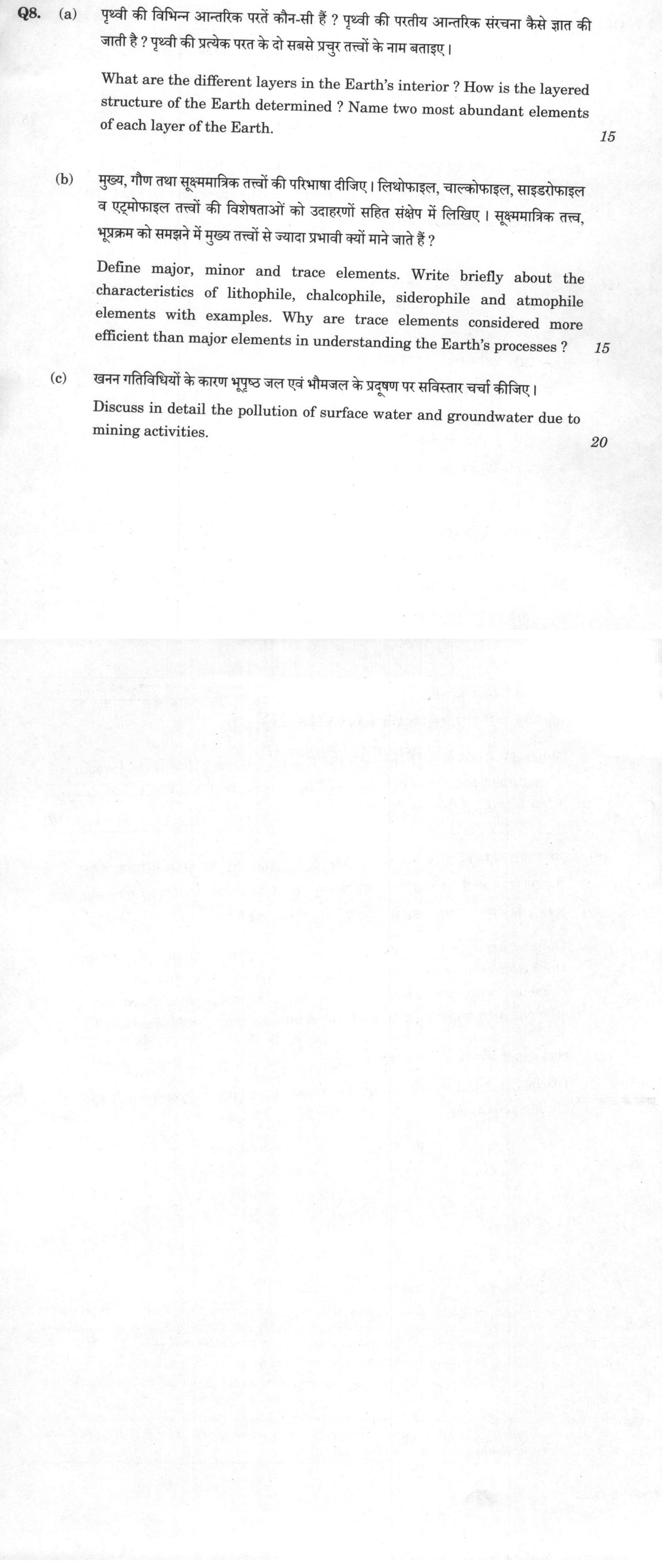
(a) What are the different layers in the Earth's interior ? How is the layered structure of the Earth determined ? Name two most…
What are the different layers in the Earth's interior ? How is the layered structure of the Earth determined ? Name two most abundant elements of each layer of the Earth. 15 marks
Define major, minor and trace elements. Write briefly about the characteristics of lithophile, chalcophile, siderophile and atmophile elements with examples. Why are trace elements considered more efficient than major elements in understanding the Earth's processes ? 15 marks
Discuss in detail the pollution of surface water and groundwater due to mining activities. 20 marks
हिंदी में प्रश्न पढ़ें
पृथ्वी की विभिन्न आंतरिक परतें कौन-सी हैं ? पृथ्वी की परतीय आंतरिक संरचना कैसे ज्ञात की जाती है ? पृथ्वी की प्रत्येक परत के दो सबसे प्रचुर तत्वों के नाम बताइए । (15 अंक)
मुख्य, गौण तथा सूक्ष्मात्रिक तत्वों की परिभाषा दीजिए । लिथोफाइल, चाल्कोफाइल, साइडरोफाइल व एट्मोफाइल तत्वों की विशेषताओं को उदाहरणों सहित संक्षेप में लिखिए । सूक्ष्मात्रिक तत्व, भूप्रक्रम को समझने में मुख्य तत्वों से ज्यादा प्रभावी क्यों माने जाते हैं ? (15 अंक)
खनन गतिविधियों के कारण भूपृष्ठ जल एवं भौमजल के प्रदूषण पर सविस्तार चर्चा कीजिए । (20 अंक)
Model answer
Written by UPSC Answer Check against this question's marking rubric, to the expected length. UPSC does not publish answers for Mains — this is one way to score well, not an official key.
Earth’s layered interior The Earth is differentiated into crust, mantle, outer core and inner core. The crust is a thin silicate shell; the mantle is a silicate layer; the outer core is a liquid Fe-Ni alloy; the inner core is solid Fe-Ni. The layered structure is determined chiefly by seismic tomography: P and S waves change velocity at the Moho, 410/660 km discontinuities, core-mantle boundary and inner-core boundary; S waves do not travel through the liquid outer core, creating shadow zones. Meteorite analogies, high-pressure experiments, geothermal gradients and geomagnetic field data refine density, temperature and state. The two most abundant elements are oxygen and silicon in the crust, oxygen and magnesium in the mantle, and iron and nickel in both the outer and inner cores, with light elements such as sulphur and oxygen in the outer core.
Elemental classes and trace elements Major elements exceed 1 wt% in a rock; minor elements are 0.1–1 wt%; trace elements are below 0.1 wt%. Goldschmidt’s classification links chemistry to mineral hosts: lithophile (oxygen-loving) elements such as Al, Na, Ca, Mg and Si enter silicates; chalcophile (sulphur-loving) elements such as Cu, Zn, Pb and Ni enter sulphides; siderophile (iron-loving) elements such as Au, Pt, Ir and Os concentrate in metal phases; atmophile (gas-loving) elements such as H, N and noble gases remain volatile. Trace elements are more efficient than major elements for interpreting Earth processes because their concentrations respond strongly to small changes in temperature, pressure, oxygen fugacity and melt composition. Modern analytical methods detect them at low concentrations, so small geochemical signals are not masked by major-element abundance; partition coefficients make them sensitive tracers of partial melting, crystal-liquid fractionation, metasomatism, fluid transport, ore-forming processes and tectonic settings, and give discriminatory power in petrogenetic modelling.
Mining and water pollution Mining disturbs rock, exposes sulphides, and creates waste that mobilises contaminants. The issue has chemical, hydrological and socio-economic dimensions. Surface water is polluted by acid mine drainage, where pyrite oxidation produces sulphuric acid and leaches Fe, Mn, As, Cd, Pb and Hg; by sediment loading from overburden and tailings; and by tailings-dam failures that release slurries. Groundwater is contaminated through seepage from waste-rock dumps, tailings ponds and pit lakes, and by dewatering that lowers water tables, concentrates salts and metals, and induces subsidence. Open pits and shafts intercept aquifers, while abandoned workings store contaminated water. In India, coal mining in Jharia and the Damodar basin has degraded rivers, soils and aquifers; iron-ore mining in Goa and Odisha has increased turbidity and sedimentation in the Mandovi and coastal waters; uranium mining at Jaduguda raises radionuclide and heavy-metal concerns in groundwater; copper mining at Khetri and bauxite mining in the Eastern Ghats have affected local water quality and recharge. The impacts are economic and social: reduced crop yields, damaged fisheries, higher public-health costs, and loss of drinking-water sources.
Way forward A critical discussion must connect these effects to geochemical controls: Eh-pH, redox and mineral stability determine whether metals remain solid or become mobile. Sustainable practice therefore requires mine-water treatment, neutralisation of acidity, lined tailings, controlled dewatering, monitoring of aquifers and rivers, and closure planning. It also requires long-term monitoring after closure, because abandoned mines can continue to generate acid water for decades. India’s Mine Water Utilisation Policy, 2017 encourages reuse of mine water for irrigation, industry and recharge, while SDG 6 and SDG 12 link clean water and responsible consumption to mining governance. A balanced approach should combine stricter environmental clearances, community participation, remediation funds and circular use of mine water, so that mineral development does not transfer pollution to surface and groundwater.
What "Discuss" is asking you to do
Lay the issue out from more than one side — how it arose, what is claimed for it, what is held against it, and where it now stands. UPSC attaches discuss to broad topics with several live dimensions, so coverage of the dimensions earns more than the strength of your opinion.
Structure that answers it
Set the issue up → the case as it is made → the case against → the dimension both sides leave out → where the balance now lies
Where marks are lost
Listing facts with no thread between them, or arguing one side throughout and calling it a discussion.
How this answer will be evaluated
Approach
Framework: Geology Paper 2: Define > Process > Field/Petrographic Evidence > Indian Example. (a) describe: define > structure or process in order > labelled diagram > significance | (b) write short notes: define > 3-4 key features > one example > one-line significance | (c) discuss: intro > 3-4 dimensions > example > balanced close Full marks: Precise definitions, correct geochemical groups, detailed AMD mechanism, named Indian examples, clear diagrams.
Key points expected
- List Crust, Mantle, Outer Core, Inner Core
- Explain determination via seismic waves (P/S) and discontinuities
- Name two most abundant elements for each layer
- Mention Moho, Gutenberg, and Lehmann discontinuities
- Define major, minor, and trace elements
- Characterize lithophile, chalcophile, siderophile, atmophile with examples
- Explain why trace elements are efficient for Earth processes
- Mention Goldschmidt's classification
Evaluation rubric
Each sub-part is marked on its own, against the marks and word limit printed on the paper.
- (a) Identify Earth's interior layers, determination methods, and key elements. 15 marks
describe— define → structure or process in order → labelled diagram → significance
Must cover
- List Crust, Mantle, Outer Core, Inner Core
- Explain determination via seismic waves (P/S) and discontinuities
- Name two most abundant elements for each layer
- Mention Moho, Gutenberg, and Lehmann discontinuities
Loses marks
- Confusing lithosphere with crust
- Omitting the method of determination
- Listing incorrect elements for specific layers
Earns more
- Sketch of Earth's interior with depth scale
- Mention density variations (e.g., 2.7 to 13 g/cm3)
- Reference to Indian shield crustal thickness
Extra mark
- Specific seismic velocity values at discontinuities
- Mention of specific Indian craton depth
- (b) Define element categories and geochemical groups; explain trace element utility. 15 marks
write short notes— define → 3-4 key features → one example → one-line significance
Must cover
- Define major, minor, and trace elements
- Characterize lithophile, chalcophile, siderophile, atmophile with examples
- Explain why trace elements are efficient for Earth processes
- Mention Goldschmidt's classification
Loses marks
- Confusing major and minor element definitions
- Missing examples for geochemical groups
- Failing to explain the 'efficiency' of trace elements
Earns more
- Table comparing the four geochemical groups
- Example of trace element as a tracer (e.g., Sr, Nd)
- Link to mineral deposit formation
Extra mark
- Specific Indian example of trace element enrichment
- Reference to specific geochemical anomaly
- (c) Detail surface and groundwater pollution mechanisms from mining. 20 marks
discuss— intro → 3-4 dimensions → example → balanced close
Must cover
- Explain Acid Mine Drainage (AMD) mechanism
- Describe heavy metal leaching (As, Pb, Hg)
- Discuss turbidity and sedimentation in surface water
- Explain groundwater contamination pathways
Loses marks
- Generic description without mining-specific mechanisms
- Ignoring groundwater pollution
- No mention of heavy metals or AMD
Earns more
- Sketch of AMD formation process
- Mention of specific Indian mining pollution case (e.g., Jharia, Singrauli)
- Reference to remediation techniques
Extra mark
- Specific pH or metal concentration data
- Mention of specific Indian river affected by mining
Practice this exact question
Write your answer and it is marked point by point against the model answer above — what you covered, what you missed, what you got wrong.
Evaluate my answer →More from Geology 2024 Paper II
- Q5 Answer the following questions in about 150 words each. (a) Give an account of the geolog…
- Q6 (a) Explain the various peculiarities inherent in the mineral industry. (15 marks) (b) Wh…
- Q7 (a) (i) What is the difference between a sample and a specimen ? (5 marks) (ii) Describe…
- Q8 (a) What are the different layers in the Earth's interior ? How is the layered structure…