Paper II — Q2
(a) What are the symmetry elements present in the normal class of an isometric system ? Write the Hermann-Mauguin notation of the…
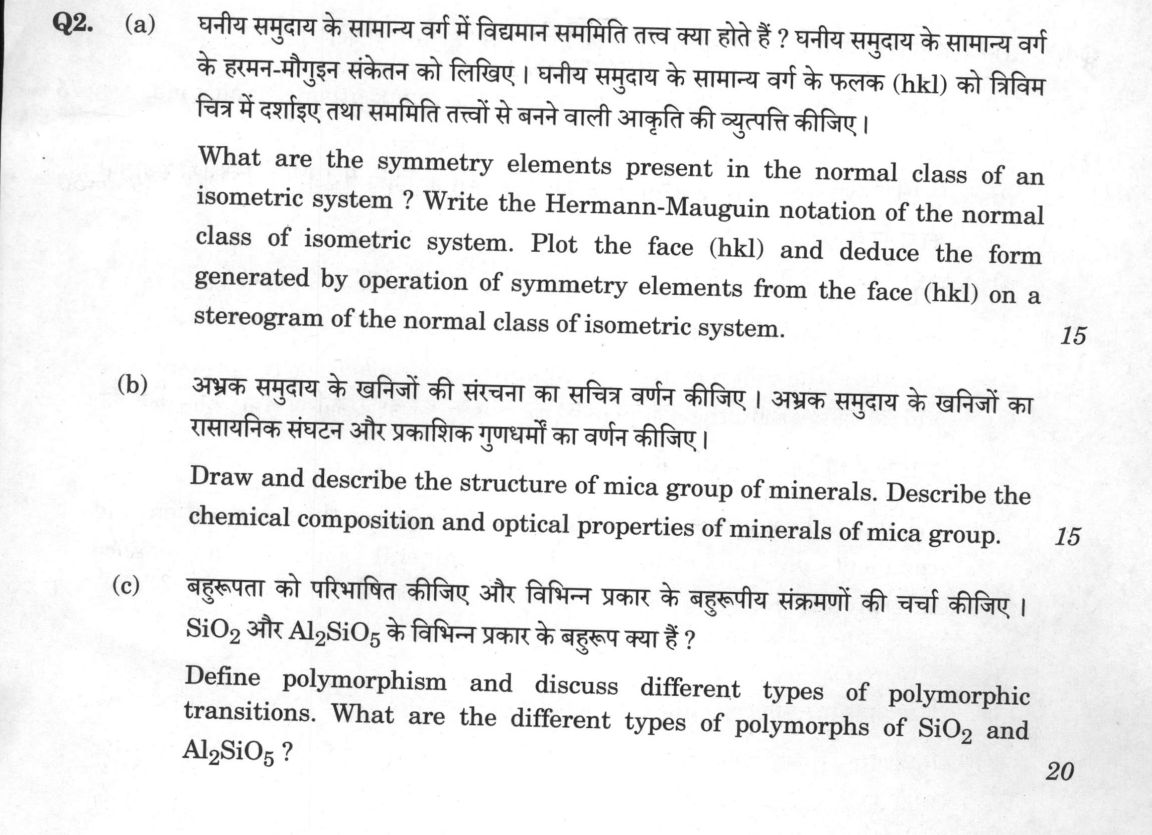
What are the symmetry elements present in the normal class of an isometric system ? Write the Hermann-Mauguin notation of the normal class of isometric system. Plot the face (hkl) and deduce the form generated by operation of symmetry elements from the face (hkl) on a stereogram of the normal class of isometric system. 15 marks
Draw and describe the structure of mica group of minerals. Describe the chemical composition and optical properties of minerals of mica group. 15 marks
Define polymorphism and discuss different types of polymorphic transitions. What are the different types of polymorphs of SiO₂ and Al₂SiO₅ ? 20 marks
हिंदी में प्रश्न पढ़ें
घनीय समुदाय के सामान्य वर्ग में विद्यमान सममिति तत्व क्या होते हैं ? घनीय समुदाय के सामान्य वर्ग के हरमन-मौगुइन संकेतन को लिखिए । घनीय समुदाय के सामान्य वर्ग के फलक (hkl) को त्रिविम चित्र में दर्शाइए तथा सममिति तत्वों से बनने वाली आकृति की व्युत्पत्ति कीजिए । (15 अंक)
अभ्रक समुदाय के खनिजों की संरचना का सचित्र वर्णन कीजिए । अभ्रक समुदाय के खनिजों का रासायनिक संयटन और प्रकाशिक गुणधर्मों का वर्णन कीजिए । (15 अंक)
बहुरूपता को परिभाषित कीजिए और विभिन्न प्रकार के बहुरूपीय संक्रमणों की चर्चा कीजिए । SiO₂ और Al₂SiO₅ के विभिन्न प्रकार के बहुरूप क्या हैं ? (20 अंक)
Model answer
Written by UPSC Answer Check against this question's marking rubric, to the expected length. UPSC does not publish answers for Mains — this is one way to score well, not an official key.
(a) Isometric normal class. The normal or holohedral isometric class has the maximum symmetry of the system: thirteen axes—three four-fold, four three-fold and six two-fold—nine mirror planes and one centre of symmetry, i.e. 23 symmetry elements. Its Hermann–Mauguin notation is 4/m 3̄ 2/m. To plot a general face (hkl), place its pole in the positive octant of the stereogram. The nine mirror planes appear as great-circle traces and divide the upper stereogram into 24 fundamental spherical triangles. The three-fold axes and mirror planes generate the six positive permutations in that octant: (hkl), (hlk), (khl), (klh), (lkh) and (l hk); the four-fold and two-fold axes, with the centre, produce the remaining sign-changed poles. Thus the complete form has 48 equivalent poles, distributed as 6 per octant; the upper-hemisphere stereogram displays 24 projected poles, with closed and open symbols for opposite faces. The generated form is the hexoctahedron {hkl}. Special positions reduce the form: {h0l} gives a tetrahexahedron, {hhl} a trisoctahedron, {100} a cube, {110} a dodecahedron and {111} an octahedron.
(b) Mica structure. Micas are 2:1 phyllosilicates with a T-O-T layer structure. In a sketch, two tetrahedral sheets share basal oxygen to form a (Si2O5)2− tetrahedral layer; the apical oxygens link to a central octahedral sheet in which Al, Mg or Fe occupy octahedral sites with OH or O. An interlayer of K+ (or Ca, Na, H2O) balances charge and separates the T-O-T packages, producing perfect {001} cleavage. The weak interlayer bonding explains the easy cleavage and the low hardness parallel to {001}. Dioctahedral micas have only two of three octahedral sites occupied; muscovite, KAl2(AlSi3O10)(OH)2, is Al-rich and usually colourless or pale. Trioctahedral micas have all three sites occupied; biotite, K(Mg,Fe)3(AlSi3O10)(OH)2, and phlogopite, KMg3(AlSi3O10)(OH)2, are Fe-Mg rich and brown to green. Optically, micas are biaxial, usually negative, with moderate 2V (about 40–50°), high relief, low hardness and strong perfect basal cleavage. Muscovite shows weak pleochroism, while biotite shows strong brown pleochroism. Important Indian occurrences include Koderma in Jharkhand and Nellore in Andhra Pradesh.
(c) Polymorphism. Polymorphism is the occurrence of one chemical composition in two or more different crystal structures. Polymorphic transitions are changes from one polymorph to another with temperature or pressure. Reconstructive transitions require breaking and reforming bonds, have high activation energy and are sluggish; examples include quartz–tridymite–cristobalite and kyanite–andalusite–sillimanite. Displacive transitions involve small shifts or rotations of atoms without bond breaking, have low activation energy and are rapid; α–β quartz at 573°C and α–β cristobalite are typical. Order–disorder transitions involve a change in the ordering of atoms over crystallographic sites, as in high- to low-temperature feldspars. The SiO₂ polymorphs are quartz, tridymite, cristobalite, coesite and stishovite; the α and β varieties of quartz, tridymite and cristobalite are low- and high-temperature forms. Quartz is stable at low pressure and low to moderate temperature; tridymite at high temperature and low pressure; cristobalite at still higher temperature and low pressure; coesite at high pressure and moderate temperature; stishovite at very high pressure, so it is an impact indicator. The Al₂SiO₅ polymorphs are kyanite, andalusite and sillimanite. Kyanite is stable at high pressure and lower temperature, andalusite at low pressure and lower temperature, and sillimanite at high temperature. Their triple point, near 480°C and 4.5 kbar, is a key metamorphic index. In Barrovian higher-pressure sequences, kyanite occurs before sillimanite; in Buchan low-pressure sequences, andalusite occurs before sillimanite. In Indian Precambrian terrains, sillimanite at Sonapahar in Meghalaya and Pipra in Madhya Pradesh records high-grade metamorphism. Thus symmetry, layer structure and polymorphism explain mineral form, optical behaviour and geological significance.
What "Describe" is asking you to do
Give a full, ordered account of the thing named — its parts, stages or mechanism — in the sequence in which it actually exists or occurs. Most describe questions come from the science optionals, where the marks sit in correct technical detail and, where the stem says so, a labelled diagram.
Structure that answers it
One-line identification of the subject → the parts or stages in their real order, each with its defining detail → labelled diagram where the subject is structural → closing line on function or significance
Where marks are lost
Loose general prose where the examiner is ticking named parts, correct terminology and their sequence; and in the General Studies papers, turning to evaluation before the description is finished.
How this answer will be evaluated
Approach
(a) explain: definition/context > points in order > small example > short close | (b) describe: define > structure or process in order > labelled diagram > significance | (c) discuss: intro > 3-4 dimensions > example > balanced close Full marks: Accurate symmetry elements, clear stereogram, detailed mica structure, comprehensive polymorphism discussion.
Key points expected
- List 4 L3, 3 L4, 6 L2, 9 Pc, 1 C
- State HM notation as 4/m 3 2/m
- Plot face (hkl) on stereogram
- Deduce form generated by symmetry operations
- Draw 2:1 T-O-T layer structure
- Describe interlayer cations (K, Na, Ca)
- State chemical composition (e.g., KAl2(AlSi3O10)(OH)2)
- Describe optical properties (birefringence, cleavage)
Evaluation rubric
Each sub-part is marked on its own, against the marks and word limit printed on the paper.
- (a) List symmetry elements, provide HM notation, and plot the form on a stereogram. 15 marks
explain— definition/context → points in order → small example → short close
Must cover
- List 4 L3, 3 L4, 6 L2, 9 Pc, 1 C
- State HM notation as 4/m 3 2/m
- Plot face (hkl) on stereogram
- Deduce form generated by symmetry operations
Loses marks
- Confusing normal class with holohedral class
- Missing the stereogram plot entirely
Earns more
- Correctly identifies the form as hexoctahedron
- Accurate stereogram with correct pole positions
Extra mark
- Mentions specific symmetry operations (e.g., 4-fold rotation)
- (b) Draw mica structure, describe chemical composition and optical properties. 15 marks
describe— define → structure or process in order → labelled diagram → significance
Must cover
- Draw 2:1 T-O-T layer structure
- Describe interlayer cations (K, Na, Ca)
- State chemical composition (e.g., KAl2(AlSi3O10)(OH)2)
- Describe optical properties (birefringence, cleavage)
Loses marks
- Confusing mica with clay structure
- Missing the structural diagram
Earns more
- Mentions specific micas (Muscovite, Biotite)
- Notes perfect basal cleavage
Extra mark
- Mentions Indian mica occurrences (e.g., Jharkhand)
- (c) Define polymorphism, discuss transition types, and list polymorphs of SiO2 and Al2SiO5. 20 marks
discuss— intro → 3-4 dimensions → example → balanced close
Must cover
- Define polymorphism
- Discuss types of transitions (displacive, reconstructive)
- List polymorphs of SiO2 (Quartz, Cristobalite, Tridymite)
- List polymorphs of Al2SiO5 (Andalusite, Sillimanite, Kyanite)
Loses marks
- Confusing polymorphism with polytypism
- Missing the transition types discussion
Earns more
- Mentions P-T conditions for transitions
- Notes economic importance of polymorphs
Extra mark
- Mentions specific Indian occurrences of these minerals
Practice this exact question
Write your answer and it is marked point by point against the model answer above — what you covered, what you missed, what you got wrong.
Evaluate my answer →More from Geology 2024 Paper II
- Q1 Answer the following questions in about 150 words each. (a) What are the different types…
- Q2 (a) What are the symmetry elements present in the normal class of an isometric system ? W…
- Q3 (a) Describe the mineral reactions in prograde metamorphism of argillaceous sedimentary r…
- Q4 (a) Discuss the various factors that control the composition of sandstone. (15 marks) (b)…
- Q5 Answer the following questions in about 150 words each. (a) Give an account of the geolog…