Paper II — Q5
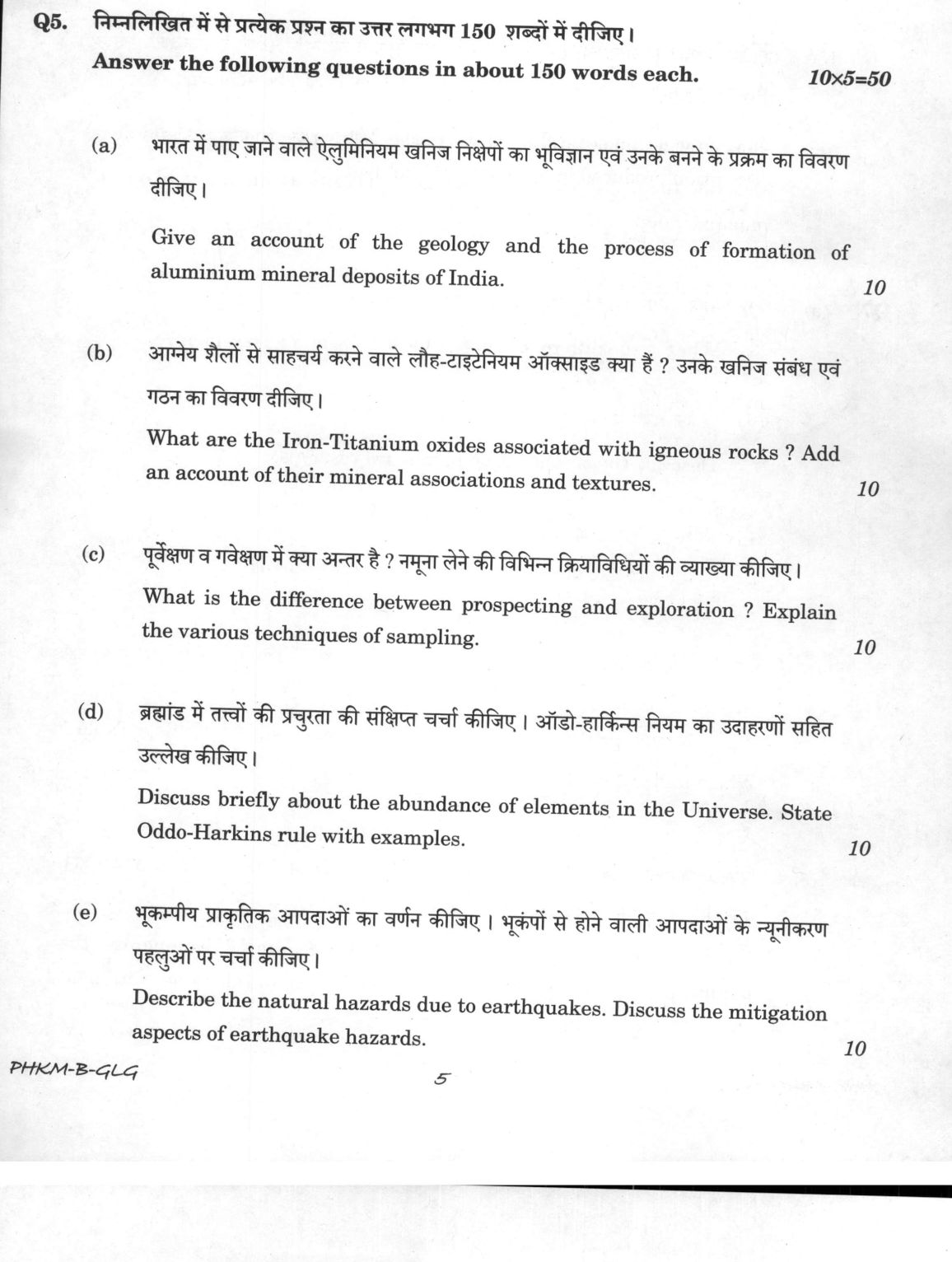
Answer the following questions in about 150 words each. (a) Give an account of the geology and the process of formation of…
Answer the following questions in about 150 words each.
Give an account of the geology and the process of formation of aluminium mineral deposits of India. 10 marks
What are the Iron-Titanium oxides associated with igneous rocks ? Add an account of their mineral associations and textures. 10 marks
What is the difference between prospecting and exploration ? Explain the various techniques of sampling. 10 marks
Discuss briefly about the abundance of elements in the Universe. State Oddo-Harkins rule with examples. 10 marks
Describe the natural hazards due to earthquakes. Discuss the mitigation aspects of earthquake hazards. 10 marks
हिंदी में प्रश्न पढ़ें
निम्नलिखित में से प्रत्येक प्रश्न का उत्तर लगभग 150 शब्दों में दीजिए।
भारत में पाए जाने वाले ऐलुमिनियम खनिज निक्षेपों का भूविज्ञान एवं उनके बनने के प्रक्रम का विवरण दीजिए। (10 अंक)
आग्नेय शैलों से साहचर्य करने वाले लोह-टाइटेनियम ऑक्साइड क्या हैं ? उनके खनिज संबंध एवं गठन का विवरण दीजिए। (10 अंक)
पूर्वेक्षण व गवेषण में क्या अंतर है ? नमूना लेने की विभिन्न क्रियाविधियों की व्याख्या कीजिए। (10 अंक)
ब्रह्मांड में तत्वों की प्रचुरता की संक्षिप्त चर्चा कीजिए। ऑडो-हार्किन्स नियम का उदाहरणों सहित उल्लेख कीजिए। (10 अंक)
भूकंपीय प्राकृतिक आपदाओं का वर्णन कीजिए। भूकंपों से होने वाली आपदाओं के न्यूनीकरण पहलुओं पर चर्चा कीजिए। (10 अंक)
Model answer
Written by UPSC Answer Check against this question's marking rubric, to the 150-word length. UPSC does not publish answers for Mains — this is one way to score well, not an official key.
(a) Aluminium mineral deposits. India’s bauxite deposits are chiefly residual products of lateritization, in which aluminous rocks such as granites, gneisses, schists and volcanic rocks are subjected to prolonged tropical chemical weathering. Leaching removes silica, alkalis and ferric oxides, while aluminium concentrates as gibbsite, boehmite and diaspore in laterite crusts. Uplift, erosion and repeated weathering cycles control thickness and grade. The Eastern Ghats belt in Odisha, Jharkhand, Andhra Pradesh and Telangana hosts the largest lateritic bauxite occurrences; Gujarat and Madhya Pradesh contain important lateritic deposits. Karstic bauxite forms in limestone solution features where aluminous clays are enriched, especially in Jharkhand, whereas lateritic bauxite forms as a residual cap over crystalline rocks. Economic bauxite generally requires Al₂O₃ above 40 per cent and SiO₂ below 5 per cent, with low impurities, because silica raises alumina losses and caustic consumption in Bayer processing. These deposits underpin India’s aluminium industry and export earnings.
(b) Iron-titanium oxides in igneous rocks. Iron-titanium oxides are common accessory or dominant minerals in mafic and ultramafic igneous rocks, especially layered intrusions, ophiolites, basaltic cumulates and komatiites. The principal minerals are ilmenite (FeTiO₃), magnetite (Fe₃O₄), ulvöspinel (Fe₂TiO₄) and hematite (Fe₂O₃), with titanomagnetite forming a solid-solution series between ulvöspinel and magnetite; oxidation state, expressed as fO₂, controls the relative stability of magnetite, ilmenite and hematite. They commonly occur with chromite, olivine, pyroxene, plagioclase, apatite, zircon and platinum-group elements, and may carry vanadium, nickel and rare earths. Textures reveal their history: oxide cumulate layers, oikocrystic magnetite enclosing silicates, resorbed xenocrysts, brecciated oxide bands, and oxide-silicate reaction rims. On cooling, exsolution produces ilmenite lamellae in magnetite, and oxidation may develop hematite rims or lamellae. In India, such associations are important in the Eastern Ghats, Deccan traps and ophiolitic melange belts, where oxide minerals may indicate chromite, V-Ti and PGE potential. Such textures are used to infer magma evolution, oxidation conditions and ore-forming processes.
(c) Prospecting, exploration and sampling. Prospecting is the early, regional search for mineral targets using geological mapping, remote sensing, geophysics and reconnaissance geochemistry; it is broad, low-cost and risk-oriented. Exploration is the detailed, deposit-scale investigation that tests a target by trenching, drilling, geotechnical work and resource estimation, moving from inference to bankable confidence. In the UNFC classification, prospecting corresponds broadly to G4 reconnaissance, while exploration generally spans G3 to G1, with G1 representing detailed, mine-planning grade data. Sampling links field evidence to assay results. Chip samples are taken from exposed outcrops or trenches; channel samples follow a fixed width along a face; bulk samples represent larger volumes for metallurgical or grade tests; core samples from drill holes provide continuous stratigraphy and grade control. Good sampling requires systematic or random spacing, composite intervals, avoidance of bias, proper splitting, crushing, grinding and preparation for chemical or instrumental assay, with geostatistical methods used to estimate continuity and uncertainty.
(d) Cosmic abundance and Oddo-Harkins rule. The Universe is dominated by hydrogen and helium, from Big Bang nucleosynthesis, with heavier elements produced by stellar nucleosynthesis, supernovae and neutron-star mergers. By mass, hydrogen and helium exceed 98 per cent, while oxygen, carbon, neon, iron, nitrogen and silicon are the principal “metals”. Earth’s crust differs sharply: oxygen, silicon, aluminium, iron, calcium, sodium, potassium and magnesium dominate through silicate differentiation in continental crust. The Oddo-Harkins rule observes that elements with even atomic numbers are usually more abundant than their odd-numbered neighbours, because even-even nuclei, with paired protons and neutrons, generally have higher binding energy per nucleon and are more stable. It is not universal; hydrogen, an odd-Z element, is far more abundant than helium by mass. Typical examples include iron (Z=26) being more abundant than manganese (Z=25) and cobalt (Z=27), oxygen (Z=8) than nitrogen (Z=7) and fluorine (Z=9), and silicon (Z=14) than aluminium (Z=13) and phosphorus (Z=15).
(e) Earthquake hazards and mitigation. Earthquakes generate direct and secondary hazards. Ground shaking damages buildings, bridges and lifelines; liquefaction can cause soft ground to flow, toppling structures; surface rupture breaks land, pipelines and roads; co-seismic landslides and rockfalls block valleys and rivers; undersea earthquakes may generate tsunamis that inundate coasts. Secondary effects include fires from gas leaks, collapse of unsafe structures, disruption of water and sanitation, and disease. Mitigation must be multi-layered. Seismic hazard zoning and land-use planning keep critical facilities away from active faults, liquefiable soils and steep slopes. Building codes such as IS 1893, with local bylaws and competent design, ensure ductile, base-isolated or seismic-resistant construction; retrofitting of old schools, hospitals and industrial plants reduces vulnerability. Early warning, community preparedness, drills, emergency planning and insurance improve resilience. The National Disaster Management Authority and state authorities must enforce codes, monitor construction and integrate risk into planning, because mitigation is cheaper than reconstruction.
What "Discuss" is asking you to do
Lay the issue out from more than one side — how it arose, what is claimed for it, what is held against it, and where it now stands. UPSC attaches discuss to broad topics with several live dimensions, so coverage of the dimensions earns more than the strength of your opinion.
Structure that answers it
Set the issue up → the case as it is made → the case against → the dimension both sides leave out → where the balance now lies
Where marks are lost
Listing facts with no thread between them, or arguing one side throughout and calling it a discussion.
How this answer will be evaluated
Approach
Framework: Geology Paper 2: Define > Process > Field/Petrographic Evidence > Indian Example. (a) account for: state the phenomenon > the causes in order of weight > conclusion | (b) describe: define > structure or process in order > labelled diagram > significance | (c) compare: paired headings or table > key differences > significance > conclusion | (d) discuss: intro > 3-4 dimensions > example > balanced close | (e) describe: define > structure or process in order > labelled diagram > significance Full marks: Precise Indian examples, correct processes, named formations, clear distinctions
Key points expected
- Identify Bauxite as primary ore
- Explain lateritic weathering of feldspathic rocks
- Name specific Indian craton or basin
- Describe stratigraphic/geological setting
- Name specific Fe-Ti oxide minerals
- Describe mineral associations
- Explain textures in igneous rocks
- Link to igneous rock type
Evaluation rubric
Each sub-part is marked on its own, against the marks and word limit printed on the paper.
- (a) Geology and formation process of Indian aluminium deposits. 10 marks · 150 words
account for— state the phenomenon → the causes in order of weight → conclusion
Must cover
- Identify Bauxite as primary ore
- Explain lateritic weathering of feldspathic rocks
- Name specific Indian craton or basin
- Describe stratigraphic/geological setting
Loses marks
- Generic description without Indian example
- Missing formation process details
Earns more
- Mention specific mineral composition
- Link formation to climatic conditions
- Reference specific Indian formation name
Extra mark
- Sketch of weathering profile
- Specific stratigraphic age
- (b) Iron-Titanium oxides in igneous rocks with associations and textures. 10 marks · 150 words
describe— define → structure or process in order → labelled diagram → significance
Must cover
- Name specific Fe-Ti oxide minerals
- Describe mineral associations
- Explain textures in igneous rocks
- Link to igneous rock type
Loses marks
- No texture description
- Missing mineral associations
Earns more
- Mention specific igneous rock example
- Describe crystal habit
- Reference specific Indian occurrence
Extra mark
- Petrographic sketch
- Phase diagram reference
- (c) Difference between prospecting and exploration plus sampling techniques. 10 marks · 150 words
compare— paired headings or table → key differences → significance → conclusion
Must cover
- Define prospecting vs exploration
- State key differences
- Explain various sampling techniques
- Describe sampling methods
Loses marks
- No clear distinction between terms
- Missing sampling techniques
Earns more
- Mention specific sampling tools
- Reference field application
- Describe systematic sampling
Extra mark
- Sampling diagram
- Specific technique example
- (d) Elemental abundance in Universe and Oddo-Harkins rule with examples. 10 marks · 150 words
discuss— intro → 3-4 dimensions → example → balanced close
Must cover
- Discuss elemental abundance patterns
- State Oddo-Harkins rule
- Provide examples of rule
- Explain rule's significance
Loses marks
- No examples for Oddo-Harkins
- Missing abundance discussion
Earns more
- Mention specific element examples
- Reference cosmic abundance data
- Explain odd-even effect
Extra mark
- Abundance chart reference
- Specific isotope example
- (e) Earthquake natural hazards and mitigation aspects. 10 marks · 150 words
describe— define → structure or process in order → labelled diagram → significance
Must cover
- Describe earthquake hazards
- Explain mitigation measures
- Link hazards to mitigation
- Mention specific mitigation strategies
Loses marks
- No mitigation discussion
- Generic hazard description
Earns more
- Reference Indian earthquake zones
- Mention building codes
- Describe early warning systems
Extra mark
- Mitigation diagram
- Specific Indian example
Practice this exact question
Write your answer and it is marked point by point against the model answer above — what you covered, what you missed, what you got wrong.
Evaluate my answer →More from Geology 2024 Paper II
- Q2 (a) What are the symmetry elements present in the normal class of an isometric system ? W…
- Q3 (a) Describe the mineral reactions in prograde metamorphism of argillaceous sedimentary r…
- Q4 (a) Discuss the various factors that control the composition of sandstone. (15 marks) (b)…
- Q5 Answer the following questions in about 150 words each. (a) Give an account of the geolog…
- Q6 (a) Explain the various peculiarities inherent in the mineral industry. (15 marks) (b) Wh…
- Q7 (a) (i) What is the difference between a sample and a specimen ? (5 marks) (ii) Describe…
- Q8 (a) What are the different layers in the Earth's interior ? How is the layered structure…